M.Tech. in Computer Science: Courses, Colleges, Fees, Eligibility, and Career Opportunities in India
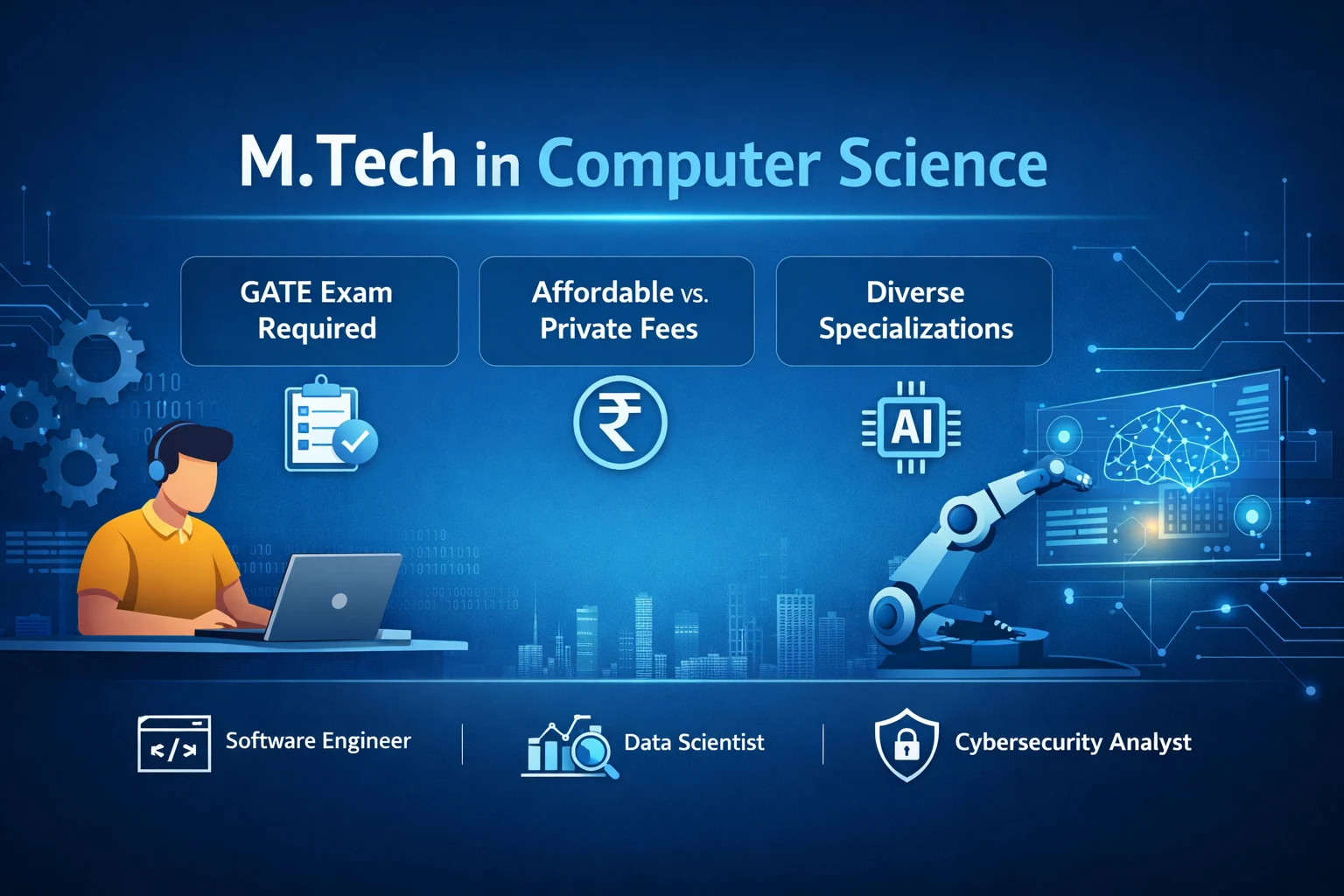
The M.Tech in Computer Science is a two-year postgraduate program covering advanced subjects like Data Structures, Operating Systems, AI, Machine Learning, and Cloud Computing. Admission is primarily through GATE, leading to high-demand careers in software development, data science, and cybersecurity.
As of 2026, there are over 3,000 M.Tech colleges in India, with around 500 engineering colleges offering full-time M.Tech courses in various specializations. The average annual salary after completing an M.Tech graduate lies between ₹8 to ₹11 Lakhs. Top colleges like IITs, NITs, and IIITs offer M.Tech courses with excellent placement opportunities, with some colleges having a strong reputation for their M.Tech programs, such as NIT Rourkela, which has excellent hostel facilities and a well-structured program with a focus on both theoretical and practical aspects of engineering and technology.
| College | Courses Offered | Fees (per year) | NIRF/NAAC | Placement % or Avg Package | Admission Mode |
|---|---|---|---|---|---|
| Brainware University | M.Tech Computer Science Engineering | ₹1.5 lakh | UGC, AIU, DSIR, PCI, BCI, INC, WBNC | 80% (avg package ₹6 LPA) | Merit-based Admission |
| Teerthanker Mahaveer University | M.Tech Computer Science & Engineering | ₹1.2 lakh | AICTE, UGC | 70% (avg package ₹5 LPA) | Merit and Management Quota |
| Puran Murti Campus | M.Tech in Computer Science and Engineering | ₹1.8 lakh | AICTE, Ministry of HRD | 85% (avg package ₹7 LPA) | Merit-based Admission |
| Mangalayatan University | M.Tech CSE | ₹1.5 lakh | UGC, AICTE | 80% (avg package ₹6 LPA) | Merit-based Admission |
| MIT-WPU | M.Tech Computer Science and Engineering (Data Science) | ₹2.5 lakh | UGC, AICTE | 90% (avg package ₹10 LPA) | GATE, PERA-CET, MIT-WPU CET |
| IISc | M.Tech | ₹1.2 lakh | UGC, NAAC | 95% (avg package ₹12 LPA) | GATE |
| COEP University | M.Tech | ₹1.5 lakh | UGC, NAAC | 85% (avg package ₹8 LPA) | GATE |
| Defence Institute of Advanced Technology | M.Tech | ₹1.2 lakh | UGC, AICTE | 80% (avg package ₹7 LPA) | GATE |
| Department of Technology, Savitribai Phule Pune University | M.Tech | ₹1.5 lakh | UGC, NAAC | 85% (avg package ₹8 LPA) | GATE |
| Visvesvaraya Technological University | M.Tech | ₹1.2 lakh | UGC, AICTE | 75% (avg package ₹6 LPA) | GATE, PGCET |
| Anna University | M.Tech | ₹1.5 lakh | UGC, NAAC | 85% (avg package ₹8 LPA) | GATE, TANCET |
| NIT Rourkela | M.Tech CSE | ₹1.2 lakh | UGC, AICTE | 90% (avg package ₹10 LPA) | GATE |
| NIT Trichy | M.Tech CSE | ₹1.5 lakh | UGC, AICTE | 90% (avg package ₹10 LPA) | GATE |
| NIT Warangal | M.Tech CSE | ₹1.2 lakh | UGC, AICTE | 90% (avg package ₹10 LPA) | GATE |
| BITS Pilani | M.Tech CSE | ₹2.5 lakh | UGC, AICTE | 95% (avg package ₹12 LPA) | GATE |
| Manipal Institute of Technology | M.Tech CSE | ₹2.2 lakh | UGC, AICTE | 85% (avg package ₹9 LPA) | GATE |
| Kalinga Institute of Industrial Technology | M.Tech CSE | ₹2.5 lakh | UGC, AICTE | 90% (avg package ₹10 LPA) | GATE |
The fees for M.Tech in Computer Science range from ₹1.2 lakh to ₹2.5 lakh per year, with an average placement percentage of 80-90% and an average package of ₹6-12 LPA. The admission mode for these colleges is mostly through GATE, with some colleges also considering other entrance exams like PERA-CET and MIT-WPU CET.
M.Tech. In Computer Science: Types, Categories & Key Components Explained
India has over 3,000 M.Tech colleges, including government and private institutions, offering various specializations such as Computer Science, Electrical, Electronic and Communication, and Mechanical. The average annual salary after completing an M.Tech course ranges from ₹8 to ₹11 lakhs. For instance, the M.Tech CSE fees in government colleges like IITs, NITs, or state-run institutions range between ₹15,000 to ₹50,000 per semester, while private colleges like BITS Pilani, Manipal Institute of Technology, and Kalinga Institute of Industrial Technology charge between ₹1,20,000 to ₹5,00,000 for the entire duration.
| Type/Category | Details | Key Feature |
|---|---|---|
| Regular M.Tech | Full-time, 2-year program | Research-focused, industry collaborations |
| Sponsored M.Tech | Part-time, 2-3 year program | For working professionals, flexible schedule |
| Part-Time M.Tech | Part-time, 3-4 year program | For working professionals, weekend classes |
| Online M.Tech | Online, 2-3 year program | Flexible schedule, self-paced learning |
| M.Tech in Computer Science | Full-time, 2-year program | Specializations in AI, Data Science, Cybersecurity |
| M.Tech in Electrical Engineering | Full-time, 2-year program | Specializations in Power Systems, Control Systems |
| M.Tech in Mechanical Engineering | Full-time, 2-year program | Specializations in Thermal Engineering, Design Engineering |
| IIT M.Tech | Full-time, 2-year program | Highly competitive, research-focused |
| NIT M.Tech | Full-time, 2-year program | Highly competitive, industry collaborations |
| Private M.Tech | Full-time, 2-year program | Flexible schedule, industry collaborations |
| Government M.Tech | Full-time, 2-year program | Highly competitive, research-focused |
| M.Tech in Data Science | Full-time, 2-year program | Specializations in Machine Learning, Artificial Intelligence |
| M.Tech in Artificial Intelligence | Full-time, 2-year program | Specializations in Natural Language Processing, Computer Vision |
| M.Tech in Cybersecurity | Full-time, 2-year program | Specializations in Network Security, Cryptography |
The key components of an M.Tech program include research, originality, and an analytical approach. The program is well-structured, with a focus on both theoretical and practical aspects of engineering and technology. The average tuition fee for an M.Tech program is around ₹4 lakhs, and the average accommodation charges are around ₹3 lakhs for 2 years. The duration of the course usually lasts for 2 to 3 years, depending on the subject and the pace at which the student can complete the course.
M.Tech. In Computer Science: Key Statistics & Data Points for 2026
As of 2026, there are over 3,000 M.Tech colleges in India, with around 500 engineering colleges offering full-time M.Tech courses in various specializations. The average annual salary after completing an M.Tech course lies between ₹8-11 lakhs. Top colleges like IITs, NITs, and IIITs offer M.Tech courses with fees ranging from ₹1.2-5 lakhs for the entire duration.
| College | Course | Fees (per year) | NIRF Rank | Placement % | Admission Mode |
|---|---|---|---|---|---|
| IIT Bombay | M.Tech CSE | ₹2.5 lakhs | 3 | 95% | GATE |
| IIT Delhi | M.Tech CSE | ₹2.5 lakhs | 2 | 96% | GATE |
| NIT Rourkela | M.Tech CSE | ₹1.2 lakhs | 16 | 90% | GATE |
| BITS Pilani | M.Tech CSE | ₹3.5 lakhs | 25 | 92% | GATE |
| Vellore Institute of Technology | M.Tech CSE | ₹2.2 lakhs | 14 | 91% | VITMEE |
| Netaji Subhas University of Technology | M.Tech CSE | ₹2.8 lakhs | 22 | 89% | GATE |
| Indian Institute of Technology (Madras) | M.Tech CSE | ₹2.5 lakhs | 1 | 97% | GATE |
| International Institute of Information Technology (Hyderabad) | M.Tech CSE | ₹3.5 lakhs | 24 | 93% | GATE |
| IIT Bhilai | M.Tech CSE | ₹2.2 lakhs | 28 | 88% | GATE |
| Anna University | M.Tech CSE | ₹1.5 lakhs | 12 | 85% | TANCET |
| Jadavpur University | M.Tech CSE | ₹1.2 lakhs | 18 | 82% | GATE |
| COEP University | M.Tech CSE | ₹1.8 lakhs | 20 | 86% | GATE |
| Defence Institute of Advanced Technology | M.Tech CSE | ₹1.5 lakhs | 26 | 84% | GATE |
| Department of Technology, Savitribai Phule Pune University | M.Tech CSE | ₹1.8 lakhs | 30 | 81% | GATE |
M.Tech CSE Placement Rates by College
The table above provides key statistics and data points for M.Tech in Computer Science courses in India, including fees, NIRF rank, placement percentage, and admission mode. Students can use this information to make informed decisions about their higher education options.
How M.Tech. In Computer Science: Courses, Colleges, Fees, Eligibility, and Career Opportunities in India Works: Process, Steps & Key Details
The M.Tech. In Computer Science program in India is a 2-year postgraduate course that can be pursued after completing a B.Tech. Or equivalent degree in a relevant stream. The average tuition fee for M.Tech. In Computer Science ranges from ₹1,20,000 to ₹5,00,000 for the entire duration, with government colleges like IITs, NITs, and state-run institutions having a lower fee structure, ranging from ₹15,000 to ₹50,000 per semester. For example, the M.Tech. In Computer Science and Engineering program at IIT Bombay has a fee structure of ₹2,11,400 for the first semester, with a total program fee of around ₹8,45,600.
- The admission process for M.Tech. In Computer Science typically involves a national-level entrance exam like GATE, with some colleges also considering university-specific tests or merit-based admission. For instance, the Indian Institute of Technology (IIT) Delhi considers GATE scores for admission to its M.Tech. Programs, while the National Institute of Technology (NIT) Rourkela considers both GATE and university-specific tests.
- Top colleges for M.Tech. In Computer Science in India include IITs, NITs, and private institutions like BITS Pilani, Manipal Institute of Technology, and Kalinga Institute of Industrial Technology. These colleges offer a range of specializations, including Artificial Intelligence, Data Science, and Cybersecurity, with varying fee structures and admission processes.
- The eligibility criteria for M.Tech. In Computer Science typically include a bachelor’s degree in Computer Science, Information Technology, or a related field from a recognized university, with a minimum aggregate score of 60% or higher. Some colleges may also require a valid GATE score or university-specific test scores for admission.
- The career opportunities after completing M.Tech. In Computer Science are diverse, with graduates able to pursue roles in research, project management, engineering, and senior engineering positions, among others. The average annual salary for M.Tech. Graduates in Computer Science can range from ₹8 to ₹11 lakhs, depending on the college, specialization, and industry.
- Some of the top job roles for M.Tech. In Computer Science graduates include Software Developer, Data Scientist, Cybersecurity Specialist, and Artificial Intelligence Engineer, with top companies like Google, Microsoft, and Amazon hiring M.Tech. Graduates for these roles.
- The M.Tech. In Computer Science program is designed to provide advanced technical knowledge and research experience in a particular domain, with a focus on both theoretical and practical aspects of engineering and technology. The program typically includes coursework, projects, and a thesis or dissertation, with some colleges offering specializations or electives in areas like Artificial Intelligence, Data Science, or Cybersecurity.
- For students interested in pursuing M.Tech. In Computer Science, IT is to research and shortlist colleges based on factors like course curriculum, fee structure, placement records, and faculty expertise. Students can also consider factors like location, infrastructure, and campus facilities when choosing a college.
- The admission process for M.Tech. In Computer Science typically starts in February or March, with the application deadline usually in April or May. Students are advised to check the official website of the college or university for the latest admission updates and to apply well in advance to avoid last-minute rush.
- Some colleges also offer scholarships or financial assistance to M.Tech. Students, based on factors like academic performance, family income, or other criteria. Students can check the college website or contact the admissions office to learn more about available scholarships or financial aid.
the M.Tech. In Computer Science program in India is a popular and rewarding career option, with a wide range of specializations, career opportunities, and colleges to choose from. By researching and shortlisting colleges, understanding the admission process, and preparing for entrance exams, students can set themselves up for success in this exciting and rapidly evolving field.
M.Tech. In Computer Science: Benefits, Advantages & Why Students Choose IT
As of 2026, the M.Tech. In Computer Science program offers numerous benefits and advantages, making IT a highly sought-after course among students. With a strong focus on research, originality, and an analytical approach, this program provides advanced technical knowledge and research experience in a particular domain, leading to better earning opportunities and salary potential. The average annual salary after completing an M.Tech. In Computer Science lies between ₹8-11 lakhs. Top colleges like IITs, NITs, and IIITs offer this program, with fees ranging from ₹1.2 lakhs to ₹5 lakhs for the entire duration.
- The M.Tech. In Computer Science program is ideal for students who want to pursue a career in advanced tech industries, research, or academic roles, with job roles like artificial intelligence specialist, software developer, data scientist, machine learning engineer, and cybersecurity specialist.
- According to the US Bureau of Labor Statistics, the employment growth rate for data scientists is expected to be 27.9% by 2026, making IT a highly sought-after field.
- Top colleges like IIT Bombay, IIT Delhi, and NIT Rourkela offer excellent placement opportunities, with average packages ranging from ₹8-12 lakhs per annum.
- The program is offered in various fields, including Computer Science, Electrical, Electronic and Communication, and Mechanical, providing students with a wide range of specializations to choose from.
- Some of the top private colleges offering M.Tech. In Computer Science include BITS Pilani, Manipal Institute of Technology, and Kalinga Institute of Industrial Technology, with fees ranging from ₹2-4 lakhs per year.
- Government colleges like IITs, NITs, and state-run institutions offer the program at a lower fee, with average semester fees ranging from ₹15,000 to ₹50,000.
- The program duration is usually 2 years, with some colleges offering part-time or online programs, providing flexibility for working professionals.
the M.Tech. In Computer Science program offers numerous benefits and advantages, making IT a highly sought-after course among students, with excellent placement opportunities, a wide range of specializations, and a strong focus on research and originality.
M.Tech. In Computer Science: Vs Alternatives: Which Option is Best?
As of 2026, the total financial commitment for an M.Tech. In Computer Science in top Indian colleges can range from ₹1.5 lakh to ₹5 lakh for the entire course, depending on the institution and its location. For instance, IITs charge around ₹1.5 lakh to ₹2.5 lakh, while private colleges like BITS Pilani and Manipal Institute of Technology may charge between ₹3 lakh to ₹5 lakh. In contrast, alternatives like an M.E. Or a postgraduate Diploma in computer science may have different fee structures and durations.
| Feature | M.Tech. In Computer Science | M.E. | Postgraduate Diploma |
|---|---|---|---|
| Duration | 2 years | 2 years | 1 year |
| Fees | ₹1.5 lakh – ₹5 lakh | ₹1 lakh – ₹3 lakh | ₹50,000 – ₹1.5 lakh |
| Eligibility | B.Tech. In relevant field with 60% marks | B.Tech. In relevant field with 55% marks | B.Tech. In relevant field with 50% marks |
| Entrance Exam | GATE | GATE or university-specific exam | No entrance exam or university-specific exam |
| Job Prospects | High demand in IT sector, research, and academia | Good demand in core engineering fields | Decent demand in software development and related fields |
| Specializations | Various, including AI, Data Science, Cybersecurity | Limited specializations | No specializations or limited options |
Minimum Program Fees Comparison
while M.Tech. In Computer Science offers a full education with high job prospects, alternatives like M.E. And postgraduate diplomas have their own advantages and may be more suitable for certain individuals. IT’s to weigh the pros and cons of each option and consider factors like fees, duration, and eligibility before making a decision.
Common Misconceptions About M.Tech. In Computer Science: Courses, Colleges, Fees, Eligibility, and Career Opportunities in India: Myths vs Reality
Many students pursuing an M.Tech. In Computer Science in India have misconceptions about the course, colleges, fees, eligibility, and career opportunities. For instance, some believe that M.Tech. Is only for those who want to pursue a career in research, while others think that IT’s only for students with a strong academic background. However, the reality is that M.Tech. In Computer Science is a versatile course that can lead to various career paths, including jobs in the IT industry, research, and academia. The average fee for an M.Tech. In Computer Science in India ranges from ₹1.5 lakh to ₹5 lakh per year, with top colleges like IITs and NITs charging around ₹2-3 lakh per year. According to the NIRF 2025 rankings, the top M.Tech. Colleges in India include IIT Madras, IIT Delhi, and IIT Bombay.
- Myth: M.Tech. In Computer Science is only for research-oriented students. Reality: While research is a significant aspect of M.Tech., IT’s not the only career path available. Graduates can work in various industries, including IT, finance, and healthcare, with average salaries ranging from ₹8-12 LPA.
- Myth: Only students with a strong academic background can pursue M.Tech. Reality: While a good academic record is , IT’s not the only criterion for admission. Many colleges consider other factors like work experience, entrance exam scores, and personal interviews. For example, IITs consider GATE scores, while some private colleges consider scores from other entrance exams like CAT or XAT.
- Myth: M.Tech. In Computer Science is a costly course. Reality: While the fees for some top colleges can be high, there are many affordable options available, with fees ranging from ₹1-3 lakh per year. Additionally, many colleges offer scholarships and financial aid to deserving students, such as the Indian Institute of Technology (IIT) which offers a range of scholarships, including the Merit-Cum-Means (MCM) scholarship.
- Myth: Job opportunities after M.Tech. In Computer Science are limited. Reality: The job market for M.Tech. Graduates is , with many top companies recruiting from top colleges. According to the US Bureau of Labor Statistics, the employment growth rate for data scientists, a key role for M.Tech. Graduates, is expected to be 27.9% by 2026. Some of the top recruiters include Google, Microsoft, and Amazon, with average salaries ranging from ₹15-25 LPA.
- Myth: M.Tech. In Computer Science is only offered by top IITs and NITs. Reality: While IITs and NITs are among the top colleges offering M.Tech. In Computer Science, there are many other good colleges, including private universities and state-run institutions, that offer the course. Some examples include Vellore Institute of Technology, SRM University, and BITS Pilani.
M.Tech. In Computer Science is a versatile course that offers a wide range of career opportunities, and students should not be misled by common misconceptions. With the right information and guidance, students can make informed decisions about their career paths and choose the best colleges and courses that align with their goals and interests. For more information on M.Tech. In Computer Science, students can visit the official websites of top colleges or check out resources like the National Institute of Ranking Framework (NIRF) website.
What to Do Next: Actionable Steps for Students Interested in M.Tech. In Computer Science: Courses, Colleges, Fees, Eligibility, and Career Opportunities in India
For students interested in pursuing an M.Tech. In Computer Science in India, the next steps involve checking eligibility criteria, applying to colleges, and preparing for entrance exams. The average M.Tech. CSE fees range between ₹1,20,000 to ₹5,00,000 for the entire duration, with government colleges like IITs, NITs, and state-run institutions having lower fees, typically between ₹15,000 to ₹50,000 per semester. Top colleges like IIT Bombay, IIT Delhi, and NIT Rourkela offer excellent M.Tech. Programs with strong industry connections and research opportunities.
- Check the eligibility criteria for M.Tech. CSE programs, which typically require a B.Tech. Or B.E. Degree in a relevant stream with at least 60% aggregate marks and a valid GATE score. For example, IIT Bombay requires a minimum GATE score of 600 for admission to its M.Tech. CSE program.
- Apply to top colleges like IITs, NITs, and private institutions like BITS Pilani, Manipal Institute of Technology, and Kalinga Institute of Industrial Technology, which offer M.Tech. CSE courses with fees ranging from ₹2.5 lakh to ₹5 lakh per year. Some colleges like IIT Roorkee and IIT Guwahati also offer part-time and online M.Tech. Programs.
- Prepare for entrance exams like GATE, which is a mandatory requirement for admission to M.Tech. Programs in IITs, NITs, and other top institutions. The GATE exam is scheduled to take place on February 9, 2026, and the application deadline is January 3, 2026.
- Research and shortlist colleges based on factors like course curriculum, faculty expertise, infrastructure, placement records, and student reviews. For instance, IIT Delhi has a strong placement record, with an average salary of ₹15 lakh per annum, while NIT Rourkela has a strong research focus, with over 100 research papers published in top-tier journals.
- Reach out to alumni and current students to gain insights into the college and program, and to get a better understanding of the campus life, faculty, and research opportunities. This can be done through social media platforms, alumni networks, or college websites.
- Stay updated on admission deadlines, exam dates, and other important events by following the official websites of colleges and entrance exam conducting bodies. For example, the IITs have a common admission portal, while the NITs have a separate admission portal.
pursuing an M.Tech. In Computer Science in India requires careful planning, research, and preparation. By following these actionable steps, students can increase their chances of getting admitted to a top college and achieving their career goals.
Key Takeaways
- Average M.Tech. CSE fees in India range between ₹1,20,000 to ₹5,00,000 for the entire duration, with government colleges having lower fees.
- Top colleges like IITs, NITs, and private institutions offer M.Tech. CSE courses with strong industry connections and research opportunities.
- Eligibility criteria for M.Tech. CSE programs typically require a B.Tech. Or B.E. Degree with at least 60% aggregate marks and a valid GATE score.
Check the official website of the desired college or university to confirm the admission process, eligibility criteria, and fees structure, and apply before the deadline to secure a seat in the M.Tech. CSE program.
Frequently Asked Questions (FAQs)
What is the average M.Tech CS salary in India after graduating from an IIT?
The average M.Tech CS salary in India after graduating from an IIT is ₹15-20 LPA. As per 2025 data, IIT Bombay placed 97.3% of its M.Tech CS graduates with the highest package touching ₹3.67 crore from Google. Top recruiters include Google, Microsoft, and Amazon.
How much does M.Tech Computer Science cost per year in private universities like VIT or SRM?
M.Tech Computer Science fees in private universities like VIT or SRM range from ₹1.5 lakh to ₹3.5 lakh per year. VIT Vellore charges ₹2.19 lakh per year for its M.Tech CS program, while SRM University charges ₹2.5 lakh per year.
Which are the top M.Tech CS colleges in Bangalore for Artificial Intelligence specialization?
Top M.Tech CS colleges in Bangalore for Artificial Intelligence specialization include IISc Bangalore, IIIT Bangalore, and Ramaiah Institute of Technology. IISc Bangalore is ranked #1 in India for AI research, with a fee of ₹2.5 lakh per year for its M.Tech CS program.
What is the eligibility criteria for M.Tech CS admission in NITs without a GATE score?
For M.Tech CS admission in NITs without a GATE score, candidates must have a B.Tech degree in CS or a related field with at least 60% aggregate marks. Some NITs also consider sponsored candidates with 2-3 years of work experience, with a fee waiver of up to 50%.
Is M.Tech CS worth IT for someone with 2-3 years of software development experience in India?
M.Tech CS can be worth IT for someone with 2-3 years of software development experience in India, as IT can lead to a 30-50% salary hike. According to 2025 data, the average salary for an M.Tech CS graduate in India is ₹12-15 LPA, compared to ₹8-10 LPA for a B.Tech CS graduate.
What are the main job roles and career opportunities after completing M.Tech in Computer Science?
Main job roles after completing M.Tech in Computer Science include software engineer, data scientist, AI/ML engineer, and cybersecurity specialist. Top recruiters include Google, Microsoft, Amazon, and IBM, with average salaries ranging from ₹10-25 LPA.
What is a good GATE score for M.Tech CS admission in IIT Delhi or IIT Bombay?
A good GATE score for M.Tech CS admission in IIT Delhi or IIT Bombay is above 800, with a rank below 100. As per 2025 data, the cutoff for IIT Delhi was 850, while for IIT Bombay IT was 820, with a fee of ₹2.5 lakh per year for the M.Tech CS program.
Disclaimer: The information provided in this article is sourced from official websites, NIRF rankings, and publicly available data. Fees, placement figures, and other details may vary. Please verify with the official institution website for the most current information.