MA International Relations in India: Colleges, Fees, Syllabus, and Career Opportunities
The MA International Relations program in India prepares students for careers in diplomacy, policy research, and global governance. It covers eligibility, admission process, syllabus, top colleges, fees, and career opportunities for aspiring international affairs professionals.
The MA International Relations program in India is a two-year postgraduate course that explores global politics, diplomacy, international organizations, and foreign policy analysis. The program builds strong analytical, research, and communication skills while offering insights into global governance, security studies, and international cooperation. Students typically require a bachelor’s degree in any discipline with 50%–60% aggregate marks for admission, and some universities may consider entrance exam scores or interviews. Graduates can pursue careers in government services, international organizations, think tanks, NGOs, and corporate sectors as policy analysts, diplomats, or research professionals, with average salaries ranging from INR 3 LPA to INR 8 LPA. This article provides a complete overview of course structure, colleges, fees, syllabus, and career prospects.
MA International Relations Course Overview
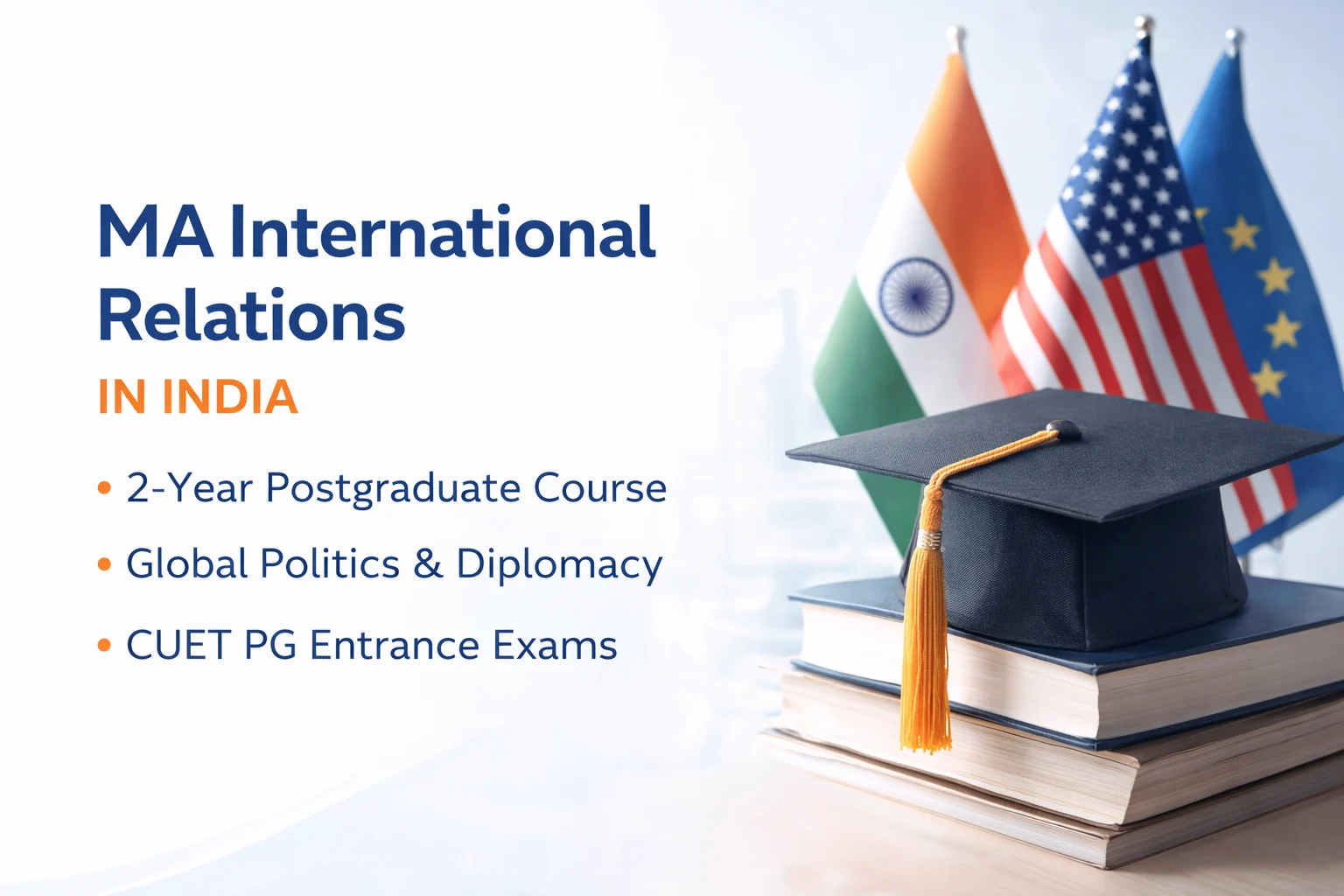
The MA International Relations program in India is a 2-year postgraduate degree that focuses on global politics, diplomacy, foreign policy, international security, and international organizations. The course develops analytical, research, and policy-making skills required to understand contemporary global issues and geopolitical developments. Students study international relations theories, international political economy, strategic studies, and global governance systems.
Eligibility generally requires a bachelor’s degree in any discipline with 50%–60% aggregate marks, while admission is commonly based on entrance examinations such as CUET PG or university-level tests. Annual fees vary widely depending on institution type. Graduates can pursue careers in diplomacy, research, international organizations, policy analysis, media, and academia.
| Feature | Description | Details |
|---|---|---|
| Course Level | Program Type | Postgraduate Degree (MA) |
| Program Duration | Typical Course Length | 2 Years (4 Semesters) |
| Average Fees | Annual Fee Range | INR 2,000 – INR 1,50,000 |
| Eligibility | Minimum Qualification | Bachelor’s degree in any discipline with 50%–60% marks |
| Entrance Exams | Accepted Exams | CUET PG, University Entrance Tests |
| Admission Process | Selection Method | Entrance Exam / Merit + Interview (varies by university) |
| Specializations | Areas of Study | Foreign Policy, International Law, Global Governance, Security Studies |
| Core Subjects | Academic Focus | IR Theories, International Political Economy, Diplomacy, Strategic Studies |
| Career Prospects | Potential Job Roles | Diplomat, Policy Analyst, IR Officer, Research Analyst, Consultant |
| Average Salary | Expected Salary Range | INR 3 LPA – INR 8 LPA (Entry Level) |
| Top Colleges | Leading Institutions | Jawaharlal Nehru University, University of Delhi, Banaras Hindu University, Jamia Millia Islamia, Christ University, Symbiosis International University |
Skills Developed During the Program
- Critical thinking and geopolitical analysis
- Policy research and strategic assessment
- Diplomatic communication and negotiation
- International law and governance understanding
- Data interpretation and global issue analysis
MA International Relations Eligibility Criteria
Admission to the MA International Relations program in India requires candidates to hold a recognized bachelor’s degree from a university approved by the University Grants Commission or equivalent authority. Universities admit students through merit-based evaluation or postgraduate entrance examinations such as CUET PG.
Eligibility conditions may slightly vary across institutions, but most universities follow standard postgraduate admission norms. Relaxation in minimum marks is usually provided to reserved categories as per Government of India regulations.
| Parameter | Requirement | Details |
|---|---|---|
| Minimum Qualification | Bachelor’s Degree | A 3-year or equivalent undergraduate degree from a recognized university |
| Minimum Percentage / CGPA | 50% – 60% | Varies by university and category; relaxation applicable for reserved categories |
| Acceptable Streams | Any Discipline | Humanities, Social Sciences, Commerce, Science, or related backgrounds preferred |
| Preferred Subjects | Academic Background | Political Science, History, Economics, Sociology, Public Administration (preferred but not mandatory) |
| Age Limit | Not Applicable | No prescribed upper age limit in most universities |
| Reservation Policy | Government Norms | SC/ST/OBC/EWS/PwD reservation as per central/state university rules |
| Entrance Exams | National/University Level | CUET PG or university-specific entrance examinations |
| English Language Requirement | International Applicants | TOEFL/IELTS scores may be required for foreign students |
| Additional Requirements | Selection Process | Document verification, entrance score evaluation, and interview (if applicable) |
MA International Relations Admission Process
Admission to MA International Relations programs in India follows a structured selection procedure combining eligibility verification, entrance examination performance, and institutional admission processes. Application fees generally range between INR 500 – INR 2,000, depending on the university.
Step-by-Step Admission Process
- Research and Shortlist Universities
- Identify institutions offering MA International Relations such as Jawaharlal Nehru University, University of Delhi, and Jamia Millia Islamia.
- Check Eligibility Requirements
- Confirm academic qualifications, minimum percentage, and subject requirements.
- Appear for Entrance Examination
- Register and prepare for CUET PG or university-level entrance tests where applicable.
- Fill Application Form
- Complete the online application form on the official university portal.
- Upload academic records, photographs, and identity proof.
- Pay Application Fee
- Submit payment through online modes such as debit card, credit card, or net banking.
- Entrance Test / Interview Round
- Attend written tests, group discussions, or personal interviews if conducted by the university.
- Merit List & Selection
- Universities release merit lists based on entrance scores and academic performance.
- Admission Confirmation
- Selected candidates must pay admission fees (approx. INR 2,000 – INR 15,000 initially) and submit original documents.
- Document Verification
- Verification of degree certificates, mark sheets, ID proof, caste certificates (if applicable).
- Course Commencement
- Attend orientation sessions and begin the 2-year MA International Relations program.
Top Government Colleges in India for MA International Relations
India offers several reputed government universities providing MA International Relations or closely related postgraduate programs in International Studies, Political Science (International Relations), and Global Studies. These institutions are known for strong academic research, policy exposure, and preparation for careers in diplomacy, academia, public policy, and international organizations.
Annual tuition fees in government universities are comparatively affordable, generally ranging between INR 2,000 and INR 20,000 per year. Admission is primarily conducted through national-level postgraduate entrance examinations such as CUET PG or university-specific entrance tests.
| College Name | City | NIRF Rank | Approx. Annual Fees | Admission Mode | Program Highlights |
|---|---|---|---|---|---|
| Jawaharlal Nehru University | New Delhi | 2 | INR 2,000 – 5,000 | Entrance Exam | International Studies, diplomacy, strategic affairs specialization |
| University of Delhi | New Delhi | 11 | INR 10,000 – 15,000 | CUET PG | Political Science with IR focus, foreign policy studies |
| Banaras Hindu University | Varanasi | 11 | INR 6,000 – 8,000 | Entrance Exam | Global governance, diplomacy, political economy |
| Jamia Millia Islamia | New Delhi | 16 | INR 8,000 – 12,000 | Entrance Exam | International politics, West Asian & global studies |
| University of Hyderabad | Hyderabad | 15 | INR 5,000 – 7,000 | Entrance Exam | International relations theory and global politics |
| Aligarh Muslim University | Aligarh | 18 | INR 10,000 – 12,000 | Entrance Exam | Diplomacy, security studies, international organizations |
| Pondicherry University | Puducherry | 20 | INR 7,000 – 9,000 | CUET PG | Foreign policy and global governance focus |
| Jadavpur University | Kolkata | 12 | INR 8,000 – 10,000 | Merit/Entrance | International politics and area studies |
| Andhra University | Visakhapatnam | 25 | INR 7,000 – 9,000 | Entrance Exam | International relations and diplomatic studies |
Top Private Colleges in India for MA International Relations
Private universities in India increasingly offer specialized postgraduate programs in International Relations, Global Affairs, Diplomacy, and Public Policy with industry exposure, internships, and international collaborations. Annual fees generally range between INR 50,000 and INR 2,50,000, depending on infrastructure, faculty expertise, and global partnerships.
| College Name | City | Annual Fees (Approx.) | Admission Mode | Specializations Offered | Program Features |
|---|---|---|---|---|---|
| Christ University | Bengaluru | INR 70,000 – 90,000 | Merit + Interview | Global Politics, Foreign Policy | NGO internships and policy exposure |
| Symbiosis School of International Studies | Pune | INR 1,50,000+ | Entrance Exam | Security Studies, Global Governance | Study abroad & international internships |
| Amity University | Noida | INR 1,00,000 – 1,20,000 | Merit-based | Diplomacy, IR Studies | Industry interaction and research projects |
| Jindal School of International Affairs | Sonipat | INR 2,00,000+ | Entrance + Interview | Area Studies, Global Politics | Policy labs and global faculty exposure |
| Shiv Nadar University | Greater Noida | INR 1,40,000 – 1,60,000 | Merit-based | Governance, Human Rights | International academic collaborations |
| Azim Premji University | Bengaluru | INR 90,000 – 1,10,000 | Entrance Exam | Development Studies, Public Policy | Fieldwork and research immersion |
| Manipal Academy of Higher Education | Manipal | INR 1,00,000 – 1,20,000 | Merit-based | Security Studies, Diplomacy | Internship and research training |
MA International Relations Subjects and Syllabus
The MA International Relations program in India is a two-year postgraduate course designed to develop a strong understanding of global politics, diplomacy, foreign policy analysis, international organizations, and strategic affairs. The curriculum combines theoretical learning with research training, internships, policy analysis, and dissertation work.
The program is typically divided into four semesters, including core papers, electives, skill-based learning, research methodology, and a final dissertation project. The syllabus may vary slightly across universities but broadly follows the structure below.
| Semester | Core Subjects | Elective Subjects | Credits (Approx.) | Academic Activities |
|---|---|---|---|---|
| Semester 1 | Theories of International Relations, International Political Economy, Research Methodology | Foreign Policy Analysis, Conflict Resolution | 16–20 | Seminars, Group Discussions |
| Semester 2 | International Organizations, International Law, Comparative Politics | Human Rights Studies, Global Governance | 16–20 | Research Paper & Presentations |
| Semester 3 | Security Studies, Diplomacy & Negotiation, Geopolitics | Area Studies (South Asia/Middle East/Europe), Development Studies | 16–20 | Internship, Fieldwork |
| Semester 4 | Dissertation / Project Work | EU Studies, Indo-Pacific Studies, Strategic Affairs | 16–20 | Viva Voce & Dissertation Defense |
Check the syllabus for MA International Relations.
Skill-Based and Interdisciplinary Components
| Component | Subjects / Activities | Credits |
|---|---|---|
| Research Training | Statistical Analysis, Policy Research Methods | 6–8 |
| Language Courses | French, Spanish, Chinese, Arabic (varies by university) | 4–6 |
| Professional Skills | Academic Writing, Leadership & Communication | 4 |
| Practical Exposure | Model UN, Policy Brief Writing, Case Studies | 4 |
| Summer Internship | Think Tanks / NGOs / Government Bodies | 2–4 |
| Dissertation | Original Research Thesis | 10–12 |
MA International Relations Fee Structure
The fee structure for MA International Relations programs varies widely depending on institution type. Government universities offer affordable education, while private universities provide global exposure, industry collaborations, and international exchange opportunities.
| Institution / College Type | Average Annual Tuition Fees | Hostel Fees (Approx.) | Examination Fees | Other Expenses |
|---|---|---|---|---|
| Jawaharlal Nehru University | INR 2,000 – 5,000 | INR 4,000 – 6,000 | INR 1,000 | INR 5,000 |
| University of Delhi | INR 10,000 – 15,000 | INR 8,000 – 12,000 | INR 2,000 | INR 10,000 |
| Christ University | INR 70,000 – 90,000 | INR 45,000 – 60,000 | INR 5,000 | INR 10,000 |
| Symbiosis School of International Studies | INR 1,40,000 – 1,60,000 | INR 90,000 – 1,10,000 | INR 10,000 | INR 20,000 |
| Loyola College | INR 40,000 – 60,000 | INR 25,000 – 35,000 | INR 5,000 | INR 10,000 |
| Amity University | INR 1,00,000 – 1,20,000 | INR 70,000 – 85,000 | INR 10,000 | INR 15,000 |
Entrance Exams for MA International Relations in India
Admission to MA International Relations programs is generally based on postgraduate entrance examinations assessing analytical ability, political awareness, reasoning, and subject knowledge.
| Exam Name | Conducting Body | Exam Type | Eligibility | Syllabus Overview | Official Portal |
|---|---|---|---|---|---|
| CUET PG | National Testing Agency | National Level | Bachelor’s degree (50%+) | Language comprehension, reasoning, domain subjects | cuet.nta.nic.in |
| JNUEE | Jawaharlal Nehru University | University Level | Graduation | IR theory, global politics, history | jnu.ac.in |
| Delhi University PG Entrance Exam | University of Delhi | University Level | Graduation | Political science, reasoning, English | du.ac.in |
| Christ University Entrance Test | Christ University | University Level | Graduation | English, GK, analytical reasoning | christuniversity.in |
| Symbiosis Entrance Test | Symbiosis International | University Level | Graduation | GK, reasoning, international affairs | siu.edu.in |
| Amity University Entrance Exam | Amity University | University Level | Graduation | English, reasoning, subject knowledge | amity.edu |
Preparation Tips for Aspirants
- Build strong conceptual understanding of international politics and global affairs
- Read newspapers and international policy journals regularly
- Focus on current affairs, diplomacy, and geopolitical developments
- Practice reasoning and analytical aptitude questions
- Solve previous years’ entrance papers and mock tests
These steps significantly improve chances of admission to leading MA International Relations programs in India.
Frequently Asked Questions (FAQs)
Q1. What is the duration of the MA International Relations course in India?
The MA International Relations course in India is typically 2 years long. It is a postgraduate course that focuses on the study of global politics, international organizations, and diplomacy. The course examines theories of international relations, foreign policy analysis, and global governance.
Q2. What are the eligibility criteria for Indian students to pursue MA International Relations?
Indian students must have a bachelor’s degree in any discipline from a recognized university to be eligible for MA International Relations. They must also have a minimum of 50% – 60% aggregate marks in their bachelor’s degree, although this may vary by institution. Some universities may also require entrance exam scores, such as CUET PG.
Q3. What is the average annual fee for MA International Relations in government and private colleges in India?
The average annual fee for MA International Relations in government colleges in India is between INR 2,000 – INR 15,000. In contrast, private colleges charge between INR 50,000 – INR 1,50,000 per annum. For example, Jawaharlal Nehru University (JNU) charges INR 2,000 per year, while Symbiosis School of International Studies charges INR 1,50,000 per year.
Q4. What are the career prospects for MA International Relations graduates in India?
MA International Relations graduates in India have opportunities in government, international organizations, NGOs, and the private sector. They can work as diplomats, policy analysts, international relations officers, or research analysts. The expected salary range after graduation is between INR 3 LPA – INR 8 LPA, depending on experience and role.