
Master of Pharmacy (Mpharm) 2026: Full Form, Course Fees, Syllabus, Fees, Top Colleges, Salary, Scope
The Master of Pharmacy (MPharm), or Master of Pharmacy, is a prestigious two-year postgraduate program that builds advanced expertise in pharmaceutical sciences beyond the BPharm level. Designed for graduates passionate about drug discovery, formulation, research, and regulatory aspects, the course delves into specialised areas such as pharmaceutics, pharmacology, pharmaceutical chemistry, quality assurance, and more. The curriculum typically covers advanced topics like pharmacokinetics, drug design, clinical pharmacy, industrial pharmacy, and research methodology, often culminating in a thesis or project work. In India, MPharm fees range from INR 50,000 to INR 9 lakhs or more, depending on whether it’s a government or private institution. Top colleges include NIPER institutes, Jamia Hamdard University, Panjab University, ICT Mumbai, BITS Pilani, and Manipal College of Pharmaceutical Sciences. This guide explores the full form, eligibility, syllabus, fees, leading institutions, salary prospects, and career scope to help aspiring pharmacists make informed decisions.
MPharm Course Details
The Master of Pharmacy (MPharm) is a specialized postgraduate program that offers in-depth knowledge and research-oriented training in various branches of pharmaceutical sciences. Spanning 2 years (divided into 4 semesters), it emphasizes advanced topics like drug formulation, pharmacology, analysis, regulatory affairs, and clinical research, often including practical lab work, seminars, and a mandatory dissertation or project. This course equips graduates with the skills needed for roles in R&D, quality assurance, academia, and the booming pharmaceutical industry. Admission is primarily entrance-based, with eligibility requiring a BPharm degree from a recognized university (typically with 50-55% aggregate marks). Here’s a full overview in tabular form:
| Aspect | Details |
| Course Level | Postgraduate |
| Full-form | Master of Pharmacy |
| Duration | 2 years (4 semesters) |
| Eligibility | BPharm degree with minimum 50-55% marks from a PCI-recognized university |
| Admission Process | Entrance exam-based (primarily) or merit-based |
| Top Accepted Entrance Examinations | GPAT, NIPER JEE, state-level exams (e.g., AP PGECET, TS PGECET, OJEE), institute-specific tests |
| Average Fee | INR 50,000 – 5 lakhs (varies; government colleges lower, private/NIPER higher) |
| Average Salary | INR 4 – 8 LPA (freshers; higher with experience/specialization up to 10-15 LPA) |
| Top Job Roles | Research Scientist, Quality Control/Assurance Manager, Regulatory Affairs Officer, Pharmacologist, Clinical Research Associate, Production Manager |
| Top Recruiting Companies | Sun Pharmaceuticals, Cipla, Dr. Reddy’s Laboratories, Lupin, Pfizer, Glenmark, Torrent Pharma, Biocon, Novartis, Research labs & hospitals |
MPharm Full Form
The MPharm Full Form stands for Master of Pharmacy. It is the standard abbreviation and full expansion used for this prestigious postgraduate degree in pharmaceutical sciences, particularly in India and several other countries. While sometimes written as M.Pharm or M. Pharm with periods for stylistic reasons, MPharm (without periods) is widely accepted in academic and professional contexts, including official university websites, entrance exams like GPAT, and regulatory bodies such as the Pharmacy Council of India (PCI).
Why study MPharm?
Pursuing an MPharm provides advanced specialization, deeper research exposure, and hands-on training in advanced areas like drug discovery, formulation development, clinical trials, and regulatory science—skills that go far beyond undergraduate knowledge. It unlocks superior career prospects, including high-demand roles in R&D, quality assurance, pharmacovigilance, and academia, where MPharm graduates often secure leadership positions unavailable to BPharm holders alone. The program boosts earning potential significantly, with fresher salaries typically starting higher and faster growth (often reaching ₹8-15 LPA or more with experience). In a sector witnessing strong demand driven by India’s pharma exports, innovation in biologics, and global opportunities, MPharm offers job stability, international mobility, and the chance to contribute meaningfully to healthcare advancements.
MPharm Admissions
Admissions to the Master of Pharmacy (MPharm) program in India are predominantly entrance exam-based, ensuring a merit-driven selection process aligned with national standards. The primary national-level exam is the Graduate Pharmacy Aptitude Test (GPAT), conducted by the National Board of Examinations in Medical Sciences (NBEMS). This exam qualifies candidates for most government, private, and deemed universities offering MPharm seats (including stipends/scholarships for qualified candidates). For premier institutes like the National Institutes of Pharmaceutical Education and Research (NIPERs), candidates must appear for NIPER JEE, often requiring a valid GPAT score as a prerequisite for eligibility in many cases.
MPharm Eligibility
To be eligible for MPharm admission in India, candidates must hold a Bachelor of Pharmacy (BPharm) degree from an institution approved by the Pharmacy Council of India (PCI) and affiliated with a recognized university. The minimum aggregate marks required in BPharm are typically 50-55% (or equivalent CGPA), with relaxations of 5% for reserved categories (SC/ST/OBC/PwD) as per government norms, some top institutes like NIPERs demand 60% or higher (CGPA 6.75/10). Final-year BPharm students can apply provisionally, provided they submit proof of passing before final admission. A valid score in entrance exams like GPAT is mandatory for most seats (especially for scholarships/AICTE fellowships), while NIPER JEE is required for NIPER admissions. There is generally no upper age limit. Registration with the State Pharmacy Council may be required post-admission in certain cases.
| Aspect | Details |
| Qualifying Degree | BPharm from PCI-approved institution and recognized university |
| Minimum Marks | 50-55% aggregate (relaxation to 45-50% for reserved categories) |
| Entrance Exam | GPAT (national); NIPER JEE (for NIPERs); state/institute-specific exams |
| Other Requirements | Final-year students eligible provisionally; valid entrance score required for most seats |
| Age Limit | No upper age limit in most cases |
| Reservation | As per Central/State Government norms (SC/ST/OBC/PwD/EWS) |
MPharm Admissions: Important Dates
Important dates for MPharm admissions vary by entrance exam and counseling authority. As of February 2026, the key national exam GPAT 2026 cycle is complete, with counseling rounds underway or imminent for 2026-27 intake. NIPER JEE 2026 dates are typically announced later in the year. Below are the confirmed/ recent key dates for GPAT 2026 (primary gateway for most MPharm admissions) and tentative timeline for NIPER JEE based on patterns:
| Event | GPAT 2026 Dates (Confirmed) | NIPER JEE 2026 (Tentative) |
| Notification Release | December 22, 2025 | March-April 2026 |
| Application Form Start | December 23, 2025 | April 2026 |
| Last Date to Apply | January 12, 2026 | May 2026 |
| Application Correction Window | February 2026 (e.g., 17-19 Feb) | May 2026 |
| Admit Card Release | March 2, 2026 | June 2026 |
| Exam Date | March 7, 2026 | June 2026 |
| Result Declaration | By April 7, 2026 | July 2026 |
| Counselling/Admission Rounds | April-June 2026 onwards (ongoing in 2026) | July-August 2026 |
Top Entrance Exams for MPharma with Dates
The Master of Pharmacy (MPharm) admissions in India are largely driven by national and state-level entrance exams, with GPAT serving as the primary national gateway for most institutions, including eligibility for AICTE scholarships and stipends. NIPER JEE is crucial for admission to the prestigious National Institutes of Pharmaceutical Education and Research (NIPERs). State-level exams like AP PGECET, TS PGECET, and OJEE cater to government and affiliated colleges in respective states, often accepting GPAT scores alternatively for some seats. Other exams include institute-specific tests (e.g., BITS Pilani, Manipal) or merit-based admissions in private universities.
| Entrance Exam | Conducting Body | Registration Dates (2026 Cycle) | Exam Dates (2026) | Key Notes / Status as of Feb 06, 2026 |
| GPAT | National Board of Examinations in Medical Sciences (NBEMS) | December 23, 2025 – January 12, 2026 (closed) | March 7, 2026 | Primary national exam; results expected April 2026; counseling ongoing/upcoming |
| NIPER JEE | NIPER (rotational, e.g., Guwahati/Mohali) | Tentative: April – May 2026 | Tentative: June 2026 | For NIPER institutes; often requires GPAT qualification; dates TBA soon |
| AP PGECET | Andhra Pradesh State Council of Higher Education (APSCHE) | Tentative: March – April 2026 | Tentative: Late April – May 2026 (e.g., April 28–30 or May 8–11) | State-level for AP colleges; accepts GPAT for some seats |
| TS PGECET | Telangana State Council of Higher Education (TSCHE) | Tentative: March – April 2026 | Tentative: May 28–31, 2026 | For Telangana institutions; GPAT preferred for certain admissions |
| OJEE (Pharmacy PG) | Odisha Joint Entrance Examination Committee | Tentative: January – March 2026 | Tentative: May – June 2026 | For Odisha state seats; merit/GPAT-based options available |
MPharm Syllabus
The Master of Pharmacy (MPharm) syllabus in India is regulated by the Pharmacy Council of India (PCI) and follows a standardised framework implemented since the 2016-17 academic session (with minor amendments up to 2020 and beyond). The 2-year program is divided into 4 semesters, with the first two focusing on core and specialisation-specific theory, practicals, seminars, and assignments, while Semesters 3 and 4 are dedicated to research work, dissertation/project, and related activities like journal club and discussions. Below is the detailed syllabus:
| Year/Semester | Key Subjects/Theory Courses (Common/Core + Specialisation Examples) | Practicals/Labs | Notes |
| Year 1 – Semester 1 | – Modern Pharmaceutical Analytical Techniques – Drug Delivery System – Modern Pharmaceutics (or branch-specific: e.g., Advanced Organic Chemistry for Pharmaceutical Chemistry, Advanced Pharmacology for Pharmacology) – Regulatory Affairs | – Pharmaceutical Analysis/Branch Practical I – Branch Practical II | Focus on foundational advanced techniques, analysis, and delivery systems; 4 theory + 2 practical subjects typically. |
| Year 1 – Semester 2 | – Advanced/Modern Pharmaceutics II (or branch-specific: e.g., Advanced Medicinal Chemistry, Pharmacotherapeutics, Industrial Pharmacy) – Molecular Pharmacology/Biopharmaceutics & Pharmacokinetics – Computer Aided Drug Design (common in many branches) – Elective/Branch-specific (e.g., Herbal Drug Technology, Quality Assurance) | – Branch Practical III – Branch Practical IV | Builds on Semester 1 with deeper specialization; emphasis on research-oriented topics. |
| Year 2 – Semester 3 | – Research Methodology & Biostatistics (common) – Specialization-specific advanced topics (if any) – Journal Club/Discussions | – Research Work/Dissertation (Phase I) | Primarily research-focused; students start thesis under supervisor guidance. |
| Year 2 – Semester 4 | – Advanced research topics (as per project) | – Research Work/Dissertation (Phase II & Completion) – Thesis Submission & Viva-Voce | Culminates in dissertation submission, viva, and evaluation; focus on original research contribution. |
Download MPharma Syllabus
Below is the latest MPharma syllabus with a semester-wise breakdown, which you can download for your reference: M.Pharm Syllabus 2026
Top MPharma Colleges in India
Top MPharma colleges in India include government-backed NIPERs (known for excellent research and stipends via GPAT/NIPER JEE) and reputed universities like Jamia Hamdard (retaining Rank 1 for consecutive years) and BITS Pilani. Admission is highly competitive, mostly through GPAT (for most seats, with scholarships) or NIPER JEE for NIPER campuses, requiring strong entrance scores. Here’s a detailed table of the top MPharm colleges list in India:
| Rank (NIRF 2025) | College Name | Location | Cutoff (Approx. GPAT Rank / NIPER JEE) | Fees (Total for 2 Years, Approx.) | Average Placement (Freshers) |
| 1 | Jamia Hamdard | New Delhi | GPAT: Top 100-500 (branch-wise) | INR 4-6 Lakhs | INR 5-8 LPA |
| 2 | Birla Institute of Technology & Science (BITS) Pilani | Pilani, Rajasthan | BITS HD / GPAT: Competitive | INR 10-12 Lakhs | INR 6-10 LPA |
| 3 | Panjab University | Chandigarh | GPAT: Top 200-800 | INR 50,000 – 1 Lakh | INR 4-7 LPA |
| 4 | JSS College of Pharmacy (Ooty) | Ooty, Tamil Nadu | GPAT: Top 300-1000 | INR 3-5 Lakhs | INR 4-8 LPA |
| 5 | National Institute of Pharmaceutical Education and Research (NIPER) Hyderabad | Hyderabad, Telangana | NIPER JEE: Top ranks (GPAT qual. Req.) | INR 1-2 Lakhs (subsidized) | INR 6-10 LPA |
| 6 | Institute of Chemical Technology (ICT) | Mumbai, Maharashtra | GPAT: Top 100-600 | INR 1-3 Lakhs | INR 5-9 LPA |
| 7 | JSS College of Pharmacy | Mysuru, Karnataka | GPAT: Top 400-1200 | INR 3-4 Lakhs | INR 4-7 LPA |
| 8 | Manipal College of Pharmaceutical Sciences | Manipal/Udupi, Karnataka | Institute test / GPAT | INR 4-6 Lakhs | INR 5-9 LPA |
| 9 | National Institute of Pharmaceutical Education and Research (NIPER) Mohali | Mohali, Punjab | NIPER JEE: Top ranks | INR 1-2.5 Lakhs (subsidized) | INR 6-12 LPA (up to 15 LPA high) |
| 10 | SRM Institute of Science and Technology | Chennai, Tamil Nadu | GPAT / Institute merit | INR 3-5 Lakhs | INR 4-8 LPA |
Top MPharma Colleges Abroad
Pursuing a Master of Pharmacy (MPharm) or equivalent postgraduate program (often MS/MSc in Pharmaceutical Sciences, Pharmacology, or Pharmacy) abroad offers top-tier research facilities, advanced drug discovery opportunities, international exposure, and strong industry connections in global pharma hubs. Unlike India’s MPharm, many abroad programs are research-intensive (1-2 years), emphasize innovation in areas like biotechnology, clinical pharmacology, and regulatory science, and lead to high-paying roles in R&D, biotech firms, academia, or regulatory bodies worldwide. Top destinations include the USA (strong in innovation and funding), UK (prestigious research universities), Australia (excellent industry ties), Canada (affordable with post-study work options), and others like Germany (low/no tuition in public unis). Here’s a detailed table of top MPharm-equivalent colleges abroad:
| Rank (QS 2025 Pharmacy & Pharmacology) | University Name | Location | Approx. Tuition Fees (Total, USD) | Typical Admission Requirements | Average Starting Salary (Freshers, USD) / Notes |
| 1 | Harvard University | Cambridge, USA | 100,000–150,000 (for related MS/PhD tracks) | GPA 3.5+, GRE (optional), strong research background | 80,000–120,000+ (high in biotech/pharma R&D) |
| 2 | University of Oxford | Oxford, UK | 40,000–60,000 | First-class bachelor’s, research proposal | 50,000–80,000 GBP (strong global pharma links) |
| 3 | University College London (UCL) | London, UK | 35,000–55,000 | 2:1 honours equivalent, IELTS 7.0+ | 45,000–75,000 GBP (excellent research output) |
| 4 | Monash University | Melbourne, Australia | 50,000–70,000 AUD | GPA 65%+, relevant bachelor’s | 60,000–90,000 AUD (industry-focused) |
| 5 | University of California, San Francisco (UCSF) | San Francisco, USA | 60,000–100,000 | GPA 3.0+, GRE optional, letters of rec | 90,000–130,000 (top biotech hub) |
| 6 | Johns Hopkins University | Baltimore, USA | 80,000–120,000 | Strong academics, research experience | 85,000–110,000 (clinical/translational focus) |
| 7 | University of Toronto | Toronto, Canada | 30,000–50,000 CAD | B+ average, English proficiency | 60,000–90,000 CAD (good post-study work visa) |
| 8 | National University of Singapore (NUS) | Singapore | 40,000–60,000 SGD | Good honours degree, research aptitude | 50,000–80,000 SGD (Asia pharma growth) |
| 9 | University of Sydney | Sydney, Australia | 50,000–70,000 AUD | Credit average, IELTS 6.5+ | 65,000–95,000 AUD (active research scene) |
| 10 | McGill University | Montreal, Canada | 25,000–45,000 CAD | B average, thesis-based options | 55,000–85,000 CAD (affordable, multicultural) |
MPharm Placements
MPharm placements in India remain strong in 2026, driven by the pharmaceutical industry’s growth, rising exports, and demand for skilled professionals in R&D, quality assurance, regulatory affairs, and clinical research. Top colleges like NIPERs, Jamia Hamdard, BITS Pilani, ICT Mumbai, and Panjab University report strong placement records, with many graduates securing roles through campus drives, often with stipends/scholarships via GPAT qualification boosting employability. Freshers typically receive average packages of INR 4-8 LPA, with top performers from premier institutes landing offers up to INR 10-18 LPA or more in specialized roles (e.g., R&D at MNCs). Placement rates often exceed 70-90% at leading institutions, influenced by specialization (e.g., Pharmacology and Regulatory Affairs see higher packages), skills like data analysis/AI in pharma, and internships. Government jobs via exams offer stability with perks, while private sector roles provide faster growth. As of 2026, trends show increasing focus on biologics, pharmacovigilance, and digital pharma, enhancing opportunities for MPharm holders. Here’s a summary table of placement insights from top colleges (based on recent NIRF 2025 data, college reports, and industry trends as of 2026):
| College Name | NIRF 2025 Rank | Average Placement Package (Freshers) | Highest Package (Recent) | Placement Rate (Approx.) | Key Notes |
| Jamia Hamdard, New Delhi | 1 | INR 5-8 LPA | Up to INR 12-15 LPA | 80-90% | Strong industry ties, high R&D focus |
| BITS Pilani | 2 | INR 6-10 LPA | Up to INR 18-21 LPA | 85-95% | Excellent for research & MNC roles |
| Panjab University, Chandigarh | 3 | INR 4-7 LPA | Up to INR 10-13 LPA | 75-85% | Affordable, good government linkages |
| JSS College of Pharmacy, Ooty | 4 | INR 4-8 LPA | Up to INR 9-12 LPA | 80%+ | High median packages in South India |
| NIPER Hyderabad/Mohali | 5-9 | INR 6-12 LPA | Up to INR 15 LPA+ | 85-95% | Stipends via GPAT, top research placements |
| Institute of Chemical Technology (ICT), Mumbai | 6 | INR 5-9 LPA | Up to INR 12-15 LPA | 80-90% | Strong chemical/pharma industry network |
Note: Packages vary by specialization, experience, location, and economic factors; many include incentives/bonuses. Check official college placement cells for latest stats.
MPharm Jobs & Top Recruiters
MPharm graduates access diverse, high-demand job roles in India’s thriving pharma sector (projected to grow significantly by 2030), spanning research, manufacturing, regulation, and healthcare. Key job profiles include Research Scientist (drug discovery/formulation), Quality Control/Assurance Manager (testing/compliance), Regulatory Affairs Officer (approvals/filings), Pharmacologist (drug effects/studies), Clinical Research Associate (trials/data), Production Manager (manufacturing), and Pharmacovigilance Specialist (safety monitoring). Other emerging roles involve medical writing, academia (lecturer/professor), and sales/marketing (Medical Representative). Top recruiters actively hire MPharm talent for freshers and experienced positions, with MNCs offering global exposure and Indian giants providing volume opportunities. Salaries start at INR 4-8 LPA for freshers, scaling to INR 10-20+ LPA with 5+ years in specialized roles.
Top MPharma Recruiting Companies
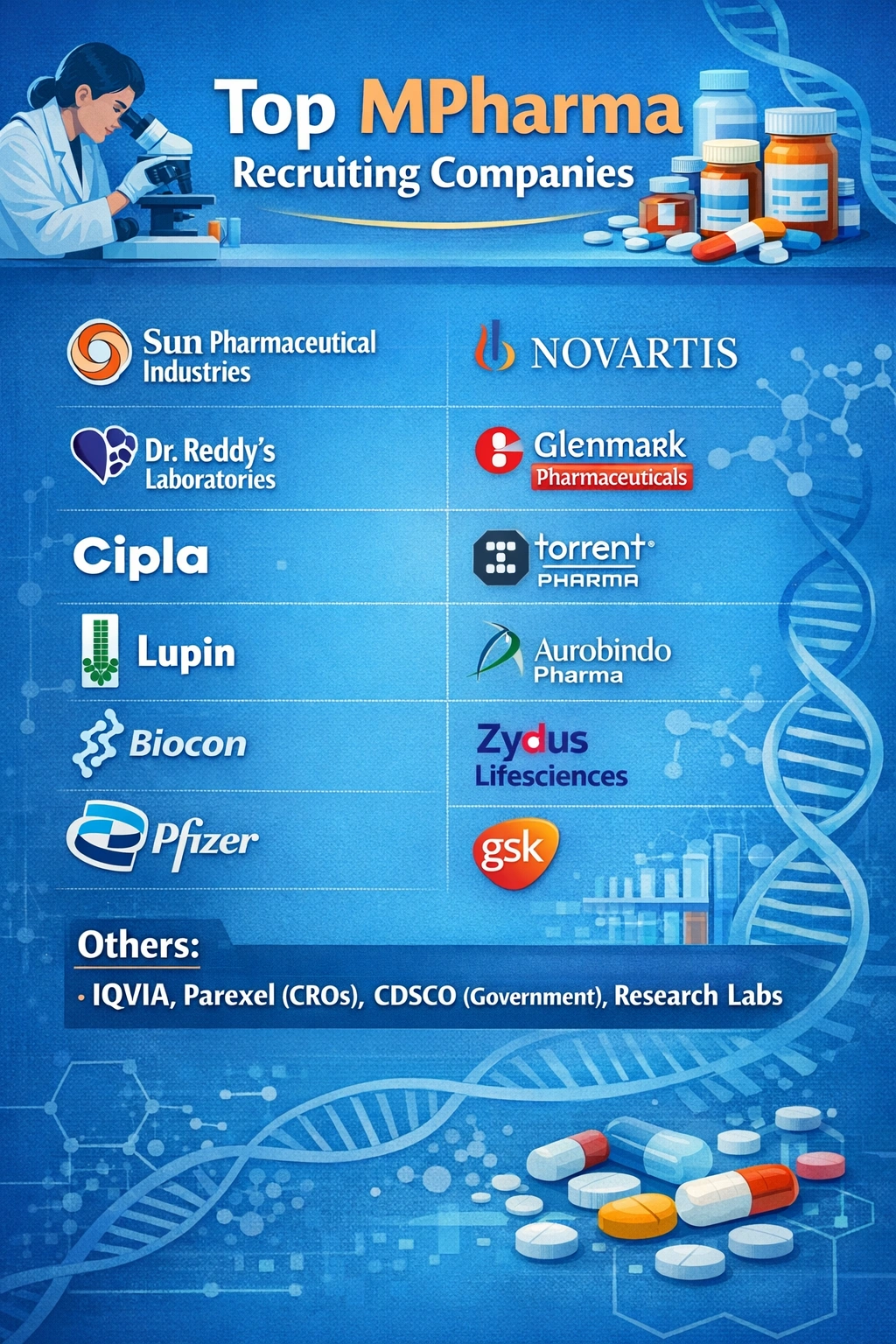 These firms prioritize GPAT-qualified candidates for R&D and often conduct campus placements at top institutes.
MPharma Scope
The scope of MPharm in India as of 2026 is exceptionally promising, fueled by the booming pharmaceutical industry, rising exports, advancements in biologics, personalized medicine, AI-driven drug discovery, and increased focus on clinical research and regulatory compliance. This postgraduate degree significantly enhances career prospects over BPharm, opening doors to specialized, high-responsibility roles in R&D, quality assurance, pharmacovigilance, regulatory affairs, academia, and government sectors. With India’s pharma sector projected to create substantial jobs and global opportunities, MPharm graduates enjoy strong job security, rapid career progression, international mobility (e.g., in USA, UK, Canada for higher packages), and meaningful contributions to healthcare innovation. Emerging fields like pharmacovigilance, clinical trials, and digital pharma further amplify demand.
| Aspect | Details | Salary Range (INR LPA) – Freshers | Salary Range (INR LPA) – Experienced (5+ Years) | Key Opportunities & Notes |
| Overall Scope | High demand in pharma R&D, manufacturing, regulation, clinical trials, academia; growing in biologics, AI pharma, pharmacovigilance | 4-8 | 10-20+ (up to 35+ in senior roles) | Excellent growth; global mobility; job creation projected high by 2030 |
| Private Sector | Pharma companies, CROs, biotech firms (e.g., R&D, QA/QC, production, medical writing) | 3.5-7 | 8-25+ | Fastest growth; MNCs offer incentives/bonuses |
| Government Sector | Drug Inspector, Scientist (ICMR/CSIR), Lecturer, Regulatory Officer (CDSCO), Research roles | 4-8 (₹35k-75k/month) | 10-18+ (with perks) | Stability, PF, pensions; via competitive exams |
| Top Job Roles | Research Scientist, Regulatory Affairs Officer, Pharmacovigilance Specialist, Clinical Research Associate, Production Manager, Medical Writer, Lecturer | 4-10 (specialization-dependent) | 10-35+ | Highest in R&D/Regulatory; emerging: AI in drug development |
| Specialization Impact | Pharmacology/Regulatory Affairs/Pharmaceutics offer best packages; others like Pharmacy Practice strong in clinical roles | 5-10 | 12-30+ | Choose based on interest (e.g., Regulatory highest potential) |
| Highest Earning Potential | Senior R&D Manager, Clinical Project Manager, Regulatory Head in MNCs | N/A | 15-35+ | With experience, PhD, or global roles |
| Future Trends | AI/bioinformatics, personalized medicine, pharmacovigilance, exports growth | Increasing from 2026 onwards | High upward trajectory | Certifications (e.g., regulatory/clinical) enhance scope |
FAQs
1. What is the full form of MPharm and its duration?
MPharm stands for Master of Pharmacy. It is a 2-year full-time postgraduate program divided into 4 semesters, designed to provide advanced knowledge and specialization in pharmaceutical sciences after completing BPharm. The course includes theoretical subjects, practical labs, seminars, and a mandatory research dissertation in the final year.
2. What is the eligibility criteria for MPharm admission in India?
Candidates must hold a BPharm degree from a PCI-recognized university with a minimum aggregate of 50-55% marks (relaxations for reserved categories). Final-year BPharm students can apply provisionally. A valid entrance exam score, such as GPAT, is required for most seats, especially in government and top institutes.
3. Which entrance exams are accepted for MPharm admissions?
The primary national exam is GPAT, conducted by NBEMS, qualifying candidates for scholarships and most colleges. NIPER JEE is essential for NIPER institutes. State-level exams like AP PGECET, TS PGECET, and OJEE are accepted in respective states, while some private universities use merit or their own tests.
4. What are the average fees for MPharm in India?
Fees vary widely: government colleges and NIPERs charge INR 50,000 to 2 lakhs for the entire course (often subsidized with GPAT stipends). Private and deemed universities range from INR 2 lakhs to 9 lakhs or more, depending on infrastructure, location, and specialization.
5. What are the top job roles and average salary after MPharm?
Common roles include Research Scientist, Regulatory Affairs Officer, Quality Control Manager, Pharmacologist, and Clinical Research Associate. Freshers earn INR 4-8 LPA on average, with higher packages (up to INR 10-15 LPA) in premium institutes, specializations like pharmacology, or MNCs.
6. What is the career scope after completing MPharm?
MPharm opens doors to R&D, quality assurance, regulatory affairs, pharmacovigilance, academia, and clinical trials in India’s growing pharma sector. It offers better prospects than BPharm, with opportunities in private companies, government roles, CROs, and abroad. Specializations and skills enhance global mobility and higher earnings.
7. Why choose MPharm over stopping at BPharm?
MPharm provides deeper specialization, research exposure, and advanced skills in drug development and regulation, leading to senior roles unavailable to BPharm graduates. It boosts salary potential, job stability, and career growth in a high-demand industry, plus eligibility for scholarships and PhD pursuits.