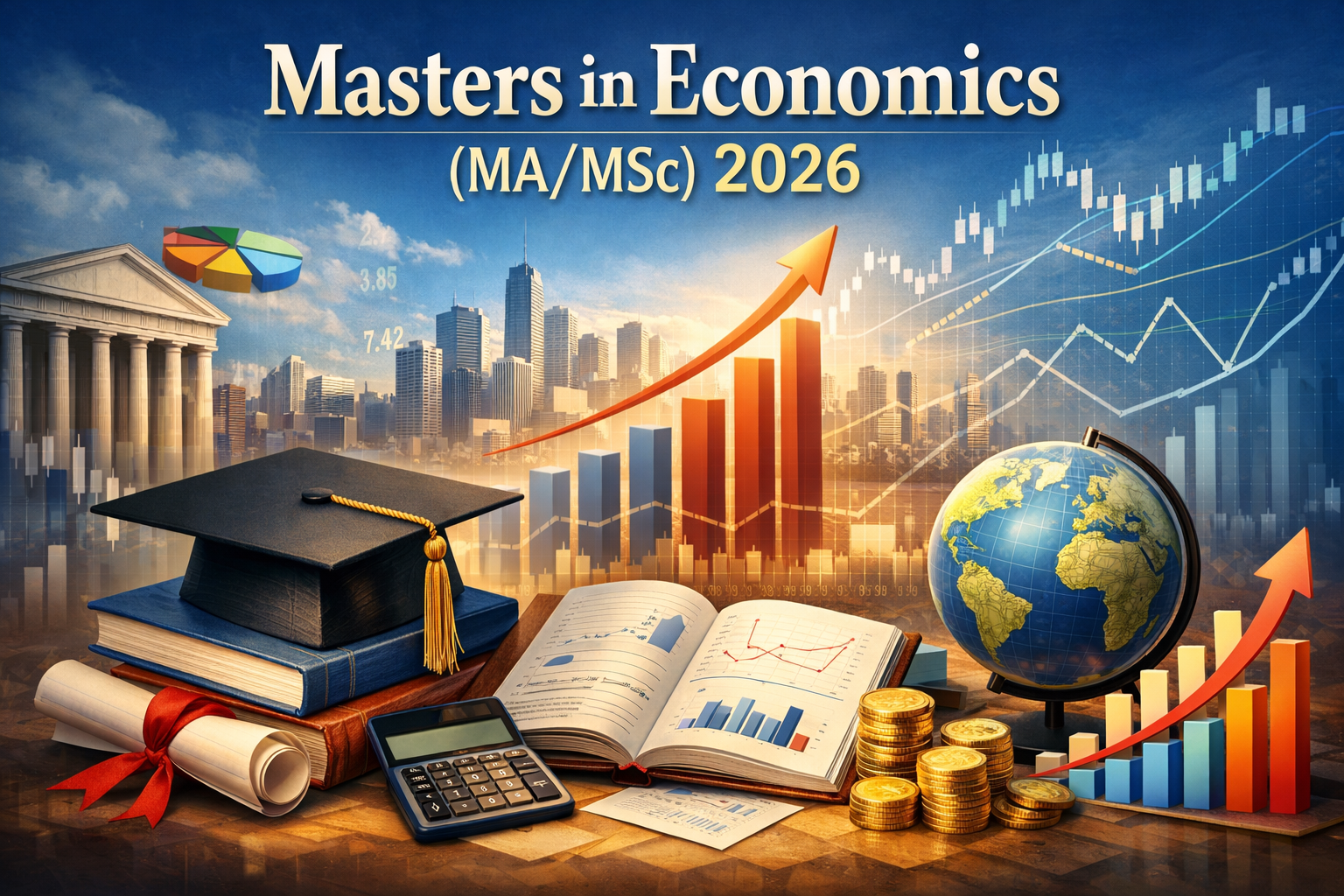
Masters in Economics (Ma/msc) 2026: Course, Colleges, Fees & Career Scope India
Masters in Economics (MA/MSc) 2026 is a postgraduate program designed for students who want to gain advanced knowledge of economic theories, data analysis, and policy-making. The course focuses on core areas such as microeconomics, macroeconomics, econometrics, public finance, and international economics. It helps students understand real-world economic issues like inflation, unemployment, growth, and development in the Indian and global context.
MA Economics is usually more theory-oriented, while MSc Economics emphasises quantitative and analytical skills. Graduates can explore careers in banking, finance, research, policy analysis, corporate strategy, and government services. With strong demand across public and private sectors, a master’s degree in economics offers excellent career growth, competitive salaries, and opportunities for higher studies such as a PhD, MPhil, or professional certifications.
What is Masters in Economics?: Overview
A masters in economics is a two-year postgraduate degree providing in-depth knowledge of economic theory, policy, and quantitative methods. Programs are offered as either an MA Economics, emphasizing theoretical aspects, or an MSc Economics, emphasizing quantitative skills. Core subjects include Microeconomics, Macroeconomics, Econometrics, and Mathematical Economics. Graduates can find opportunities in institutions like the Reserve Bank of India (RBI), the Union Public Service Commission (UPSC), research organizations, the finance sector, and data analytics firms. A masters in economics is suitable for individuals with backgrounds in finance, engineering, accounting, management, statistics, mathematics, or economics. The following table compares MA Economics and MSc Economics programs in India.
| Feature | MA Economics | MSc Economics |
|---|---|---|
| Duration | 2 years (typical) | 2 years (typical) |
| Focus | Economic Theory | Quantitative Skills |
| Career Paths | Research, Analyst roles | Research, Analyst roles |
| Suitable for | Individuals with background in finance, engineering, accounting, management, statistics, mathematics or economics | Individuals with background in finance, engineering, accounting, management, statistics, mathematics or economics |
Masters in Economics (MA/MSc) 2026
To be eligible for a masters in economics program in India, you typically need a bachelor’s degree with a minimum of 50% marks. Preference is often given to those with a background in economics or mathematics. Admission commonly involves entrance exams such as the DSE (Delhi School of Economics) entrance exam, JNU entrance exam, CUET-PG, and ISI entrance exam. Some colleges may also require a math background.
- DSE Entrance Exam: Conducted by Delhi School of Economics
- JNU Entrance Exam: Conducted by Jawaharlal Nehru University
- ISI Entrance Exam: Conducted by Indian Statistical Institute
- CUET-PG: Conducted by National Testing Agency (NTA)
- GATE (Economics): Conducted by IITs
- Individual College Entrance Exams: Conducted by individual colleges
- Math background required for some programs
- Bachelor’s degree with minimum 50% marks required
| Entrance – DSE | JNU | ISI dates |
|---|---|---|
| Entrance – DSE – June 2026, Highly Competitive | JNU – Own entrance exam | May 5, 2026 (last date for document upload) |
| Entrance – DSE – Requires math background | JNU – Conducted by Jawaharlal Nehru University | March 15, 2026 (application portal opens) |
| Entrance – DSE – Minimum 50% marks in bachelor’s degree | JNU – Eligibility criteria: bachelor’s degree with minimum 50% marks | Elite program with its own entrance exam |
| CUET-PG – Conducted by National Testing Agency (NTA) | JNU – Admission process: entrance exam and interview | Refer to ISI website for schedule |
| GATE (Economics) – Conducted by IITs | JNU – Fees: ₹ 40.04 Lakhs | Usually in February |
| DSE Entrance Exam – Requires bachelor’s degree with minimum 50% marks | JNU – Specializations: economics, finance, international trade | Application portal opens in March |
| JNU Entrance Exam – Own entrance exam | JNU – Duration: 2 years | Admission process: entrance exam and interview |
| ISI Entrance Exam – Elite program with its own entrance exam | JNU – Eligibility criteria: bachelor’s degree with minimum 50% marks | Minimum 50% marks in bachelor’s degree required |
Top Colleges for Masters in Economics (MA/MSc) in India
India’s top economics colleges offer MA and MSc programs in Economics. Fees, rankings, placements, and alumni networks vary among institutions. Delhi School of Economics (DSE) is ranked #1, with a fee of ₹30,000. Jawaharlal Nehru University (JNU) has a total fee of ₹1,00,000. Indian Statistical Institute (ISI) Kolkata has a fee of ₹20,000. Other colleges include Presidency, Jadavpur, and IGNOU. Private colleges like Ashoka University and OP Jindal offer programs with fees of ₹15,00,000 and ₹12,00,000, respectively. The following table compares these colleges.
| Top Colleges – Fees | Ranking | Placements | Alumni |
|---|---|---|---|
| Delhi School of Economics (₹30,000) | Ranked #1 by NIRF | 100% placement with average salary ₹8,00,000 | Notable alumni include Nobel laureate Amartya Sen |
| Jawaharlal Nehru University (₹1,00,000 total) | Ranked among top 5 by QS World University Rankings | 95% placement with average salary ₹7,00,000 | Alumni include former RBI Governor Raghuram Rajan |
| Indian Statistical Institute (ISI) Kolkata (₹20,000) | Ranked #1 in statistics by NIRF | 99% placement with average salary ₹9,00,000 | Notable alumni include statistician C.R. Rao |
| Ashoka University (₹15,00,000) | Ranked among top 10 private universities by QS World University Rankings | 90% placement with average salary ₹6,00,000 | Alumni include entrepreneurs and policymakers |
| OP Jindal (₹12,00,000) | Ranked among top 20 private universities by NIRF | 85% placement with average salary ₹5,50,000 | Alumni include industry leaders and researchers |
| Presidency University (₹50,000) | Ranked among top 10 universities by NIRF | 80% placement with average salary ₹4,50,000 | Notable alumni include economists and policymakers |
| Jadavpur University (₹20,000) | Ranked among top 10 universities by NIRF | 75% placement with average salary ₹4,00,000 | Alumni include industry leaders and researchers |
| IGNOU (₹10,000) | Ranked among top 10 distance learning universities by NIRF | 60% placement with average salary ₹3,50,000 | Alumni include working professionals and entrepreneurs |
Masters in Economics (MA/MSc) 2026 Syllabus
The syllabus for a masters in economics is designed to provide a full understanding of economic theory, quantitative methods, and applied economics. The first year typically covers core subjects like microeconomics, macroeconomics, econometrics, and mathematical economics. The second year offers a range of electives, including financial economics, labor economics, and international trade. Students also complete a dissertation or research project. The syllabus balances theoretical and practical knowledge, focusing on developing critical thinking, analytical, and problem-solving skills. The following table outlines a sample syllabus for a masters in economics program in India.
| Semester Subjects – Theory | Quantitative | Electives |
|---|---|---|
| Semester 1: Microeconomics, Macroeconomics, Statistics | Calculus, Linear Algebra, Probability Theory | Mathematical Economics, Econometrics |
| Semester 2: Advanced Microeconomics, Advanced Macroeconomics, Econometric Methods | Statistical Inference, Time Series Analysis | Game Theory, Behavioral Economics |
| Semester 3: Development Economics, Public Economics, International Trade | Applied Econometrics, Research Methods | Financial Economics, Labor Economics |
| Semester 4: Dissertation Research | Advanced Statistical Analysis, Machine Learning | Environmental Economics, Health Economics |
| Semester 1: Indian Economy, Economic History | Mathematical Finance, Computational Economics | International Finance, Monetary Economics |
| Semester 2: Economic Growth and Development, Economic Systems | Empirical Finance, Experimental Economics | Public Policy, Economic Journalism |
| Semester 3: Human Resource Development, Population Studies | Demographic Techniques, Spatial Economics | Rural Development, Urban Economics |
| Semester 4: Thesis Writing, Research Seminar | Advanced Research Methods, Academic Writing | Career Development, Professional Ethics |
| Semester 1: Microeconomic Theory, Macroeconomic Theory | Quantitative Methods, Statistical Analysis | Econometrics, Mathematical Economics |
| Semester 2: Development Economics, International Trade | Applied Econometrics, Research Methods | Financial Economics, Labor Economics |
Masters in Economics (MA/MSc) Fees
The fees for a masters in economics in India vary significantly depending on the type of institution. Elite institutions like the Delhi School of Economics (DSE) and the Indian Statistical Institute (ISI) offer programs at lower fees, with DSE charging ₹30,000 per year and ISI charging ₹20,000 per year. State institutions typically charge between ₹15,000 and ₹40,000 per year. Private institutions can be more expensive, with Ashoka University charging ₹15 lakhs, Jindal Global University charging ₹12 lakhs, and Christ University charging ₹2 lakhs for their programs. Distance education options, such as those offered by IGNOU, are available at a lower fee of ₹15,000.
- DSE: ₹30,000 per year (₹60,000 total)
- JNU: ₹25,000 per year
- ISI: ₹20,000 per year
- State institutions: ₹15,000 to ₹40,000 per year
- Ashoka University: ₹15 lakhs
- Jindal Global University: ₹12 lakhs
- Christ University: ₹2 lakhs
- IGNOU: ₹15,000 (distance education)
| Institute Category | College Type / Examples | Average Fees |
|---|---|---|
| Elite Institutions | ISI, DSE, JNU, other top national institutes | ₹20,000 – ₹40,000 per year |
| Top Elite Institutions | Top-ranked Indian institutes | ₹50,000 – ₹60,000 per year |
| International / Global Institutions (India Campus) | International universities with Indian campuses | ₹50,000 – ₹80,000 per year |
| State Universities | JNU, other state-funded universities | ₹15,000 – ₹40,000 per year |
| Government-Funded Institutions | Central & state government colleges | ₹10,000 – ₹25,000 per year |
| Private Universities (India) | Christ University, Ashoka University, Jindal Global University | ₹2 lakhs – ₹15 lakhs (total course fee) |
| Top Private & International Universities | Premium private & global universities | ₹10 lakhs – ₹40 lakhs (total course fee) |
| International Private Universities (India Campus) | Foreign universities operating in India | ₹25 lakhs – ₹50 lakhs (total course fee) |
| Distance Education (Government) | IGNOU and similar institutions | ₹5,000 – ₹20,000 per year |
| Online & Distance Programs | Online, correspondence, distance learning | ₹10,000 – ₹60,000 per year |
Career After Masters in Economics
After completing a Master’s in Economics (MA/MSc), graduates can explore diverse career paths across government, corporate, research, finance, and emerging data-driven sectors. The degree builds strong analytical, quantitative, and problem-solving skills that are highly valued across industries.
Government & Public Sector Careers
Economics postgraduates can work as economists, policy analysts, or officers through exams like UPSC, Indian Economic Service (IES), RBI Grade B, SEBI, NABARD, and State PSCs. These roles focus on economic planning, regulation, and public policy.
Banking, Finance & Corporate Sector
Many graduates enter banking, investment firms, fintech companies, and corporates as financial analysts, risk analysts, business economists, and strategy consultants. Strong demand exists in private banks, NBFCs, consulting firms, and multinational companies.
Data Analytics & Research Roles
With skills in econometrics, statistics, Python, R, or SQL, students can work as data analysts, data scientists, or economic analysts. Research roles are available in think tanks, NGOs, research organizations, and corporate research teams.
Academia & Teaching
Those interested in teaching and research can pursue PhD or MPhil and become lecturers, professors, or academic researchers in universities and colleges.
Media, Journalism & Development Sector
Economics graduates also work as economic journalists, news analysts, and development professionals in media houses, international agencies, and policy institutions.
Overall, a master’s in economics offers strong career flexibility, salary growth, and opportunities in both traditional and emerging sectors.
Masters in Economics (MA/MSc) Salary
Salaries for masters in economics graduates in India depend on the institution, sector, and job role. Graduates from DSE and ISI can earn between ₹12-25 LPA, while general graduates can earn between ₹5-10 LPA. The Reserve Bank of India (RBI) offers salaries ranging from ₹12-15 LPA. Consulting firms like McKinsey hire economics graduates at salaries between ₹15-30 LPA. Academia offers salaries between ₹8-18 LPA, while data science roles can offer salaries between ₹15-40 LPA after acquiring skills in Python/R.
- Data Analyst: ₹6-12 LPA (general), ₹15-40 LPA (data science)
- Economist: ₹12-25 LPA (DSE/ISI), ₹8-15 LPA (general), ₹15-30 LPA (consulting)
- Research Analyst: ₹12-25 LPA (DSE/ISI), ₹7-14 LPA (general), ₹12-15 LPA (RBI)
- Statistician: ₹5-10 LPA (general)
- Teacher/Professor: ₹6-18 LPA (depending on experience and institution)
- News Analyst/Reporter: ₹4-8 LPA (general)
- Finance roles: ₹10-25 LPA (general), ₹15-40 LPA (data science)
- Policy-making roles: ₹8-20 LPA (general), ₹12-30 LPA (DSE/ISI)
| Category | Sector / Role | Average Salary (LPA) |
|---|---|---|
| Top Institutes | DSE / ISI graduates (Top firms, RBI, PSUs) | ₹12 – ₹25 LPA |
| General Institutes | Economics graduates across private & public sectors | ₹5 – ₹10 LPA |
| Corporate Consulting | Consulting firms (McKinsey, BCG, Bain, Big 4) | ₹15 – ₹30 LPA |
| Academia & Research | Universities, think tanks, research institutions | ₹8 – ₹18 LPA |
| Data & Analytics | Data Scientist (with Python/R, ML skills) | ₹15 – ₹40 LPA |
| Data & Analytics | Data Analyst (entry–mid level roles) | ₹6 – ₹12 LPA |
| Finance Sector | Banking, investment, risk, finance roles | ₹10 – ₹25 LPA |
| Policy & Governance | Government & private policy-making roles | ₹8 – ₹20 LPA |
| Media & Journalism | News Analyst / Economic Reporter | ₹4 – ₹8 LPA |
| Research & Analysis | Research Analyst (corporate, policy, NGOs) | ₹7 – ₹14 LPA |
Studies After Masters in Economics (MA/MSc)
After completing a Master’s in Economics (MA/MSc), students have multiple study options to specialize further, move into research, or gain professional expertise. Some of the most popular choices are listed below:
PhD in Economics
A PhD is ideal for students interested in research, teaching, or policy-making roles. It focuses on advanced economic theory, econometrics, and original research. Graduates work as professors, economists, or research analysts in universities, think tanks, and international organizations.
MPhil in Economics
MPhil is a research-oriented program that builds strong analytical and academic skills. It often acts as a bridge between a master’s degree and a PhD and is suitable for students planning academic or research careers.
MBA (Finance, Analytics, or Strategy)
An MBA helps economics graduates move into corporate leadership roles. Specializations like finance, business analytics, and strategy are popular for careers in consulting, banking, and management.
Professional Courses
Courses such as CFA, FRM, Actuarial Science, or Data Analytics enhance technical and financial expertise. These programs are well-suited for roles in investment banking, risk management, and financial analysis.
Government & Competitive Exam Preparation
Many graduates prepare for UPSC, Indian Economic Service (IES), RBI Grade B, SSC, and State Public Service exams. A strong economics background is highly beneficial for these roles.
International Studies
Students can also pursue a second master’s degree or specialized programs in economics, public policy, or development economics abroad for global career exposure.
These study options allow economics graduates to align their education with careers in academia, finance, policy-making, or corporate sectors.
FAQs
1. What can I study after completing MA/MSc Economics?
After MA/MSc Economics, you can pursue PhD, MPhil, MBA, CFA, FRM, Data Analytics, Actuarial Science, or prepare for UPSC, RBI Grade B, and IES exams.
2. Is PhD in Economics a good option after master’s degree?
Yes, a PhD in Economics is ideal for research, teaching, and policy roles, offering opportunities in universities, think tanks, international organizations, and government research institutions.
3. Can I do MBA after MA/MSc Economics?
Yes, economics graduates can pursue MBA in Finance, Analytics, Strategy, or Consulting to build managerial skills and access leadership roles in corporate and financial sectors.
4. Which professional courses are best after MSc Economics?
Popular professional courses include CFA, FRM, Actuarial Science, Data Science, and Business Analytics, helping graduates enter finance, investment banking, and risk management roles.
5. Are government jobs available after master’s in economics?
Yes, graduates can appear for UPSC, Indian Economic Service, RBI Grade B, SSC, and State PSC exams for roles in administration, policy-making, and economic planning.
6. Is MPhil Economics necessary before PhD?
MPhil is not mandatory for PhD but helps strengthen research skills, academic writing, and conceptual clarity, especially for students aiming for teaching and research careers.
7. Can I study economics abroad after MA in India?
Yes, students can pursue specialized master’s or PhD programs abroad in economics, public policy, development studies, or applied economics for global exposure and careers.
8. What skills should I develop after MSc Economics?
Students should build skills in data analysis, econometrics, statistical software, research methodology, critical thinking, and communication to improve career and academic prospects.
9. Is CFA useful for economics graduates?
Yes, CFA complements economics knowledge with financial analysis and investment management skills, opening careers in portfolio management, equity research, and finance roles.
10. What is the best career-oriented study option after MA Economics?
The best option depends on goals—PhD for academia, MBA or CFA for corporate roles, and competitive exams for government careers with long-term stability.