MBA in Entrepreneurship: Admission, Colleges, Fees & Salary in India
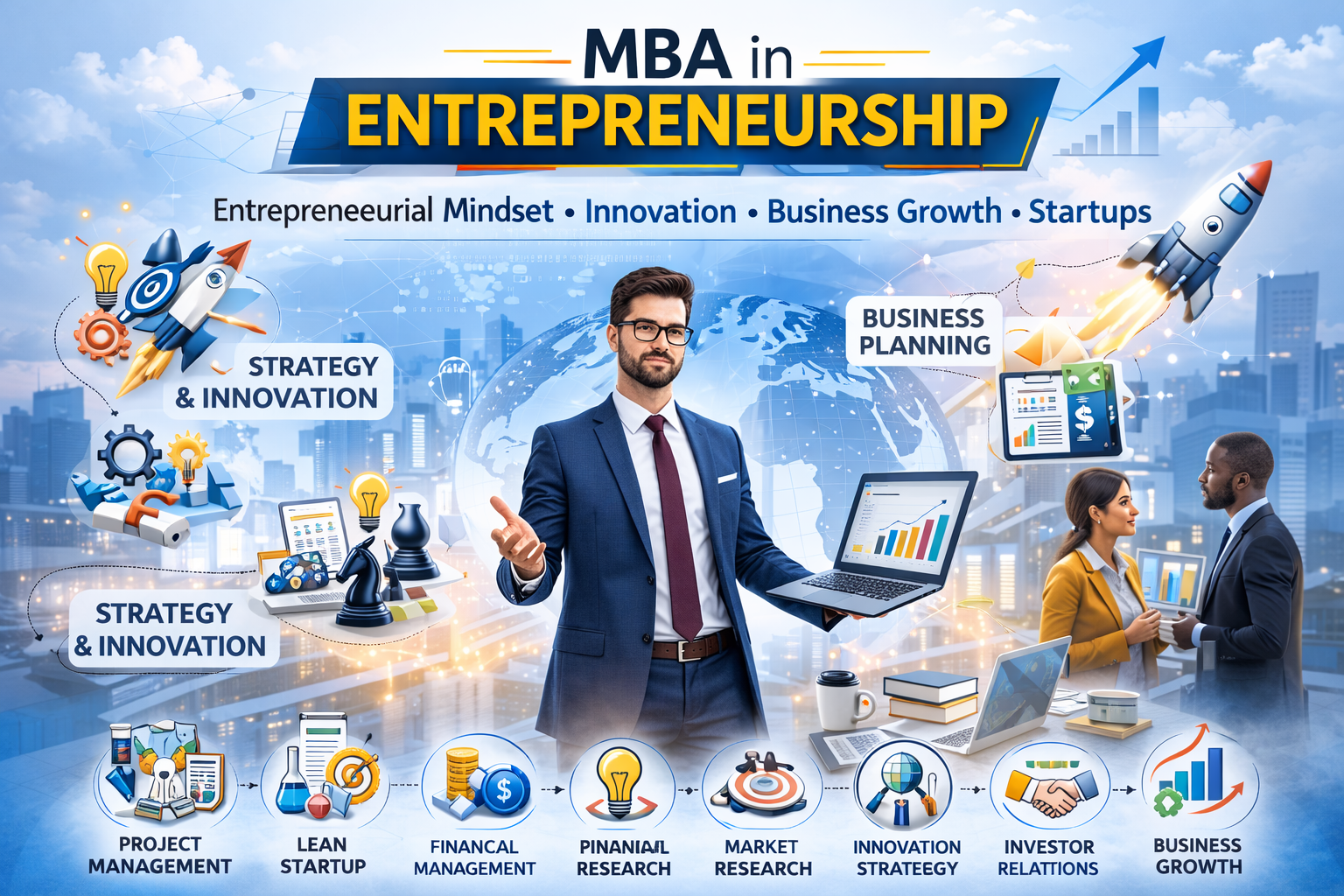
An MBA in Entrepreneurship is a specialized postgraduate program designed to prepare students to launch, manage, and scale their own businesses. It equips students with business strategy, leadership, innovation, and management skills, making them ready for corporate, startup, or consulting roles.
The program is suitable for students who want to start their own ventures, grow family businesses, or work in innovative corporate positions. It combines theory, case studies, internships, and practical business projects.
MBA in Entrepreneurship: Key Highlights
🔔 Admission Alerts 2026
- Application Open: JNU MBA 2026-2028 session applications are now open.
- Eligibility: JNU MBA requires CAT 2025 scores (70% weightage).
- Prospectus: Check JNU’s PG and ADOP e-Prospectus 2026-27 for MBA details.
- Exam Date: ME/MTech exam scheduled for May 23, 2026.
MBA in Entrepreneurship is focused on business creation and innovation. The program covers topics like business planning, strategic management, marketing, operations, finance, and legal frameworks.
Unlike traditional MBAs, this course emphasizes:
-
Developing entrepreneurial mindsets
-
Understanding market trends and opportunities
-
Building practical skills through projects and startup internships
-
Leadership and strategic decision-making
Students also gain access to incubators, mentors, and funding opportunities, making it easier to transition from learning to running real businesses.
| Key Aspect | Details |
|---|---|
| Program Name | Master of Business Administration (MBA) in Entrepreneurship |
| Duration | 1–2 years (Full-Time / Part-Time options) |
| Eligibility | Bachelor’s degree in any discipline; some colleges may require relevant work experience |
| Core Focus Areas | Business planning, Startup management, Innovation strategy, Market research, Investor relations |
| Key Skills Developed | Leadership, Strategic thinking, Financial management, Risk analysis, Problem-solving, Networking |
| Specializations / Electives | Lean Startup, Project Management, Digital Entrepreneurship, Venture Funding, Business Analytics |
| Learning Methodology | Case studies, Group projects, Business simulations, Internship / Live startup projects |
| Career Opportunities | Entrepreneur, Startup Founder, Business Consultant, Business Development Manager, Venture Capital Analyst |
| Top Recruiters | Startups, Consulting firms, Incubators, Venture capital firms, Large corporations with innovation labs |
| Average Salary | ₹6–15 LPA (varies with role, experience, and organization) |
| Entrepreneurial Advantage | Hands-on startup experience, mentorship opportunities, exposure to funding and business networking |
| Global Opportunities | MBA in Entrepreneurship graduates can also explore international startup ecosystems, accelerator programs, and global venture opportunities |
Eligibility Criteria for MBA in Entrepreneurship in India
Pursuing an MBA in Entrepreneurship requires candidates to meet certain academic, professional, and admission-related criteria. This ensures that students have the foundational knowledge and skills necessary for business management and entrepreneurial success. Below is an in-depth look at the eligibility requirements:
1. Educational Qualification
To apply for an MBA in Entrepreneurship, candidates must have:
-
A Bachelor’s degree from a recognized university in any discipline (Arts, Science, Commerce, Engineering, or Management).
-
Minimum aggregate marks typically range from 50% to 60%, though it may vary depending on the institution and category (relaxed for SC/ST/OBC candidates in some universities).
-
Some universities may prefer candidates with a BBA, B.Com, or B.Sc in Business/Finance for better preparedness, but students from any discipline are eligible.
Key Points:
-
No prior specialization in business is mandatory.
-
Graduates from non-commerce or non-business backgrounds are often encouraged, as entrepreneurship demands diverse perspectives.
2. Work Experience (Optional or Preferred)
While not mandatory for all colleges, relevant work experience is often preferred or may be required by certain institutions:
-
Duration: 1–3 years of professional experience in business, management, startups, or corporate settings.
-
Benefits of having experience:
-
Better understanding of business challenges
-
Practical knowledge of management principles
-
Easier grasp of entrepreneurship concepts and case studies
-
-
Some top business schools may provide weightage in admissions for candidates with entrepreneurial or managerial experience.
3. Entrance Exams
Admission to MBA programs, including Entrepreneurship, is usually merit-based or entrance exam-based. Commonly accepted exams include:
| Exam | Conducting Body | Key Focus Areas |
|---|---|---|
| CAT (Common Admission Test) | IIMs & Participating B-Schools | Quantitative Aptitude, Verbal Ability, Logical Reasoning, Data Interpretation |
| MAT (Management Aptitude Test) | AIMA | Language, Quant, Intelligence & Data Analysis, Indian & Global Environment |
| XAT (Xavier Aptitude Test) | XLRI & Participating Institutes | Verbal, Quantitative, Decision Making, General Knowledge |
| CMAT (Common Management Admission Test) | NTA | Language, Quant, Logical Reasoning, General Awareness |
| GMAT (Graduate Management Admission Test) | Graduate Management Admission Council | Analytical Writing, Quantitative, Verbal, Integrated Reasoning |
| Institute-specific Entrance Exams | Various Private/Deemed Universities | Written Test + Group Discussion + Personal Interview |
Note: Some colleges also consider academic performance and work experience alongside entrance exam scores.
4. Age Limit
Most Indian universities do not have a strict age limit for MBA admissions. However:
-
Candidates in their early 20s to mid-30s are the typical demographic.
-
Executive MBA programs (focused on experienced professionals) may have minimum experience requirements instead of age criteria.
5. Other Selection Criteria
Apart from educational qualifications and entrance exam scores, institutes often consider:
-
Group Discussion (GD): To assess communication, teamwork, and leadership skills.
-
Personal Interview (PI): To evaluate motivation, entrepreneurial mindset, and problem-solving ability.
-
Statement of Purpose (SOP) or Resume: Highlighting prior work, entrepreneurial projects, or startup experience.
-
Letters of Recommendation: From academic or professional mentors (for selective institutions).
6. Preferred Skills for Admission
While not mandatory, candidates with the following skills are highly preferred:
-
Basic understanding of business or economics
-
Analytical and logical reasoning abilities
-
Strong communication and presentation skills
-
Problem-solving mindset
-
Creativity and innovation potential
These skills demonstrate readiness to handle entrepreneurship-focused curriculum and startup-related projects.
Admission Process for MBA in Entrepreneurship
Admission to an MBA in Entrepreneurship program is usually multi-step:
Qualifying Entrance Exams:
-
-
CAT for IIMs and top B-schools
-
XAT for XLRI and associated colleges
-
MAT for multiple mid-tier colleges
-
GMAT for international programs or private institutes
-
CUET for central universities
-
Application Process:
-
-
Fill out college application forms online
-
Submit academic records, entrance scores, and personal statements
-
Group Discussion (GD) / Personal Interview (PI):
-
-
Colleges assess communication skills, problem-solving, and leadership potential
-
Final Selection:
-
-
Based on entrance scores, GD/PI performance, academic record, and sometimes work experience
-
Some colleges, like IIMs and ISB, also consider entrepreneurial potential or startup projects during admissions.
Top Colleges for MBA in Entrepreneurship in India
Premier Government / Institute Options
| College | Location | Duration | Key Features |
|---|---|---|---|
| IIM Ahmedabad | Ahmedabad | 2 years | Offers entrepreneurship electives, mentorship, and incubation support |
| IIM Bangalore | Bangalore | 2 years | Startup guidance, innovation labs, global exposure |
| SPJIMR Mumbai | Mumbai | 2 years | Focus on social entrepreneurship, innovation workshops |
| DMS IIT Delhi | Delhi | 2 years | Integrates technology and entrepreneurial projects |
Top Private Colleges
| College | Location | Duration | Key Features |
|---|---|---|---|
| ISB Hyderabad | Hyderabad | 1 year | Short-duration, intensive entrepreneurship focus, industry mentorship |
| NMIMS Mumbai | Mumbai | 2 years | Innovation labs, startup incubation support |
| Symbiosis Pune | Pune | 2 years | Practical business projects, incubation programs |
| Amity University | Noida | 2 years | Hands-on startup projects, business simulation labs |
These colleges often have startup incubators, funding opportunities, and industry mentors to support aspiring entrepreneurs.
MBA in Entrepreneurship Fee Structure
MBA in Entrepreneurship fees vary significantly depending on college type and reputation:
| Type of Institute | Approx. Fees (INR) | Features |
|---|---|---|
| Government / Premier Institutes | ₹10–26 Lakhs | Subsidized, high ROI, startup incubation programs |
| Private Colleges | ₹15–40 Lakhs | Modern infrastructure, mentorship programs, global exposure |
Notes:
-
Scholarships and financial aid are available for meritorious or economically disadvantaged students.
-
Fees generally include tuition, labs, and sometimes startup incubation support.
MBA in Entrepreneurship Subjects and Syllabus
The course is usually 2 years, combining core management subjects with entrepreneurship-specific modules.
First Year: Core Management Subjects
-
Principles of Management
-
Managerial Economics
-
Marketing Management
-
Financial Management
-
Human Resource Management
-
Business Communication
-
Business Research & Analytics
Second Year: Entrepreneurship Focus
-
New Venture Creation & Business Planning
-
Innovation & Creativity
-
Legal Aspects of Business
-
Fundraising & Venture Capital
-
Technology & Operations for Startups
-
Project Work / Startup Internship
This curriculum ensures students are job-ready and startup-ready simultaneously.
Skills Required to Succeed in MBA in Entrepreneurship
Success in entrepreneurship requires both management and entrepreneurial skills:
-
Leadership & Decision-Making – Leading teams and making strategic choices.
-
Financial & Analytical Skills – Planning budgets, analyzing market opportunities, understanding funding.
-
Creativity & Innovation – Developing unique products or business ideas.
-
Communication & Negotiation – Pitching ideas to investors and negotiating contracts.
-
Problem-Solving Skills – Overcoming business challenges and operational issues.
-
Networking Skills – Building connections with mentors, investors, and industry experts.
-
Risk-Taking Ability – Evaluating opportunities and making calculated decisions.
Developing these skills during MBA prepares graduates for real-world business challenges.
Career Opportunities After MBA in Entrepreneurship
Graduates can explore a variety of entrepreneurial and corporate roles:
-
Entrepreneur / Startup Founder – Launching new ventures in tech, FMCG, or services.
-
Business Consultant – Advising startups or small businesses on strategy and operations.
-
Venture Capital Analyst / Investment Manager – Evaluating startups for investment.
-
Corporate Innovation Manager – Leading innovation and strategic projects in established companies.
-
Business Development Manager – Expanding markets, client acquisition, and strategic partnerships.
Industries include technology, FMCG, healthcare, social enterprise, finance, and e-commerce.
Salary Packages for MBA in Entrepreneurship Graduates
Salary depends on role, experience, specialization, and startup success:
| Role | Average Salary (INR) | Top Salary (INR) |
|---|---|---|
| Entrepreneur / Startup Founder | Varies widely | Depends on business success |
| Business Consultant | ₹6–12 LPA | ₹25+ LPA |
| Venture Capital Analyst | ₹7–10 LPA | ₹20+ LPA |
| Corporate Innovation Manager | ₹8–15 LPA | ₹25+ LPA |
| Business Development Manager | ₹5–10 LPA | ₹20+ LPA |
Graduates from top institutes often receive higher starting packages and access to global opportunities.
Higher Studies and Certifications After MBA in Entrepreneurship
Students can pursue further studies or certifications to enhance expertise and global career prospects:
-
PhD in Entrepreneurship / Management – Focused on research, teaching, or consulting.
-
Executive MBA (EMBA) – For working professionals to gain advanced entrepreneurial knowledge.
-
Professional Certifications
-
Financial: CFA, FRM
-
Project Management: PMP, Lean Six Sigma
-
Digital & Marketing: Google Analytics, HubSpot, Digital Marketing Courses
-
-
International MBA / Global Programs – Exposure to global markets and business strategies.
-
Startup Incubation Programs – Short-term programs to support startup launches, mentorship, and funding.
These certifications and programs enhance credibility and increase chances of funding or corporate growth.
FAQs
What is MBA in Entrepreneurship?
It is a postgraduate program focused on innovation, business creation, and management, preparing students to start their ventures or work in entrepreneurial roles.
What are the eligibility criteria for MBA in Entrepreneurship?
Bachelor’s degree with at least 50% marks. Work experience is optional. Entrance exams like CAT, MAT, XAT, GMAT, or CUET may be required.
Which colleges offer MBA in Entrepreneurship?
Top colleges include IIM Ahmedabad, IIM Bangalore, ISB Hyderabad, SPJIMR Mumbai, NMIMS Mumbai, and DMS IIT Delhi.
What is the fee for MBA in Entrepreneurship?
Fees range ₹10–26 Lakhs in government institutes and ₹15–40 Lakhs in private colleges. Scholarships and financial aid are available.
What career options are available after MBA in Entrepreneurship?
Entrepreneurs, Business Consultants, Venture Capital Analysts, Corporate Innovation Managers, and Business Development Managers are common career paths.
Is MBA in Entrepreneurship worth it?
Yes, for students with entrepreneurial aspirations. It provides skills, mentorship, funding opportunities, networking, and leadership training for long-term career growth.
What skills are required for MBA in Entrepreneurship?
Leadership, creativity, financial literacy, decision-making, networking, problem-solving, and risk-taking are essential for entrepreneurial success.
Can I start my own business after MBA in Entrepreneurship?
Yes, the program is designed to prepare students to launch and scale their own startups successfully.
What is the average salary after MBA in Entrepreneurship?
Corporate roles: ₹5–15 LPA, successful startups: variable. Top colleges provide ₹20–25 LPA for consultancy or management positions.
Are there specialization options in MBA in Entrepreneurship?
Yes, specializations include Innovation Management, Social Entrepreneurship, Family Business Management, Business Analytics, and International Business.
Q: What is the typical duration of an MBA in Entrepreneurship program in India?
Most MBA in Entrepreneurship programs in India are full-time, two-year postgraduate degrees. Some executive or part-time options might extend to three years, catering to working professionals. This duration allows for comprehensive curriculum coverage, practical projects, and mentorship.
Q: What are the approximate fees for an MBA in Entrepreneurship in India for 2026?
For 2026, fees can range widely. Government-funded institutions like IIMs might charge ₹15-25 lakhs. Private universities and business schools could range from ₹8-30 lakhs, depending on their ranking and facilities. Always check specific college websites for updated figures.
Q: Which entrance exams are generally required for admission to an MBA in Entrepreneurship in India?
Most Indian B-schools accept national-level exams like CAT, XAT, GMAT, or NMAT. Some institutions might also conduct their own entrance tests. A strong score in these exams, alongside academic performance and interview, is crucial for admission.
Q: What is the career scope after completing an MBA in Entrepreneurship in India?
Graduates can launch their own startups, join existing startups in leadership roles, or work in corporate innovation departments. Roles include business development manager, product manager, venture capitalist, or consultant. The focus is on creating and scaling new ventures.
Q: What is the expected average starting salary for an MBA in Entrepreneurship graduate in India for 2026?
For 2026, a fresh MBA in Entrepreneurship graduate can expect an average starting salary ranging from ₹6-15 lakhs per annum. This can vary significantly based on the institution, individual skills, and the success/funding of the startup or company they join.
Q: Is an MBA in Entrepreneurship from India recognized and valuable for pursuing opportunities abroad?
Yes, an MBA from a reputable Indian institution, especially those accredited by bodies like AICTE/UGC, holds value internationally. The entrepreneurial skills gained are universally applicable. Many graduates pursue global startup ecosystems or further studies abroad, leveraging their Indian MBA foundation.