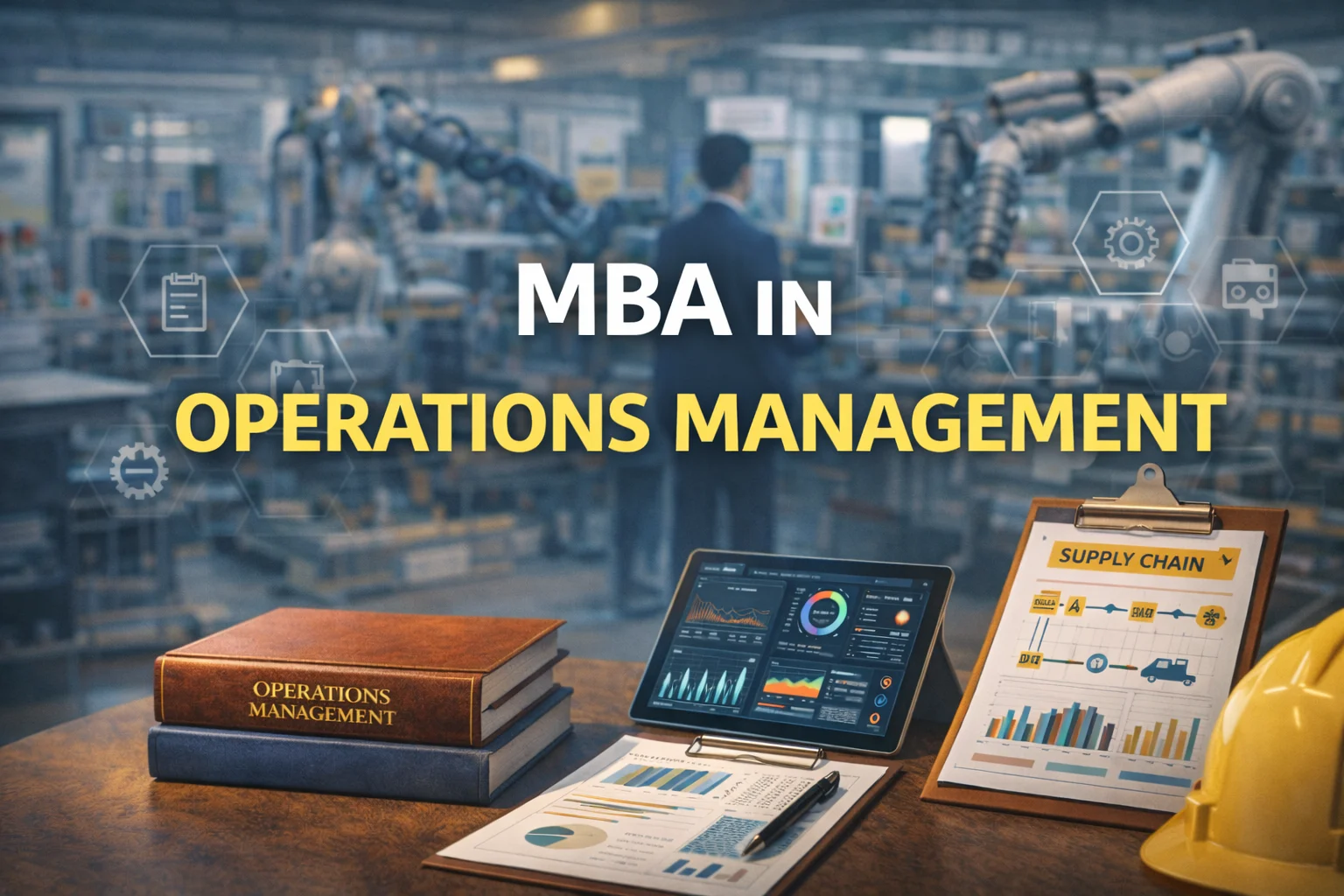
MBA in Operations Management: Course Details, Eligibility, Fees, Syllabus, Jobs & Salary
MBA in Operations Management is a postgraduate management programme that develops the ability to optimise processes, manage resources, reduce prices and ensure smooth execution of organisational strategies. This programme makes focusses on designing, managing, and improving business operations and supply chain systems.
In this competitive and technical business environment, organisations heavily depend on efficiency of operations to sustain profitability and customer satisfaction. Operation plays a central role in converting business strategy into execution, whether its a manufacturing, logistics, e-commerce, healthcare, or even IT services. This has significantly increased the relevance of an MBA in operations management across industries.
Students learn to work with complex operational challenges, manage cross-functional teams and make data-driven decisions which in turn impacts the performance of organisations.
What is MBA in Operations Management?
This two-year postgraduate degree focuses on the planning, execution, control, and optimisation of business operations. MBA in Operations Management programme creates expertise in various areas such as production systems, supply chain coordination, logistics, quality management, and process improvement.
This programme usually centred around the backend of business functions which ensures efficiency and scalability. Graduates are taught how materials, information, technology, and human resources flow across organisations and how these flows can be optimised for better performance. And MBA in Operations Management programme is perfect for students who are analytical, process-oriented, and interested in managing large-scale systems rather than purely customer-facing roles.
Why MBA in Operations Management is Relevant Today?
Current organisations work in various complex environments which are marked by global supply chains, digital transformation, changing demand, and cost pressures. These challenges are balanced by the operations management professionals while maintaining quality as well as efficiency.
Key reasons why this programme has gained importance include:
-
Rise of global and digital supply chains
-
Growth of e-commerce and logistics networks
-
Increased focus on cost optimisation and efficiency
-
Integration of analytics and automation in operations
-
Demand for professionals who can manage scale and complexity
An MBA in operations management prepares professionals to lead operational excellence initiatives and contribute directly to business outcomes.
MBA in Operations Management: Course Highlights
| Parameter | Details |
|---|---|
| Course Level | Postgraduate |
| Duration | 2 Years |
| Eligibility | Bachelor’s degree with minimum 50% |
| Admission Process | Entrance exam + selection rounds |
| Average Fees | ₹2 – ₹12 lakh |
| Learning Focus | Operations, supply chain, analytics |
| Career Roles | Operations, supply chain, project management |
| Average Salary | ₹6 – ₹18 LPA |
People Also Read


Eligibility Criteria for MBA Operations Management
Admission Process
Admission to MBA in Operations Management usually follows a structured selection process:
-
Entrance Examination
Candidates appear for national or institute-level MBA entrance exams. -
Shortlisting
Based on entrance scores, academics, and work experience. -
Group Discussion / Written Ability Test
Evaluates communication, analytical thinking, and teamwork. -
Personal Interview
Assesses motivation, domain understanding, and career goals.
Some universities also offer online or distance MBA programmes with merit-based admissions.
MBA in Operations Management Fees
The fees for this programme varies entirely depending on different institutions, programme mode and facilities that are offered in the campus.
| Institute Type | Approximate Fees |
|---|---|
| Government Universities | ₹1.5 – ₹4 lakh |
| Private B-Schools | ₹5 – ₹12 lakh |
| Online / Distance MBA | ₹1 – ₹3 lakh |
Top MBA in Operations Management Colleges in India
India has several reputed business schools where aspirants can pursue an MBA with a specialisation in Operations Management, Operations & Supply Chain, or related branches. These colleges provide strong academic programmes, industry exposure, internships, and excellent placement opportunities in operations, logistics, analytics, and supply chain roles.
Indian Institute of Management (IIM) Bangalore
IIM Bangalore offers an MBA programme with a specialisation in Operations & Supply Chain Management. The institute is known for its rigorous curriculum, case-based pedagogy, and strong placement records for operations roles.
Indian Institute of Management (IIM) Calcutta
IIM Calcutta provides MBA/PGP programmes where students can specialise in Operations and Supply Chain Management. It is acclaimed for its analytics, strategic operations, and industry collaborations.
Indian Institute of Management (IIM) Mumbai (formerly NITIE)
IIM Mumbai, known for its deep expertise in industrial engineering and operations, offers a dedicated MBA (Operations & Supply Chain Management) programme with strong experiential learning and industry integration.
S.P. Jain Institute of Management and Research (SPJIMR), Mumbai
SPJIMR’s MBA programme allows specialisation in Operations Management and is respected for its industry exposure and holistic learning environment.
Shailesh J. Mehta School of Management (SJMSOM), IIT Bombay
Part of IIT Bombay, SJMSOM offers an MBA with a strong emphasis on Operations & Supply Chain specialisation. The institute combines technical and managerial perspectives.
Symbiosis Institute of Operations Management (SIOM), Nashik
SIOM is one of the few Indian institutes dedicated primarily to Operations Management, with an MBA focussed on operations, supply chain, and process excellence.
International Management Institute (IMI), New Delhi
IMI offers a PGDM with specialisation in Operations Management, preparing students for roles in supply chain, logistics, and process management.
Institute of Management Technology (IMT), Ghaziabad
IMT Ghaziabad provides a PGDM with an Operations Management specialisation, blending practical learning with industry engagement.
K J Somaiya Institute of Management, Mumbai
K J Somaiya offers an MBA with an Operations focus, equipping students with analytical, planning, and process control expertise.
Faculty of Management Studies (FMS), Delhi University
FMS offers an MBA with operations and supply chain electives, backed by strong faculty and excellent placement outcomes.
XLRI – Xavier School of Management, Jamshedpur
XLRI offers a PGDM with the option to specialise in Operations Management, known for its leadership development and rigorous curriculum.
What You Will Study in This Programme?
Studying MBA in Operations Management develops a strong managerial insight along with deep operational expertise. The curriculum combines core business administration concepts with operations-focused specialisations, through which students can manage complex processes across manufacturing and service industries.
Core Management Subjects
These subjects build a solid foundation in general management and business decision-making:
-
Principles of Management
-
Financial Management
-
Marketing Management
-
Human Resource Management
-
Managerial Economics
-
Strategic Management
-
Business Research Methods
-
Business Communication
Operations & Supply Chain Subjects
These modules focus on optimising processes, systems, and resources across organisations:
-
Operations and Process Management
-
Supply Chain Management
-
Logistics and Distribution Management
-
Quality Management and Six Sigma
-
Project Management
-
Production Planning and Control
-
Operations Strategy
-
Risk and Inventory Management
Analytics, Tools & Decision Sciences
To support data-driven operational decisions, students are exposed to:
-
Business Analytics and Decision Science
-
Operations Research Techniques
-
ERP Systems (SAP/Oracle – fundamentals)
-
Advanced MS Excel and Data Visualisation Tools
-
Supply Chain Modelling Software
Practical Exposure & Industry Integration
Most institutes integrate hands-on learning components such as:
-
Summer internships
-
Live industry projects
-
Process improvement assignments
-
Business simulations and case studies
-
Industry visits and expert-led workshops
This structured approach ensures that students graduate with practical problem-solving ability, operational leadership skills, and industry-ready expertise.
Career Scope After MBA in Operations Management
MBA in Operations Management opens a wide range of career options for the students pursuing this programme. As every organisation relies on efficient processes, supply chains, and resource optimisation, the students usually have a broad working exposure through this course. Graduates can work in both manufacturing and service-driven sectors across domestic and global markets.
Operations professionals play a critical role in improving productivity, reducing costs, managing risks, and aligning execution with business strategy. With increasing adoption of automation, analytics, and digital supply chains, the demand for skilled operations managers continues to grow.
Key Employment Sectors
MBA in Operations Management graduates find opportunities across multiple industries, including:
-
Manufacturing & Production
-
Supply Chain & Logistics
-
E-commerce & Retail
-
Consulting Firms
-
IT & Technology Services
-
Healthcare & Pharmaceuticals
-
Infrastructure & Construction
-
FMCG & Consumer Goods
-
Energy & Utilities
Operations roles are essential in both large enterprises and fast-growing startups.
Job Roles After MBA in Operations Management
Depending on experience, domain knowledge, and specialisation, graduates can explore roles such as:
-
Operations Manager
-
Supply Chain Manager
-
Logistics Manager
-
Project Manager
-
Process Improvement Analyst
-
Operations Consultant
-
Production Planning Manager
-
Inventory & Procurement Manager
With experience, professionals can advance to senior positions such as Head of Operations, Supply Chain Director, COO, or Strategy Lead.
MBA in Operations Management Salary
The salary after an MBA in Operations Management varies based on role, industry, organisation size, and experience level.
| Experience Level | Average Salary |
|---|---|
| Entry-Level | ₹5 – ₹8 LPA |
| Mid-Level (5–8 Years) | ₹10 – ₹15 LPA |
| Senior-Level | ₹18 – ₹30+ LPA |
Professionals with expertise in analytics, ERP systems, global supply chains, or consulting roles often command higher compensation packages.
International Career Opportunities
Operations management skills are globally transferable, opening doors to international roles in:
-
Middle East (UAE, Saudi Arabia, Qatar)
-
Europe
-
North America
-
Southeast Asia
-
Global consulting and logistics firms
International roles often offer higher salaries, cross-border exposure, and opportunities to work on large-scale supply chain and transformation projects.
Skills Required for MBA in Operations Management
To succeed in operations roles, professionals must develop a blend of analytical, technical, and managerial skills:
-
Analytical and problem-solving ability
-
Process optimisation and decision-making
-
Leadership and team coordination
-
Data-driven thinking
-
Risk assessment and planning
-
Communication and stakeholder management
MBA programmes focus heavily on building these competencies through case studies, simulations, and live projects.
Advantages of MBA in Operations Management
-
High demand across industries
-
Strong job stability and long-term relevance
-
Direct impact on organisational performance
-
Leadership and strategic growth opportunities
-
Integration with analytics and digital technologies
-
Globally applicable skill set
Who Should Pursue MBA in Operations Management?
This programme is ideal for:
-
Graduates interested in operations, logistics, or supply chains
-
Engineers and science graduates seeking managerial roles
-
Professionals aiming for backend leadership positions
-
Individuals who enjoy optimisation, analytics, and strategy execution
-
Aspirants looking for stable and scalable career growth
What’s the Future Scope with MBA in Operations Management?
The future of an MBA in Operations Management is positive due to the growing trend of efficiency, sustainability, automation, and data-driven decision-making. Emerging fields such as digital supply chains, “Industry 4.0“, AI-driven operations, and green logistics are expanding the scope of careers in this field. By viewing operations as a strategic business function rather than a support service, organizations are transforming the role of operations leaders to a central position for creating long-lasting business success.
FAQs
Q1. What is MBA in operations management?
It focuses on planning, managing, and optimising business operations, supply chains, logistics, and organisational processes.
Q2. What is the scope of MBA in operations management?
Graduates find opportunities across manufacturing, logistics, e-commerce, IT, healthcare, consulting, and infrastructure sectors.
Q3. What are jobs for MBA operations management graduates?
Common roles include operations manager, supply chain manager, production planner, logistics head, and operations consultant.
Q4. What is the salary of MBA in operations?
MBA in operations management salary typically ranges from ₹6–18 LPA, based on role, industry, and experience.
Q5. What is the syllabus for MBA in operations management?
The syllabus covers operations strategy, supply chain management, analytics, quality control, and process optimisation.
Q6. Is this programme good for engineers?
Yes, engineers adapt well due to strong quantitative, analytical, and process-oriented coursework.
Q7. Is work experience necessary for MBA in Operations Management?
Work experience is not mandatory, but it can improve learning outcomes and placement prospects.
Q8. Which industries hire MBA in operations management graduates?
Manufacturing, FMCG, logistics, retail, pharmaceuticals, IT services, and consulting firms actively recruit graduates.
Q9. Are there good jobs for for this role in India?
Yes, demand is strong in supply chain, production, logistics, and operations strategy roles.
Q10. What skills are developed during this programme?
Students gain skills in process optimisation, data-driven decision-making, project management, and operational leadership.