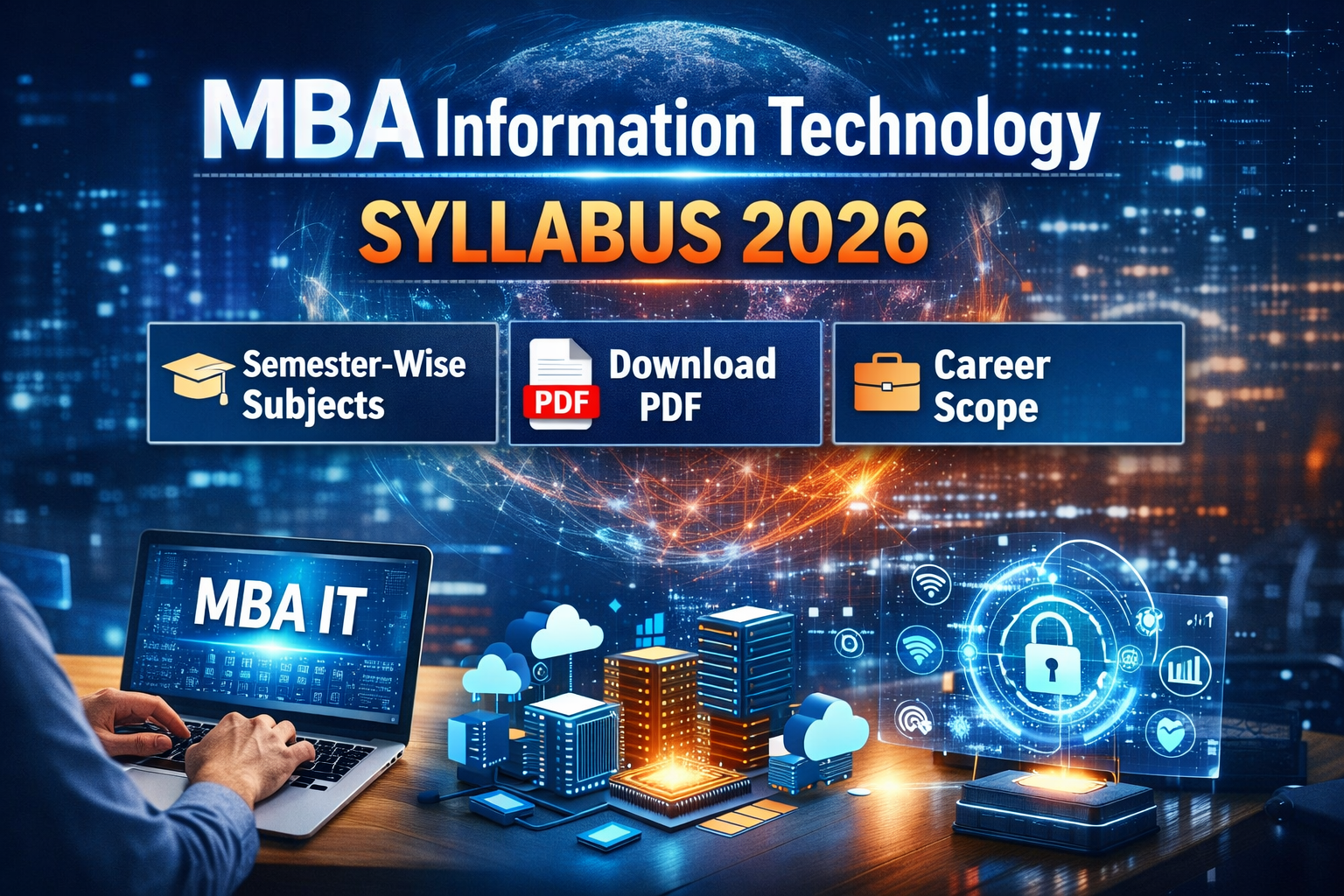
MBA Information Technology Syllabus 2026: Semester-Wise Subjects, PDF & Career Scope
MBA in Information Technology (MBA IT) is a professional management course that aims to provide professionals with a solid foundation in business management and a sophisticated understanding of information technology systems.
In the current digitalized economy, companies are already dependent on technology to improve organizational workflow, data management, customer experience, and competitive edge. This increased dependency has greatly enhanced the call for professionals who are able to bridge the gap between the technical teams and management in an effective way.
MBA IT is important in the digital transformation because the course equips students with the skills to handle IT resources, run technology-based projects, and to coordinate IT strategies and business objectives. The program combines both managerial decision-making experience with data analytics, ERP, cloud computing, cybersecurity, and IT governance topics, which produce extremely useful graduates in industries.
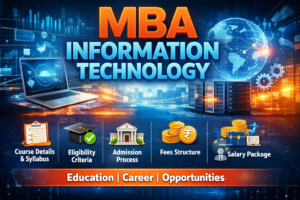
MBA Information Technology Course Highlights
| Particulars | Details |
| Course Level | Postgraduate |
| Duration | 2 Years (4 Semesters) |
| Eligibility | Bachelor’s degree (any discipline) with a minimum 50% |
| Admission Process | Entrance Exam + GD/PI |
| Average Fees | ₹2 – ₹10 Lakh |
| Career Opportunities | IT Manager, Business Analyst, Product Manager |
| Average Salary | ₹6 – ₹15 LPA |
MBA Information Technology Syllabus Overview
| Aspect | Details |
| Program Structure | The MBA in Information Technology is divided into 4 semesters over 2 years, combining core management subjects, IT specialization courses, electives, and practical exposure. |
| Semester Division | Semester 1 & 2: Core management fundamentals and IT basics. Semester 3: Advanced IT management subjects, electives, and industry exposure
Semester 4: Strategic IT, emerging technologies, and capstone project |
| Credit System | Most universities follow a credit-based system (typically 90–120 credits total). Each subject carries 3–4 credits, while projects and internships carry a higher weightage. |
| Core Management Subjects | Principles of Management, Organizational Behaviour, Managerial Economics, Financial Management, Marketing Management, Human Resource Management, Operations Management |
| Core IT Subjects | Introduction to IT, Database Management Systems, Management Information Systems (MIS), Software Engineering, ERP, IT Project Management, Data Communication & Networking |
| Elective Subjects | Cyber Security Management, Business Intelligence, Digital Marketing, Blockchain Technology, IoT, Machine Learning for Business, Cloud Computing, FinTech Systems |
| Practical Components | Communication Lab, Excel & Data Analysis Lab, DBMS Lab, ERP Lab, Simulation Exercises, Case Study Analysis |
| Industry Exposure | Summer Internship (8–10 weeks), Live Industry Projects, Corporate Interaction Programs, Guest Lectures by IT Professionals |
| Teaching Methodology | Case study-based learning, hands-on labs, group projects, simulations, seminars, workshops, and blended learning modules |
| Evaluation Pattern | Continuous Internal Assessment (quizzes, presentations, assignments, mid-term exams) + End-of-Semester Examinations + Project Evaluation |
| Capstone Project | A major industry-oriented project in the final semester focusing on real-world IT and business problems, followed by viva voce |
| Skill Development Focus | IT strategy formulation, business analytics, project management, digital transformation leadership, data-driven decision-making |
| Software & Tools Covered | MS Excel, SQL, ERP tools (SAP/Oracle), project management tools, cloud platforms, analytics dashboards |
| Outcome of the Syllabus | Prepares graduates for managerial roles in IT, consulting, analytics, product management, and digital transformation initiatives |
MBA Information Technology Syllabus PDF Download
MBA Information Technology Syllabus PDF Download
People Also Read


MBA Information Technology Semester-Wise Syllabus
The MBA Information Technology semester-wise syllabus is structured across four semesters, progressively blending core management concepts with advanced IT and industry-focused learning.
MBA IT Syllabus – Semester 1
| Category | Subjects | Key Topics Covered |
| Core Management | Management Principles & Organizational Behaviour | Management theories, leadership styles, motivation, team dynamics, organizational culture |
| Core Management | Managerial Economics | Demand analysis, production theory, cost concepts, pricing strategies, macroeconomic environment |
| Core Management | Financial Accounting for Managers | Financial statements, ratio analysis, cost accounting, budgeting, financial decision-making |
| Core Management | Business Communication | Professional writing, presentations, business correspondence, interpersonal communication |
| Quantitative | Quantitative Techniques | Probability, statistics, linear programming, decision-making models |
| IT Foundation | Introduction to Information Technology | Computer systems, IT infrastructure, software applications, business IT alignment |
| Practical | Communication Lab | Public speaking, group discussions, presentation skills |
| Practical | Excel & Data Analysis Basics | Spreadsheets, formulas, data visualization, business reporting |
MBA IT Syllabus – Semester 2
| Category | Subjects | Key Topics Covered |
| Core Management | Marketing Management | Consumer behavior, branding, pricing strategies, digital marketing fundamentals |
| Core Management | Financial Management | Capital budgeting, working capital management, risk and return analysis |
| Core Management | Human Resource Management | Recruitment, training, performance appraisal, HR analytics |
| IT Core | Database Management Systems (DBMS) | Data models, SQL, normalization, database design, data security |
| Research | Business Research Methods | Research design, sampling, data collection, hypothesis testing |
| Operations | Operations Management | Supply chain management, quality control, process optimization |
| Practical | DBMS Lab | SQL queries, database creation, data manipulation |
| Project | Research Project Proposal | Topic selection, literature review, research methodology |
MBA Information Technology Syllabus – Semester 3
| Category | Subjects | Key Topics Covered |
| IT Core | Management Information Systems (MIS) | Decision support systems, information flow, system design |
| IT Core | Software Engineering | SDLC models, agile methodology, testing, quality assurance |
| IT Core | Enterprise Resource Planning (ERP) | ERP architecture, SAP/Oracle modules, business process integration |
| IT Management | IT Project Management | Project lifecycle, scheduling, risk management, agile & scrum |
| Networking | Data Communication & Networking | Network models, protocols, LAN/WAN, network security basics |
| Elective | E-Commerce Management / Business Intelligence / Digital Marketing | Online business models, data analytics, digital platforms |
| Industry Exposure | Summer Internship | Corporate training, real-world IT problem solving |
| Industry Exposure | Live Industry Project | Client-based projects, technology implementation |
MBA IT Syllabus – Semester 4
| Category | Subjects | Key Topics Covered |
| Strategy | Strategic Management | Business strategy formulation, competitive analysis, corporate governance |
| IT Governance | IT Governance & Cyber Laws | IT compliance, cyber security laws, data protection, ethics |
| Emerging Tech | Cloud Computing & Virtualization | Cloud service models, virtualization technologies, cloud deployment |
| Analytics | Big Data Analytics | Hadoop ecosystem, data processing, analytics for decision-making |
| AI & Automation | Artificial Intelligence for Managers | AI applications, machine learning basics, intelligent systems |
| Capstone | Major Project | End-to-end industry-based IT solution development |
| Evaluation | Viva | Project defense and full assessment |
MBA Information Technology Core Subjects Explained
| Category | Core Subject | Focus Area / Key Learning Outcomes |
| Management Fundamentals | Management Principles & Organizational Behaviour | Leadership styles, motivation, organizational structure, team dynamics |
| Management Fundamentals | Managerial Economics | Economic analysis, demand forecasting, cost management, pricing decisions |
| Finance | Financial Accounting for Managers | Financial statements, budgeting, cost control, managerial decision-making |
| Finance | Financial Management | Capital budgeting, investment decisions, financial planning, risk analysis |
| Marketing | Marketing Management | Consumer behavior, branding, marketing strategy, digital marketing basics |
| Human Resources | Human Resource Management | Talent acquisition, performance management, HR analytics |
| Quantitative Analysis | Quantitative Techniques | Statistical tools, optimization models, data-driven decision-making |
| Communication | Business Communication | Professional writing, presentations, interpersonal and corporate communication |
| IT Foundations | Introduction to Information Technology | IT infrastructure, software systems, business–technology alignment |
| IT Core | Database Management Systems (DBMS) | Data modeling, SQL, database design, data security |
| IT Core | Management Information Systems (MIS) | Information flow, decision support systems, system design |
| IT Core | Software Engineering | SDLC models, agile methodology, testing and quality assurance |
| Enterprise Systems | Enterprise Resource Planning (ERP) | Integrated business processes, SAP/Oracle systems |
| IT Management | IT Project Management | Project planning, scheduling, risk management, agile frameworks |
| Operations | Operations Management | Supply chain, process optimization, quality management |
| Research | Business Research Methods | Research design, data analysis, business problem-solving |
MBA Information Technology Practical & Project Work
Practical training and project work constitute an important part of MBA Information Technology program, as they ensure that students have an exposure to the real-life business and technological problems. Where theoretical study contributes to the creation of conceptual understanding, practical study assists the student learners to implement IT tools and management principles in the real organizational setting.
Practical Components in MBA IT
MBA IT programs have several laboratory and skill based modules that enhance technical and analytical skills. Typical practical units are Communication Labs, Excel and Business Analytics Labs, Database Management System (DBMS) Labs and ERP or Simulation Labs. The training provided in these labs is data manipulation, data reporting, system modeling and the use of software at the enterprise level, which are critical in managerial IT positions.
Industry Internship and Live Projects
A summer internship of 8-10 weeks is required of most of the universities in the second semester. The students are placed in IT companies, consulting firms, banks or startups during this period to learn the IT processes within organizations. Also, live industry project opportunities enable students to address actual business challenges based on digital transformation, automation, analytics or system implementation.
Case Studies and Business Simulations
The analysis of case studies and simulation exercises are very popular in exposing students to technological-driven decision-making situations. Such activities enhance leadership, problem-solving, and strategic thinking through simulating real corporate settings.
Final Capstone Project
During the last semester, learners complete a major project, which incorporates concepts of management and solutions of IT. Report, presentations and viva voice are used to evaluate the project and demonstrate the industrial preparedness of the student.
MBA Information Technology Syllabus: Important Books
The suggested books can assist the students to grasp the fundamental management principles, IT systems, analytics, and new technologies discussed in the MBA IT syllabus.
| Subject Area | Book Title | Author(s) |
| Management Principles | Management: Text and Cases | K. Aswathappa |
| Organizational Behaviour | Organizational Behavior | Stephen P. Robbins |
| Managerial Economics | Managerial Economics | D.N. Dwivedi |
| Financial Accounting | Financial Accounting for Management | R. Narayanaswamy |
| Financial Management | Financial Management | I.M. Pandey |
| Marketing Management | Marketing Management | Philip Kotler & Kevin Lane Keller |
| Business Communication | Business Communication Today | Bovee & Thill |
| Quantitative Techniques | Quantitative Techniques for Management | Vohra |
| Database Management Systems | Database System Concepts | Silberschatz, Korth & Sudarshan |
| Management Information Systems | Management Information Systems | Kenneth C. Laudon & Jane P. Laudon |
| Software Engineering | Software Engineering | Ian Sommerville |
| Enterprise Resource Planning (ERP) | Enterprise Resource Planning | Alexis Leon |
| IT Project Management | Information Technology Project Management | Kathy Schwalbe |
| Data Communication & Networking | Data Communications and Networking | Behrouz A. Forouzan |
| Strategic Management | Strategic Management | Fred R. David |
| Big Data Analytics | Big Data Analytics | Seema Acharya & Subhasini Chellappan |
| Artificial Intelligence | Artificial Intelligence: A Modern Approach | Stuart Russell & Peter Norvig |
| Cyber Laws & IT Governance | Cyber Laws of India | Farooq Ahmad |
How To Cover MBA Information Technology Syllabus?
It is a good idea to strike a balance between concept clarity, practical exposure and constant revision to cover the MBA Information Technology syllabus.
- Start with a complete analysis of the semester-wise syllabus to learn about the main subjects, choices and practice aspects.
- First concentrate on basics of management, which include Organizational Behaviour, Economics, Finance, and Marketing to establish a strong foundation.
- Allocate individual study time on technical courses such as DBMS, MIS, ERP and IT Project Management.
- Use books which are recommended by the university and standard textbooks as opposed to using the notes which are summarized.
- The hands-on learning will be conducted with the help of such tools as Excel, SQL, ERP software, and analytics platforms.
- Relate theory and practice in businesses like digital transformation and automation.
- Make brief notes, diagrams, and flow charts to revise difficult IT contents easily.
- Complete question papers and case studies that were done in past years to know expectations of exams.
- Choose electives that are aligned with career objectives, including analytics, cybersecurity, or cloud technologies.
- Join prolific internship, live project, presentations, and seminars.
- Check and revise, get ready to viva voice and project reviews.
- Add industry-based certifications in addition to the MBA IT coursework.
FAQs
What is included in the MBA Information Technology syllabus?
MBA IT syllabus includes fundamental management courses, IT basics, modern technologies, elective courses, hands on laboratories, internships and final term project.
Is MBA Information Technology syllabus suitable for non-IT students?
Yes, the course begins with general knowledge of IT, and therefore, it can be taken by non-IT graduates, and later, the course discusses in-depth IT and management concepts.
Does MBA IT syllabus include programming or coding?
Core subjects include MIS, DBMS, ERP, IT Project Management, Software Engineering, Strategic Management, and IT Governance with management fundamentals.
What are the core subjects in MBA Information Technology?
The main courses are MIS, DBMS, ERP, IT Project Management, Software Engineering, Strategic Management and IT Governance in addition to management fundamentals.
How is the MBA IT syllabus structured semester-wise?
The syllabus will consist of four semesters which will include four semesters of management basics, IT core subjects, Electives, internship and a final semester major project.
Are internships mandatory in MBA Information Technology?
Yes, much to your question, a compulsory summer internship is there in most universities to give exposure to industry and put theory of IT and management to practice.
What electives are available in the MBA IT syllabus?
Cyber Security, Cloud computing, Business intelligence, Digital Marketing, Blockchain, IoT, and Machine Learning to the business applications are electives of MBA IT syllabus.
Which skills are gained after completing the MBA IT syllabus?
Students will have a skill in IT strategy, business analytics, project management, digital leadership, technology risk management, and enterprise system handling.
How often is the MBA Information Technology syllabus updated?
The syllabus in most universities is usually revised after a period of two to three years to incorporate some emerging technologies as well as meet the current industry demands.
Which certifications complement the MBA IT syllabus?
PMP, ITIL, AWS, SAP, Google Data Analytics, and cloud security and others are major certifications that improve career opportunities following MBA IT.