MS Ophthalmology: Eligibility, Colleges, Fees & Career in India
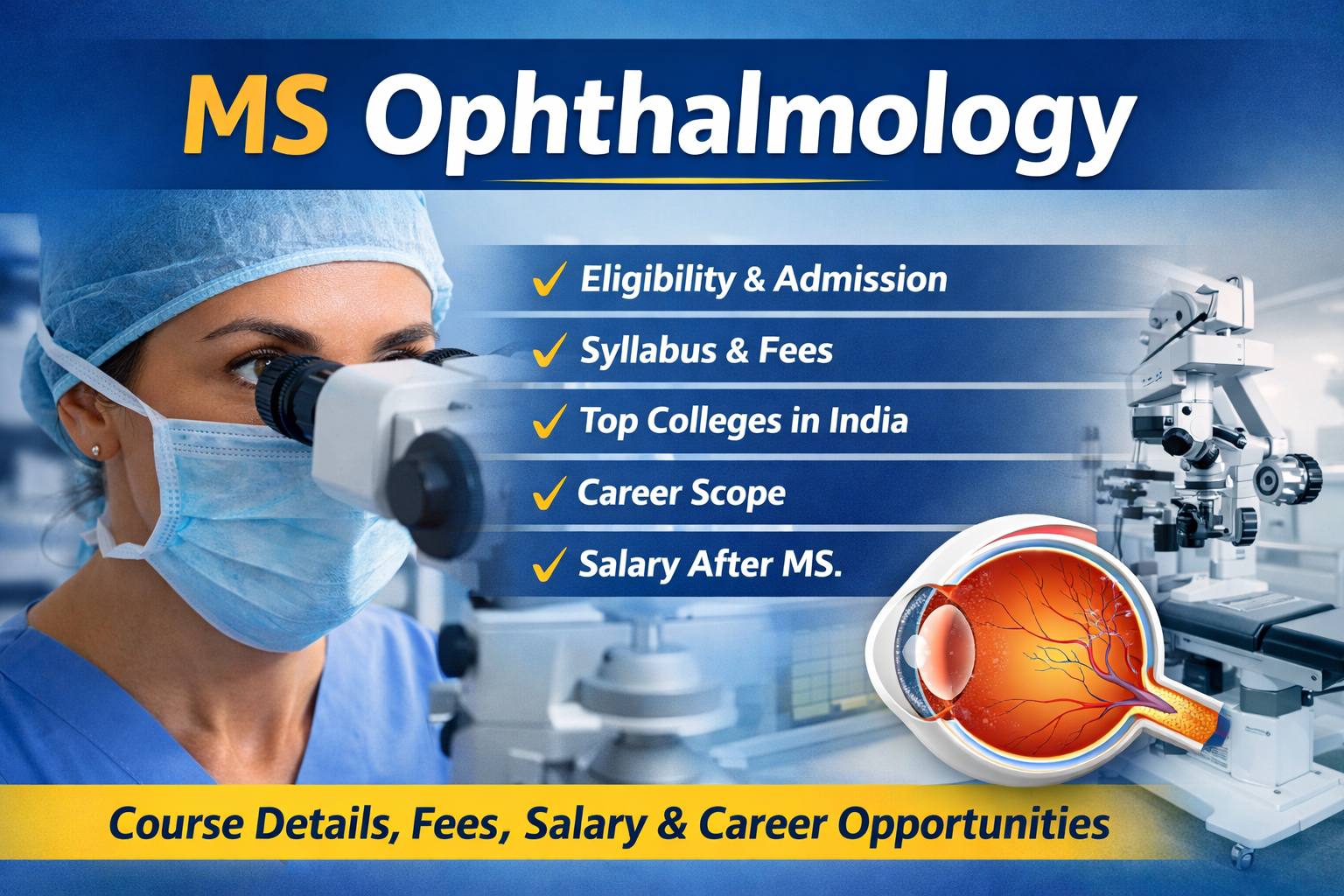
MS Ophthalmology, a highly sought-after postgraduate medical specialization, offers 936 seats across 128 government medical colleges in India for the 2026 academic session. This three-year Master of Surgery program focuses on the diagnosis, treatment, and prevention of eye diseases, attracting MBBS graduates aiming for a career in eye care. The MS Ophthalmology course curriculum focuses on advanced surgical techniques and disease management, preparing specialists for a critical healthcare field.
For aspiring ophthalmologists, understanding the core facts about this specialization is for 2026 admissions. The table below outlines key details, eligibility criteria, and the admission process for MS Ophthalmology programs in India.
| Parameter | Details |
|---|---|
| Course Name | MS Ophthalmology (Master of Surgery in Ophthalmology) |
| Course Duration | 3 Years (Full-Time) |
| Admission Mode | Entrance-based |
| Primary Entrance Exam | NEET PG (National Eligibility cum Entrance Test for Postgraduate) |
| Alternative Entrance Exam (AIIMS/JIPMER) | INI CET (for AIIMS, JIPMER, PGIMER, NIMHANS) |
| NEET PG Regulatory Body | National Board of Examinations (NBE) |
| Minimum Eligibility | MBBS Degree from a recognized medical college/university |
| Mandatory Internship | One-year rotating internship after MBBS (completed by March 31st, 2026) |
| Medical Council Registration | Permanent registration with the Medical Council of India (MCI) or any State Medical Council |
| Minimum Qualifying Percentile | NEET PG qualifying percentile as per National Medical Commission (NMC) norms |
| Selection Process | NEET PG/INI CET qualification followed by centralized counselling |
| Counselling Body (All India Quota) | Medical Counselling Committee (MCC) for 50% All India Quota (AIQ) seats |
| Counselling Body (State Quota) | Respective State Authorities for 50% State Quota seats |
| AIQ Counselling Rounds | Round 1, Round 2, Mop-up Round, Stray Vacancy Round |
| State Quota Counselling Rounds | Round 1, Round 2, Mop-up Round, Stray Vacancy Round |
| Colleges under AIQ | Private unaided, aided minority, non-minority, and Deemed Medical colleges |
| Colleges under State Quota | State government institutions and private institutes |
| Centralized Admission Exception | Some medical institutions conduct their own admissions, not covered by NEET PG centralized counselling |
| INI CET 2026 Exam Date (July Session) | May 17, 2026 |
| INI CET 2026 Results Date (July Session) | May 23, 2026 |
| Regulatory Body for PG Medical Education | National Medical Commission (NMC) with prior approval of MoHFW |
The admission for MS Ophthalmology in 2026 remains highly competitive, with NEET PG serving as the primary gateway to most government and private institutions. Candidates must meet stringent eligibility criteria, including a mandatory one-year rotating internship, to qualify for the national and state-level counselling processes.
MS Ophthalmology: Types, Categories & Key Components Explained
🔔 Admission Alerts 2026
- Application Deadline: MSRUAS Bangalore applications close today, March 26, 2026.
- Exam Date: ISI Admission 2026 exam is scheduled for May 10, 2026.
- Application Closed: ISI Admission 2026 application deadline was March 13, 2026.
- Application Open: Galgotias University MSc Optometry Distance Education admissions open.
For the 2026-27 academic session, aspiring MS Ophthalmology course candidates must hold an MBBS degree and clear the NEET PG entrance exam. Admission to MS Ophthalmology programs across India is primarily entrance-based, with over 936 seats available in 128 government medical colleges for MD/MS Ophthalmology (based on 2026 data).
| Component/Category | Details for MS Ophthalmology (2026) | Key Feature/Requirement |
|---|---|---|
| Core Eligibility Criteria | MBBS Degree from a recognized medical college/institution/university; permanent registration with a State Medical Council. | Mandatory MBBS degree and valid medical council registration. |
| Mandatory Internship | Completion of a one-year rotating internship after MBBS. | Internship must be completed by March 31st of the admission year (e.g., March 31, 2026, for the 2026-27 session). |
| Primary Entrance Examination | National Eligibility Cum Entrance Test (NEET PG). | Qualifying NEET PG with a minimum percentile is for most admissions. |
| Alternative Entrance Exam (AIIMS/INIs) | Institute of National Importance Combined Entrance Test (INI CET) for AIIMS Delhi and other INIs. | Separate exam for admission to M.D. Ophthalmology programs at AIIMS and other INIs. |
| NEET PG Conducting Authority | National Board of Examinations (NBE). | NBE is responsible for conducting NEET PG and releasing results. |
| INI CET 2026 (July Session) Schedule | Exam Date: May 17, 2026; Results Date: May 23, 2026. | dates for candidates targeting AIIMS and other INIs for the July 2026 session. |
| General Admission Mode | Primarily entrance-based, followed by centralized counselling. | Merit in the entrance exam (NEET PG or INI CET) is the sole basis for selection. |
| All India Quota (AIQ) Counselling | Accounts for 50% of seats in government medical colleges; counselling conducted by the Medical Counselling Committee (MCC). | Includes seats in private unaided, aided minority, non-minority, and Deemed Medical colleges. |
| State Quota Counselling | Covers the remaining seats in state government institutions and private institutes; counselling managed by respective state authorities. | Specific eligibility and domicile rules apply for state quota seats. |
| AIQ Counselling Rounds | Typically includes AIQ Round 1, AIQ Round 2, AIQ Mop-up Round, and AIQ Stray Vacancy Round. | Multiple rounds allow for seat allocation based on evolving preferences and availability. |
| State Quota Counselling Rounds | Generally comprises State Quota Round 1, State Quota Round 2, State Quota Mop-up Round, and State Quota Stray Vacancy Round. | Follows a similar multi-round structure as AIQ, managed by state bodies. |
| Governing Regulations | Admissions are governed by the Post Graduate Medical Education Regulations, as amended by the National Medical Commission (NMC). | Ensures standardized eligibility and admission processes across institutions (Source: NMC). |
| Deemed University Admissions | Seats in Deemed-to-be-Universities are also filled through MCC NEET PG counselling. | Candidates must register on the MCC portal for eCounselling for these institutions. |
| Non-Centralized Institutions | Some medical institutions are not covered under centralized admissions for MS/MD seats through NEET-PG. | Candidates must check individual college websites for their specific admission processes. |
Understanding these admission components and eligibility criteria is for MBBS graduates planning to pursue MS Ophthalmology in 2026, as competition for the limited seats, such as the 936 MD/MS Ophthalmology seats in 128 government colleges, remains high.
MS Ophthalmology: Key Statistics & Data Points for 2026
MS Ophthalmology is a 3-year postgraduate medical specialization, primarily admitting MBBS graduates through competitive entrance exams like NEET PG. For the 2026 academic session, admissions will largely depend on NEET PG 2026 scores and subsequent counselling rounds conducted by the Medical Counselling Committee (MCC) for 50% All India Quota seats.
| Metric | Value | Source |
|---|---|---|
| Course Name | MS Ophthalmology | Official Course Structure |
| Admission Mode | Entrance-based | NEET PG/INI CET |
| Typical Course Duration | 3 Years (Full-Time) | NMC Regulations |
| Primary Entrance Exam | NEET PG | National Board of Examinations |
| Other Major Entrance Exam (for AIIMS/JIPMER) | INI CET | AIIMS Delhi |
| NEET PG Conducting Body | National Board of Examinations (NBE) | NBE Official Website |
| INI CET 2026 Exam Date (July Session) | May 17, 2026 | AIIMS Delhi Official Notification |
| INI CET 2026 Results Date (July Session) | May 23, 2026 | AIIMS Delhi Official Notification |
| Eligibility Criteria | MBBS Degree, Permanent Medical Council Registration, One-year Rotating Internship, Minimum 50-55% in MBBS | NMC Regulations |
| Internship Completion Deadline | March 31st (before academic year commencement) | MCC NEET PG Counselling Guidelines |
| All India Quota (AIQ) Counselling Body | Medical Counselling Committee (MCC) | MCC Official Website |
| State Quota Counselling Body | State Authorities | State Medical Education Departments |
| AIQ Seat Percentage | 50% | MCC NEET PG Counselling Guidelines |
| Colleges under AIQ Counselling | Private unaided, aided minority, non-minority, and Deemed Medical colleges | MCC NEET PG Counselling Guidelines |
| Colleges under State Quota Counselling | State government institutions and private institutes | State Counselling Authorities |
| AIQ Counselling Rounds | Round 1, Round 2, Mop-up Round, Stray Vacancy Round | MCC NEET PG Counselling Guidelines |
| Number of Government Medical Colleges (MD/MS Ophthalmology) | 128 (across India) | Official Data (2026-27 session) |
| Total Seats Offered (MD/MS Ophthalmology in Govt. Colleges) | 936 (across India) | Official Data (2026-27 session) |
| AIIMS Delhi MS Ophthalmology Total Fee (2026) | ₹5,111 | AIIMS Delhi Official Website |
Key MS Ophthalmology Statistics
These statistics the competitive of MS Ophthalmology admissions, with 128 government medical colleges offering 936 seats across India, emphasizing the importance of strong NEET PG performance for the 2026 academic year.
How MS Ophthalmology Works: Process, Steps & Key Details
Admission to MS Ophthalmology in India for the 2026 academic session is primarily entrance-based, with NEET PG 2026 scores being for securing a seat. Candidates must hold an MBBS degree and complete a one-year rotating internship by March 31st before the academic year commences, as per the latest NMC regulations. The selection process involves qualifying the NEET PG exam and participating in subsequent counselling rounds. The detailed process and key steps for pursuing MS Ophthalmology in 2026 are outlined below:
- Eligibility Criteria: Aspirants must possess an MBBS degree from a medical college recognized by the National Medical Commission (NMC). A permanent registration with a State Medical Council or the MCI (now NMC) is mandatory, along with the completion of a one-year rotating internship by March 31st of the admission year.
- Primary Entrance Exam: The National Eligibility cum Entrance Test for Postgraduate (NEET PG) is the main entrance examination for MS Ophthalmology admissions across most Indian medical colleges. A valid NEET PG score and rank are for counselling eligibility.
- AIIMS Admissions (INI CET): For admission to M.D. Ophthalmology at AIIMS Delhi, candidates must qualify through the INI CET exam. The INI CET July 2026 exam is scheduled for May 17, 2026, with results expected by May 23, 2026.
- Selection Process: Admission is primarily based on the NEET PG score and rank. Candidates need to score well due to limited seats and tough competition, especially in government colleges which are highly sought after.
- National Counselling (MCC): The Medical Counselling Committee (MCC) conducts the NEET PG counselling for 50% All India Quota (AIQ) seats. This includes seats in private unaided, aided minority, non-minority, and Deemed Medical colleges.
- State-Level Counselling: State authorities manage counselling for the remaining 50% state quota seats, which cover state government institutions and private institutes within that state. The counselling schedule for Round-3 and Stray Round for 2026 PG Medical Admissions has already been announced.
- Counselling Rounds: Both AIQ and State Quota counselling typically involve multiple rounds, including AIQ Round 1, AIQ Round 2, AIQ Mop-up Round, and AIQ Stray Vacancy Round. Similar rounds are conducted for State Quota seats.
- Post-Allotment Procedure: After seat allotment, candidates receive a Provisional Allotment Letter. Admission is confirmed upon payment of the registration and counselling fees, followed by reporting to the allotted institution and fulfilling all prescribed eligibility criteria by the NMC.
Understanding these specific steps and eligibility requirements is for MBBS graduates planning to pursue MS Ophthalmology in the 2026 academic year.
MS Ophthalmology: Benefits, Advantages & Why Students Choose IT
MS Ophthalmology is a highly sought-after postgraduate medical degree in India, with an average salary range of ₹12 LPA for freshers. The course duration is 3 years, and the eligibility criteria require students to pass their MBBS degree with at least 50% to 55% marks in aggregate, along with a valid NEET-PG score. Many top-ranked colleges in India offer MS Ophthalmology, including CMC Vellore, AIIMS Delhi, and KMC Mangalore, with an average course fee ranging from ₹1,00,000 to ₹7,00,000.
- The MS Ophthalmology course curriculum focuses on the study, diagnosis, and treatment of eye-related problems, making IT a rapidly gaining popularity among students in India and abroad.
- Students who complete their MS Ophthalmology degree become eligible for various job roles, including Ophthalmologists, ENT Specialists, and Professors, with a salary scale depending on factors like work experience, surgical procedure skills, and job location.
- Many government and private medical establishments hire MS Ophthalmology graduates, offering a good job scope in both the public and private sectors, with an average salary range of ₹4,00,000 to ₹12,00,000 per annum.
- Some of the best jobs for MS Ophthalmology graduates include working as a Consultant, Professor, Surgeon, and ENT Specialist, with various private companies offering career opportunities for aspirants after completing their degrees.
- The admission process for MS Ophthalmology is almost the same in every state of India, with students needing to submit their application form to the respective universities and pass the entrance exam held by the college.
- MS Ophthalmology graduates have a high job scope in India, with the increase in the country’s development leading to a high demand for skilled professionals in the field, and a good salary range, making IT a worthy course to choose from.
- For more information on MS Ophthalmology courses, students can visit the MS Ophthalmology course page, which provides detailed information on the course syllabus, subjects, fees, and top colleges offering the course.
, MS Ophthalmology is a highly sought-after postgraduate medical degree in India, offering a wide range of career opportunities and a good salary range, making IT a worthy course to choose from for students interested in pursuing a career in the field of ophthalmology.
MS Ophthalmology vs Alternatives: Which Option is Best?
For MBBS graduates aspiring to pursue MS Ophthalmology in 2026, understanding the admission pathways is for strategic planning. India’s NEET PG counselling process offers two primary routes: the All India Quota (AIQ) and the State Quota, each governing approximately 50% of the seats in government medical colleges. These distinct quotas present different opportunities and challenges for candidates based on their NEET PG rank and domicile status.
| Feature | All India Quota (AIQ) for MS Ophthalmology | State Quota for MS Ophthalmology |
|---|---|---|
| Quota Percentage | 50% of total seats in government medical colleges | 50% of total seats in government medical colleges + all seats in state private colleges |
| Counselling Body | Medical Counselling Committee (MCC) | Respective State Counselling Authorities |
| Colleges Covered | Government medical colleges, private unaided, aided minority, non-minority, and Deemed Medical colleges across India | State government institutions and private institutes located within a specific state |
| Counselling Rounds | AIQ Round 1, AIQ Round 2, AIQ Mop-up Round, AIQ Stray Vacancy Round | State Quota Round 1, State Quota Round 2, State Quota Mop-up Round, State Quota Stray Vacancy Round |
| Eligibility Criteria | MBBS degree, 1-year rotating internship, permanent MCI/SMC registration, NEET PG qualifying score | MBBS degree, 1-year rotating internship, permanent MCI/SMC registration, NEET PG qualifying score, state domicile |
| Competition Level | Generally higher due to pan-India competition for limited seats | Varies by state, often high for top state colleges, but limited to state candidates |
| Seat Availability | Access to seats across all participating institutions nationwide | Limited to colleges within the specific state of domicile |
| Application Process | Centralized application and choice filling via the MCC portal | Separate application and choice filling via the respective state counselling portal |
Choosing between the All India Quota and State Quota requires careful consideration of NEET PG rank, domicile status, and preferred institutions for MS Ophthalmology. Students should review the specific counselling schedules for both MCC and state authorities for the 2026 admission cycle to maximize their chances.
Common Misconceptions About MS Ophthalmology: Myths vs Reality
MS Ophthalmology is a postgraduate medical degree that focuses on the study, diagnosis, and treatment of eye-related problems. Despite its growing popularity, there are several misconceptions about this course. For instance, many students believe that MS Ophthalmology is only about surgery, but in reality, IT also involves medical and rehabilitative services. According to the latest data, the average salary for MS Ophthalmology freshers in India is ₹12 LPA, with a growth outlook of lucrative employment opportunities.
- Myth: MS Ophthalmology is only for those who want to become surgeons. Reality: While surgery is a part of the course, IT also involves medical and rehabilitative services, and students can explore various career prospects such as Professor, ENT Specialist, Ophthalmologist, etc.
- Myth: MS Ophthalmology has limited job opportunities. Reality: The demand for MS Ophthalmology is rising every year, and there are ample career options to choose from, with many government and private medical establishments hiring individuals who have completed their MS in Ophthalmology degree.
- Myth: MS Ophthalmology is a costly course. Reality: The average course fee lies between ₹1,00,000 to ₹7,00,000 INR, which is relatively affordable compared to other postgraduate medical courses.
- Myth: MS Ophthalmology is only offered by a few colleges. Reality: There are many top-ranked colleges in India that offer MS Ophthalmology, including CMC Vellore, AIIMS Delhi, KMC Mangalore, and Kasturba Medical College.
- Myth: MS Ophthalmology has a low salary scale. Reality: The salary scale of professionals with an MS Ophthalmology degree depends on factors like work experience, surgical procedures, highest qualification, and job location, with an average salary range of ₹4,00,000 to ₹12,00,000 per annum.
, MS Ophthalmology is a worthy course to choose from, with ample career options, a relatively affordable fee structure, and a high demand in the job market. Students who are interested in pursuing a career in ophthalmology should consider this course as a viable option.
What to Do Next: Actionable Steps for Students Interested in MS Ophthalmology
To pursue MS Ophthalmology, students must first complete their MBBS degree from a recognized medical college, followed by a one-year rotating internship and permanent registration with the Medical Council of India (MCI) or any state medical council. The average salary for MS Ophthalmology freshers in India is ₹12 LPA, with career prospects including Professor, ENT Specialist, Ophthalmologist, and more. Eligible candidates must qualify the NEET-PG entrance exam with a minimum qualifying percentile to secure admission to top colleges like AIIMS Delhi, CMC Vellore, and KMC Mangalore.
- Check the eligibility criteria for MS Ophthalmology, which includes an MBBS degree, one-year rotating internship, and valid registration with the MCI or state medical council, with an average course fee ranging from ₹1,00,000 to ₹7,00,000 INR.
- Prepare for the NEET-PG entrance exam, which is a mandatory requirement for admission to MS Ophthalmology programs, with a minimum qualifying percentile of 50th percentile for general category students.
- Apply to top colleges like AIIMS Delhi, CMC Vellore, KMC Mangalore, and Kasturba Medical College, which offer MS Ophthalmology programs with an average salary scale of ₹5,00,000 to ₹12,00,000 per annum.
- Explore career prospects, including Professor, ENT Specialist, Ophthalmologist, and more, with job opportunities in both the public and private sectors, and an average salary of ₹12 LPA for freshers.
- Check the important dates for NEET-PG, including the exam date, result date, and counselling schedule, to ensure timely completion of the admission process.
- Visit the official websites of top colleges, such as AIIMS Delhi and CMC Vellore, to learn more about their MS Ophthalmology programs, admission processes, and eligibility criteria.
, students interested in MS Ophthalmology must carefully review the eligibility criteria, prepare for the NEET-PG entrance exam, and apply to top colleges to secure admission to this highly sought-after program.
Key Takeaways
- The average salary for MS Ophthalmology freshers in India is ₹12 LPA, with career prospects including Professor, ENT Specialist, Ophthalmologist, and more.
- Eligible candidates must qualify the NEET-PG entrance exam with a minimum qualifying percentile to secure admission to top colleges like AIIMS Delhi, CMC Vellore, and KMC Mangalore.
- The average course fee for MS Ophthalmology programs ranges from ₹1,00,000 to ₹7,00,000 INR, with top colleges offering programs with an average salary scale of ₹5,00,000 to ₹12,00,000 per annum.
Check the official website of the Medical Council of India (MCI) or the National Eligibility Cum Entrance Test (NEET) to learn more about the eligibility criteria and admission process for MS Ophthalmology programs, and apply before the deadline to secure admission to this highly competitive program.
Frequently Asked Questions (FAQs)
MS Ophthalmology fees private college India kitna hai?
The total fees for MS Ophthalmology in private colleges across India typically range from ₹20 lakh to ₹50 lakh for the entire three-year program. This is significantly higher than government institutions like AIIMS Delhi, which charges ₹5,111 for its M.D. Ophthalmology course (as per 2026 data). Specific fees vary widely based on the college’s reputation, location, and infrastructure.
What is the average salary for an ophthalmologist in India after MS?
After completing MS Ophthalmology, an ophthalmologist in India can expect an average starting salary range of ₹4-12 LPA. This figure can increase significantly with experience, specialization, and the type of medical establishment (government or private). Experienced ophthalmologists with 5+ years of practice often command packages upwards of ₹15-25 LPA.
NEET PG rank kitna chahiye for MS Ophthalmology government seat?
Securing a government seat for MS Ophthalmology through NEET PG is highly competitive, typically requiring a top rank within the first few thousand, often below 5,000 for popular colleges. Cut-off ranks vary annually based on factors like the number of available seats, exam difficulty, and candidate performance. For admissions to AIIMS Delhi, candidates must qualify through the INI-CET exam, not NEET PG.
Which are the best colleges for MS Ophthalmology in Delhi NCR with fees structure?
AIIMS Delhi is a premier institution for M.D. Ophthalmology in Delhi NCR, offering the program with a total course fee of ₹5,111 for the entire duration (as per 2026 data). Admission to AIIMS Delhi is based on the INI-CET entrance examination. Other reputable government institutions in the region also offer MS Ophthalmology, though their specific 2026 fee structures are not detailed in the provided data.
What kind of jobs can I get after completing MS Ophthalmology in India?
After completing MS Ophthalmology in India, graduates primarily work as Ophthalmologists in various settings, including private clinics, corporate hospitals, and government healthcare facilities. Other career prospects include becoming a Professor or Lecturer in medical colleges, or serving as a Consultant Ophthalmologist in specialized eye care centers. Many government and private medical establishments actively recruit MS Ophthalmology graduates.
Is MS Ophthalmology better than MD Medicine for future scope in India?
MS Ophthalmology and MD Medicine are distinct postgraduate medical specializations, both offering excellent career prospects in India, depending on a doctor’s interests. MS Ophthalmology focuses on the surgical and medical management of eye diseases, with high demand for specialists due to increasing ocular conditions. MD Medicine, conversely, deals with the diagnosis and non-surgical treatment of internal diseases, leading to roles as physicians or further super-specialization. The choice between them depends on individual preference for surgical versus non-surgical patient care.
MS Ophthalmology course duration and admission process in India?
The MS Ophthalmology course duration in India is typically three years (36 months) after completing MBBS and a mandatory one-year rotating internship. The admission process primarily requires an MBBS degree, permanent registration with the Medical Council of India (MCI) or a State Medical Council, and a qualifying score in national-level entrance exams like NEET PG. For institutions like AIIMS, admission is through the INI-CET exam, followed by counselling rounds for seat allocation.
Disclaimer: The information provided in this article is sourced from official websites, NIRF rankings, and publicly available data. Fees, placement figures, and other details may vary. Please verify with the official institution website for the most current information.
Q: What is the typical duration of an MS Ophthalmology program in India?
An MS Ophthalmology program in India is generally a three-year postgraduate degree course. This includes extensive clinical training, surgical exposure, and academic learning, preparing graduates for specialized practice in ophthalmology. The curriculum is designed to meet the standards set by the National Medical Commission (NMC).
Q: What are the approximate fees for MS Ophthalmology in government vs. private colleges for 2026?
For 2026, government medical colleges might charge ₹50,000 – ₹3,00,000 annually for MS Ophthalmology. Private colleges, however, could range from ₹8,00,000 to ₹30,00,000 per year, varying significantly based on the institution’s reputation and facilities. These figures are estimates and subject to change.
Q: Which entrance exams are mandatory for admission to MS Ophthalmology in India?
The primary entrance exam for MS Ophthalmology admissions in India is NEET PG (National Eligibility cum Entrance Test for Postgraduate). Conducted by the National Board of Examinations in Medical Sciences (NBEMS), a good score in NEET PG is crucial for securing a seat in both government and private medical colleges across the country.
Q: What is the career scope after completing MS Ophthalmology in India?
After MS Ophthalmology, graduates can work as consultants in hospitals, establish private practices, or pursue super-specializations like Vitreoretinal Surgery, Glaucoma, or Pediatric Ophthalmology. Opportunities also exist in academic research and teaching roles within medical colleges and institutions across India.
Q: What is the average starting salary for an MS Ophthalmologist in India (2026 figures)?
In 2026, an MS Ophthalmologist in India can expect an average starting salary ranging from ₹8,00,000 to ₹18,00,000 per annum. This figure can vary based on the employing institution (government vs. private), city, and individual skills. With experience and specialization, earnings can significantly increase.
Q: What is the scope for MS Ophthalmologists looking to practice abroad?
MS Ophthalmologists from India have good scope abroad, particularly in countries like the UK, USA, Canada, and Australia. However, they typically need to clear licensing exams (e.g., USMLE, PLAB, MCCQE) and fulfill specific residency or fellowship requirements of the respective country to practice independently. Recognition of Indian degrees varies.