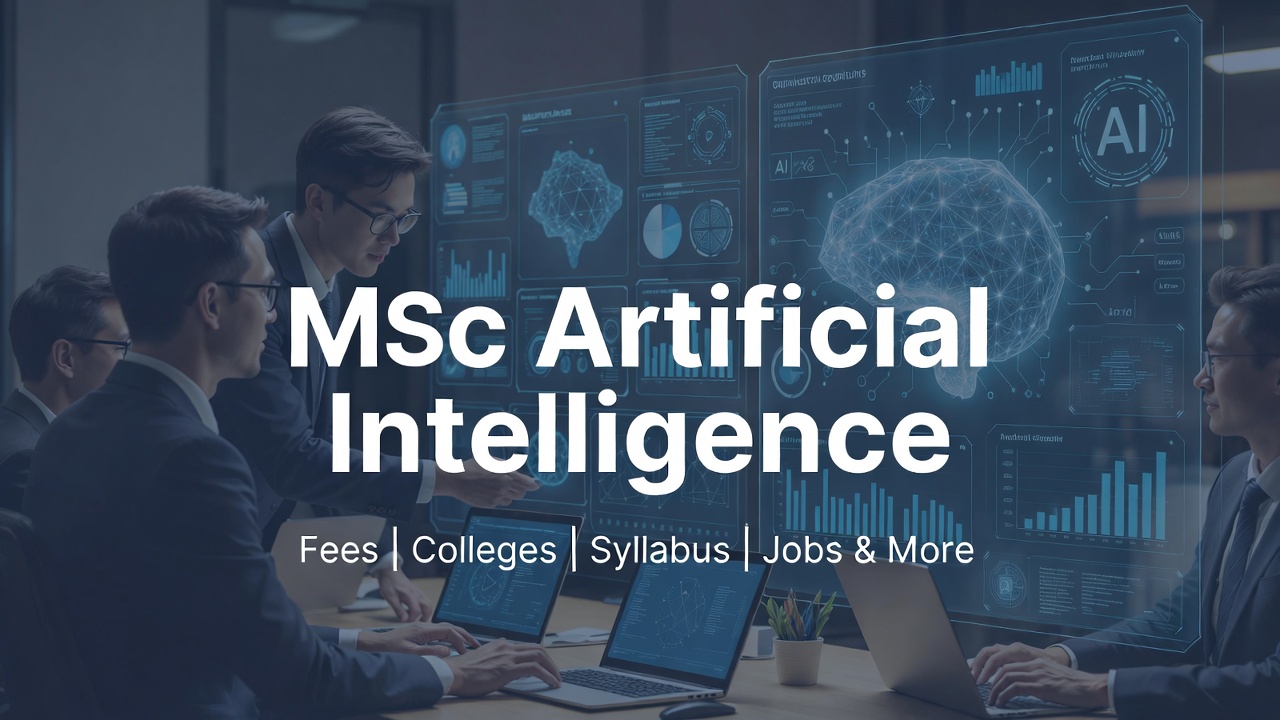
MSC Artificial Intelligence in India: Colleges, Fees, Syllabus, and Career Opportunities
With the rise of AI, an MSc in Artificial Intelligence has become a sought after masters degree. Find everything you need to know about this course here.
The demand for skilled professionals in artificial intelligence is rapidly increasing, making an MSc Artificial Intelligence a valuable degree. This postgraduate program in India equips students with full AI skills, leading to promising careers in AI innovation. Graduates are well-prepared to capitalize on the growing need for AI experts. The MSc Artificial Intelligence program is offered at numerous Indian universities, with tuition and fees varying by institution. While specific eligibility criteria differ, a relevant bachelor’s degree is generally required. This article provides a detailed overview of the MSc Artificial Intelligence program in India, covering top colleges, fees, syllabus, and career opportunities. This article examines the MSc Artificial Intelligence program, including top government colleges like IIT Madras and IIT Delhi, which are highly ranked by the NIRF. We will also explore the typical syllabus and course structure.
🔔 Admission Alerts 2026
- Application Open: IGNOU Online MSc AI & ML for January 2026 cycle.
- GATE Cutoff: IIT Hyderabad M.Tech AI is 544-640.
- GATE Cutoff: IISc Bangalore M.Tech AI is 475-835.
- Scholarship Alert: Apply for GOI Scholarships via National Scholarship Portal.
- UGC Update: Check approved Online programs for 2026 academic batch.
MSc Artificial Intelligence: Course Overview, Scope, and Key Highlights in India
The MSc Artificial Intelligence program in India is a 1-2 years postgraduate course designed to provide students with a full skill set in the field of AI. Here is an overview of the course:
| Parameter | Description |
|---|---|
| Degree Title | MSc Artificial Intelligence (or MSc in AI & Machine Learning / AI & Data Science) |
| Duration | Usually 1-2 years full-time (4 semesters) |
| Total Credits | Typically 70–90 credits |
| Mode of Study | Full-time on-campus/ online or hybrid options |
| Entry Point | Usually July/August |
| Core / Compulsory Modules | Mathematics for AI/Data Science, Introduction to Artificial Intelligence, Machine Learning, Deep Learning / Neural Networks, Python Programming / Data Structures & Algorithms, Fundamentals of Data Science |
| Major Project / Dissertation | Individual project / dissertation (often 10–20 credits in final semester); may include mini-projects, capstone, or industry-based work |
| Typical Focus | Balances theory (math, algorithms), practical skills (Python, ML frameworks like TensorFlow/PyTorch), applications (NLP, computer vision, big data), and ethics/responsible AI |
| Career Preparation | Aimed at roles like AI Engineer, ML Engineer, Data Scientist, AI Researcher, or further PhD; strong industry alignment with tools, projects, and placements |
MSc Artificial Intelligence Eligibility Criteria: Detailed Requirements for Indian Students
To be considered for admission to an MSc Artificial Intelligence program in India, students must meet specific eligibility criteria. While requirements vary by college or university, here is a broad overview:
- Educational Qualification: Candidates must hold a bachelor’s degree from a UGC-recognized university in a relevant field such as B.Sc. In Computer Science, IT, Mathematics, Statistics, Data Science, BCA, B.Tech/BE in CSE/IT, or equivalent disciplines.
- Minimum Aggregate Marks: Applicants generally need at least 50-60% marks in their qualifying bachelor’s degree, with many institutions requiring 60% or higher; relaxation to 45-55% is often provided for SC/ST/OBC/PwD categories as per government norms.
- Mathematics or Relevant Subjects Requirement: Mathematics (or Statistics) must have been studied as a compulsory subject at the 10+2 level and/or during graduation to ensure a strong foundation for AI concepts and algorithms.
- Entrance Exam or Selection Process: Admission is typically based on merit from undergraduate marks, university-specific entrance tests (like VITMEE), or national exams (such as GATE in some cases), often followed by interviews or programming assessments.
- Additional Requirements for Diverse Backgrounds: Non-computer science graduates may need to complete bridge courses in programming, data structures, or mathematics; English proficiency and provisional admission for final-year students are commonly allowed upon meeting criteria later.
- Age and Other Conditions: There is usually no strict upper age limit, making the program accessible to both fresh graduates and working professionals, especially in online or part-time modes offered by various institutions.
MSc Artificial Intelligence Admission Process: A Step-by-Step Guide for Indian Aspirants
The MSc Artificial Intelligence admission process in India typically involves several steps. While the process may vary by college or university, it generally includes submitting an application, meeting eligibility criteria, and passing an entrance exam or interview.
- Possess a Bachelor’s degree in Computer Science, Mathematics, or a related field, with a minimum aggregate score of 60% or above.
- Submit a valid GATE score, or scores from other institution-specific exams.
- Submit all required documents, including mark sheets, certificates, and identification proof.
- Meet specific subject requirements, such as mathematics and computer science, as specified by the institution.
- Apply for admission through the institution’s official website or a centralized admission portal, if available.
- Pay the application fee, ranging from INR 500 to INR 2,000, depending on the institution.
- Pass the entrance exam or interview, if required, demonstrating knowledge and skills in artificial intelligence and related areas.
- Check the institution’s website for the merit or selection list, usually published after the entrance exam or interview.
- Confirm admission by paying tuition fees, ranging from INR 50,000 to INR 2,00,000 per year, depending on the institution.
- Attend the orientation program and complete other formalities, such as submitting original documents and medical certificates, to finalize the admission process.
Top Government Colleges in India for MSc Artificial Intelligence
The following table lists top government colleges in India offering MSc Artificial Intelligence or related programs, along with their fees, duration and admission mode.
| College Name (City) | Total Course Fees (approx.) | Course Duration | Admission Mode |
|---|---|---|---|
| Kerala University (Thiruvananthapuram) | INR 3,465 | 2 years | Entrance exam / CUET PG |
| Central University of Karnataka (Kalaburagi) | INR 65,000–70,000 | 2 years | CUET PG |
| Chaudhary Devi Lal University (Sirsa) | INR 36,000 | 2 years | Merit-based / University entrance |
| Avinashilingam Institute (Coimbatore) – Deemed (Women-only) | INR 75,000–1,00,000 | 2 years | Merit-based / Institute test |
| Delhi Institute of Pharmaceutical Sciences and Research (New Delhi) | INR 1,60,000 | 2 years | GPAT / Merit-based |
(Note: Top IITs like IIT Madras, IIT Bombay, IIT Delhi offer MTech in AI/Data Science, not pure MSc. Central universities dominate lower-fee options.)
Top Private Colleges in India for MSc Artificial Intelligence
The table below lists top private colleges in India that offer MSc Artificial Intelligence or related programs, along with their city, fees, duration and admission modes:
| College Name (City) | Total Course Fees (approx.) | Course Duration | Admission Mode |
|---|---|---|---|
| Parul University (Vadodara) | INR 99,000–3,25,000 | 2 years | Merit-based / Entrance |
| Ganpat University (Mehsana) | INR 45,000–2,65,000 | 2 years | Merit / GUJCET or equivalent |
| Christ University (Bengaluru) | INR 2,00,000–2,84,000 | 2 years | University entrance / Merit |
| Amity University (Noida) | INR 74,000–3,00,000 | 2 years | Merit-based / Entrance |
| CV Raman Global University (Bhubaneswar) | INR 40,000–80,000 | 2 years | Entrance (GATE/OJEE/JEE) |
| MIT ADT University (Pune) | INR 75,000–6,00,000 | 2 years | PERA CET / JEE / GATE |
| BITS Pilani (Online / Work Integrated) | INR 2,10,000–2,80,000 (total for program) | 2 years | Merit-based / Online application |
| Bennett University (Greater Noida) | INR 3,00,000–4,00,000 | 2 years | Merit / Entrance |
| REVA University (Bengaluru) | INR 5,00,000–5,50,000 | 2 years | Merit / University test |
| Sri Sri University (Cuttack) | INR 2,80,000–3,00,000 | 2 years | Merit-based |
| O.P. Jindal Global University (Sonipat) | INR 4,00,000+ (1-year variant) | 1–2 years | Merit / Interview |
| University of Aberdeen Mumbai Campus | INR 10,00,000+ (international fees) | 1 year | Merit / Application |
Top International Colleges for MSc Artificial Intelligence
AI studies is an increasingly popular international degree. Here is a list of top international colleges to pursue this degree:
| College Name | Location | Course Fees (Approx) | Course Duration |
|---|---|---|---|
| Carnegie Mellon University | Pittsburgh, USA | $100,000 – $120,000 | 1.5–2 years |
| Stanford University | Stanford, USA | $120,000 – $150,000 | 1.5–2 years |
| Massachusetts Institute of Technology (MIT) | Cambridge, USA | $110,000 – $140,000 | 1–2 years |
| University of California, Berkeley | Berkeley, USA | $80,000 – $110,000 | 1–2 years |
| University of Oxford | Oxford, UK | £40,000 – £50,000 | 1 year |
| Imperial College London | London, UK | £40,000 – £45,000 | 1 year |
| ETH Zurich | Zurich, Switzerland | CHF 3,000–6,000 | 1.5–2 years |
| Technical University of Munich (TUM) | Munich, Germany | €6,000–€12,000 | 2 years |
| National University of Singapore (NUS) | Singapore | SGD 50,000–70,000 | 1–2 years |
| University of Edinburgh | Edinburgh, UK | £40,000 – £45,000 | 1 year |
MSc Artificial Intelligence Syllabus: Year-wise Breakdown for Indian Universities
Central University of Andhra Pradesh MSc AI
The MSc Artificial Intelligence program in India is a two-year postgraduate course covering a wide range of subjects related to artificial intelligence. While syllabus for each college varies, here is a broad overview:
| Year (Semesters) | Core Subjects | Electives ( |
|---|---|---|
| Year 1 (Semesters 1 & 2) | Mathematics for AI / Probability & Statistics, Introduction to Artificial Intelligence / Foundations of AI, Machine Learning Fundamentals | Natural Language Processing (NLP), Computer Vision Basics, Big Data Analytics / Cloud Computing |
| Year 2 (Semesters 3 & 4) | Deep Learning / Neural Networks, Advanced Machine Learning / Reinforcement Learning, Ethics & Responsible AI / AI Governance | Generative AI / MLOps, Robotics / IoT for AI, Agentic AI / Soft Computing |
Core Subjects Taught in MSc Artificial Intelligence
Here are detailed descriptions of the core subjects taught in MSc Artificial Intelligence course:
| Subject Name | Subject Description |
|---|---|
| Mathematics for AI / Data Science | Covers linear algebra, probability, statistics, calculus, and optimization essential for AI algorithms and model understanding. |
| Introduction to Artificial Intelligence | Provides foundational concepts of AI, including agents, search strategies, knowledge representation, reasoning, and problem-solving paradigms. |
| Machine Learning Fundamentals | Explores supervised, unsupervised, and reinforcement learning techniques, algorithms, evaluation metrics, and model training processes. |
| Artificial Neural Networks / Deep Learning | Introduces neural network architectures, backpropagation, activation functions, and frameworks for building deep learning models. |
| Natural Language Processing (NLP) | Focuses on techniques for processing, understanding, and generating human language, including tokenization, sentiment analysis, and transformers. |
| Computer Vision / Image Processing | Teaches methods for interpreting visual data, including image classification, object detection, segmentation, and convolutional neural networks. |
| Advanced Data Structures & Algorithms | Builds on core programming with efficient data structures, algorithmic design, complexity analysis, and optimization for AI applications. |
| Big Data Analytics | Covers handling large-scale data using tools like Hadoop/Spark, distributed computing, and analytics pipelines for real-world AI datasets. |
| Ethics & Responsible AI / AI Governance | Examines ethical issues, bias mitigation, fairness, privacy, societal impact, and regulatory frameworks in AI development and deployment. |
MSc Artificial Intelligence Fee Structure: Comparison of Government and Private Colleges in India
The MSc Artificial Intelligence program is a 2-year postgraduate course offered by various government and private colleges in India. The fee structure varies significantly. Here is a side by side comparison of various fee elements:
| Fee Component | Government Colleges (Typical Range) | Private Colleges (Typical Range) |
|---|---|---|
| Tuition Fees (Total for 2 Years) | INR 3,000 – 70,000 | INR 2,00,000 – 6,00,000+ |
| Admission / Registration / One-Time Fees | INR 1,000 – 10,000 | INR 10,000 – 50,000 |
| Examination / Semester Fees | INR 2,000 – 15,000 | INR 10,000 – 50,000 |
| Hostel / Accommodation Fees (per year, optional) | INR 10,000 – 30,000 | INR 50,000 – 2,00,000+ |
| Mess / Food Fees (per year, approximate) | INR 20,000 – 40,000 | INR 40,000 – 1,00,000 |
| Other Fees (Lab, Library, Internet, etc.) | INR 5,000 – 20,000 | INR 20,000 – 1,00,000 |
| Total Estimated Cost (2 Years, including hostel/mess where applicable) | INR 50,000 – 2,00,000 | INR 3,00,000 – 10,00,000+ |
Entrance Exams for MSc Artificial Intelligence in India: Eligibility and Key Details
Entrance exams are a crucial step in the admission process for an MSc Artificial Intelligence in India. These exams assess a candidate’s knowledge and skills in areas relevant to artificial intelligence, such as mathematics, computer science, and programming. Common entrance exams include:
| Exam Name | College / Accepting Institutions | Tentative Date (2026) |
|---|---|---|
| CUET PG (Common University Entrance Test – Postgraduate) | Central Universities (e.g., Central University of Karnataka, Kerala University), many state/deemed universities accepting CUET PG scores | March 6 – March 27, 2026 |
| VITMEE (VIT Master’s Entrance Exam) | Vellore Institute of Technology (VIT) – for MSc AI & ML, MSc Data Science | Typically May–June 2026 |
| University-Specific Entrance Tests / Merit-Based | Christ University (Bengaluru) – entrance test or merit; REVA University; Parul University; Amity University; Avinashilingam Institute | Varies |
| GATE (Graduate Aptitude Test in Engineering) – DA (Data Science & AI) paper | Primarily for MTech AI/ML/Data Science at IITs/NITs/IIITs; some MSc programs accept GATE scores | February 2026 |
| Other University-Specific / Institute Tests | RKMVERI (Ramakrishna Mission Vivekananda Educational and Research Institute); Plaksha University (MS AI) | Varies |
Scope for Higher Studies After MSc Artificial Intelligence
Msc Artificial Intelligence degree holders looking to pursue higher studies can explore the following options:
- PhD in Artificial Intelligence: After completing an MSc in Artificial Intelligence, pursuing a PhD in AI allows students to conduct in-depth research in areas like machine learning, neural networks, and robotics at premier institutions such as IITs or Anurag University in India, typically requiring qualification in exams like GATE or NET for admission and lasting 3-5 years.
- PhD in Data Science and Artificial Intelligence: This advanced degree builds on MSc foundations by focusing on interdisciplinary research in data-driven AI applications, offered at places like IIT Bombay, where candidates with a relevant Master’s can explore topics such as big data analytics and AI ethics, often leading to academic or industry research roles.
- PhD in Computer Science with AI Specialization: Opting for a PhD in Computer Science emphasizing AI enables exploration of specialized fields like natural language processing or computer vision, available at universities including NCU India, providing opportunities for innovative thesis work and careers in academia, tech firms, or policy-making.
- International PhD Programs in AI: Graduates can apply for PhD positions abroad at universities in the US, UK, or Europe, which often include funding and stipends, requiring strong research proposals, GRE scores, and English proficiency tests, allowing access to global collaborations and advanced AI facilities for 4-6 years of study.
Top Job Roles & Salary Ranges After MSc Artificial Intelligence
Take a look at top job roles after MSc Artificial Intelligence with description and salary range:
| Job Role | Job Description | Salary Range (INR LPA) |
|---|---|---|
| AI Engineer | Designs, develops, and deploys AI models and systems using machine learning frameworks. | 6–25 |
| Machine Learning Engineer | Builds, trains, and optimizes ML models for production, focusing on scalability and performance. | 8–30 |
| Data Scientist | Analyzes complex data to derive insights, build predictive models, and support AI-driven decisions. | 8–25 |
| NLP Engineer | Develops systems for understanding and generating human language, including chatbots and sentiment analysis. | 10–35 |
| Computer Vision Engineer | Creates algorithms for image/video processing, object detection, and visual AI applications. | 10–30 |
| AI Research Scientist | Conducts advanced research on new AI techniques, publishes papers, and innovates algorithms. | 15–50 |
| MLOps Engineer | Manages ML lifecycle: deployment, monitoring, automation, and CI/CD pipelines for AI models. | 12–40 |
| Generative AI Specialist | Works on generative models like LLMs, diffusion models, and prompt engineering for content creation. | 12–45 |
Top Industry Recruiters For MSc Artificial Intelligence
Here is a list of top recruiters to target for various sectors after MSc in Artificial Intelligence:
| Industry/Sector | Top Recruiters |
|---|---|
| IT Services & Consulting | TCS, Infosys, Wipro, Accenture |
| Tech Giants / Product Companies | Google, Microsoft, Amazon, IBM |
| E-commerce & Retail | Flipkart, Amazon India, Reliance Retail |
| Analytics & AI Startups / Specialized Firms | Fractal Analytics, Haptik, Mad Street Den |
| Other High-Growth Sectors (e.g., Fintech, Healthcare, Automotive) | HCLTech, Tech Mahindra, Cognizant |
Preparation Tips for Admission into MSc Artificial Intelligence
Here are 5 practical preparation tips for securing admission to an MSc in Artificial Intelligence in India:
- Strengthen your foundational knowledge in mathematics and programming: Build proficiency in linear algebra, probability, statistics, calculus, and Python, as these are core prerequisites for most programs and entrance exams.
- Research specific university requirements and entrance processes thoroughly: Check official websites for eligibility, accepted exams like CUET PG or merit-based criteria, and deadlines to tailor your application strategy effectively.
- Prepare rigorously for entrance exams like CUET PG or university tests: Understand the pattern (MCQs on math, CS, reasoning), practice previous papers, and focus on high-weightage topics such as machine learning basics, data structures, and logical reasoning for competitive scores.
- Build a strong profile with relevant projects and experience: Work on personal AI/ML projects, contribute to open-source, or complete internships/certifications (e.g., in Python or TensorFlow) to showcase practical skills, especially for interviews or merit-based admissions.
- Craft a compelling application with timely documents and preparation: Write a clear Statement of Purpose highlighting your AI interest, prepare for potential interviews by researching the program, and submit all requirements (transcripts, recommendations) well before deadlines to avoid last-minute issues.
MSc Artificial Intelligence vs MTech Artificial Intelligence
Many students are confused between an MSc and MTech degree in Artificial Intelligence. Here is a side-by-side comparison that will help make a clearer decision:
| Aspect | MSc Artificial Intelligence | MTech Artificial Intelligence |
|---|---|---|
| Degree Type | Master of Science | Master of Technology |
| Typical Duration | 2 years (4 semesters) | 2 years (4 semesters) |
| Eligibility | Bachelor’s in relevant fields: B.Sc. (CS/IT/Math/Stats/Data Science/Physics), BCA | B.Tech/B.E. In CSE/IT/ECE or related engineering branches |
| Primary Admission Mode | Merit-based (UG marks) or university-specific entrance / CUET PG (for central universities) | National entrance exam: GATE; some accept university tests |
| Typical Institutions | Christ University, REVA University, Parul University, BITS Pilani, Amity University, Central University of Karnataka, Kerala University | IIT Delhi, IIT Hyderabad, IIT Bombay, IIT Madras, IIT Kharagpur, IIIT Hyderabad, NITs |
| Fee Range (Total for 2 Years) | Government/Central: INR 50,000 – 2 Lakhs Private: INR 2–6 Lakhs | Government/IITs: INR 2–4 Lakhs (subsidized) Private: INR 3–8 Lakhs+ |
| Curriculum Focus | More theoretical + interdisciplinary | More project/implementation heavy |
| Research vs Industry | Balanced; good for research/PhD pathway or applied roles | More practical; strong emphasis on engineering projects, tools, and deployment; excellent for tech jobs |
| Career Outcomes | Data Scientist, AI/ML Engineer, NLP Specialist, Research Analyst roles | AI Engineer, ML Engineer, MLOps Specialist, Research Engineer roles |
| Average Starting Salary (Freshers) | INR 6–12 LPA | INR 10–20+ LPA |
| Best Suited For | Science graduates, those interested in theoretical AI/research, or switching from non-engineering backgrounds | Engineering graduates seeking deep technical expertise, high-paying industry roles, or R&D in tech giants |
Frequently Asked Questions (FAQs)
Q1. What is the duration of the MSc Artificial Intelligence program in India?
The MSc Artificial Intelligence program in India typically lasts for 1 to 2 years at the postgraduate level. This duration includes tuition and other fees.
Q2. Which government colleges in India offer MSc Artificial Intelligence?
Several government and central universities in India offer MSc in Artificial Intelligence, including Kerala University, Central University of Karnataka, and Chaudhary Devi Lal University. However, availability remains limited compared to private institutions.
Q3. What is the type of colleges that Karunya Institute of Technology and Sciences and IIT Bombay are?
Karunya Institute of Technology and Sciences is a private college, while IIT Bombay is a government college. Their MSc Artificial Intelligence programs have different fee structures.
Q4. What are the key highlights of the MSc Artificial Intelligence program in India?
The MSc Artificial Intelligence program provides students with a full skill set in AI, preparing graduates for careers in AI innovation. The program includes tuition and other fees.
Q5. Who is eligible for MSc in AI?
Candidates are eligible for an MSc in Artificial Intelligence in India if they hold a bachelor’s degree in relevant fields like Computer Science, IT, Mathematics, Statistics, Data Science, BCA, or B.Tech/BE with 50–60% aggregate marks. Mathematics or Statistics at undergraduate level is often mandatory.
Q6. Is an MSc in Artificial Intelligence worth it?
Yes, an MSc in Artificial Intelligence is worth it in India for 2026. It offers strong career prospects in high-demand roles like AI Engineer and Data Scientist. Freshers typically earn ₹6–12 LPA in this fast growing and booming sector.
Q: What is the typical fee structure for an MSc in Artificial Intelligence in India for 2026?
For 2026, the average tuition fees for an MSc in AI in India can range from INR 1,50,000 to INR 6,00,000 per annum in private institutions. Government universities, often UGC/AICTE approved, might have lower fees, typically between INR 50,000 to INR 2,50,000 annually, depending on the institution’s prestige and facilities.
Q: What is the duration of an MSc Artificial Intelligence program in India?
An MSc in Artificial Intelligence in India is typically a full-time, two-year postgraduate program. It is usually divided into four semesters, with each semester focusing on core AI concepts, advanced topics, practical applications, and often includes a research project or dissertation in the final year.
Q: Are there specific entrance exams required for admission to MSc AI programs in India?
Yes, many top Indian universities require entrance exams. While some conduct their own tests, common national-level exams like GATE (Graduate Aptitude Test in Engineering) are widely accepted. Some institutions might also consider scores from exams like CUET PG (Common University Entrance Test – Postgraduate) or state-specific entrance tests. A strong academic background is also crucial.
Q: What is the career scope after completing an MSc in Artificial Intelligence in India?
Graduates can pursue diverse roles like AI Engineer, Machine Learning Engineer, Data Scientist, AI Researcher, Robotics Engineer, or NLP Engineer. Opportunities exist across IT, healthcare, finance, and automotive sectors. With India’s growing digital economy, demand for AI professionals is consistently high, offering excellent growth prospects in companies and even IIMs for research.
Q: What is the expected average starting salary for an MSc AI graduate in India in 2026?
For 2026, a fresh MSc AI graduate in India can expect an average starting salary ranging from INR 6,00,000 to INR 12,00,000 per annum. This figure can vary significantly based on the university’s reputation, the candidate’s skills, practical experience (internships), and the hiring company’s size and location within India.
Q: What is the scope for pursuing higher studies or jobs abroad after an MSc in AI from India?
An MSc in AI from a reputable Indian institution provides a strong foundation for global opportunities. Graduates can pursue PhDs or research positions in leading universities worldwide. For jobs, the skills acquired are highly transferable, making graduates eligible for AI/ML roles in countries like the USA, Canada, UK, and Germany, often requiring competitive visa processes.