MSc Biology in India: Courses, Colleges, Fees, Scope, and Entrance Exams
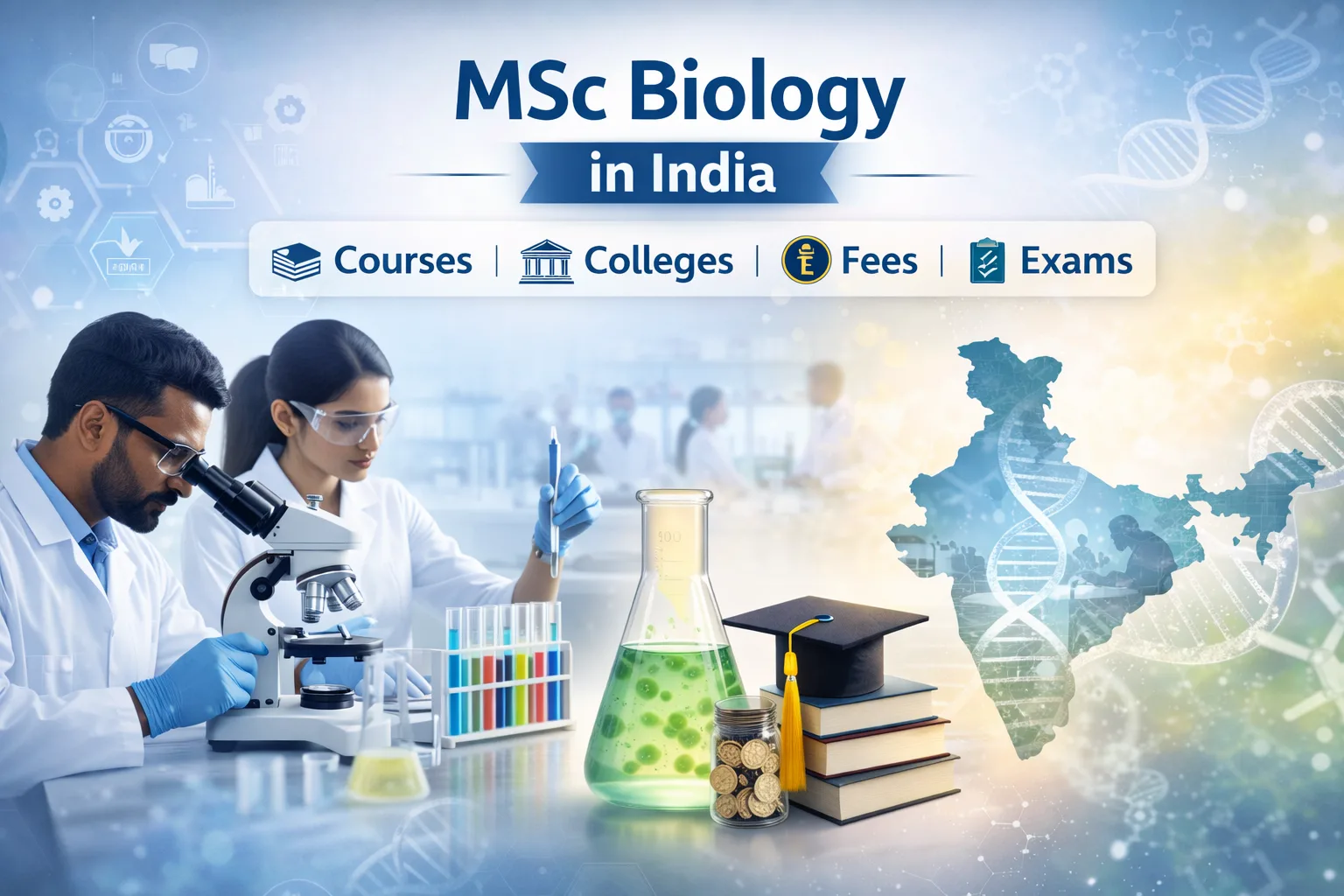
MSc Biology in India is a two-year postgraduate program focusing on advanced biological sciences, research skills, and laboratory techniques. The course offers specializations in areas such as microbiology, biotechnology, and genetics, opening career opportunities in research, healthcare, academia, and the biotechnology industry.
The growing demand for skilled professionals in biological sciences has made MSc Biology in India a sought-after postgraduate program. This two-year course offers an in-depth understanding of living systems, covering areas like Botany, Zoology, Microbiology, and Biotechnology. Eligibility typically requires a Bachelor’s degree in a relevant field with at least 50% marks. Annual fees range from INR 20,000 to INR 2,00,000, depending on the institution. Graduates can pursue careers in research, academia, healthcare, and industry, taking roles such as Research Scientist, Microbiologist, Lecturer, or Biotechnologist, with salaries ranging from INR 3 LPA to INR 8 LPA. Admission is generally through merit or entrance exams, with some colleges conducting their own tests.
MSc Biology: Course Overview
The MSc Biology program in India is a two-year postgraduate course that explores the structure, function, growth, evolution, and classification of living organisms. The curriculum emphasizes practical and theoretical understanding of biological systems and prepares students for research, academics, and industry roles. The course is divided into four semesters and offers specializations such as MSc Molecular Biology, MSc Cell Biology, MSc Marine Biology, MSc Environmental Biology, MSc Computational Biology, and MSc Cancer Biology and Therapeutics. Annual fees range from INR 20,000 to INR 2,00,000, depending on the institution. Applicants must hold a Bachelor’s degree in a relevant field with a minimum of 50% marks. Ensure that the college has UGC/AICTE approval, particularly for integrated MSc programs.
| Feature | Description | Details |
|---|---|---|
| Duration | Course Length | 2 Years, divided into 4 semesters |
| Examination Type | Semester-wise | Two semesters per year with theory and practical exams |
| Eligibility | Academic Qualification | BSc in Biology, Zoology, Botany, Microbiology, or equivalent with at least 50% marks |
| Admission Process | Entrance/Merit | Some colleges conduct entrance exams; others admit based on merit in the qualifying degree |
| Specializations | Available MSc Biology Specializations | MSc Molecular Biology, MSc Cell Biology, MSc Marine Biology, MSc Environmental Biology, MSc Computational Biology, MSc Cancer Biology and Therapeutics |
| Integrated Programs | Availability | Some colleges offer integrated MSc Biology programs combining UG + PG study |
| UGC/AICTE Approval | Importance | Colleges must have UGC/AICTE approval for recognition and accreditation |
| Job Opportunities | Career Scope | Research Scientist, Lecturer, Microbiologist, Biotechnologist, and other roles in research, academia, and industry |
MSc Biology Eligibility Criteria
Eligibility for MSc Biology programs in India varies across universities, but generally requires a Bachelor’s degree in a relevant field such as BSc Biology, BSc Biological Sciences, BSc Biotechnology, MBBS, BAMS, BHMS, or B.Pharm. Minimum percentage requirements range from 50% to 60%, depending on the university and the candidate’s category. Some universities may specify prerequisite subjects like Botany, Zoology, Biochemistry, or Microbiology. Age restrictions and relaxation policies may also apply for certain reserved categories.
| College/University | Minimum Percentage | Required Subjects | Other Requirements |
|---|---|---|---|
| Delhi University | 50% | BSc in relevant field | Merit-based / CUET PG |
| Banaras Hindu University | 50% | BSc in Biology/Zoology/Botany | CUET PG / University Entrance |
| Jawaharlal Nehru University | 55% | BSc in relevant field | Entrance Exam (JNU Entrance) |
| All India Institute of Medical Sciences (AIIMS) | 60% | BSc in relevant field | Entrance Exam / Merit-based |
| Christian Medical College, Vellore | 55% | BSc in Biology/Biotechnology | Entrance Exam / Merit-based |
| Manipal Academy of Higher Education | 50% | BSc in relevant field | Entrance Exam / Merit-based |
| Amity University | 55% | BSc in Biology/Biotechnology | Merit-based / Entrance Test |
| University of Hyderabad | 50% | BSc in relevant field | CUET PG / Entrance Exam |
| Indian Institute of Science Education and Research (IISER) | 60% | BSc in Biology/Biotechnology | Entrance Exam / Merit-based |
MSc Biology Admission Process
The MSc Biology admission process in India typically involves eligibility verification, entrance exams, counseling, and fee payment. The process may differ across universities. Some institutions use national or university-level entrance exams like CUET PG and IIT JAM, while others offer merit-based admissions. Reservation policies apply according to government norms.
Step-by-Step Admission Process:
- Check Eligibility: Ensure minimum percentage and required subjects are met.
- Entrance Exam Application: Register for exams such as CUET PG (INR 800–1,000) or IIT JAM (INR 2,000 for two papers).
- Merit-Based Selection: Some colleges, like Presidency College Kolkata, admit students based on undergraduate performance (minimum 60%).
- Document Verification: Submit original mark sheets, certificates, and other required documents during counseling.
- Fee Payment: Admission fees range from INR 5,000 to INR 50,000 to confirm the seat.
- Counseling/Interview: Attend counseling sessions or interviews if required.
- Reservation Policies: Seats reserved for SC/ST/OBC candidates, with relaxations in minimum percentage as per norms.
- Admission Formalities: Complete forms, submit documents, and confirm enrollment after fee payment.
- Academic Session: Classes usually start in July or August, with a two-year duration for the MSc Biology program.
This process ensures transparent admission and proper seat allocation based on merit, entrance exams, and reservation policies.
Top Government Colleges for MSc Biology in India
The table below lists top government colleges in India offering MSc Biology or related programs such as MSc Biological Sciences, MSc Molecular Biology, and MSc Biotechnology. These colleges are renowned for academic excellence, research facilities, and faculty expertise. Admission is usually merit-based or through national/state-level entrance exams. Some colleges also offer integrated MSc programs. Fees are indicative and may vary.
| College Name | City | NIRF Ranking | Annual Fees (INR) | Admission Mode | Specializations Offered |
|---|---|---|---|---|---|
| Banaras Hindu University (BHU) | Varanasi | 11 | 5,000 | Entrance Exam / Merit | MSc in Botany, Zoology, Biochemistry, Microbiology |
| Jawaharlal Nehru University (JNU) | New Delhi | 2 | 3,000 | Entrance Exam | MSc in Life Sciences, Biotechnology |
| University of Delhi (DU) | New Delhi | 11 | 15,000 | Merit / Entrance Exam | MSc in Zoology, Botany, Microbiology, Biomedical Sciences |
| All India Institute of Medical Sciences (AIIMS) | New Delhi | 1 (Medical) | 1,500 | Entrance Exam | MSc in Biophysics, Biochemistry, Pharmacology |
| Indian Institute of Science (IISc) | Bengaluru | 1 | 25,000 | Entrance Exam | MSc in Biological Sciences, Molecular Biophysics |
| IISER Kolkata | Kolkata | 5 | 20,000 | Entrance Exam | Integrated MSc in Biology, Chemical Sciences |
| IISER Pune | Pune | 4 | 22,000 | Entrance Exam | Integrated MSc in Biology, Physical Sciences |
| University of Hyderabad | Hyderabad | 14 | 10,000 | Entrance Exam / Merit | MSc in Biotechnology, Plant Biology, Animal Biology |
| Aligarh Muslim University (AMU) | Aligarh | 18 | 8,000 | Entrance Exam | MSc in Botany, Zoology, Microbiology, Biochemistry |
| Presidency College | Kolkata | – | 2,000 | Merit | MSc in Zoology, Botany, Microbiology, Biotechnology |
Top Private Colleges for MSc Biology in India
Top private institutions in India offer MSc Biology programs with strong research infrastructure and industry collaborations. Some also provide integrated BSc–MSc programs. Annual fees vary widely, and admission may be merit-based or through entrance exams.
| College Name | City | Ranking | Annual Fees (INR) | Admission Mode | Specializations Offered |
|---|---|---|---|---|---|
| Christian Medical College | Vellore | India Today #1 (Medical) | 1,20,000 | Merit / Entrance Exam | MSc in Biotechnology, MSc in Microbiology |
| Manipal Academy of Higher Education | Manipal | India Today #4 (Private University) | 2,50,000 | Entrance Exam / Merit | MSc in Biochemistry, MSc in Biotechnology |
| Amity University | Noida | India Today #6 (Private University) | 1,80,000 | Merit / Entrance Exam | MSc in Biotechnology, MSc in Microbiology |
| BITS Pilani | Pilani | India Today #2 (Private Engineering) | 2,00,000 | Merit / Entrance Exam | MSc in Biological Sciences, MSc in Biotechnology |
| VIT Vellore | Vellore | India Today #14 (Private Engineering) | 1,50,000 | Merit / Entrance Exam | MSc in Biotechnology, MSc in Microbiology |
| SRM University | Chennai | India Today #15 (Private University) | 1,20,000 | Merit / Entrance Exam | MSc in Biochemistry, MSc in Biotechnology |
| Lovely Professional University (LPU) | Phagwara | India Today #19 (Private University) | 80,000 | Merit / Entrance Exam | MSc in Biotechnology, MSc in Microbiology |
| Jain University | Bangalore | India Today #20 (Private University) | 1,00,000 | Merit / Entrance Exam | MSc in Biochemistry, MSc in Biotechnology |
| Gitam University | Visakhapatnam | India Today #24 (Private University) | 90,000 | Merit / Entrance Exam | MSc in Biotechnology, MSc in Microbiology |
| KIIT Bhubaneswar | Bhubaneswar | India Today #25 (Private University) | 1,10,000 | Merit / Entrance Exam | MSc in Biochemistry, MSc in Biotechnology |
MSc Biology Subjects and Syllabus
MSc Biology programs in India provide a mix of theoretical knowledge and practical skills. The course is typically structured into four semesters with core and elective subjects, including lab work and research projects.
| Semester | Core Subject | Elective Subject | Credit Hours | Description |
|---|---|---|---|---|
| Semester 1 | Biochemistry | Biostatistics | 3–5 | Study of chemical processes in living organisms, metabolic pathways, enzyme kinetics |
| Semester 1 | Cell Biology | Bioinformatics | 3–5 | Study of cell structure, signaling, transport, and division |
| Semester 2 | Molecular Biology | Immunology | 3–5 | Structure and function of DNA, RNA, and proteins |
| Semester 2 | Genetics | Microbiology | 3–5 | Heredity, Mendelian and molecular genetics, microbial studies |
| Semester 3 | Developmental Biology | Plant Physiology | 3–5 | Organismal growth and development, embryogenesis, morphogenesis |
| Semester 3 | Ecology | Animal Physiology | 3–5 | Organism–environment interactions, population and ecosystem ecology |
| Semester 4 | Evolutionary Biology | Biotechnology | 3–5 | Evolutionary processes, phylogeny, applied biotechnology |
| Semester 4 | Research Methodology | Environmental Biology | 3–5 | Experimental design, data analysis, lab and field research |
| Semester 4 | Thesis/Dissertation | – | 3–5 | Original research project under faculty guidance |
MSc Biology Fee Structure: Government vs Private Colleges in India
Tuition and associated costs differ significantly between government and private institutions. Scholarships and financial aid are often available for meritorious or needy students.
| College Type | Average Tuition Fees (INR) | Hostel Fees (INR) | Other Charges (INR) | Total Fees (INR) |
|---|---|---|---|---|
| Government College (Low) | 5,000 | 20,000 | 10,000 | 35,000 |
| Government College (High) | 20,000 | 30,000 | 15,000 | 65,000 |
| Private College (Low) | 50,000 | 40,000 | 20,000 | 1,10,000 |
| Private College (High) | 2,00,000 | 60,000 | 30,000 | 2,90,000 |
| IIT Delhi | 2,25,000 | 80,000 | 25,000 | 3,30,000 |
| NIT Trichy | 1,85,000 | 50,000 | 20,000 | 2,55,000 |
| University of Delhi | 15,000 | 30,000 | 15,000 | 60,000 |
| JNU | 3,000 | 20,000 | 10,000 | 33,000 |
| BHU | 5,000 | 25,000 | 12,000 | 42,000 |
| AMU | 10,000 | 30,000 | 15,000 | 55,000 |
Entrance Exams for MSc Biology in India
Major entrance exams include CUET PG, IIT JAM, JGEEBILS, BHU PET, and university-specific tests. These assess knowledge in biology and allied subjects, and eligibility varies by exam.
| Exam Name | Conducting Body | Exam Type | Eligibility | Syllabus Overview |
|---|---|---|---|---|
| CUET PG | National Testing Agency (NTA) | National-level | Bachelor’s in relevant field | Botany, Zoology, Biochemistry, Biotechnology |
| IIT JAM | Indian Institutes of Technology (IITs) | National-level | Bachelor’s in relevant field | Biology, Chemistry, Physics, Mathematics; focus on analytical skills |
| JGEEBILS | Tata Institute of Fundamental Research (TIFR) | National-level | Bachelor’s in relevant field | Molecular Biology, Genetics, Evolutionary Biology |
| BHU PET | Banaras Hindu University | University-level | Bachelor’s in relevant field | Botany, Zoology, Biochemistry |
| JNU Entrance Exam | Jawaharlal Nehru University | University-level | Bachelor’s in relevant field | Biology, Chemistry, Mathematics, theoretical and practical knowledge |
| DU Entrance Exam | University of Delhi | University-level | Bachelor’s in relevant field | Botany, Zoology, Biochemistry, Biotechnology |
| AMU Entrance Exam | Aligarh Muslim University | University-level | Bachelor’s in relevant field | Biology, Chemistry, Mathematics, theory and practical knowledge |
Career Opportunities, Jobs, and Salary for MSc Biology Graduates
MSc Biology graduates enjoy diverse career paths across research, academia, industry, healthcare, and government sectors. They are trained to analyze biological systems, conduct experiments, and apply scientific knowledge to real-world problems, making them valuable in multiple domains.
-
Job Roles: Research Scientist, Lecturer/Professor, Microbiologist, Biotechnologist, Geneticist, Environmental Consultant, Lab Technician, Quality Control Analyst, Clinical Research Associate.
-
Employers: Universities, Colleges, National and International Research Institutes, Biotech and Pharmaceutical Companies, Hospitals, Environmental and Conservation Organizations, Government Departments, and NGOs.
-
Average Salary: Fresh graduates typically earn between INR 3 LPA and INR 8 LPA. With experience, specialization, or a PhD, salaries can rise to INR 12–20 LPA or higher in research-intensive roles or senior academic positions.
-
Further Studies: Graduates can pursue a PhD in Biological Sciences, Molecular Biology, Biotechnology, Environmental Science, or interdisciplinary areas to advance in research, academia, and leadership positions.
Frequently Asked Questions (FAQs)
Q1. What is the duration of the MSc Biology course in India?
The MSc Biology course in India lasts 2 years, divided into four semesters. It is a postgraduate program requiring a Bachelor’s degree in a relevant field.
Q2. What are the eligibility criteria for MSc Biology admission in Indian universities?
MSc Biology admission requires a Bachelor’s degree in a relevant field, such as BSc in Biology, Zoology, Botany, Microbiology, or equivalent, with a minimum of 50% marks. Some universities, like Presidency College, Kolkata, require at least 60%.
Q3. What is the average course fee for MSc Biology in government and private colleges in India?
Average tuition fees for MSc Biology in government colleges range from INR 5,000 to INR 20,000 per year, while private colleges charge between INR 50,000 and INR 2,00,000 per year. Fees vary based on college type and location.
Q4. What are the core subjects covered in the MSc Biology syllabus?
The MSc Biology syllabus covers core subjects like Biochemistry, Cell Biology, Molecular Biology, Genetics, and Ecology, taught over four semesters with a combination of core and elective subjects.
Q5. What are the entrance exams for MSc Biology admission in India, and what is their eligibility criteria?
Entrance exams for MSc Biology admission in India include CUET PG, JNU Entrance Exam, and BHU PET. Eligibility requires a Bachelor’s degree in a relevant field, and the syllabus is based on the BSc Biology curriculum.