MSc Geology: Eligibility, Syllabus, Colleges & Careers
MSc Geology is one of the most sought-after postgraduate programs for students passionate about understanding the Earth, its resources, and environmental systems. This blog provides a complete guide to MSc Geology, covering eligibility criteria, admission process, top colleges in India, syllabus, specializations, career opportunities, and challenges in the field. By the end of this article, you will have a clear roadmap for pursuing MSc Geology and building a successful career in the geosciences sector.
Geology is not just about studying rocks—it involves understanding natural resources, groundwater, soil, tectonic structures, and environmental processes. With industrial growth, environmental awareness, and global research initiatives, MSc Geology graduates are in high demand in India and abroad. This blog also highlights research options, government and private sector roles, and future study pathways, making it a complete resource for aspiring geologists.
Why Choose MSc Geology?
Choosing MSc Geology opens up multiple career and research opportunities. The program equips students with both theoretical knowledge and hands-on skills needed to work in exploration, research, environmental consultancy, and education.
Growing Career Demand
The demand for geologists is rising due to industrial development, natural resource exploration, and environmental management needs. Mining, petroleum, and construction sectors require experts to analyze minerals, rock structures, and soil conditions.
Practical and Research-Oriented Program
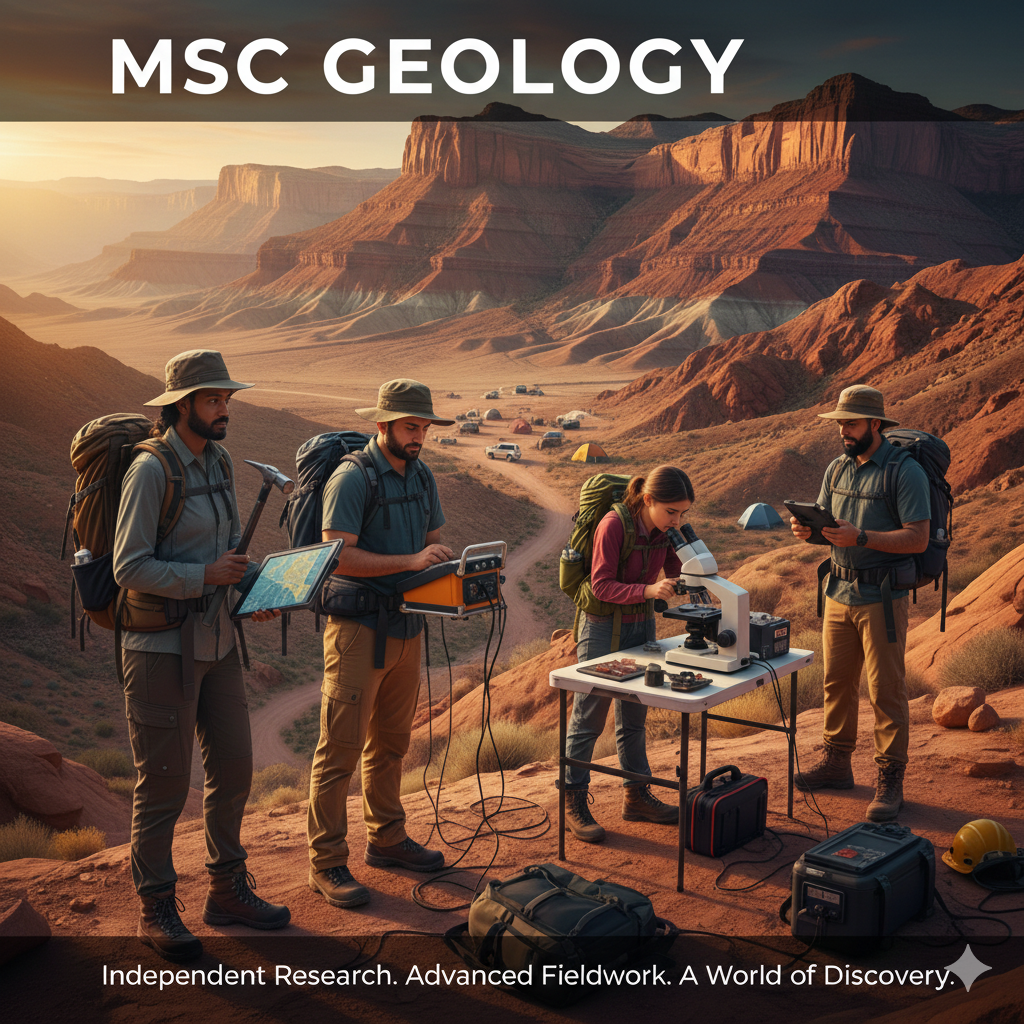
MSc Geology emphasizes fieldwork, laboratory experiments, and research projects. Students gain practical experience in rock and mineral analysis, mapping, and environmental assessments.
Opportunities Abroad
MSc Geology graduates can work internationally in countries with active mining, oil, and environmental research sectors. This includes roles in consultancy, research organizations, and global environmental initiatives.
MSc Geology: Key Highlights
| Feature | Details |
|---|---|
| Course Name | MSc Geology |
| Level | Postgraduate (Master’s) |
| Duration | 2 years (4 semesters) |
| Eligibility | BSc in Geology, Earth Sciences, Environmental Science, or related fields with minimum 50% marks |
| Age Limit | Generally no upper age limit |
| Admission Process | Merit-based or entrance exam, followed by document verification and fee payment |
| Specializations | Mineralogy & Petrology, Structural Geology & Tectonics, Hydrogeology, Paleontology & Stratigraphy, Environmental Geology, Geochemistry & Geophysics |
| Key Subjects | Mineralogy, Petrology, Structural Geology, Paleontology, Geochemistry, Hydrogeology, Environmental Geology, Remote Sensing, GIS, Fieldwork |
| Practical Exposure | Extensive laboratory work, fieldwork, mapping, sampling, and research projects |
| Top Colleges in India | IISc Bangalore, BHU Varanasi, University of Delhi, Pune University, Jadavpur University |
| Career Opportunities | Researcher, Lecturer, Geologist, Petroleum Geologist, Hydrogeologist, Environmental Consultant, Lab Analyst |
| Scope | Mining, Petroleum, Environmental Consultancy, Hydrogeology, Research, Academia, Government Geological Surveys |
| Higher Studies Options | PhD, MPhil, Certification courses in GIS, Hydrogeology, Geophysics, Remote Sensing |
Eligibility Criteria for MSc Geology
MSc Geology is a specialized postgraduate program designed for students interested in Earth sciences, mineral exploration, hydrogeology, environmental studies, and geological research. To ensure that candidates are academically prepared, universities set eligibility criteria that applicants must meet before enrollment.
Educational Qualification
The primary requirement for MSc Geology is a Bachelor’s degree in Geology, Earth Sciences, or related disciplines. Some universities also accept students who have completed BSc in Environmental Science, Geography, or Natural Sciences, provided they have studied geology-related subjects during their undergraduate program. Candidates with a strong foundation in mineralogy, petrology, structural geology, and geochemistry are generally preferred.
Minimum Marks Requirement
Most Indian universities require candidates to have secured at least 50% marks in their undergraduate degree. Some prestigious institutions, such as IISc Bangalore or Banaras Hindu University, may set higher minimum marks for merit-based admissions. Students who have scored slightly less may still qualify through entrance examinations or additional screening tests.
Age Criteria
There is generally no upper age limit for MSc Geology in most universities. Fresh graduates as well as working professionals are eligible to apply. However, some institutes may specify a minimum age requirement, usually 17 years at the time of admission, to ensure candidates have completed their undergraduate education.
Entrance Exams
While many universities admit students purely based on merit (undergraduate scores), some institutes conduct entrance exams to assess knowledge in geology, physics, chemistry, and mathematics. These exams evaluate candidates’ analytical and technical skills to ensure they are prepared for postgraduate-level coursework.
Physical Fitness
Since MSc Geology involves fieldwork in remote locations, lab experiments, and geological mapping, candidates are expected to be physically fit. Fitness ensures students can actively participate in field studies, sample collection, and surveys, which are crucial components of the course.
| Criteria | Details |
|---|---|
| Educational Qualification | BSc in Geology, Earth Sciences, Environmental Science, or related field |
| Minimum Marks | 50% in graduation (varies by university) |
| Age Limit | Minimum 17 years; no upper limit in most institutes |
| Entrance Exam | Required by some universities; others admit based on merit |
| Physical Fitness | Necessary for fieldwork and lab sessions |
Admission Process for MSc Geology
The admission process for MSc Geology is designed to be transparent and student-friendly. While specific steps may vary across universities, most institutes follow a systematic approach that includes application submission, evaluation, selection, and enrollment.
Step 1: Application Form
The first step in the admission process is completing the application form, which can be submitted online via the university website or offline at the campus. Students need to provide personal details, academic records, choice of specialization, and other relevant information. Accuracy is crucial, as any discrepancies may lead to disqualification.
Step 2: Entrance Exam or Merit-Based Selection
Depending on the university, students may be required to appear for an entrance exam. These exams typically cover core geology topics, physics, chemistry, and mathematics, ensuring candidates are academically prepared for advanced coursework.
-
Merit-Based Admission: Some universities offer admission solely based on undergraduate marks. The merit list is prepared by evaluating candidates’ BSc performance, with preference given to those with higher marks in geology subjects.
-
Entrance-Based Admission: Prestigious institutes may require a competitive exam to assess technical knowledge, problem-solving skills, and analytical reasoning. Students who clear the exam are then shortlisted for the next stage.
Step 3: Merit List Announcement
After evaluating applications, entrance exam scores, and/or undergraduate marks, the university publishes a merit list. Candidates who meet the cutoff are eligible for the next stage, which includes document verification and counseling.
Step 4: Document Verification
Shortlisted students must submit original academic certificates, mark sheets, identity proofs, passport-sized photographs, and category certificates (if applicable). Document verification ensures the authenticity of academic qualifications and eligibility.
Step 5: Counseling (if applicable)
Some universities conduct counseling sessions where students are guided on course selection, specialization, and other academic options. During counseling, students may also have the opportunity to clarify doubts regarding fieldwork, research projects, and elective subjects.
Step 6: Fee Payment and Enrollment
Once selected, students must pay the course fee to confirm their admission. After payment, students are officially enrolled in the MSc Geology program, gaining access to lectures, laboratory facilities, and fieldwork assignments.
Step 7: Commencement of Classes and Field Training
Classes typically begin with theoretical lectures in geology, followed by laboratory exercises, field studies, and practical mapping projects. Fieldwork may involve rock sampling, mineral identification, fossil studies, and environmental surveys, depending on the semester and specialization.
Key Subjects in MSc Geology
MSc Geology is designed to provide students with a thorough understanding of Earth sciences, blending theoretical knowledge with practical and research-oriented skills. The syllabus includes core subjects that cover all aspects of geology, from rock formations to environmental studies, ensuring graduates are well-equipped for careers in research, industry, and consultancy.
| Semester | Subjects | Description |
|---|---|---|
| Semester 1 | Mineralogy, Petrology, Structural Geology, Geophysics Basics | Introduction to minerals, rock classification, tectonic structures, and basic physical principles applied to geological studies. |
| Semester 2 | Paleontology, Geochemistry, Hydrogeology, Sedimentology | Study of fossils, chemical composition of Earth materials, groundwater systems, and sedimentary processes. |
| Semester 3 | Environmental Geology, Remote Sensing, GIS Applications, Electives | Focus on geological hazards, environmental assessment, mapping using GIS, and additional specialized courses. |
| Semester 4 | Dissertation / Research Project, Advanced Fieldwork, Seminar Presentations | Practical research, field studies, report writing, and presentation skills to prepare students for professional and academic roles. |
-
Mineralogy: Study of mineral composition, structures, properties, and industrial uses. Students learn how to identify and classify minerals using laboratory techniques and field observation.
-
Petrology: Analysis of rocks, their origin, formation processes, and classification. It is essential for mineral exploration and understanding Earth’s crust.
-
Structural Geology: Examination of folds, faults, joints, and tectonic structures. Students learn to interpret geological formations and map geological features.
-
Geophysics: Introduction to the application of physics in studying Earth’s interior, seismic waves, and geophysical exploration methods.
-
Paleontology: Study of fossils and past life forms to understand Earth’s evolutionary history.
-
Geochemistry: Analysis of chemical composition of rocks, minerals, and soils to study geological processes and environmental interactions.
-
Hydrogeology: Study of groundwater flow, aquifers, and water resource management.
-
Sedimentology: Understanding sedimentary rocks, depositional environments, and geological history reconstruction.
-
Environmental Geology: Assessment of geological hazards like earthquakes, landslides, and soil erosion, along with sustainable management practices.
-
Remote Sensing & GIS: Techniques for mapping, monitoring, and analyzing geological data using satellite imagery and digital tools.
-
Research & Dissertation: Students carry out independent research projects, developing skills in data collection, analysis, and scientific reporting.
MSc Geology emphasizes a combination of classroom learning, laboratory experiments, and extensive fieldwork, ensuring graduates gain practical expertise and are prepared for professional roles in exploration, environmental consultancy, and academia.
Specializations in MSc Geology
MSc Geology offers various specializations that allow students to focus on their areas of interest and align their careers with specific geological sectors. Each specialization offers unique opportunities for research, industry, and consultancy.
| Specialization | Focus Area | Career Scope |
|---|---|---|
| Mineralogy & Petrology | Study of minerals, rocks, and igneous, metamorphic, and sedimentary processes | Mineral exploration, mining, laboratory analysis, research |
| Structural Geology & Tectonics | Analysis of faults, folds, earthquakes, and tectonic evolution | Geological surveys, petroleum and mineral exploration, research |
| Paleontology & Stratigraphy | Fossils, sedimentary layers, and Earth’s evolutionary history | Research in universities, museums, fossil study, oil and gas exploration |
| Hydrogeology | Groundwater exploration, aquifer management, water quality assessment | Environmental consultancy, water resource management, government hydrogeology departments |
| Environmental Geology | Geological hazards, pollution assessment, sustainability | Environmental agencies, disaster management, environmental consultancy, research |
| Geochemistry & Geophysics | Chemical composition and physical analysis of Earth | Mining companies, oil and gas exploration, research organizations, remote sensing |
Top Colleges for MSc Geology in India
| College / University | Location | Approx. Fees (Total) | Key Highlights |
|---|---|---|---|
| Indian Institute of Science | Bangalore, Karnataka | ~₹90,000–₹1,50,000+ per 2 yrs* | Premier research institute with interdisciplinary Earth science focus and excellent research exposure (fees may vary by dept). |
| Banaras Hindu University | Varanasi, Uttar Pradesh | ₹6,700–₹40,000+ total* | High-quality geology program with strong fieldwork, mineralogy, and tectonics focus; low regular fees. |
| University of Delhi | Delhi | ~₹20,000–₹40,000* | Government university with solid geology syllabus and research opportunities. |
| Pune University | Pune, Maharashtra | ₹1.50 Lakh* | Includes lab work, field trips, and core geological training. |
| Jadavpur University | Kolkata, West Bengal | ~₹20,000–₹50,000* | Strong geophysics, GIS, and remote sensing focus. |
| University of Calcutta | Kolkata, West Bengal | ~₹10,000–₹25,000* (varies) | One of India’s oldest geology departments. |
| Indian Institute of Science Education and Research Pune | Pune, Maharashtra | ~₹1.78–₹1.94 Lakh* | Research‑intensive MSc Geology program with median placement ~₹8 LPA. |
| Amity University, Mohali | Mohali, Punjab | ~₹2.00 Lakh* | Private university with higher fees, broader industry exposure. |
| University of Madras | Chennai, Tamil Nadu | ~₹80,000/yr* | Offers coastal geology and environmental modules. |
| Mohanlal Sukhadia University | Udaipur, Rajasthan | ~₹2.58 Lakh* | Geology and applied geology programs with placement support. |
Career Opportunities After MSc Geology
MSc Geology graduates enjoy a wide array of career options across research, industry, government, and consultancy sectors. The program equips students with practical fieldwork experience, laboratory skills, and advanced analytical knowledge, making them suitable for technical and academic roles.
1. Teaching and Academia
Graduates can join colleges and universities as lecturers, research assistants, or lab instructors. Pursuing a PhD in Geology opens further opportunities to become professors or lead specialized research projects. Academia allows geologists to contribute to scientific knowledge and mentor the next generation of Earth scientists.
2. Exploration and Mining Sector
The mineral and petroleum sectors are a significant employment area for MSc Geology graduates. Roles include mineral exploration geologist, petroleum geologist, mining consultant, and laboratory analyst. Professionals work on identifying mineral deposits, analyzing rock samples, and planning extraction processes efficiently and sustainably.
3. Hydrogeology and Environmental Consultancy
Hydrogeology specialists focus on groundwater management, aquifer mapping, and water quality assessment. Environmental geologists advise industries and governments on pollution control, disaster management, land-use planning, and sustainable resource development. Careers in this sector are critical for addressing global environmental challenges.
4. Government Jobs
MSc Geology graduates can work with government organizations such as the Geological Survey of India (GSI), Ministry of Mines, Ministry of Environment, and Water Resource Departments. Positions include survey geologist, hydrogeologist, environmental officer, and project consultant for infrastructure development.
5. Research and Laboratories
Graduates are employed in research organizations and laboratories to analyze rock, mineral, and soil samples, conduct geophysical studies, and develop new technologies for mineral exploration, environmental monitoring, and GIS mapping.
6. International Opportunities
With advanced skills in geology, graduates can pursue careers abroad in mining, petroleum, environmental consultancy, and geoscientific research organizations. Countries with developed industrial and exploration sectors actively recruit trained geologists for technical and research roles.
Advantages of Studying MSc Geology
Pursuing MSc Geology offers multiple benefits, both academically and professionally.
1. Advanced Technical Knowledge
The program provides in-depth knowledge of Earth sciences, including mineralogy, petrology, structural geology, hydrogeology, and geochemistry. Graduates gain expertise in analytical techniques, GIS, remote sensing, and lab-based methods.
2. Strong Practical Skills
MSc Geology emphasizes hands-on fieldwork and laboratory experiments, ensuring students gain practical experience in mapping, sampling, and data analysis, making them job-ready immediately after graduation.
3. Diverse Career Opportunities
Graduates can work in research, teaching, exploration, environmental consultancy, hydrogeology, mining, petroleum, and government agencies, offering flexibility to choose a career based on interests and specialization.
4. High Demand in India and Abroad
Industrial development, mineral exploration, and environmental management have increased the need for skilled geologists. There are opportunities in both domestic and international markets.
5. Research and Academic Growth
MSc Geology serves as a foundation for PhD programs and advanced research, allowing students to contribute to scientific knowledge and pursue academic careers globally.
6. Contribution to Society and Environment
Geologists play a crucial role in natural resource management, disaster mitigation, and environmental sustainability, making it a profession that combines science with societal impact.
Challenges in MSc Geology
While MSc Geology offers exciting career paths, students should be aware of the challenges associated with the field.
1. Rigorous Fieldwork
A significant portion of MSc Geology involves field studies in remote and challenging terrains. Students must be prepared for hiking, sample collection, and working under varying climatic conditions.
2. Rapid Technological Advancements
The geology sector is evolving with modern tools such as GIS, remote sensing, geophysical exploration techniques, and advanced laboratory equipment. Professionals must continuously update their skills to stay competitive.
3. High Responsibility Roles
Geologists often handle projects related to mineral extraction, groundwater management, and environmental impact assessments. Errors can have financial, environmental, or safety consequences, requiring careful planning and precision.
4. Analytical and Research Challenges
Processing large datasets, performing geochemical analyses, and interpreting geological maps can be complex and time-consuming. Students must develop strong analytical and problem-solving skills.
5. Job Location Constraints
Many geoscience jobs, particularly in mining, exploration, or hydrogeology, may require working in remote areas or relocation to field sites, which may not appeal to all students.
6. Competition in Academic Roles
While research and teaching are attractive options, competition for positions in universities and research institutions is high. Candidates often pursue PhDs or additional certifications to enhance employability.
Despite these challenges, MSc Geology graduates who combine technical knowledge, practical skills, and adaptability can have a rewarding and high-impact career in science, industry, and environmental management.
Difference Between BSc and MSc Geology
| Feature | BSc Geology | MSc Geology |
|---|---|---|
| Level | Undergraduate (Bachelor’s) | Postgraduate (Master’s) |
| Duration | 3 years | 2 years (4 semesters) |
| Eligibility | Completion of 10+2 with Science stream (Physics, Chemistry, Biology/Maths/Geology) | BSc in Geology, Earth Sciences, Environmental Science, or related fields |
| Focus | Foundational concepts of geology, basic mineralogy, petrology, earth processes | Advanced geology, research methodology, field studies, and specialization in areas like hydrogeology or paleontology |
| Practical Exposure | Introductory lab experiments, field trips | Extensive laboratory work, advanced fieldwork, research projects, and GIS/remote sensing applications |
| Specializations | Limited (general geology, environmental geology basics) | Multiple options: Mineralogy & Petrology, Hydrogeology, Paleontology, Structural Geology, Environmental Geology, Geochemistry & Geophysics |
| Skills Developed | Basic analytical skills, rock/mineral identification, geological mapping | Advanced analytical skills, research methodology, data interpretation, GIS mapping, fieldwork expertise |
| Career Opportunities | Junior geologist, field assistant, laboratory technician, surveyor | Researcher, lecturer, hydrogeologist, petroleum/mining geologist, environmental consultant, government geologist |
| Higher Studies Options | MSc Geology, MPhil, professional certifications | PhD in Geology, specialized research, postdoctoral studies |
| Scope | Entry-level roles in industry and surveys | Advanced roles in research, academia, industrial sectors, government, and international opportunities |
| Salary Expectations | Moderate, starting roles in labs, fieldwork, or surveying | Higher, specialized roles in research, industry, environmental consultancy, or government organizations |
| Objective | Introduce foundational geology concepts | Develop expertise, specialization, and professional readiness in geological sciences |
| Research Exposure | Minimal, introductory research projects | High, dissertation, field research, data analysis, and advanced laboratory work |
FAQs
What is MSc Geology course?
MSc Geology is a postgraduate program focusing on Earth sciences, mineralogy, petrology, paleontology, geochemistry, hydrogeology, environmental geology, and research-oriented practical fieldwork for academic, industrial, and consultancy careers.
What is the duration of MSc Geology?
The course is typically two years, divided into four semesters, combining theoretical knowledge, laboratory experiments, field training, and dissertation/research projects to prepare graduates for practical and research roles.
What is the eligibility for MSc Geology?
Candidates must have a BSc degree in Geology, Earth Sciences, or related subjects with a minimum of 50% marks. Some universities may require entrance exams for selection.
Is MSc Geology a good career option?
Yes, MSc Geology offers careers in research, teaching, mining, petroleum, hydrogeology, environmental consultancy, and government roles. Global opportunities exist in exploration, environmental management, and geoscientific research.
What jobs are available after MSc Geology?
Graduates can work as geologists, mining experts, hydrogeologists, environmental consultants, researchers, lecturers, petroleum geologists, and lab analysts. Opportunities are available in government, private sector, and research institutions.
Can MSc Geology graduates pursue PhD?
Yes, MSc Geology graduates can pursue a PhD in specialized fields such as mineralogy, petrology, hydrogeology, tectonics, geophysics, or environmental geology to build research-focused academic careers.
What are the main subjects in MSc Geology?
Key subjects include mineralogy, petrology, structural geology, paleontology, geochemistry, hydrogeology, geophysics, environmental geology, remote sensing, GIS, and field research methodology.
What is the scope of MSc Geology in India?
Scope includes mining, petroleum exploration, hydrogeology, environmental consultancy, research organizations, academia, government geological surveys, disaster management, and resource management with high demand in India.
Can I pursue MSc Geology after BSc Environmental Science?
Yes, students with BSc Environmental Science can pursue MSc Geology if they have studied relevant geology subjects or pass a qualifying entrance exam in geology.
What higher studies are possible after MSc Geology?
Students can pursue PhD, MPhil, or specialized certifications in hydrogeology, geophysics, GIS, remote sensing, and environmental management for advanced research and academic opportunities.