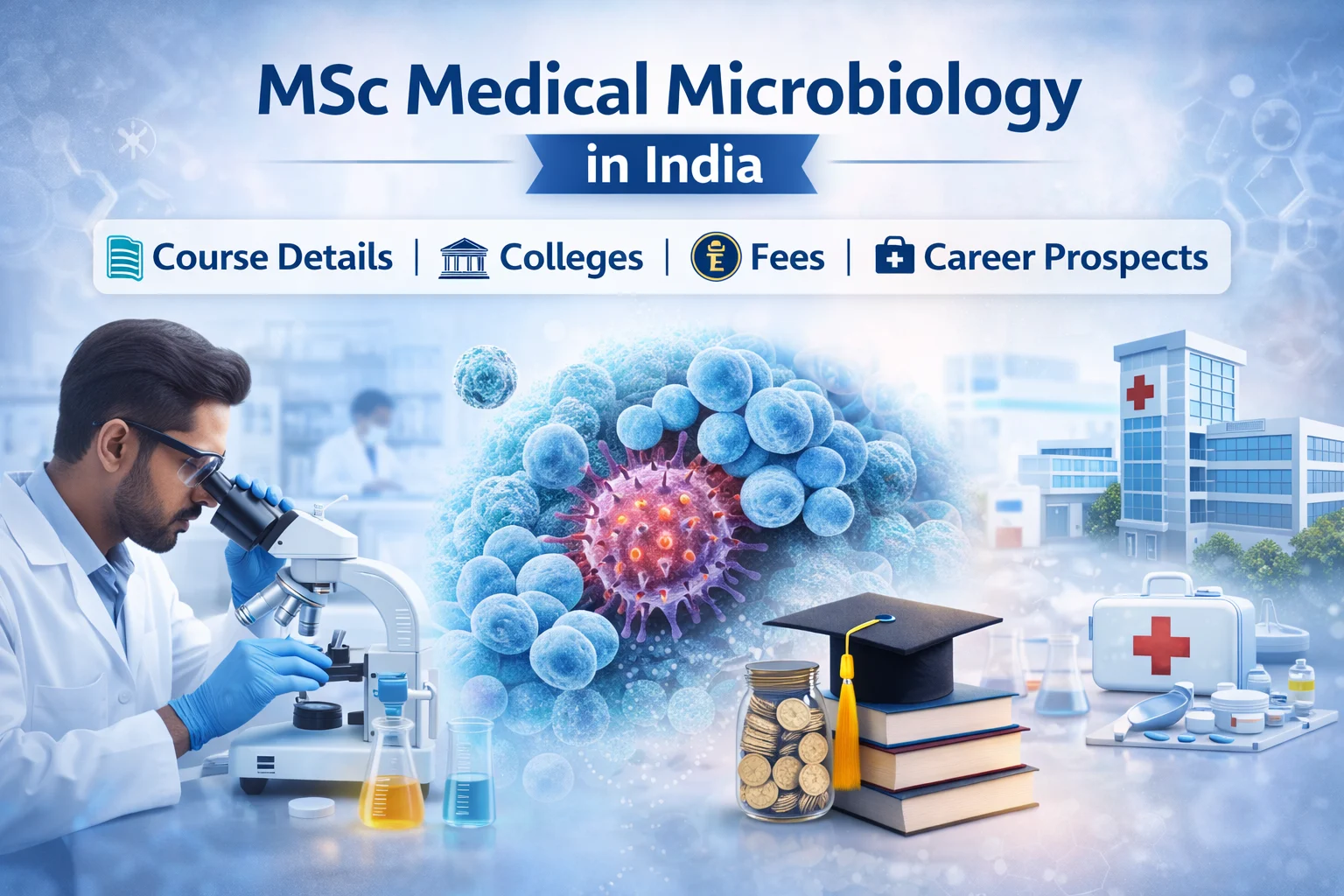
MSc Medical Microbiology is a two-year postgraduate program focused on the study of microorganisms and their role in human health and disease. Graduates can pursue careers in hospitals, research labs, and pharmaceutical companies, with salaries ranging from INR 3–8 LPA. Admission is through merit or entrance exams.
The rise of infectious diseases and antimicrobial resistance has increased the demand for skilled medical microbiology professionals. An MSc Medical Microbiology in India is a two-year postgraduate program that equips students with in-depth knowledge of microorganisms, their role in human diseases, and laboratory techniques for diagnosis and research. Applicants generally need a BSc in Microbiology or a related field with at least 50% marks, along with foundational knowledge in Biochemistry and Biotechnology. The curriculum blends theoretical concepts with practical laboratory training to prepare graduates for careers in research, clinical diagnostics, public health, and pharmaceuticals. Fees vary between government and private institutions. This guide covers top colleges, admission procedures, syllabus, and career prospects for informed decision-making.
MSc Medical Microbiology: Course Overview
The MSc Medical Microbiology course in India is a two-year postgraduate program that provides in-depth knowledge of microorganisms responsible for human diseases, laboratory diagnostics, and applied microbiology techniques. The curriculum combines theoretical understanding with extensive practical and research-oriented sessions across four semesters. Eligibility requires a bachelor’s degree in Microbiology, Biotechnology, Biochemistry, or a related field with at least 50% marks. Admission is generally merit-based or through entrance exams such as CUET PG or university-specific tests. Average annual fees range from INR 50,000 to INR 2,00,000, depending on the institution. Graduates can pursue careers in research, clinical diagnostics, public health, pharmaceuticals, and academia, meeting the growing demand for skilled medical microbiology professionals in India.
Feature
Details
Course Name
MSc Medical Microbiology
Level
Postgraduate
Duration
2 Years (4 Semesters)
Eligibility
BSc in Microbiology, Biotechnology, Biochemistry, or related field with ≥50% marks
Laboratory techniques, microbial culture, diagnostics, research projects
Average Annual Fees
INR 50,000 – INR 2,00,000
Top Colleges
AIIMS Delhi, JNU, BHU, University of Delhi, Christian Medical College Vellore
Career Opportunities
Research Scientist, Clinical Microbiologist, Laboratory Technician, Biotechnologist, Lecturer/Professor
Average Salary (Freshers)
INR 3 LPA – 5 LPA
Average Salary (Experienced)
INR 6 LPA – 12 LPA
MSc Medical Microbiology Eligibility Criteria in India
To be eligible for MSc Medical Microbiology programs in India, candidates generally need a bachelor’s degree in Microbiology or a related field such as BSc MLT, BSc Biomedical Science, BSc Biochemistry, or BSc Biotechnology. Most universities require a minimum of 50% marks in the qualifying degree, though this may vary by institution. Some colleges may also specify prerequisites in subjects like Microbiology, Biochemistry, and Biotechnology. Graduates holding a BSc MLT Microbiology degree are also eligible to apply. Certain institutions may have age limits or relaxations for reserved categories.
College/University
Minimum Percentage
Required Subjects
Other Requirements
Delhi University (DU)
50%
BSc in Microbiology / Biological Sciences / Life Sciences
Merit-based / CUET PG score (where applicable)
Banaras Hindu University (BHU)
50%
BSc in Microbiology / Biotechnology / Biochemistry
CUET PG / University Entrance Test
Jawaharlal Nehru University (JNU)
55%
BSc in Microbiology / Life Sciences
JNU Entrance Test / CUET PG
All India Institute of Medical Sciences (AIIMS)
60%
BSc in Microbiology / Biotechnology
Institute-level entrance or merit-based selection
Christian Medical College (CMC) Vellore
55%
BSc in Microbiology / Biotechnology
Merit-based / College entrance (where applicable)
Manipal Academy of Higher Education (MAHE)
50%
BSc in Microbiology / Biotechnology / Biochemistry
Entrance test / Merit-based
Amity University
55%
BSc in Microbiology / Biotechnology
Merit-based / Entrance test (Amity Test)
University of Hyderabad
50%
BSc in Microbiology / Biological Sciences
CUET PG / University entrance exam
Indian Institute of Science Education and Research (IISER)
60%
BSc in Microbiology / Biotechnology / Biological Sciences
Institute entrance / merit-based
Tata Institute of Fundamental Research (TIFR)
55–60%
BSc in Biological Sciences / Microbiology
TIFR Graduate Entrance Exam (JGEEBILS)
Indian Institute of Technology (IIT) — JAM Biotechnology
55%
BSc in Biotechnology / Microbiology
Qualify IIT JAM (Biotechnology) + counseling
University of Madras
50%
BSc in Microbiology / Life Sciences
Merit-based / University entrance
Aligarh Muslim University (AMU)
50%
BSc in Microbiology / Biological Sciences
AMU Entrance or merit-based
Panjab University
50%
BSc in Microbiology / Biotechnology
Entrance test / Merit
Jamia Millia Islamia (JMI)
50%
BSc in Microbiology / Biological Sciences
CUET PG / University test
MSc Medical Microbiology Admission Process in India
The admission process for MSc Medical Microbiology programs in India typically involves merit-based or entrance exam-based selection. The process is competitive, and candidates must carefully follow all steps to secure admission:
Application: Submit an online or offline application through the university/college portal, along with required documents like mark sheets, identity proof, and entrance exam scorecards (if applicable).
Entrance Exams (if applicable): Some institutions require scores from exams such as GAT-B (Graduate Aptitude Test in Biotechnology), ICMR Entrance Exam, or university-specific tests.
Merit List / Seat Allotment: Seats are allocated based on merit, entrance exam scores, and student preferences.
Counseling & Document Verification: Attend counseling sessions and verify original documents such as mark sheets, degree certificates, and identity proofs.
Fee Payment: Pay admission fees ranging from ₹10,000 to ₹50,000, depending on the institution.
Scholarships & Financial Aid: Explore scholarships such as the National Fellowship or Scholarship for Higher Education of ST Students.
Hostel & Accommodation: Apply for hostel or on-campus accommodation if required.
Admission to MSc Medical Microbiology programs is often competitive due to limited seats in top colleges. Candidates are advised to thoroughly research colleges, faculty expertise, research opportunities, and job placement records to make informed decisions about their future careers in medical microbiology.
Top Government Colleges for MSc Medical Microbiology in India
These government‑funded medical colleges and universities are known for strong academics, research exposure, clinical lab training and affordability for M.Sc Medical Microbiology / Microbiology with medical focus programs. Many of these institutions are also highly ranked in national frameworks (e.g., NIRF Medical / Overall rankings).
College / Institute
City / State
Typical NIRF / Reputation
Approx. Annual Fees
Admission Mode
All India Institute of Medical Sciences (AIIMS)
New Delhi, Delhi
Top medical institute in India (NIRF #1)
Very low (nominal)
Entrance / Merit
Postgraduate Institute of Medical Education & Research (PGIMER)
Chandigarh
Premier postgraduate medical institute
Very low
Entrance / Merit
Jawaharlal Institute of Postgraduate Medical Education & Research (JIPMER)
Puducherry
High‑ranked medical institute
Very low
Entrance / Merit
Sanjay Gandhi Postgraduate Institute of Medical Sciences (SGPGIMS)
Lucknow, UP
Strong research focus
Low
Institutional exam
National Institute of Mental Health and Neurosciences (NIMHANS) – Microbiology/Neuro Science labs
Bengaluru, KA
Renowned research institute
Low
Entrance / Merit
Jawaharlal Nehru Medical College (JLNMC) – Microbiology dept.
Ajmer, Rajasthan
Government medical college
Low
Merit / Exam as per university
University departments (e.g., University of Delhi, University of Hyderabad, University of Madras)
Various
Central/state universities with Microbiology/Medical Microbiology
Low
Merit / CUET / State test
Top Private Colleges / Universities for MSc Medical Microbiology in India
The following private or deemed universities are known for strong programs in M.Sc Medical Microbiology / Microbiology with good labs, industry links, and placements. Fees are higher compared with government colleges.
College / University
City / State
Indicative NIRF / Ranking
Approx. Annual Fees
Admission Mode
SRM Institute of Science and Technology (SRMIST)
Chennai, TN
Ranked among top private science universities
Moderate–High
CUET / University test
Vellore Institute of Technology (VIT)
Vellore, TN
Ranked among top private tech universities
Moderate
Merit / Entrance
Manipal Academy of Higher Education (MAHE)
Manipal, KA
Well‑known private medical/science campus
Moderate
Entrance / Merit
Amrita Vishwa Vidyapeetham
Coimbatore, TN
Highly reputed private university
Moderate
Entrance / Merit
JSS Academy of Higher Education and Research
Mysuru, KA
Multi‑discipline university
Moderate
Merit / Test
Dr. D. Y. Patil Vidyapeeth
Pune, MH
Deemed university with strong medical sciences
Moderate
Entrance / Merit
Saveetha University
Chennai, TN
Known for health sciences
Moderate
Entrance / Merit
Siksha ‘O’ Anusandhan University
Bhubaneswar, OR
Deemed university with science focus
Moderate
Entrance / Merit
Chandigarh University
Chandigarh
Large multidisciplinary private university
Moderate
CUET / Merit
MSc Medical Microbiology – Subjects and Syllabus
The MSc Medical Microbiology postgraduate program in India is a 2‑year (4 semester) course focused on the study of microbes that cause human disease, laboratory diagnosis, host‑pathogen interactions, immunological responses, and practical lab techniques. Depending on the university, core and elective subjects may vary slightly, but the foundational structure remains similar across institutions.
MSc Medical Microbiology – Fee Structure in India (Govt vs Private Colleges)
Fees for MSc Medical Microbiology programs in India vary based on type and reputation of the institution. Government colleges have significantly lower fees, while private and deemed universities charge higher tuition with additional costs such as hostel and lab fees.
Fee Component
Government Colleges (INR/year approx.)
Private Colleges (INR/year approx.)
Tuition Fee
₹10,000 – ₹40,000
₹80,000 – ₹2,50,000
Lab/Practical Fee
₹5,000 – ₹10,000
₹10,000 – ₹25,000
Examination Fee
₹1,000 – ₹5,000
₹3,000 – ₹10,000
Library & Misc.
₹1,000 – ₹3,000
₹5,000 – ₹15,000
Hostel Fee (Optional)
₹10,000 – ₹40,000
₹40,000 – ₹1,00,000
Estimated Annual Total
~₹27,000 – ₹98,000
~₹1,30,000 – ₹4,00,000
Entrance Exams for MSc Medical Microbiology in India
Admission to MSc Medical Microbiology is often based on national, university, or state level entrance exams. Some colleges also offer admissions through merit score or their own entrance tests. Common routes include:
Entrance Exam
Conducting Body
Exam Type
Basic Eligibility
Typical Exam Period
CUET‑PG
National Testing Agency (NTA)
National PG entrance
Bachelor’s degree in biological/life sciences
May‑June (annual)
JNU CEEB
Jawaharlal Nehru University
University PG entrance
BSc with relevant subjects
April
University‑specific tests
Various Universities
Institutional exam
Varies by institute
Varies (Apr–Jun)
State PG entrance exams
State Governments
State entrance
Bachelor’s degree in science
Varies by state
Jobs and Career After MSc Medical Microbiology
Graduates with MSc Medical Microbiology have a variety of career paths in healthcare, research, industry, government labs, and academia. The skills include diagnostics, pathogen identification, epidemiology, research tools, and laboratory quality control.
Common Job Roles
• Clinical Microbiologist – Work in hospitals and diagnostic labs to identify pathogens.
• Research Scientist / Associate – Conduct research in academic, industrial, or biotech labs.
• Quality Control / Quality Assurance Analyst – Ensure safety and efficacy in pharmaceutical/food industries.
• Public Health Microbiologist – Work with health agencies on disease surveillance and outbreak control.
• Laboratory Manager / Supervisor – Manage clinical or research lab operations.
• Academic Lecturer / Trainer – Teach and guide students in universities or colleges.
Career and Salary (India)
• Entry‑level Roles: ₹3 – ₹6 lakh per annum (approx.)
• Mid‑level Roles: ₹6 – ₹8+ lakh per annum
• Senior / Specialist Roles: ₹8 – ₹12+ lakh per annum (varies widely depending on experience and sector)
Further Growth Options
• PhD in Microbiology / Infectious Diseases / Immunology – Opens research scientist or academic careers.
• CSIR‑UGC NET / DBT JRF – For research fellowships and teaching eligibility.
• Industry certifications in clinical diagnostics, quality management systems, biosafety, or regulatory science.
Frequently Asked Questions (FAQs)
Q1. What is the duration of the MSc Medical Microbiology course?
The MSc Medical Microbiology course is a 2-year postgraduate program focusing on the study of microorganisms related to human diseases. It provides students with a comprehensive understanding of the field.
Q2. What are the eligibility criteria for MSc Medical Microbiology in India?
To be eligible for an MSc Medical Microbiology program in India, you must have a BSc in Microbiology or a related field with a minimum of 50% marks. You should also have studied subjects like Microbiology, Biochemistry, and Biotechnology. An entrance exam score may also be required.
Q3. What is the admission process for MSc Medical Microbiology in India?
The admission process for MSc Medical Microbiology in India involves either merit-based admission or entrance exams conducted by universities. You can apply online or offline through the college or university website and then attend counseling sessions for seat allotment.
Q4. What are the core subjects covered in the MSc Medical Microbiology course?
The MSc Medical Microbiology course covers core subjects such as General Microbiology, Immunology, Systematic Bacteriology, Virology, Medical Parasitology, Mycology, Applied Microbiology, and Recent Advances in Medical Microbiology. These subjects are taught over four semesters, along with practical and lab sessions.
Q5. How is the admission criteria determined for MSc Medical Microbiology in India?
Admission criteria for MSc Medical Microbiology in India are determined by entrance exams or merit-based admission, depending on the college or university. Generally, it is based on bachelor’s degree marks or entrance exam scores.
Shreoshree Chakrabarty is an experienced content writer with over five years of professional expertise in creating engaging and impactful content across diverse formats. Over the course of her career, she has collaborated with well-known brands such as Myntra and Justdial, contributing high-quality content that aligns with brand voice and audience expectations.
Academically, Shreoshree holds a Master’s degree in Mass Communication, and outside of her professional pursuits, she is an avid reader and a passionate traveller who enjoys exploring new places and cultures. She also loves watching movies, finding inspiration in cinema and literature that often reflects in her writing style.
MD Radiodiagnosis is a 3-year postgraduate medical program focused on medical imaging techniques like X-ray, CT, MRI, and ultrasound. The course prepares doctors for careers in diagnostic imaging, interventional radiology, and hospital-based healthcare services with strong earning potential in India and abroad. MD Radiodiagnosis is one of the most sought-after postgraduate medical specialisations in India…
A PhD in Microbiology in India is a research-focused program advancing knowledge in bacteria, viruses, fungi, and immunology. Graduates can pursue careers in academia, research labs, biotechnology, pharmaceuticals, and public health. Top colleges offer structured coursework, lab training, and fellowship opportunities. The growing need to tackle infectious diseases, ensure environmental sustainability, and secure food safety…
MSc Biology in India is a two-year postgraduate program focusing on advanced biological sciences, research skills, and laboratory techniques. The course offers specializations in areas such as microbiology, biotechnology, and genetics, opening career opportunities in research, healthcare, academia, and the biotechnology industry. The growing demand for skilled professionals in biological sciences has made MSc Biology…
The Chhattisgarh NEET PG Counselling 2025 is being conducted by the Directorate of Medical Education (DME), Raipur for admission to MD, MS, and PG Diploma courses in government and private medical colleges across Chhattisgarh. A total of 875 candidates who qualified NEET PG 2025 and meet the eligibility criteria have been listed in the CG…
The demand for skilled pharmacology professionals is growing with the healthcare industry, making MD Pharmacology a highly desirable postgraduate medical degree in India. This three-year course provides in-depth knowledge of drugs and their effects on the human body, including mechanisms of action, therapeutic uses, adverse effects, and interactions. To be eligible for MD Pharmacology, you…
MD Biochemistry is a 3-year postgraduate medical program pursued after MBBS, focusing on clinical diagnostics, laboratory medicine, and research. The course offers career opportunities in medical colleges, diagnostic labs, research institutes, and healthcare organizations across India. The growing demand for specialized healthcare professionals has made MD Biochemistry a valuable postgraduate medical degree in India. This…