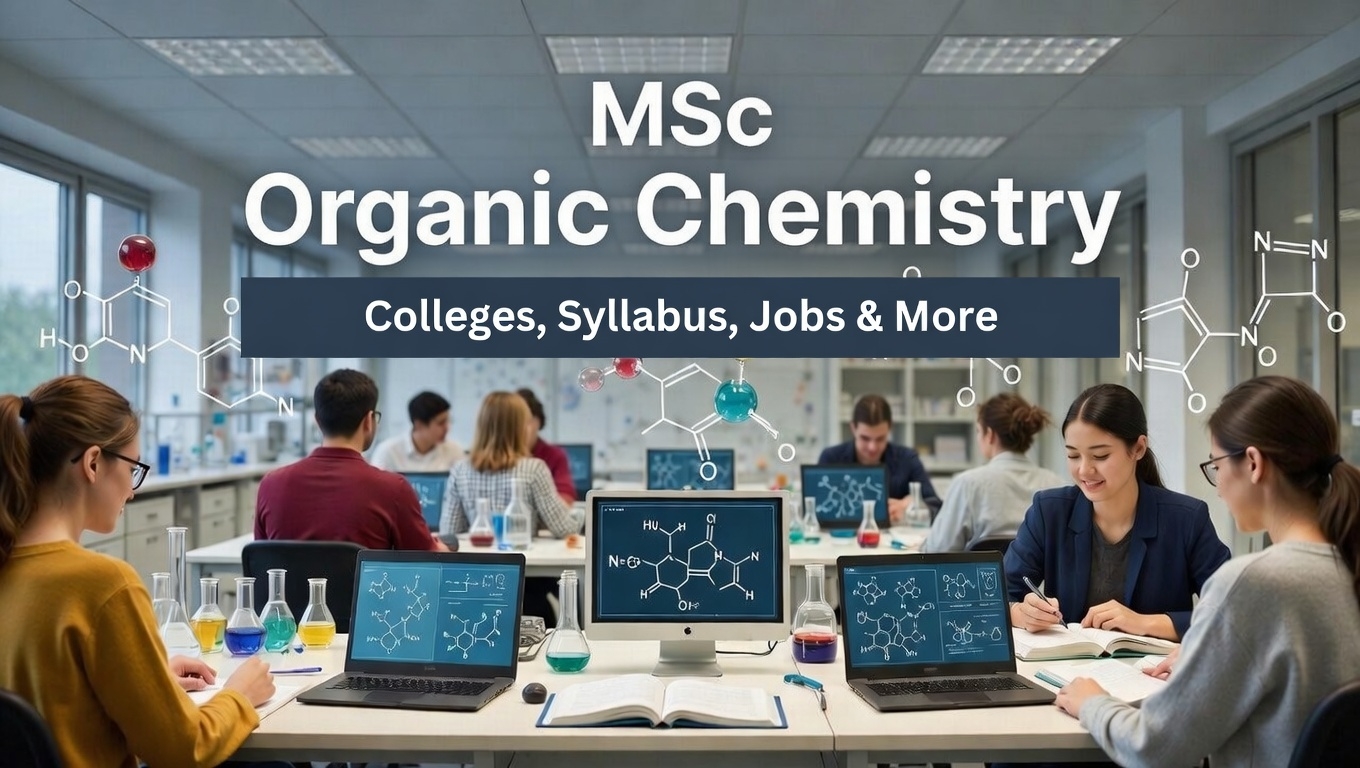
MSC Organic Chemistry in India: Colleges, Fees, Syllabus, and Career Opportunities
MSc in Organic Chemistry is a popular post-graduation course with rewarding job prospects. Take an in-depth look at this course, with top colleges, fees, jobs and more.
The MSc Organic Chemistry program in India is a two-year postgraduate course providing in-depth knowledge of organic compounds, their reactions, and applications. A Bachelor’s degree in Chemistry or a related field is the minimum requirement. Tuition fees typically range from INR 20,000 to INR 2,00,000 annually, depending on the institution. Graduates can find opportunities as research scientists, quality control chemists, and analytical chemists, with salaries ranging from INR 3 LPA to INR 7 LPA based on experience and role. Core subjects include organic reaction mechanisms, spectroscopy, and heterocyclic chemistry. Admission is generally merit-based or through entrance exams.
🔔 Admission Alerts 2026
- Application Open: IMTS Institute MSc Organic Chemistry Distance Education admissions ongoing.
- Deadline Nearing: Subharti University MSc Organic Chemistry application closes March 10, 2026.
- Admissions Open: MSc Applied Chemistry Distance Education admissions are ongoing.
- Cutoff Info: IIT JAM Chemistry Cut Off 2026 details available now.
This article provides a detailed overview of colleges offering the MSc Organic Chemistry, their fees, the syllabus, and potential career paths. This guide equips prospective students with the information needed to make informed decisions about their academic and professional journey in organic chemistry.
MSc Organic Chemistry: Course Overview
The MSc Organic Chemistry is a two-year postgraduate program that provides advanced knowledge and skills in organic chemistry. Before going in detail about the course, take a quick overview in the table below:
| Feature | Description | Details |
|---|---|---|
| Duration | Typical course duration | 2 Years |
| Eligibility | Minimum educational qualification | Bachelor’s degree in Chemistry or related field |
| Admission Process | Common admission methods | Merit-based or Entrance Exam |
| Course Fee | Average tuition fee range | INR 20,000 – INR 2,00,000 per year (Varies by college) |
| Job Roles | Potential career paths | Research Scientist, Quality Control Chemist, Analytical Chemist |
| Average Salary | Expected salary range after graduation | INR 3 LPA – INR 7 LPA (Varies by experience and role) |
| Key Subjects | Core areas of study | Organic Reaction Mechanisms, Spectroscopy, Heterocyclic Chemistry |
| Top Colleges | Notable institutions offering the program | IIT, JNU, University of Delhi, Banaras Hindu University |
| UGC/AICTE Approval | Regulatory approvals | Approved by UGC and AICTE |
| NIRF Rankings | National rankings | Varying rankings for different colleges, with IIT and JNU consistently ranked high |
MSc Organic Chemistry Eligibility Criteria: Detailed Requirements for Admission
To be eligible for an MSc Organic Chemistry program in India, applicants typically need a Bachelor’s degree in Chemistry or a related field (e.g., BSc Chemistry) with a minimum aggregate percentage between 50% and 60%. Some colleges may also require a valid score in entrance exams like CUET PG or university-specific tests. Relaxation policies may exist for reserved categories as per government norms. The following table details the eligibility criteria for MSc Organic Chemistry in India.
| Parameter | Requirement | Details | Relaxation |
|---|---|---|---|
| Qualifying Degree | Bachelor’s Degree in Chemistry or related field | BSc Chemistry, BSc Applied Chemistry, etc. | Some colleges offer relaxation to reserved categories. |
| Minimum Marks | 50% – 60% aggregate percentage | Varying percentage requirements across colleges | Relaxation of 5% for reserved categories in some colleges. |
| Subject Requirements | Chemistry as a main subject in Bachelor’s | Inorganic, Organic, and Physical Chemistry | No relaxation for subject requirements. |
| Age Limit | No age limit | Generally, no age restriction for MSc Organic Chemistry | No age relaxation applicable. |
| Reservation Policy | As per government norms | Reservation for SC, ST, OBC, and PWD categories | Relaxation in marks and age as per government regulations. |
| Entrance Exam | CUET PG, university-specific tests | Some colleges require a valid entrance exam score | No relaxation for entrance exam requirements. |
| Supporting Documents | Mark sheets, certificates, entrance exam scorecards | Required for admission and verification processes | No relaxation for document submission. |
| Application Process | Online or offline application | Varying application processes across colleges | No relaxation for application process. |
| Admission Process | Merit-based or Entrance Exam-based | Differing admission processes across colleges | No relaxation for admission process. |
| Counseling | Merit list or counseling sessions | Conducted by colleges for seat allocation | No relaxation for counseling process. |
MSc Organic Chemistry Admission Process: Step-by-Step Guide for Indian Students
The admission process for MSc Organic Chemistry in India involves several steps. The average tuition fee ranges from INR 20,000 to INR 2,00,000 per year, depending on the college. Here’s a step-by-step guide:
- Check eligibility: Ensure you have a Bachelor’s degree in Chemistry or a related field with 50% – 60% marks.
- Take entrance exams: Appear for exams like CUET PG or university-specific tests (e.g., Banaras Hindu University (BHU) or Jawaharlal Nehru University (JNU) exams).
- Apply online: Complete the application form on the college’s website, uploading required documents (mark sheets, certificates, entrance exam scorecards).
- Submit documents: If required, submit hard copies of documents to the college and ensure verification.
- Merit list: Colleges prepare merit lists based on entrance exam scores or Bachelor’s degree marks.
- Counseling: Attend counseling sessions to confirm admission and choose specializations, if needed.
- Pay fees: Pay the admission fee (INR 6,000 to INR 15,000, depending on the college) to secure your seat.
- Verification: Attend document verification to confirm the authenticity of submitted documents.
- College-specific guidelines: Check each college’s website for unique requirements.
- Admission modes: Colleges offer merit-based, entrance-based, or a combination of both.
Entrance Exams for MSc Organic Chemistry Admission in India
Admission to MSc Organic Chemistry programs in India requires entrance exams that assess a candidate’s knowledge of chemistry. The most common entrances for this course in India include:
| Exam | Conducting Body / Key Colleges | Typically Conducted During |
|---|---|---|
| IIT JAM (Chemistry) | IIT Bombay (organizing) → IITs (Bombay, Delhi, Kharagpur, etc.), NITs, IISc, IISERs, other CFTIs | February |
| CUET PG (Chemistry) | National Testing Agency (NTA) → Central Universities (DU, JNU, BHU, University of Hyderabad, etc.) | March |
| BHU PET / University-specific | Banaras Hindu University (BHU) and some others (though many now use CUET PG) | Varies |
| Other University/State-level | Various (e.g., some state unis or private like Manipal, Amity may use own tests or accept CUET/IIT JAM) | April–July |
Top Government Colleges for MSc Organic Chemistry in India
Jawaharlal Nehru Technological University Syllabus
The following table lists top government colleges in India offering MSc Organic Chemistry, including their location, course fees and admission modes:
| College / University | Location | Approximate Total Course Fees (INR) | Admission Mode |
|---|---|---|---|
| IIT Bombay | Mumbai, Maharashtra | 80,000 – 1,20,000 | IIT JAM (Chemistry) |
| IIT Delhi | New Delhi | 50,000 – 80,000 | IIT JAM (Chemistry) |
| IIT Kharagpur | Kharagpur, West Bengal | 60,000 – 1,00,000 | IIT JAM (Chemistry) |
| IIT Madras | Chennai, Tamil Nadu | 40,000 – 80,000 | IIT JAM (Chemistry) |
| Banaras Hindu University (BHU) | Varanasi, Uttar Pradesh | 10,000 – 40,000 | CUET PG or BHU-specific |
| Jawaharlal Nehru University (JNU) | New Delhi | 500 – 5,000 | CUET PG |
| University of Delhi (DU) | New Delhi | 20,000 – 50,000 | CUET PG |
| University of Hyderabad | Hyderabad, Telangana | 20,000 – 50,000 | CUET PG |
| Jamia Millia Islamia | New Delhi | 30,000 – 60,000 | CUET PG or university entrance |
| Jadavpur University | Kolkata, West Bengal | 10,000 – 40,000 | Merit-based / university entrance |
| IISER Pune | Pune, Maharashtra | 60,000 – 1,20,000 | IIT JAM (Chemistry) |
| IISER Kolkata | Kolkata, West Bengal | 60,000 – 1,20,000 | IIT JAM (Chemistry) |
| NIT Trichy (National Institute of Technology) | Tiruchirappalli, Tamil Nadu | 1,00,000 – 2,00,000 | IIT JAM (Chemistry) |
Top Private Colleges for MSc Organic Chemistry in India
The following table provides an overview of top private colleges in India offering MSc Organic Chemistry, including their location, course fees and admission mode:
| College / University | Location | Approximate Total Course Fees (INR) | Admission Mode |
|---|---|---|---|
| Christ University | Bangalore, Karnataka | 2,00,000 – 3,50,000 | University entrance / merit |
| St. Joseph’s University | Bangalore, Karnataka | 2,00,000 – 3,00,000 | Merit-based / entrance |
| Loyola College | Chennai, Tamil Nadu | 60,000 – 1,20,000 | Merit-based / university entrance |
| Fergusson College | Pune, Maharashtra | 1,00,000 – 2,00,000 | Merit-based |
| Amity University | Noida, Uttar Pradesh | 2,00,000 – 4,00,000 | Amity entrance / merit |
| VIT Vellore (Vellore Institute of Technology) | Vellore, Tamil Nadu | 1,50,000 – 3,00,000 | VIT entrance / merit |
| Manipal Academy of Higher Education (MAHE) | Manipal, Karnataka | 2,00,000 – 4,00,000 | MET / merit |
| Chandigarh University | Mohali, Punjab | 1,50,000 – 3,00,000 | CUCET / merit |
| SRM Institute of Science and Technology | Chennai, Tamil Nadu | 2,00,000 – 4,00,000 | SRMJEEE PG / merit |
| Parul University | Vadodara, Gujarat | 1,00,000 – 2,00,000 | Merit-based / entrance |
| Mithibai College | Mumbai, Maharashtra | 1,00,000 – 2,00,000 | Merit-based |
| K J Somaiya College of Science and Commerce | Mumbai, Maharashtra | 1,50,000 – 3,00,000 | Merit-based / entrance |
MSc Organic Chemistry Fee Structure: Government vs Private Colleges in India
The fee structure for MSc Organic Chemistry varies significantly between government and private colleges. Government colleges, like those affiliated with Banaras Hindu University (BHU) and the University of Delhi (DU), typically offer more affordable tuition, ranging from INR 10,000 to INR 20,000 per year. Private colleges, such as Loyola College and Christ University, charge higher fees, often between INR 50,000 and INR 2,00,000 annually. Additional costs, including hostel, examination, and miscellaneous charges, also differ. Students may be eligible for scholarships or financial aid. The table below compares the fee structure for government and private colleges in India.
| Fee Component | Government Colleges (INR) | Private Colleges (INR) | Description |
|---|---|---|---|
| Tuition Fees | 10,000 – 20,000 | 50,000 – 2,00,000 | Annual tuition fee for M.Sc. Organic Chemistry |
| Hostel Fees | 5,000 – 10,000 | 20,000 – 50,000 | Annual hostel fee for students opting for on-campus accommodation |
| Examination Fees | 1,000 – 2,000 | 2,000 – 5,000 | Fees for semester examinations and other assessments |
| Other Charges | 2,000 – 5,000 | 5,000 – 15,000 | Library fees, lab fees, and other miscellaneous charges |
| Total Fees | 18,000 – 37,000 | 77,000 – 2,70,000 | Combined total of all fees for the academic year |
| Admission Fee | 1,000 – 2,000 | 5,000 – 10,000 | One-time admission fee for new students |
| Lab Fees | 1,000 – 2,000 | 2,000 – 5,000 | Fees for laboratory equipment and materials |
| Library Fees | 500 – 1,000 | 1,000 – 2,000 | Annual fees for library services and resources |
| Alumni Association Fee | 500 – 1,000 | 1,000 – 2,000 | Annual fees for alumni association membership |
| Student Welfare Fee | 500 – 1,000 | 1,000 – 2,000 | Annual fees for student welfare activities and services |
MSc Organic Chemistry Syllabus: Year-wise Breakdown
The MSc Organic Chemistry program is a two-year course providing a full understanding of organic compounds, their properties, reactions, and synthesis, through theoretical and practical study. The curriculum is divided into four semesters, each focusing on specific areas. The table below details the syllabus, including core and elective subjects, credit hours, and lab sessions for each semester, reflecting updates as per the University Grants Commission (UGC) guidelines.
| Semester | Core Subjects | Elective Subjects | Credit Hours | Lab Sessions |
|---|---|---|---|---|
| Semester 1 | Organic Chemistry I, Chemical Bonding, Reaction Mechanism | Spectroscopy, Analytical Techniques | 18 | 6 |
| Semester 2 | Organic Chemistry II, Stereochemistry, Pericyclic Reactions | Polymer Chemistry, Green Chemistry | 18 | 6 |
| Semester 3 | Advanced Organic Chemistry, Heterocyclic Chemistry, Natural Products | Medicinal Chemistry, Supramolecular Chemistry | 18 | 6 |
| Semester 4 | Spectroscopic Methods in Organic Chemistry, Dissertation/Project Work | Advanced Topics in Organic Chemistry | 18 | 6 |
| Semester 1 (Specialization) | Organometallic Chemistry, Bioorganic Chemistry | Organic Synthesis, Catalysis | 12 | 4 |
| Semester 2 (Specialization) | Physical Organic Chemistry, Organic Photochemistry | Environmental Organic Chemistry, Agricultural Chemistry | 12 | 4 |
| Semester 3 (Electives) | Chemical Biology, Materials Chemistry | Nanotechnology, Computational Chemistry | 10 | 3 |
| Semester 4 (Project Work) | Dissertation/Project Work | Research Methodology, Scientific Writing | 15 | 5 |
| Semester 1 (Foundation) | Mathematics for Chemists, Statistics for Chemists | Computer Applications in Chemistry | 8 | 2 |
| Semester 2 (Foundation) | Chemical Engineering, Unit Operations | Process Control, Safety Management | 8 | 2 |
Core Subjects in MSc Organic Chemistry
Take an in-depth look at the various fundamental subjects taught in this course, along with their descriptions:
| Subject Name | Description |
|---|---|
| Advanced Organic Chemistry | Deep study of reaction mechanisms, stereochemistry, and organic reactivity. |
| Physical Organic Chemistry | Explores how molecular structure influences reaction rates and mechanisms. |
| Synthetic Organic Chemistry | Focuses on designing and executing multi-step organic syntheses. |
| Organic Reaction Mechanisms | Detailed analysis of how and why organic reactions proceed. |
| Spectroscopy & Structure Elucidation | Uses NMR, IR, UV-Vis, and MS to determine molecular structures. |
| Heterocyclic Chemistry | Study of heterocycles essential in pharmaceuticals and biomolecules. |
| Natural Products Chemistry | Examines isolation, structure, and synthesis of natural organic compounds. |
| Organometallic Chemistry | Covers metal–carbon compounds and their roles in catalysis and synthesis. |
What to Do After MSc Organic Chemistry?
After completing MSc in Organic Chemistry, graduates can explore a range of options:
Pursue a PhD in Organic Chemistry or a related field
Enroll in a PhD program at premier institutions like IITs, IISc, or CSIR labs to deepen expertise in advanced synthesis, drug discovery, or materials science. This opens doors to high-level R&D roles, academia, or specialized industry positions with significantly higher earning potential and leadership opportunities.
Enter the pharmaceutical or chemical industry directly
Join as a research scientist, organic chemist, or production chemist in top companies such as Sun Pharma, Dr. Reddy’s, Cipla, or Jubilant. These roles involve drug synthesis, process development, and quality assurance, providing hands-on experience, quick career progression, and competitive starting salaries in a high-demand sector.
Explore government or research organization positions
Prepare for competitive exams like CSIR-NET, GATE, or UPSC to secure scientist roles in DRDO, BARC, ISRO, or CSIR laboratories. These offer job stability, excellent benefits, research funding, and opportunities to contribute to national projects in organic synthesis and innovation.
Opt for teaching or academic careers
Qualify for UGC-NET to become a lecturer or assistant professor in colleges and universities, or join coaching institutes for entrance exam preparation. With experience and further qualifications like a PhD, this path provides intellectual fulfillment, steady income, and the chance to mentor future chemists while engaging in research
Top Job Roles and Salary Packages After MSc Organic Chemistry
Take a look at popular job opportunities, top recruiters and salary range after completing MSc Organic Chemistry below:
| Job Role | Job Description (Short) | Key Recruiters | Salary Range (INR LPA) |
|---|---|---|---|
| Research Scientist / R&D Chemist | Conduct organic synthesis, drug discovery, and compound development in labs. | Sun Pharma, Dr. Reddy’s, Cipla, Pfizer | 4–12 |
| Organic Chemist | Synthesize and analyze carbon-based compounds for pharma, materials, or agrochemicals. | Aarti Industries, BASF, Glenmark, Jubilant, Divi’s Labs | 4–10 |
| Quality Control / Assurance Analyst | Test and ensure product quality, compliance with standards in manufacturing. | Cipla, Sun Pharma, Torrent, Lupin, Alkem Labs | 3.5–9 |
| Production Chemist | Oversee large-scale synthesis and production processes in chemical/pharma plants. | Reliance, Asian Paints, UPL, SRF | 4–10 |
| Regulatory Affairs Associate | Handle documentation, compliance, and approvals for drugs/chemicals. | Novartis, Dr. Reddy’s, Biocon, Zydus Cadila | 5–12 |
| Pharma Sales / Technical Sales Executive | Promote pharmaceutical products to doctors/hospitals, often with technical demos. | Various pharma companies (e.g., Cipla, Sun, Abbott) | 5–12 |
| Toxicologist | Assess safety and toxicity of compounds, especially in pharma/drugs. | Pharma R&D firms, CROs like Syngene, government labs | 6–15 |
| Lab / Research Assistant | Support experiments, data analysis, and lab operations in research settings. | Universities, IITs, CSIR, private labs | 3–6 |
| Lecturer / Assistant Professor | Teach chemistry at colleges/universities (often requires NET/PhD for permanent roles). | Government/private colleges, coaching institutes (Allen, Aakash) | 4–10 |
Preparation Tips for Admission in MSc Organic Chemistry
Here are some practical tips to help you secure admission into M.Sc. Organic Chemistry through key entrance exams:
- Master the syllabus and prioritize high-weightage topics : Thoroughly review the official syllabus, focusing heavily on Organic Chemistry (reaction mechanisms, stereochemistry, name reactions) as it carries significant weight in most exams.
- Build strong conceptual foundations from reliable sources : Start with NCERT textbooks for basics, then advance to standard books like Morrison & Boyd for Organic Chemistry to develop deep understanding of core concepts.
- Practice previous year papers and mock tests regularly: Solve past papers and take timed mock tests weekly to familiarize yourself with question patterns, improve speed, accuracy, and identify weak areas early.
- Create concise notes and revise consistently: Make short, targeted notes on key reactions, mechanisms, formulas, and exceptions for quick, effective revision in the final weeks before the exam.
- Maintain a disciplined study schedule with balanced breaks: Follow a realistic daily timetable covering all sections, include regular revisions and short breaks to stay focused, avoid burnout, and sustain long-term motivation.
MSc Organic Chemistry vs MSc Inorganic Chemistry
Here is a side-by-side comparison of two popular MSc courses – organic and inorganic chemistry.
| Aspect | M.Sc. Organic Chemistry | M.Sc. Inorganic Chemistry |
|---|---|---|
| Main Focus | Carbon-based compounds, synthesis, reactions, and drugs | Non-carbon compounds, metals, coordination, catalysis |
| Key Subjects | Reaction Mechanisms, Stereochemistry, Spectroscopy, Heterocyclic Chemistry, Natural Products | Coordination Chemistry, Organometallic, Bioinorganic, Solid-State Chemistry, Transition Metals |
| Typical Career Paths | Pharma R&D, Drug Synthesis, Quality Control, Production Chemist | Materials Science, Catalysis, Metallurgy, Energy/Battery Research, Analytical Roles |
| Major Industries | Pharmaceuticals, Biotech, Agrochemicals, Fine Chemicals | Materials, Energy Storage, Catalysis, Government Labs, Metallurgy |
| Top Recruiters | Sun Pharma, Dr. Reddy’s, Cipla, Pfizer, Syngene, Jubilant | CSIR/DRDO/BARC, Reliance, Tata Chemicals, Battery firms, Research Institutes |
| Entry-Level Salary (INR LPA) | ₹4 – 10 | ₹4 – 9 |
| Job Market Demand | Higher in private sector (pharma boom) | Strong in govt/research & emerging tech (batteries, materials) |
| Best Suited For | Interest in drug design, synthesis, lab-based organic work | Interest in metals, materials, catalysis, inorganic applications |
Frequently Asked Questions (FAQs)
Q1. What is the typical duration of an M.Sc. Organic Chemistry course in India?
The typical duration of an M.Sc. Organic Chemistry course in India is 2 years. This is a postgraduate course that follows a bachelor’s degree in Chemistry or a related field. The course is designed to provide advanced knowledge in organic chemistry.
Q2. What are the key subjects covered in the M.Sc. Organic Chemistry syllabus?
The M.Sc. Organic Chemistry syllabus covers key subjects such as Organic Reaction Mechanisms, Spectroscopy, and Heterocyclic Chemistry. Other subjects included in the course are Stereochemistry, Pericyclic Reactions, and Advanced Organic Chemistry. The syllabus is designed to provide a full understanding of organic chemistry.
Q3. What is the average tuition fee range for M.Sc. Organic Chemistry courses in India?
The average tuition fee range for M.Sc. Organic Chemistry courses in India varies from INR 20,000 to INR 2,00,000 per year, depending on the college. Government colleges tend to have lower fees, ranging from INR 10,000 to INR 20,000 per year, while private colleges can charge up to INR 2,00,000 per year.
Q4. What are the potential c
areer paths for M.Sc. Organic Chemistry graduates in India?
M.Sc. Organic Chemistry graduates in India can pursue potential career paths such as Research Scientist, Quality Control Chemist, and Analytical Chemist. The average salary range for these roles is between INR 3 LPA and INR 7 LPA, depending on experience and the specific job role.
Q5. What are the entrance exams required for M.Sc. Organic Chemistry admission in India?
Some of the entrance exams required for M.Sc. Organic Chemistry admission in India include CUET PG, IIT JAM, DUET, and BHU PET. These exams are conducted at the national or university level and are used to determine eligibility for admission to M.Sc. Organic Chemistry courses.
Q6. What is the salary of MSc Organic Chemistry in India?
The average starting salary after M.Sc. Organic Chemistry in India ranges from ₹4-8 LPA for freshers, often higher (₹5-10 LPA) in pharmaceutical R&D roles at top companies. With experience or a PhD, it can rise to ₹10-20+ LPA, depending on location, skills, and employer.
Q7. Is organic chemistry a lot of maths?
No, M.Sc. Organic Chemistry involves very little mathematics compared to physical or inorganic branches. It focuses mainly on conceptual understanding, reaction mechanisms, stereochemistry, and synthesis logic, with only basic arithmetic requirements.
Frequently Asked Questions (FAQs)
Q: What is the typical duration and fee structure for an MSC Organic Chemistry program in India?
An MSC Organic Chemistry program in India is generally a 2-year postgraduate course. As of 2026, annual fees can range from INR 30,000 for government universities to INR 2,00,000 for private institutions, varying significantly based on the college’s reputation and facilities.
Q: Are there specific entrance exams required for MSC Organic Chemistry admissions in India?
Yes, many top Indian universities require entrance exams. Common ones include university-specific tests (e.g., DUET, BHU PET) or national-level exams like IIT JAM. Some institutions also consider NTA scores for postgraduate admissions. A strong undergraduate academic record is also crucial.
Q: What is the career scope after completing an MSC Organic Chemistry in India?
Graduates can find roles in pharmaceutical, agrochemical, petrochemical, and R&D sectors. Opportunities exist as Research Scientists, Quality Control Chemists, Analytical Chemists, or Product Development Specialists. Further studies like PhDs are also popular for academic or advanced research careers.
Q: What is the expected starting salary for an MSC Organic Chemistry graduate in India (2026 figures)?
As of 2026, a fresher with an MSC Organic Chemistry degree can expect an average starting salary ranging from INR 3.5 LPA to INR 6 LPA. This largely depends on the recruiting company, location, and the graduate’s skills and university reputation. Top-tier companies offer better packages.
Q: What are the opportunities for pursuing higher studies or jobs abroad after an MSC Organic Chemistry from India?
An MSC Organic Chemistry from India provides a strong foundation for pursuing PhDs or research positions abroad, particularly in countries like the USA, UK, Germany, and Canada. Many Indian graduates secure scholarships or research assistantships for international opportunities in academia or industry.
Q: Is an MSC Organic Chemistry degree recognized by regulatory bodies like UGC or AICTE in India?
Yes, an MSC Organic Chemistry degree offered by a university or institution approved by the University Grants Commission (UGC) is fully recognized. While AICTE primarily regulates technical education, UGC recognition is paramount for general university degrees, ensuring their validity for higher education and employment.