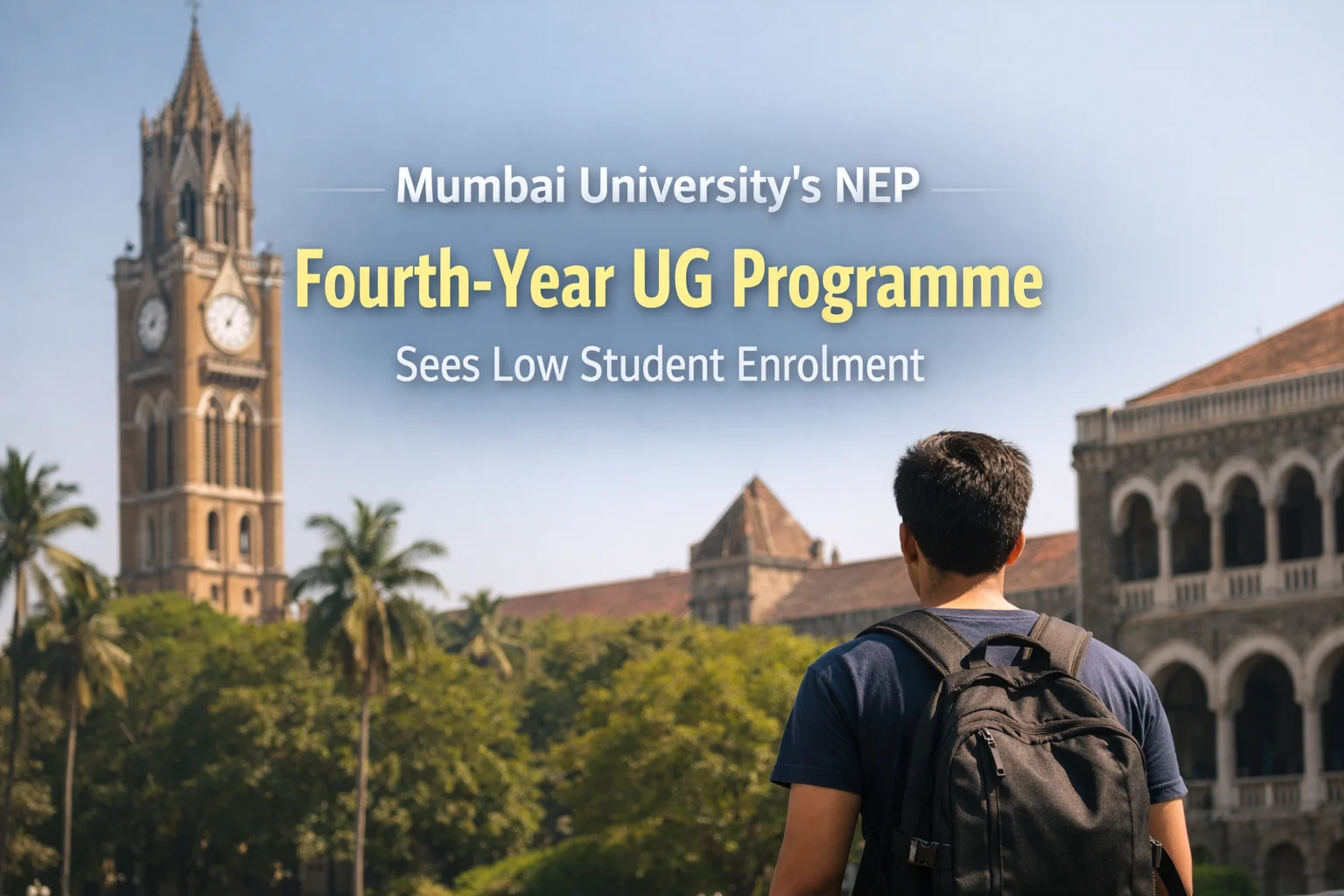
Mumbai University’s NEP Fourth-Year UG Programme Sees Low Student Enrolment
Mumbai University’s optional fourth-year undergraduate programme introduced under NEP 2020 is witnessing low student participation. Early surveys from affiliated colleges show that only a small percentage of eligible students are opting for the additional year.
Mumbai University recently introduced an optional fourth year in undergraduate programmes under the National Education Policy (NEP) 2020. However, the move has seen lower-than-expected student participation. Internal surveys from several colleges indicate that only a small percentage of eligible students have shown interest in continuing for the additional year.
Initially, it was expected that a significantly higher number of students would be opting for the extended programme. But early assessments suggest limited uptake, especially among students planning to enter the workforce right after the completion of the standard three-year degree.
Four-Year UG Structure Introduced Under NEP
The University of Mumbai has introduced a structure for the four-year undergraduate programme, which complies with the guidelines of NEP 2020. The policy encourages a multidisciplinary curriculum, flexible exit options, and research-oriented learning in higher education.
Under this structure:
-
Students who complete three years receive a standard bachelor’s degree.
-
Students who opt for the fourth year, typically with a minimum CGPA of around 7.5, can graduate with an Honours degree with a research component.
-
The fourth year includes advanced coursework, research projects, and interdisciplinary learning modules.
A major advantage for students opting for a four-year degree is that they may become eligible to pursue a one-year master’s programme.
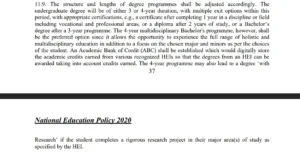
Check the NEP guidelines here.
Student Interest Much Lower Than Initial Expectations
Colleges that are affiliated with Mumbai University initially estimated that around 40–50% of students might opt for the fourth year. Although, preliminary internal surveys indicate that only about 5–10% of eligible students are currently considering continuing into the additional year.
Few institutions reported that less than one-third of eligible students have even expressed interest in the extended programme.
Reasons That Influenced Low Enrolment
Several factors appear to be influencing student decisions:
-
Limited awareness about the benefits of the four-year degree structure
-
Uncertainty about career advantages of an additional academic year
-
Preference for entering the job market after completing a three-year degree
-
Financial concerns related to the extra year of study
-
Students planning postgraduate education abroad or in specialised fields showing relatively higher interest
College administrators say that science students planning postgraduate studies appear more likely to consider the fourth year compared with students from commerce or arts streams.
College Authorities Describe the Trend as a Transitional Phase
Education administrators believe that the current response reflects a transition period as students adjust to the new system introduced under NEP.
Dr. Parag Ajgaonkar, Principal of Narsee Monjee College of Commerce and Economics, noted that students planning to pursue postgraduate education are more inclined to continue for the fourth year, while others prefer completing their degree within three years.
Similarly, Dr. Anushree Lokur, Principal of Ramnarain Ruia Autonomous College, indicated that BSc students interested in research or advanced academic studies have shown relatively stronger interest in the new structure.
University Yet to Finalise Some Implementation Details
The University of Mumbai and affiliated colleges are still working on several operational aspects of the new programme. Authorities have not yet provided detailed guidelines on:
-
Standardised fee structures
-
Lateral entry provisions for students from other institutions
-
Faculty workload distribution
-
Institutional funding for research components
As colleges prepare curricula and academic frameworks, many are awaiting further directives from the university and state higher education authorities.
NEP Implementation in Mumbai’s Higher Education System
The optional fourth year is part of the broader NEP 2020 reform agenda, which introduces a four-year undergraduate structure with multiple entry and exit points. The policy is being implemented gradually across universities in India, including those in Maharashtra.
Under the framework:
-
Students may exit after one year with a certificate,
-
Two years with a diploma,
-
Three years with a bachelor’s degree, or
-
Four years with an honours or honours with research degree.
While the reform aims to increase flexibility and improve research opportunities, the initial response from students suggests that wider acceptance may take time as institutions and learners adapt to the new academic model.


📰 More Education News
- AP ICET Application Last Date 2026: Registrations Without Late Fee Closing Soon at cets.apsche.ap.gov.inMar 11, 2026 • Simran
- Indian Navy Agniveer Recruitment 2026: Applications for SSR, MR & Medical Posts to Begin from March 14Mar 11, 2026 • Simran
- ICSE Chemistry Exam 2026 Ends: Question Paper Analysis and Unofficial Answer Key ReleasedMar 11, 2026 • Shreoshree Chakrabarty
- NCERT Class 9 English Syllabus 2026 Revised: New Textbook To Feature Sudha Murty and TagoreMar 11, 2026 • Shreoshree Chakrabarty