
NIFT PhD Admissions 2026: Teaching-Fellow Seats Quadrupled to 20; Fee Waivers Up to 100% Announced
NIFT PhD Admissions 2026: In a major policy overhaul aimed at strengthening research and academic engagement, the National Institute of Fashion Technology (NIFT) has announced key revisions to its PhD admission guidelines for the 2026 academic session, including a substantial increase in teaching-fellowship seats and enhanced tuition fee waiver benefits for eligible aspirants. The updated framework was issued through a formal notification released by the institute earlier this week.
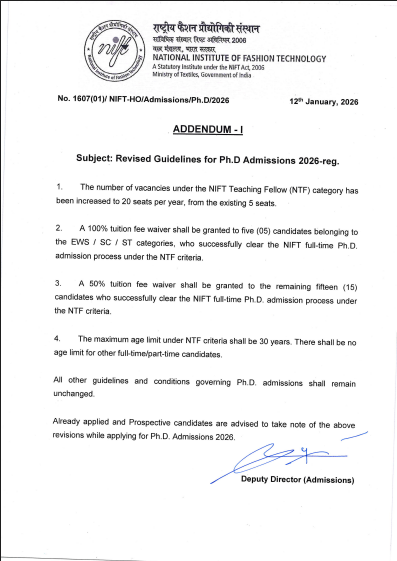
Under the revised structure, the number of NIFT Teaching Fellow (NTF) vacancies has been increased to 20 seats per year, marking a fourfold rise from the earlier allocation of just five. This expansion reflects NIFT’s strategic push to build a stronger pool of research-focused scholars who can contribute to teaching and academic activities across its network of campuses nationwide.
Download PDF- Addendum – Ph.D-2026 (1)
Enhanced Fee-Waiver Benefits to Boost Inclusivity
To make doctoral research more accessible, NIFT has introduced generous tuition fee waivers for candidates selected under the NTF category. According to the official notice:
-
Five candidates belonging to the Economically Weaker Sections (EWS), Scheduled Castes (SC), and Scheduled Tribes (ST) categories will receive a 100% tuition fee waiver upon successful selection.
-
The remaining 15 candidates selected under the same category will be eligible for a 50% tuition fee waiver as part of the revised policy.
The fee waiver provisions are expected to significantly lower financial barriers for research-oriented students, especially those from underrepresented communities. While the exact policy framework was made public only recently, institutions across India have been increasingly adopting such measures to promote diversity and inclusivity in higher education.
Age Criteria and Eligibility Clarifications
Alongside the expansion of seats and waiver benefits, the notification clarifies age eligibility for prospective applicants. For those applying under the NTF category, a maximum age limit of 30 years has been prescribed. However, the institute has not imposed any age limit on candidates opting for other full-time or part-time PhD programmes, enabling mid-career professionals and experienced scholars to pursue doctoral research at NIFT.
Admission to the PhD programme will continue to be governed by the NIFT Admissions Prospectus 2026, with all applicants required to fulfill the prescribed academic and documentation standards as outlined in that document.
Overseas Citizen of India (OCI) Applicants: A Clarified Pathway
In a separate but related clarification, NIFT has also reconfigured its eligibility criteria for Overseas Citizen of India (OCI) cardholders, addressing concerns arising from recent regulatory interpretations.
According to the updated guidelines:
-
OCI cardholders whose documents were issued prior to March 4, 2021 may apply either as Indian Nationals under the Open (General) category or under the NRI/Foreign National category, provided they fulfill all prescribed eligibility conditions.
-
Candidates holding OCI cards issued on or after March 4, 2021 will be governed by the Ministry of Home Affairs’ notification dated April 4, 2021, and must apply under the NRI/Foreign National category. These applicants are required to submit standardized test scores such as the SAT, GMAT, or GRE, depending on the programme requirements.
NIFT has underscored that verification of original documents — including the OCI card issuance date, nationality, age proof, and academic qualifications — will be mandatory for final admission clearance. In case of any discrepancy between earlier instructions and the updated prospectus, the new guidelines will take precedence.
Strengthening Research Culture at NIFT
Observers believe that the quadrupling of teaching-fellow seats and the introduction of structured fee concessions signal NIFT’s intent to deepen its research culture and attract a more diverse cohort of scholars to its doctoral programmes. The enhanced focus on research capacity aligns with broader national objectives to elevate Indian academic institutions as global research hubs.
Prospective candidates, including those who have already submitted applications, are being urged to review the revised admission guidelines carefully before finalising their submissions. With these changes, NIFT hopes to not only expand its academic footprint but also create a more equitable and supportive environment for future researchers.