PhD in Chemistry: Complete Guide to Course, Eligibility, Admission, Syllabus, Research Areas, Career Scope, and Salary
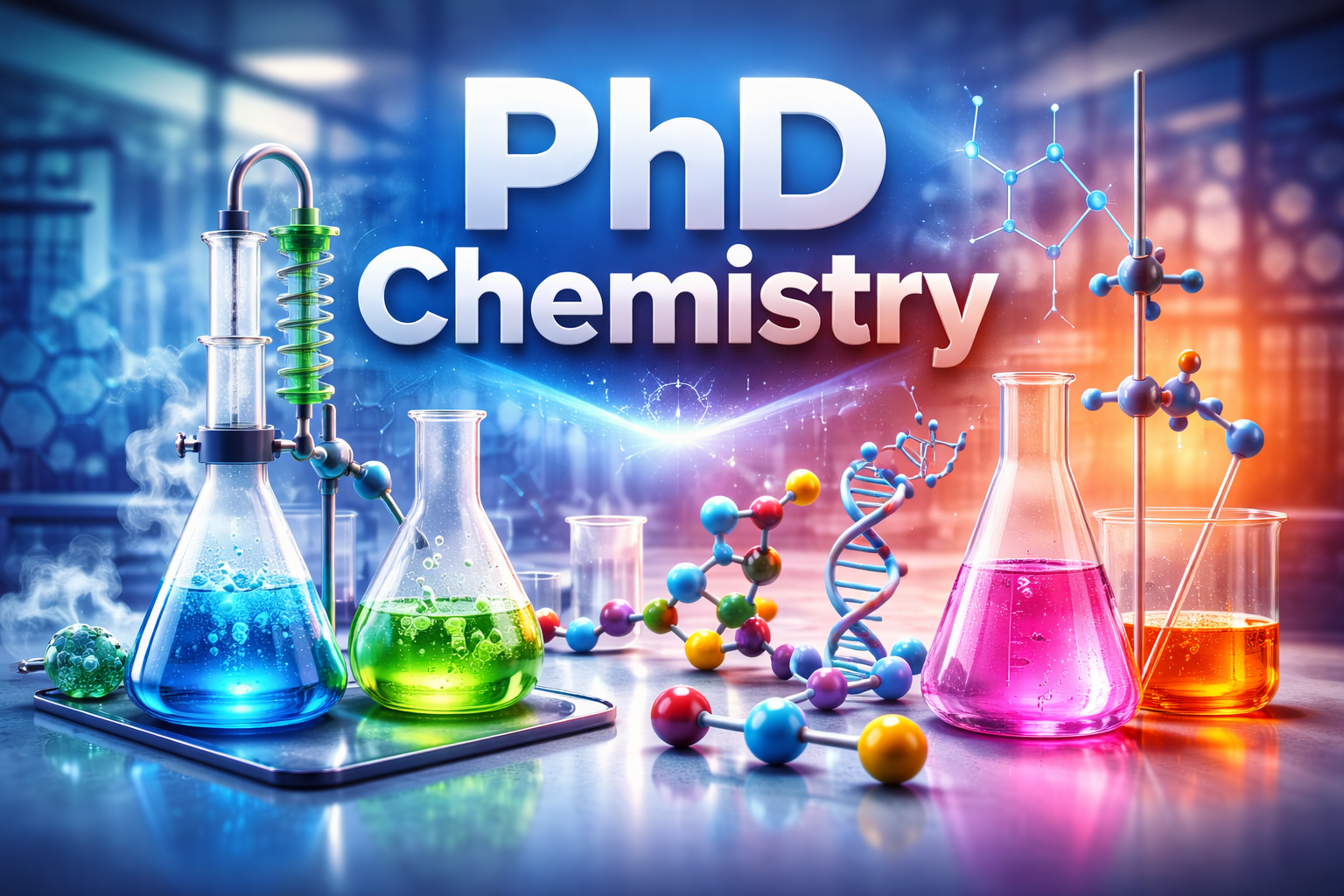
A PhD in Chemistry is the highest academic qualification in the field of chemical sciences and focuses primarily on advanced research and scientific innovation. This program is designed for students who want to explore chemistry in depth and contribute to new discoveries in areas such as drug development, materials science, environmental protection, and industrial chemistry.
Chemistry is known as the central science because it connects physics, biology, medicine, and engineering. From developing life-saving medicines to creating sustainable energy materials, chemistry plays a major role in modern technological advancement. A PhD program allows students to specialize in a particular branch of chemistry while gaining expertise in research methodologies and laboratory techniques.
During the course, students work closely with research supervisors, conduct experiments, publish research papers, and present their findings at scientific conferences. This process helps build strong analytical, technical, and problem-solving skills that are essential for high-level scientific careers.
This detailed guide explains everything about the PhD in Chemistry course including eligibility, admission process, syllabus, research areas, specializations, career opportunities, salary, and future scope.
What is PhD in Chemistry?
A PhD (Doctor of Philosophy) in Chemistry is a research-focused doctoral program that usually takes 3 to 5 years to complete, depending on the complexity of the research topic and the student’s progress.
Unlike undergraduate or postgraduate courses that focus mainly on classroom learning, a PhD program emphasizes independent research work. Students are required to identify a research problem, design experiments, analyze results, and present conclusions in the form of a thesis.
The program generally includes:
-
Coursework in the first year
-
Literature review of existing research
-
Laboratory experimentation
-
Data analysis and interpretation
-
Publication of research papers
-
Final thesis submission and viva voce
The main objective of a PhD is to create new knowledge and develop innovative solutions to scientific problems.
Why Choose PhD in Chemistry?
Choosing a PhD in Chemistry is ideal for students who are passionate about laboratory work, scientific discovery, and academic research. With growing advancements in pharmaceuticals, nanotechnology, and environmental science, there is an increasing demand for skilled chemistry researchers.
One of the biggest advantages of pursuing a PhD is the opportunity to work on real-world scientific problems such as developing new medicines, improving industrial processes, or creating eco-friendly materials.
Benefits of Studying PhD in Chemistry
-
Opportunity to specialize in advanced research areas
-
Strong career opportunities in academic and industrial sectors
-
High demand in pharmaceutical and chemical industries
-
Opportunities for international collaboration
-
Research funding and fellowship support
Students who enjoy experimentation and analytical thinking often find this field intellectually rewarding and professionally stable.
PhD in Chemistry Course Duration
The duration of a PhD in Chemistry varies depending on the university guidelines and research progress. Typically, the program takes between 3 to 5 years to complete.
The course is divided into different stages:
| Stage | Duration |
|---|---|
| Coursework | 6 Months – 1 Year |
| Research Proposal & Literature Review | 6 Months |
| Experimental Research | 2 – 3 Years |
| Thesis Writing & Submission | Final 6 Months |
| Total Duration | 3 – 5 Years |
If experiments require extensive data or advanced instrumentation, students may need additional time to complete their research.
PhD in Chemistry Coursework Structure
The first stage of a PhD program usually includes coursework designed to strengthen theoretical understanding and research skills. This phase is very important because it prepares students for advanced experimental work.
Coursework introduces students to modern scientific techniques and research tools used in chemistry laboratories worldwide.
Major Coursework Topics
-
Advanced Organic Reaction Mechanisms
-
Quantum Chemistry and Molecular Structure
-
Spectroscopic Methods of Analysis
-
Computational Chemistry Tools
-
Research Methodology and Experimental Design
-
Scientific Writing and Publication Ethics
Students are also trained to read international research journals and learn how to write scientific papers.
At the end of coursework, most universities conduct a qualifying examination. Students must pass this exam to continue their research.
Eligibility Criteria for PhD in Chemistry
The eligibility criteria for a PhD in Chemistry in India are designed to ensure that candidates have strong academic knowledge and research aptitude before entering a doctoral-level program. Since a PhD is highly research-oriented, universities and research institutes expect students to have a solid foundation in core chemistry subjects along with basic laboratory experience.
Most institutes follow similar academic requirements, but some conditions may vary depending on the university, specialization, and research area.
Academic Qualification
The most important requirement for PhD in Chemistry admission is a Master’s degree in Chemistry or a closely related discipline. Candidates must have completed:
-
MSc Chemistry
-
MSc Applied Chemistry
-
MSc Analytical Chemistry
-
MSc Organic/Inorganic/Physical Chemistry
-
MSc Biochemistry or Materials Chemistry (in some cases)
Generally, students must secure at least 55% marks in their postgraduate degree. Reserved category candidates may receive relaxation according to government rules.
Some institutes also accept candidates who have completed integrated postgraduate programs such as MSc Integrated or dual-degree courses.
Internship or Research Experience (Preferred)
Although not always mandatory, having research experience during MSc can improve admission chances. This may include:
-
Dissertation or project work
-
Laboratory training
-
Published research papers
-
Participation in research internships
Research exposure helps students handle experimental work more efficiently during their PhD.
| Eligibility Component | Details / Requirements |
|---|---|
| Educational Qualification | Master’s degree in Chemistry or related fields such as MSc Applied Chemistry, MSc Analytical Chemistry, MSc Organic/Inorganic/Physical Chemistry, MSc Biochemistry, or Materials Chemistry |
| Minimum Marks | At least 55% in postgraduate degree (relaxation for reserved categories as per government rules) |
| Integrated Programs Accepted | MSc Integrated or dual-degree programs are sometimes accepted |
| Research / Internship Experience | Preferred but not mandatory. May include dissertation/project work, laboratory training, published research papers, or participation in research internships |
| Research Aptitude | Strong foundation in core chemistry subjects and basic laboratory experience required |
| Variations | Some universities may have additional requirements depending on specialization or research area |
Entrance Exams for PhD in Chemistry
Many institutes require candidates to qualify for national-level entrance examinations for PhD admission.
| Entrance Exam | Conducting / Supporting Organization | Purpose / Use | Additional Benefit |
|---|---|---|---|
| CSIR NET (Chemical Sciences) | Council of Scientific and Industrial Research (CSIR) | PhD admission in chemistry and related fields | Qualifying candidates may receive Junior Research Fellowship (JRF) |
| UGC NET | University Grants Commission (UGC) | PhD admission and eligibility for Assistant Professor roles | Fellowship eligibility and recognition for academic positions |
| GATE (Chemistry) | Indian Institutes of Technology (IITs) | Admission to PhD programs in IITs, IISc, and other research institutes | Can improve admission chances and scholarship opportunities |
| University-level PhD Entrance Test | Individual Universities | Institute-specific PhD admissions | May include interviews, research proposal evaluation, and fellowship consideration |
PhD in Chemistry Admission Process in India
Admission to a PhD in Chemistry in India is a multi-stage process designed to ensure that candidates have the academic knowledge, research aptitude, and practical skills required for advanced scientific research. Unlike undergraduate or postgraduate admissions, PhD admissions are research-focused and usually involve eligibility verification, entrance exams, interviews, and research proposal evaluation.
The process may slightly vary between universities and research institutes, but most follow a standard procedure.
Step 1: Check Eligibility
Before applying, candidates must confirm they meet the eligibility requirements. Most institutes require:
-
A Master’s degree (MSc) in Chemistry or a related field such as Applied Chemistry, Analytical Chemistry, Organic/Inorganic/Physical Chemistry, Biochemistry, or Materials Chemistry.
-
A minimum of 55% marks (relaxation may be provided for reserved categories).
-
Strong foundation in core chemistry subjects and basic laboratory experience.
-
Some institutes may also prefer candidates with prior research or internship experience.
Candidates who meet these requirements are eligible to apply for the next stage.
Step 2: Entrance Examination
Most top universities and research institutes in India require candidates to qualify a national or university-level entrance examination. These exams assess the candidate’s:
-
Knowledge of chemistry fundamentals
-
Research aptitude
-
Analytical and problem-solving abilities
Common Entrance Exams:
-
CSIR NET (Chemical Sciences) – Conducted by the Council of Scientific and Industrial Research (CSIR), this exam is widely recognized for PhD admissions and fellowship eligibility.
-
UGC NET – Conducted by the University Grants Commission, primarily for academic eligibility, but also recognized for PhD admission.
-
GATE (Chemistry) – Accepted by IITs, IISc, and research labs, focusing on both theoretical and numerical understanding.
-
University-Level Entrance Exams – Some universities conduct their own exams, testing specialized chemistry knowledge and research aptitude.
Candidates who qualify these exams are often eligible for research fellowships like JRF or SRF.
Step 3: Application Submission
After confirming eligibility and preparing for the entrance exam, candidates must submit an application form.
Key points include:
-
Application is usually online through the university’s official portal.
-
Candidates may need to upload academic transcripts, degree certificates, research experience documents, and sometimes a research statement.
-
Pay the application fee as specified by the university.
-
Ensure deadlines are met; most PhD admissions follow a yearly cycle (usually aligned with July or January sessions).
Step 4: Shortlisting of Candidates
After entrance exam results are declared, universities shortlist candidates based on:
-
Entrance exam score
-
Academic record (MSc marks and previous research experience)
-
Research proposal (if required)
Shortlisted candidates are then called for the next stage – the interview.
Step 5: Personal Interview
The interview is a critical part of the selection process. It evaluates:
-
Subject Knowledge – Understanding of core chemistry concepts and specialization areas.
-
Research Interest – Alignment of candidate’s research interests with the faculty’s expertise.
-
Analytical Skills – Problem-solving and logical reasoning capabilities.
-
Communication Skills – Ability to present ideas clearly.
Interviews are usually conducted in person or online. Some institutes may also require a presentation on a preliminary research idea.
Step 6: Research Proposal Discussion
Some universities ask candidates to submit a brief research proposal during the application or interview stage. The discussion includes:
-
Feasibility of the proposed research
-
Resources and laboratory availability
-
Expected outcomes and contribution to scientific knowledge
A strong, innovative research proposal increases the chances of admission and fellowship allocation.
Step 7: Final Selection
The final selection is based on a holistic assessment, including:
-
Entrance exam score
-
Academic performance in MSc or equivalent
-
Research aptitude and proposal evaluation
-
Interview performance
Selected candidates receive an admission offer and, in most cases, information about fellowships (JRF/SRF) and research funding.
PhD in Chemistry Syllabus
| Subject Area | Topics Covered | Description / Focus |
|---|---|---|
| Organic Chemistry | Reaction mechanisms, synthesis methods, spectroscopy | Covers advanced organic reactions, synthetic strategies, stereochemistry, spectroscopy techniques (NMR, IR, UV-Vis) and the design of new organic compounds. |
| Inorganic Chemistry | Coordination chemistry, organometallics, bioinorganic chemistry | Focuses on metal complexes, catalytic applications, organometallic synthesis, crystal field theory, and practical lab-based inorganic synthesis techniques. |
| Physical Chemistry | Thermodynamics, kinetics, quantum chemistry, statistical mechanics | Studies energy changes, chemical kinetics, molecular interactions, quantum chemical calculations, and theoretical models for predicting chemical behavior. |
| Analytical Chemistry | Chromatography, spectroscopy, electrochemical analysis | Introduces advanced analytical techniques such as HPLC, GC-MS, ICP-MS, spectroscopy, and quantitative chemical analysis for real-world research applications. |
| Computational Chemistry | Molecular modeling, simulations, computational methods | Covers computational tools and software for molecular modeling, density functional theory (DFT), molecular docking, and predicting chemical properties. |
| Research Methodology | Experimental design, hypothesis formulation, data interpretation | Trains students in designing experiments, selecting appropriate methods, analyzing data statistically, and troubleshooting experimental challenges. |
| Scientific Writing & Communication | Research publications, thesis writing, presentation skills | Teaches writing research papers, preparing scientific reports, structuring theses, creating posters, and presenting findings at conferences. |
Research Areas in PhD Chemistry
Chemistry offers many research areas based on industry demand and scientific developments.
Organic Chemistry
Focuses on carbon-based compounds and drug development.
Inorganic Chemistry
Studies metals, catalysts, and advanced materials.
Physical Chemistry
Deals with energy changes, reaction rates, and molecular behavior.
Analytical Chemistry
Focuses on chemical analysis using advanced instruments.
Materials Chemistry
Studies nanomaterials, polymers, and smart materials.
Environmental Chemistry
Focuses on pollution control and sustainable chemical processes.
Modern research often combines multiple areas, making chemistry interdisciplinary.
PhD in Chemistry Specializations
Students can choose specialized research areas based on their interests.
-
Organic Chemistry
-
Inorganic Chemistry
-
Physical Chemistry
-
Analytical Chemistry
-
Polymer Chemistry
-
Medicinal Chemistry
-
Environmental Chemistry
-
Nanochemistry
-
Materials Chemistry
Each specialization offers different career opportunities.
Top Universities for PhD in Chemistry in India
| University / Institute | Location | Focus Areas / Specialization | Highlights |
|---|---|---|---|
| Indian Institute of Science (IISc) | Bangalore, Karnataka | Fundamental & interdisciplinary chemistry | World-class research facilities, international collaborations, strong funding |
| IIT Bombay | Mumbai, Maharashtra | Physical chemistry, materials chemistry | Advanced labs, strong faculty, industry-linked research |
| IIT Kanpur | Kanpur, Uttar Pradesh | Organic synthesis, computational chemistry | High-quality research infrastructure, publications in top journals |
| IIT Madras | Chennai, Tamil Nadu | Analytical and environmental chemistry | Research in sustainable chemistry, modern instrumentation |
| IIT Delhi | New Delhi | Catalysis, nanochemistry | Strong interdisciplinary research, collaboration with industry |
| IIT Kharagpur | Kharagpur, West Bengal | Organic, inorganic & physical chemistry | Well-established chemical sciences department |
| Jawaharlal Nehru University (JNU) | New Delhi | Theoretical chemistry, biochemistry | Interdisciplinary research, high academic standards |
| University of Delhi (DU) | Delhi | Organic, physical, analytical chemistry | Reputed chemistry department, strong publication record |
| Banaras Hindu University (BHU) | Varanasi, Uttar Pradesh | Organic, inorganic, physical chemistry | Excellent labs and experienced faculty |
| Tata Institute of Fundamental Research (TIFR) | Mumbai, Maharashtra | Experimental & theoretical chemistry | High-impact research, world-class scientific environment |
| Indian Association for the Cultivation of Science (IACS) | Kolkata, West Bengal | Materials chemistry, basic sciences | One of India’s oldest research institutes, strong PhD programs |
| National Chemical Laboratory (NCL) | Pune, Maharashtra | Industrial & applied chemical research | Industry-oriented research, modern labs |
| IISER Pune | Pune, Maharashtra | Materials & chemical biology | Integrated science research, interdisciplinary focus |
| IISER Kolkata | Kolkata, West Bengal | Theoretical & physical chemistry | Strong research culture, advanced instrumentation |
| Jadavpur University | Kolkata, West Bengal | Organic & analytical chemistry | Affordable education, well-established research groups |
| University of Hyderabad (UoH) | Hyderabad, Telangana | Interdisciplinary chemistry research | High-impact publications, well-equipped labs |
| Manipal Academy of Higher Education (MAHE) | Manipal, Karnataka | Pharmaceutical & applied chemistry | Strong industry collaborations, research opportunities |
| Amity University | Noida, Uttar Pradesh | Academic & industry-linked research | Emerging research hub, good infrastructure |
| Anna University | Chennai, Tamil Nadu | Industrial & computational chemistry | Focus on applied research and industrial linkages |
PhD in Chemistry Fellowship and Stipend
Many PhD students receive financial support through fellowships.
Major fellowship providers include:
-
Department of Science and Technology
| Fellowship Level | Monthly Stipend |
|---|---|
| Junior Research Fellow (JRF) | ₹31,000 approx |
| Senior Research Fellow (SRF) | ₹35,000 approx |
Students may also receive funding for research materials and conferences.
Skills Required for PhD in Chemistry
To succeed in a PhD program, students need technical and personal skills.
-
Analytical thinking
-
Laboratory skills
-
Problem-solving ability
-
Scientific writing
-
Patience and consistency
-
Data interpretation
Research requires long-term dedication and continuous learning.
Career Opportunities After PhD in Chemistry
PhD Chemistry graduates can work in both academic and industrial sectors.
-
Research Scientist
-
Assistant Professor
-
Analytical Chemist
-
Pharmaceutical Scientist
-
Materials Scientist
-
Environmental Scientist
Graduates can work in universities, laboratories, and industries.
Government Jobs After PhD in Chemistry
Completing a PhD in Chemistry opens up numerous opportunities in government research organizations, academic institutions, and public sector laboratories. These roles are highly respected and often offer job stability, research funding, and opportunities to contribute to national scientific development.
-
Job Security: Permanent positions in government organizations with stable salaries.
-
Research Funding: Access to state-of-the-art laboratories and grants for advanced research.
-
Career Growth: Opportunities to advance as Senior Scientists, Principal Investigators, or Professors.
-
National Contribution: Involvement in projects that impact pharmaceuticals, defense, energy, and environmental sectors.
| Organization | Location | Focus Areas | Job Roles |
|---|---|---|---|
| Council of Scientific & Industrial Research (CSIR) | Pan-India | Chemical research, materials science, pharmaceuticals | Scientist, Research Officer, Principal Scientist |
| Indian Space Research Organisation (ISRO) | Bangalore, Karnataka | Space materials, chemical propulsion, experimental chemistry | Scientist/Engineer, Research Fellow |
| Defence Research and Development Organisation (DRDO) | Pan-India | Defense materials, explosives, chemical warfare research | Scientist ‘B’/‘C’, Senior Scientist |
| Bhabha Atomic Research Centre (BARC) | Mumbai, Maharashtra | Nuclear chemistry, radiochemistry, materials | Scientific Officer, Senior Research Officer |
| Atomic Energy Commission (AEC) | Pan-India | Nuclear and radiochemistry, energy research | Research Scientist, Project Officer |
| National Chemical Laboratory (NCL) | Pune, Maharashtra | Industrial and applied chemical research | Scientist, Senior Scientist, Project Leader |
| Central Drug Research Institute (CDRI) | Lucknow, Uttar Pradesh | Pharmaceutical chemistry, drug discovery | Scientist, Principal Scientist, Research Fellow |
| Indian Institutes of Science Education & Research (IISERs) | Multiple locations | Academic research and teaching in chemistry | Assistant Professor, Senior Research Fellow |
Industrial Scope After PhD in Chemistry
Chemical and pharmaceutical industries hire PhD graduates for research and development roles.
-
Pharmaceutical Industry
-
Petrochemical Industry
-
Polymer Industry
-
Biotechnology Industry
-
Environmental Testing Industry
Industrial research focuses on product development and quality improvement.
Salary After PhD in Chemistry
Salary depends on experience, skills, and job sector.
| Job Role | Average Salary |
|---|---|
| Research Scientist | ₹6 – ₹12 LPA |
| Assistant Professor | ₹6 – ₹10 LPA |
| Pharmaceutical Scientist | ₹8 – ₹15 LPA |
| Industrial Chemist | ₹5 – ₹10 LPA |
With experience and international exposure, salaries can increase significantly.
PhD in Chemistry vs MSc Chemistry
| Parameter | MSc Chemistry | PhD Chemistry |
|---|---|---|
| Level | Postgraduate | Doctoral |
| Objective | Gain advanced theoretical knowledge and practical lab skills | Conduct original research, contribute new knowledge, and innovate |
| Duration | 2 years | 3–5 years (may extend depending on research) |
| Eligibility | BSc Chemistry or related field (50–55% marks) | MSc Chemistry or related discipline (55%+ marks), often with entrance exam (CSIR NET, GATE, UGC NET) |
| Curriculum | Coursework-heavy: Organic, Inorganic, Physical, Analytical Chemistry + lab sessions | Research-oriented: Experimentation, data analysis, computational modeling, publications, thesis writing |
| Focus | Learning and application of chemical principles | Independent research, problem-solving, discovery, and innovation |
| Research Component | Limited; small projects and dissertations | Extensive; full-time research on a chosen topic, publication of papers, thesis submission |
| Career Opportunities | Lab chemist, research assistant, quality control analyst, academic tutor | Research scientist, senior scientist, principal investigator, assistant professor/professor, industrial chemist |
| Salary Range (India) | ₹3–6 LPA (entry-level) | ₹6–15 LPA (entry-level), higher in government labs, industry, or abroad |
| Scope | Foundation for research or industrial work; stepping stone for PhD or professional courses | Specialized roles in research, academia, high-level R&D, and leadership positions in scientific projects |
A PhD provides deeper subject knowledge and higher career growth.
Challenges Faced During PhD in Chemistry
PhD programs are academically demanding.
-
Long laboratory hours
-
Experimental failures
-
Research pressure
-
Publication deadlines
However, these challenges help students become skilled researchers.
Future Scope of PhD in Chemistry
The future scope of PhD in Chemistry is very strong because of rapid developments in technology and science.
-
Green Chemistry
-
Nanotechnology
-
Drug Discovery
-
Renewable Energy Materials
-
Artificial Intelligence in Chemistry
The demand for skilled researchers is increasing globally.
Conclusion
A PhD in Chemistry is an excellent academic and research-oriented program for students interested in scientific discovery and innovation. The course provides deep knowledge, advanced laboratory training, and strong career opportunities in both academic and industrial sectors.
With increasing demand in pharmaceuticals, materials science, and environmental research, PhD Chemistry graduates have excellent career growth opportunities. Students who enjoy experimentation and problem-solving will find this field highly rewarding.
FAQs
What is the duration of a PhD in Chemistry in India?
A PhD in Chemistry typically lasts 3–5 years, including coursework and full-time research. Duration may vary based on the complexity of experiments and thesis submission timelines.
What are the eligibility criteria for PhD Chemistry admission?
Candidates need a Master’s degree in Chemistry or related fields with at least 55% marks. Entrance exams like CSIR NET, GATE, or UGC NET may be required by most institutes.
Which entrance exams are required for PhD in Chemistry?
Common entrance exams include CSIR NET, UGC NET, GATE, and university-level PhD tests. Qualifying these exams may also make candidates eligible for fellowships like JRF or SRF.
What subjects are included in the PhD Chemistry syllabus?
The syllabus includes Organic, Inorganic, Physical, Analytical, and Computational Chemistry, along with Research Methodology, Scientific Writing, and hands-on laboratory research projects.
What career opportunities are available after PhD in Chemistry?
Graduates can work as research scientists, professors, senior scientists, industrial chemists, or in government labs. Opportunities exist in academia, R&D, pharmaceuticals, defense, and high-tech industries.
Which are the top universities for PhD in Chemistry in India?
Top institutes include IISc Bangalore, IIT Bombay, IIT Kanpur, JNU, University of Delhi, BHU, TIFR, NCL Pune, and IISERs, offering world-class labs and research programs.
Can I pursue a PhD in Chemistry after MSc in a related field?
Yes, candidates with MSc in Chemistry or related disciplines such as Applied Chemistry, Biochemistry, or Materials Chemistry are eligible, subject to entrance exams and interview selection.
Is research experience mandatory for PhD Chemistry admission?
While not always mandatory, prior research experience, dissertations, internships, or published papers significantly improve admission chances and prepare students for independent laboratory research.
What is the salary after completing PhD in Chemistry in India?
PhD Chemistry graduates earn ₹6–15 LPA depending on experience, organization, and location. Government labs, R&D institutes, and multinational companies often offer higher packages.
What is the difference between MSc Chemistry and PhD Chemistry?
MSc focuses on learning advanced chemistry concepts, while PhD emphasizes original research, innovation, and scientific contribution, preparing graduates for higher-level R&D, teaching, and leadership roles.

Simran is currently working as a Senior Content Writer at Findmycollege , where she creates engaging and research-driven learning resources for students. She has completed her Graduation in Journalism from Delhi University. With 4 years of experience in the EdTech industry, she has previously contributed to leading platforms like Leverage Edu and Aakash. Her expertise lies in simplifying Engineering and Medical entrance exam content to guide aspirants in their preparation journey. Beyond writing, Simran enjoys sketching, watching movies, and finding creative inspiration in everyday life.
View all posts →