PHD in Education in India: Courses, Colleges, Fees, and Career Paths
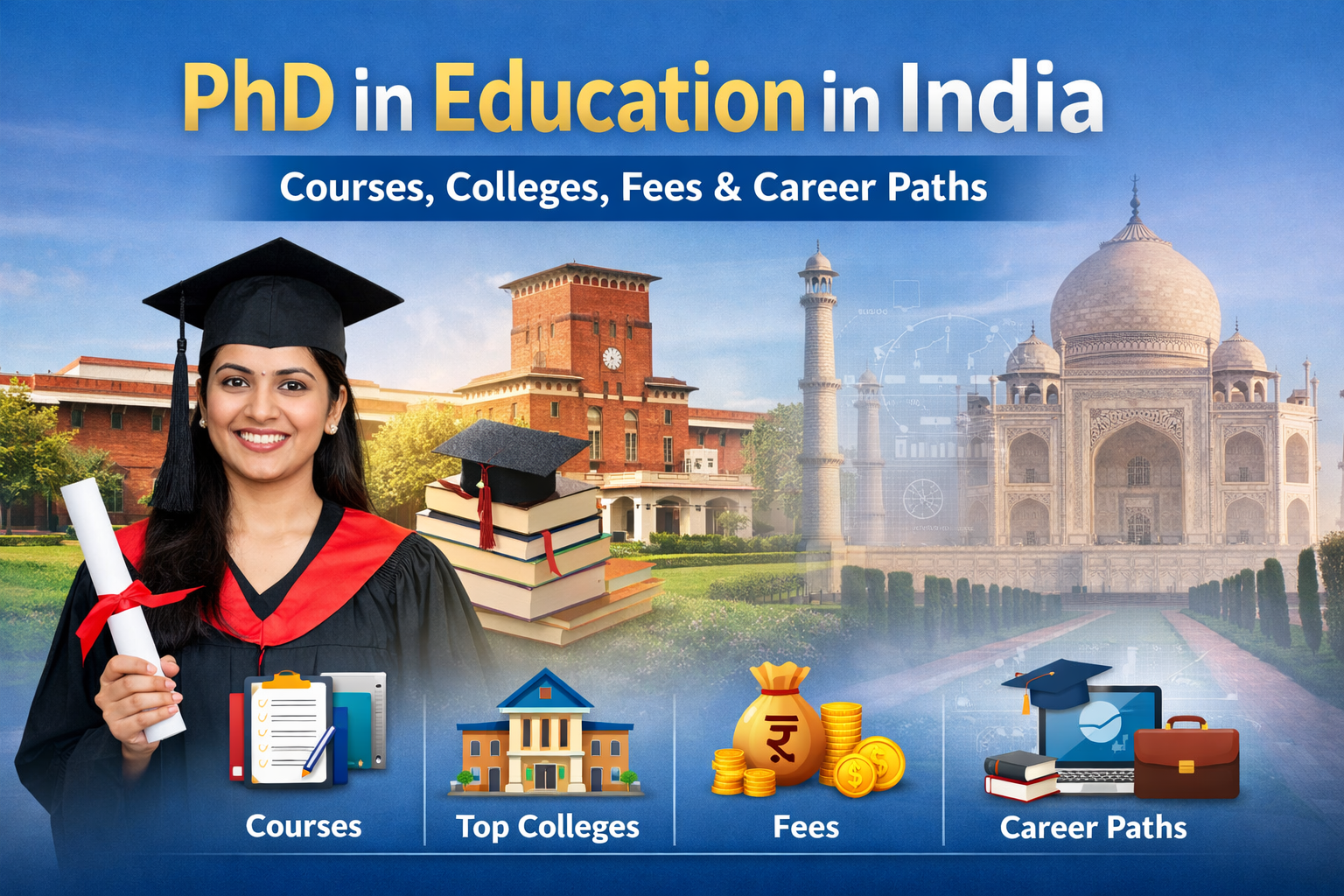
Education is the foundation of any society. With rapid changes in technology, learning systems, policies, and global standards, there is a growing need for experts who can research, innovate, and improve educational systems. A PhD in Education is the highest academic qualification in the field of education and focuses on advanced research, policy development, teaching methodologies, curriculum design, and educational leadership.
🔔 PHD in Education in India Admission Alerts 2026
- Admissions Ongoing: PhD admission for the 2026-27 academic session is currently ongoing at most Universities in India.
- JEST 2026 Deadline: The JEST 2026 Application Deadline has been extended; apply soon.
- Eligibility Check: Plan your PhD in 2026 by checking eligibility criteria, entrance exams, and application processes for various HEIs in India.
- Comprehensive Guide: Explore the comprehensive guide covering PhD admission eligibility, application process, entrance exams, and important dates for 2026.
In India, the demand for qualified researchers and professors in education has increased due to the implementation of the National Education Policy (NEP 2020) and the expansion of higher education institutions. A PhD in Education not only opens doors to academic careers but also offers opportunities in research organizations, government bodies, EdTech companies, and international institutions.
This detailed guide covers everything you need to know about pursuing a PhD in Education in India in 2026, including eligibility, admission process, entrance exams, colleges, fees, career scope, and salary prospects.
What is PhD in Education?
A PhD in Education (Doctor of Philosophy in Education) is a research-based doctoral program that focuses on studying and improving educational systems, policies, psychology, leadership, and teaching practices.
It is designed for individuals who want to:
-
Become university professors or researchers
-
Work in education policy and planning
-
Contribute to curriculum development
-
Conduct research in learning sciences
-
Lead academic institutions
Duration of PhD in Education in India
| Degree Full Form | Doctor of Philosophy |
| Degree Type | Doctoral, Research-Level |
| Typical Duration | 3 to 6 years |
| Eligibility (India) | Master’s degree (10+2+Undergraduate+Postgraduate) |
| Common Entrance Exams (India) | GATE, JEST (Application Deadline Extended for 2026) |
| Average Annual Fees (India) | ₹10,000 to ₹1,00,000 |
| Career Options | Academia, Research, Industry, Teaching |
| UGC/AICTE Approved | Yes, for Government of India approved universities |
The duration may vary depending on university rules and research progress.
Structure of the Program
A PhD in Education generally includes:
-
Coursework (Research Methodology, Statistics, Educational Theories)
-
full Examination
-
Research Proposal Approval
-
Thesis Research
-
Dissertation Submission
-
Viva Voce (Final Defense)
PhD is not just classroom study. It mainly focuses on independent research under a supervisor.
Why Choose PhD in Education in India?
Choosing a PhD is a major academic and professional decision. It requires dedication, patience, and strong research interest.
Here are the key reasons why many students pursue this degree:
Academic Career Opportunities
A PhD is mandatory to become:
-
Assistant Professor (in many universities)
-
Associate Professor
-
Professor
-
Research Guide
With increasing universities in India, the demand for qualified PhD holders is rising.
Contribution to Educational Reform
India is implementing reforms under NEP 2020. PhD scholars can contribute to:
-
Curriculum restructuring
-
Skill-based education
-
Digital and online education models
-
Teacher training programs
-
Inclusive education policies
This makes the degree socially impactful.
Research and Policy Development Roles
PhD graduates can work in:
-
Ministry of Education
-
NCERT
-
NCTE
-
Educational Research Councils
-
International agencies like UNESCO
They help design policies and improve national education standards.
Higher Salary and Leadership Roles
Doctoral degree holders often receive:
-
Higher pay scales
-
Academic promotions
-
Leadership roles in institutions
-
Consultancy opportunities
Global Opportunities
A PhD in Education also allows candidates to:
-
Apply for international academic positions
-
Work as visiting scholars
-
Participate in global education research projects
PhD in Education Eligibility Criteria
Eligibility may vary slightly between universities, but general UGC norms apply.
Educational Qualification
Candidates must have:
-
M.Ed degree
OR -
MA in Education
OR -
Equivalent postgraduate degree from a recognized university
Minimum required marks:
-
55% aggregate (General category)
-
50% aggregate (Reserved categories)
NET/JRF Requirement
Some universities require:
-
UGC NET qualification
-
UGC JRF for fellowship benefits
Candidates with JRF may receive monthly stipend support.
Other Requirements
-
Strong academic background
-
Research proposal
-
Relevant work experience (preferred in some institutions)
PhD in Education Admission Process 2026
The PhD in Education Admission Process 2026 in India follows the guidelines issued by the University Grants Commission (UGC) along with individual university regulations. Admission is mainly entrance-based, followed by an interview and research proposal evaluation. Candidates must carefully follow each step to secure admission into a recognized university.
Below is a detailed explanation of the admission process for 2026.
Step 1: Check Eligibility Criteria
Before applying, candidates must ensure they meet the basic eligibility requirements:
-
Master’s degree in Education (M.Ed / MA Education) or a related field
-
Minimum 55% aggregate marks (50% for reserved categories as per UGC norms)
-
Some universities require UGC NET qualification
-
JRF-qualified candidates may receive preference
Candidates who do not meet eligibility conditions will not be allowed to appear for the entrance exam.
Step 2: Online Application Form
Most universities open their PhD applications between April and August 2026.
Applicants must:
-
Register on the university’s official website
-
Fill in personal and academic details
-
Upload scanned documents (mark sheets, certificates, ID proof)
-
Upload research proposal (if required at application stage)
-
Pay application fee (usually ₹500–₹2,000)
It is important to double-check all information before submitting the form.
Step 3: PhD Entrance Examination
After application submission, eligible candidates must appear for the PhD entrance exam conducted by:
-
Individual universities
OR -
National Testing Agency (UGC NET / JRF)
Entrance Exam Pattern (General Format)
| Component | Details |
|---|---|
| Mode | Online / Offline |
| Duration | 2–3 hours |
| Question Type | MCQs / Descriptive (varies) |
| Subjects Covered | Research Methodology, Educational Theories, Statistics, Subject Knowledge |
The exam mainly tests:
-
Research aptitude
-
Logical reasoning
-
Understanding of educational concepts
-
Data interpretation skills
Some universities exempt candidates who have qualified UGC NET/JRF from the written test.
Step 4: Research Proposal Submission
Candidates shortlisted after the entrance exam are required to submit a detailed research proposal.
The proposal generally includes:
-
Title of the research topic
-
Background of the study
-
Research problem
-
Objectives of the study
-
Research methodology
-
Expected contribution to the field
The proposal should be clear, relevant, and aligned with the university’s research focus areas.
Step 5: Interview / Viva Voce
Shortlisted candidates are invited for a personal interview or viva voce. This is an important stage of the admission process.
During the interview, the panel evaluates:
-
Subject knowledge
-
Research aptitude
-
Clarity of research idea
-
Feasibility of proposed topic
-
Communication skills
The interview carries significant weightage in final selection.
Step 6: Final Merit List
After the interview process, universities prepare a merit list based on:
-
Entrance exam score
-
Academic performance (Master’s degree marks)
-
Research proposal quality
-
Interview performance
Selected candidates receive an admission offer letter.
Step 7: Document Verification and Enrollment
Candidates must complete:
-
Original document verification
-
Fee payment
-
Supervisor allocation
-
Registration formalities
Once completed, the candidate is officially enrolled in the PhD program.
Expected Application Timeline
| Stage | Expected Timeline |
|---|---|
| Application Start | April – June 2026 |
| Entrance Exam | July – August 2026 |
| Interview | August – September 2026 |
| Final Admission | September – October 2026 |
PhD in Education Syllabus
The PhD in Education syllabus in India is designed to develop strong research skills, theoretical understanding, and analytical abilities. Unlike undergraduate or postgraduate programs, a PhD focuses more on research work than classroom study. However, students must complete mandatory coursework in the initial phase before starting full-time research.
The syllabus may vary slightly from one university to another, but most institutions follow UGC guidelines.
1. Coursework Phase (First 6–12 Months)
During the first year, students are required to complete coursework. This stage builds a strong foundation in research and educational theory.
| Subject | Description |
|---|---|
| Research Methodology | Concepts of research design, qualitative and quantitative methods, sampling, hypothesis testing |
| Educational Statistics | Statistical tools, SPSS basics, data interpretation, regression, correlation |
| Philosophy of Education | Western and Indian philosophies, educational thinkers, ethics in education |
| Educational Psychology | Learning theories, cognitive development, motivation, intelligence |
| Advanced Educational Studies | Contemporary issues in education, global education trends |
Students must pass internal assessments and written examinations to qualify for the next stage.
2. Research Methodology (Detailed Focus)
Research Methodology is the most important subject in the PhD syllabus. It teaches scholars how to conduct scientific and systematic research.
Key topics include:
-
Types of research (Descriptive, Experimental, Action Research)
-
Research design and planning
-
Sampling techniques
-
Data collection tools (Questionnaires, Interviews, Surveys)
-
Quantitative and qualitative analysis
-
Use of software tools (SPSS, Excel, NVivo)
-
Ethical considerations in research
-
Report writing and referencing styles (APA, MLA)
This subject prepares candidates for their thesis work.
3. Educational Theories and Philosophies
This part of the syllabus focuses on understanding educational foundations.
Major topics include:
-
Indian philosophical perspectives on education
-
Western educational thinkers (Plato, Rousseau, Dewey)
-
Constructivism and behaviorism
-
Critical pedagogy
-
Humanistic education
-
Modern educational reforms
This helps scholars connect theory with real-world educational practices.
4. Advanced Educational Psychology
Educational psychology helps researchers understand learning behavior and student development.
Topics covered:
-
Cognitive development theories
-
Learning and memory
-
Emotional intelligence
-
Classroom behavior management
-
Inclusive education
-
Special education needs
-
Motivation and personality development
5. Elective Subjects (Based on Specialization)
Students may choose electives depending on their research interest.
Possible elective areas include:
-
Curriculum Development
-
Educational Leadership and Management
-
Inclusive Education
-
Teacher Education
-
Educational Technology
-
Comparative Education
-
Higher Education Studies
-
Distance and Online Education
Electives help students align coursework with their research topic.
6. Full Examination
After completing coursework, students must pass a full exam. This exam evaluates:
-
Understanding of research methods
-
Subject knowledge
-
Readiness for independent research
Only after clearing this stage can students proceed to full-time research work.
7. Thesis and Dissertation Work
The major part of the PhD syllabus is research and thesis preparation.
Research Work Includes:
-
Identifying a research problem
-
Literature review
-
Data collection
-
Data analysis
-
Interpretation of results
-
Writing chapters
-
Publishing research papers
Thesis Structure (Typical Format)
-
Introduction
-
Review of Literature
-
Research Methodology
-
Data Analysis
-
Findings and Discussion
-
Conclusion and Recommendations
-
References
Students must submit their thesis within the prescribed time and defend it through a viva voce examination.
8. Publication Requirement
As per UGC guidelines, many universities require PhD scholars to:
-
Publish at least one or two research papers
-
Present research at national or international conferences
This ensures academic quality and research contribution.
Research Areas in PhD in Education
A PhD in Education offers diverse research opportunities that address current challenges and innovations in the education system. Scholars can choose research areas based on their academic interests, professional background, and long-term career goals.
One major area is Curriculum and Instruction, which focuses on curriculum design, teaching strategies, and learning outcomes. Researchers study how different teaching methods impact student performance and engagement.
Another important field is Educational Psychology, covering learning theories, motivation, cognitive development, and classroom behavior. This area helps improve student support systems and inclusive education practices.
Educational Leadership and Administration is ideal for those interested in policy-making and institutional management. Research may include school governance, leadership styles, and education reforms.
Scholars can also explore Educational Technology, examining digital learning tools, online education, artificial intelligence in classrooms, and e-learning effectiveness.
Other emerging research areas include Inclusive Education, Teacher Education, Higher Education Studies, Comparative Education, and Education Policy Analysis.
PhD in Education Fees in India
The fees for a PhD in Education in India can vary widely based on the type of university (government vs private), reputation, and additional components such as research charges, hostel costs, and examination fees. Generally, research degrees tend to be more affordable in public institutions but can be significantly higher in private or standalone universities.
| Institution Type | Approx. Annual Tuition Fees | Notes |
|---|---|---|
| Government Universities | ₹10,000 – ₹50,000 per year | Economical option; fee may include only tuition, other charges extra. |
| Public Universities (central/state) | ₹6,000 – ₹25,000 per year | Some central universities charge lower fees for PhD programmes. |
| Private Universities | ₹1,00,000 – ₹5,00,000 per year | Fees depend on reputation and facilities; may include research and lab charges. |
| Specific Case Example | Total ₹3.90 L (over 3 years) | Example from Bharti Vishwavidyalaya for PhD Education. |
Career Paths After PhD in Education
| Career Path | Job Role Examples | Work Area | Key Responsibilities | Average Salary (Per Year) |
|---|---|---|---|---|
| Academic Career | Assistant Professor, Associate Professor, Professor | Universities & Colleges | Teaching, research, publishing papers, guiding PhD scholars | ₹6 – ₹25 lakh |
| Educational Research | Research Associate, Senior Research Fellow | Research Institutes, NGOs | Conduct research, analyze data, publish reports | ₹5 – ₹12 lakh |
| Policy Making | Policy Analyst, Education Advisor | Government Bodies, Think Tanks | Draft policies, evaluate schemes, recommend reforms | ₹8 – ₹15 lakh |
| Academic Leadership | Principal, Dean, Academic Director | Schools, Universities | Administration, academic planning, faculty supervision | ₹15 – ₹35 lakh |
| Curriculum Development | Curriculum Designer, Instructional Designer | Publishing Houses, EdTech | Develop syllabus, textbooks, digital learning content | ₹6 – ₹12 lakh |
| Education Consultant | Academic Consultant, Institutional Advisor | Consultancy Firms, Private Practice | Improve institutional performance, teacher training | ₹10 – ₹20 lakh |
| Corporate Sector | Corporate Trainer, L&D Manager | Companies, MNCs | Employee training, skill development programs | ₹8 – ₹25 lakh |
| Postdoctoral Research | Postdoctoral Fellow | Universities (India/Abroad) | Advanced research, academic publications | ₹7 – ₹18 lakh |
| NGO & Social Sector | Program Director, Project Head | NGOs, International Organizations | Lead education projects, literacy programs | ₹6 – ₹18 lakh |
Salary After PhD in Education in India
A PhD in Education offers diverse career opportunities in teaching, research, policy-making, academic leadership, and the EdTech sector, with salary varying based on role, experience, and institution type.
| Job Role | Sector | Average Salary (Per Month / LPA) | Experience Level |
|---|---|---|---|
| Assistant Professor | Government University | ₹57,000 – ₹75,000 per month | Entry-Level |
| Assistant Professor | Private University | ₹6 – 12 LPA | Entry-Level |
| Associate Professor | Government/Private | ₹1.3 – 1.5 lakh per month | 8–10+ years |
| Professor | Government/Private | ₹1.5 – 2 lakh+ per month | Senior Level |
| Research Associate | Research Institutes/NGOs | ₹4 – 8 LPA | Entry to Mid-Level |
| Senior Researcher / Project Director | Research Organizations | ₹8 – 20 LPA | Experienced |
| Education Policy Analyst | Government / Think Tanks | ₹6 – 15 LPA | Mid-Level |
| Principal / Dean | Schools / Universities | ₹8 – 25 LPA | Senior Level |
| Academic Director | Private Institutions | ₹10 – 30 LPA | Senior Level |
| Education Consultant | Private / Corporate | ₹7 – 20 LPA | Mid to Senior Level |
| Curriculum Specialist | EdTech / Publishing | ₹6 – 15 LPA | Mid-Level |
| Learning & Development Head | Corporate / EdTech | ₹10 – 25 LPA | Senior Level |
| Academic Content Lead | EdTech Companies | ₹8 – 18 LPA | Mid-Level |
Challenges in PhD in Education
Pursuing a PhD in Education is intellectually rewarding but comes with several academic, financial, and personal challenges.
-
Long Duration of Study: Completing coursework, research, and thesis writing can take 3–6 years or more.
-
Financial Limitations: Limited fellowships and delayed stipends may create financial stress.
-
Research Pressure: Publishing papers, attending conferences, and meeting academic standards can be demanding.
-
Data Collection Issues: Gaining permissions from schools or institutions for research can be difficult.
-
Supervisor Dependency: Progress often depends on regular guidance and feedback from supervisors.
-
Work-Life Imbalance: Long research hours may affect personal and social life.
-
Publication Rejections: Research papers may face multiple rejections before acceptance.
-
Career Competition: Securing permanent academic positions can be competitive.
-
Mental and Emotional Stress: Continuous revisions and academic expectations may cause anxiety.
Despite these challenges, strong planning, time management, and mentorship help scholars successfully complete their PhD and build a rewarding career.
PhD in Education vs EdD
| Basis of Comparison | PhD in Education | EdD (Doctor of Education) |
|---|---|---|
| Primary Focus | Research-oriented and theory-based | Practice-oriented and leadership-based |
| Objective | To generate new knowledge and contribute to academic research | To apply research to solve real-world educational problems |
| Ideal For | Aspiring professors, researchers, policy analysts | School leaders, administrators, academic managers |
| Research Type | Extensive theoretical and empirical research | Applied research focused on practical solutions |
| Career Path | Assistant Professor, Researcher, University Faculty | Principal, Dean, Education Administrator, Academic Director |
| Publication Requirement | Strong emphasis on publishing in peer-reviewed journals | Limited focus on academic publications |
| Curriculum Structure | Advanced research methodology and thesis-based | Leadership training, case studies, applied projects |
| Recognition in India | Highly recognized and widely offered | Less common but growing in popularity |
| Duration | 3–5 years (may extend based on research) | 3–5 years depending on institution |
| Industry Relevance | Strong in academia and policy research | Strong in school leadership and institutional management |
FAQs
1. What is the eligibility for PhD in Education in India?
To pursue a PhD in Education in India, candidates must have a Master’s degree in Education or a related field with at least 55% marks from a recognized university.
2. What is the duration of PhD in Education in India?
The duration of a PhD in Education in India typically ranges from 3 to 5 years, depending on research progress, university guidelines, and thesis submission timeline.
3. What is the average salary after PhD in Education in India?
The average starting salary after a PhD in Education in India ranges between ₹6–12 LPA, with higher earnings possible in senior academic, research, and leadership positions.
4. Is NET required for PhD in Education in India?
UGC NET is not mandatory for PhD admission if candidates qualify through university entrance exams, but NET or JRF qualification can provide fellowship benefits and advantages.
5. Which are the top universities offering PhD in Education in India?
Top universities offering PhD in Education in India include Delhi University, JNU, BHU, Jamia Millia Islamia, and Tata Institute of Social Sciences (TISS).
6. What is the scope of PhD in Education in India?
PhD in Education in India offers opportunities in teaching, academic research, policy development, curriculum design, educational leadership, and consultancy roles in public and private sectors.
7. What are the entrance exams for PhD in Education in India?
Common entrance exams for PhD in Education in India include UGC NET, university-level PhD entrance tests, and sometimes national-level research eligibility examinations conducted by institutions.
8. Can I pursue PhD in Education after M.Ed in India?
Yes, candidates with an M.Ed degree from a recognized university with minimum required marks are eligible to apply for PhD in Education programs across Indian universities.
9. What is the fee structure for PhD in Education in India?
The fee for PhD in Education in India varies widely, ranging from ₹20,000 to ₹1,50,000 per year in government universities and higher in private institutions.
10. Is PhD in Education worth it in India?
PhD in Education in India is worth it for individuals interested in research, teaching, and leadership roles, as it offers long-term career growth and academic recognition opportunities.
Q: What are the total fees for a PHD in Education in India in 2026?
The total fees for a PHD in Education in India can range significantly, typically from ₹50,000 to ₹3,00,000 per annum for government institutions and ₹1,50,000 to ₹5,00,000 per annum for private universities. A full PHD in Education usually spans 3 to 5 years, making the total cost for the entire program between ₹1,50,000 and ₹25,00,000, depending on the chosen institution and its facilities.
Q: What are the top entrance exams for PHD in Education in India for 2026 admissions?
For 2026 admissions to a PHD in Education in India, key entrance exams include the UGC NET (University Grants Commission National Eligibility Test), which is widely accepted. Many universities also conduct their own entrance tests, such as the DUET (Delhi University Entrance Test) or JNU Entrance Exam. A minimum score of 55% in your Master’s degree is often a prerequisite to even appear for these exams for a PHD in Education.
Q: What is the eligibility criteria for a PHD in Education in India in 2026?
To be eligible for a PHD in Education in India in 2026, candidates typically need a Master’s degree in Education (M.Ed.) or an equivalent postgraduate degree in a related discipline with at least 55% aggregate marks (50% for SC/ST/OBC candidates). Some universities may also require a valid score in national-level entrance exams like UGC NET or their own university-specific entrance tests, followed by an interview for the PHD in Education program.
Q: Which are the best colleges for PHD in Education in India in 2026?
For a PHD in Education in India, top institutions for 2026 include the Department of Education at Delhi University, Jamia Millia Islamia, and Jawaharlal Nehru University (JNU) in Delhi. Other highly regarded options are the Tata Institute of Social Sciences (TISS) in Mumbai and the Central University of Hyderabad. These universities are known for their strong research facilities and faculty, often accepting only the top 10-15% of applicants for their PHD in Education programs.
Q: What is the average salary after PHD in Education in India in 2026?
After completing a PHD in Education in India, the average starting salary in 2026 can range from ₹6 LPA to ₹12 LPA. Professionals can work as university professors, educational researchers, curriculum developers, or policy analysts. With 5-10 years of experience, a PHD in Education holder can expect to earn upwards of ₹15 LPA, especially in senior academic or research positions, with some reaching ₹25 LPA or more.
Q: Can I pursue a PHD in Education abroad after studying in India, and what are the options?
Yes, a PHD in Education from India is well-recognized, opening doors for further studies or research abroad. Many Indian PHD in Education graduates pursue post-doctoral fellowships or academic positions in countries like the USA, UK, Canada, and Australia. Scholarships like the Fulbright-Nehru Master’s Fellowships or Commonwealth Scholarships can cover up to 100% of tuition and living costs for a PHD in Education abroad, with many universities offering research opportunities.