PHD in English in India: Colleges, Fees, Syllabus, and Career Opportunities
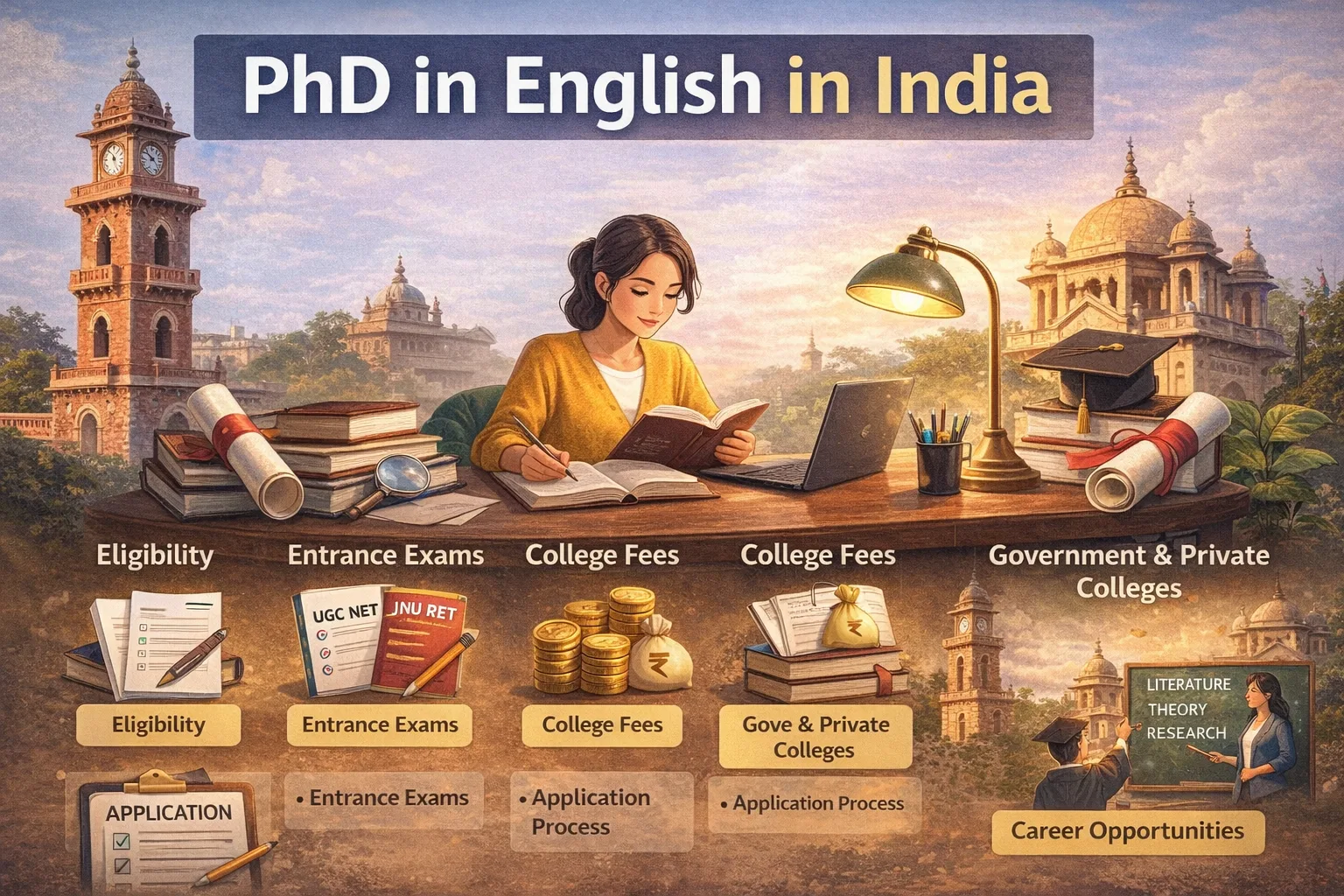
A PhD in English in India is a research-focused doctoral program designed for students seeking advanced expertise in literature, linguistics, and critical theory. Typically lasting 3–5 years, the course requires a relevant Master’s degree with at least 55% marks. Admissions usually involve national-level exams such as UGC NET or university-specific Research Entrance Tests, followed by interviews. The program builds strong research, analytical, and academic writing skills while allowing specialisation in diverse literary and language studies. Graduates can pursue careers in academia, research, publishing, writing, and editing. This article offers a complete guide to PhD in English programs in India, covering top colleges, admission process, fees, syllabus, specialisations, and career opportunities to help aspirants make informed decisions.
🔔 PHD in English in India Admission Alerts 2026
- IIT Kanpur Ph.D. English: Total fees for the 3-year, full-time program are ₹1.
- JEST 2026: Application Deadline Extended; Apply Soon (as of March 26, 2026).
- NTA Entrance Exam: BHU, BBAU, JNU, and DU PhD admissions are based on the entrance examination conducted by NTA.
- PhD Admission 2026-27: Admissions are currently ongoing at most Universities for the academic session.
PhD in English: Course Overview
A PhD in English in India is a research-intensive doctoral program focused on advanced study in English literature, linguistics, cultural studies, language education, and interdisciplinary humanities research. The program typically lasts 3–6 years depending on university regulations and research progress. Students undertake coursework in research methodology, literary theory, and specialised electives before progressing to thesis research under academic supervision. Admissions generally require a Master’s degree in English or a related discipline with at least 55% marks, along with qualification in national or university-level entrance exams followed by interviews. Graduates pursue careers in academia, research, publishing, media, writing, editing, and academic consultancy. The program emphasises critical analysis, academic writing, research design, and original scholarly contribution.
| Feature | Details |
|---|---|
| Degree Full Form | Doctor of Philosophy |
| Degree Type | Doctoral (PhD) |
| Typical Duration | 3 Years (e.g., IIT Kanpur) |
| Eligibility (India) | Master’s Degree in English or related field |
| Common Entrance Exams (India) | NTA (for BHU, BBAU, JNU, DU), JEST 2026, GATE 2026 |
| Admission Process | Entrance Examination + Interview (often includes research proposal evaluation) |
| Average Annual Fees (India) | ₹1 (e.g., IIT Kanpur) – ₹1,50,000 |
| Career Options | Assistant Professor, Researcher, Editor, Writer, Academic Consultant |
| UGC/AICTE Approved | Yes (for recognized HEIs) |
| Admission Session 2026-27 | Ongoing at most Universities |
Core Components of a PhD in English Program
- Coursework Phase: Research methods, literary criticism, theory, and specialised electives
- full Research Proposal: Defines thesis direction and methodology
- Independent Thesis Research: Original scholarly contribution under supervisor guidance
- Seminars & Publications: Participation in conferences and academic journals
- Final Thesis Submission & Viva Voce: Evaluation by external experts
PhD in English Eligibility Criteria
The eligibility criteria for a PhD in English in India generally require a Master’s degree in English or a closely related discipline with a minimum of 55% aggregate marks from a recognised university. Most institutions provide a 5% relaxation for candidates belonging to SC/ST/OBC (non-creamy layer)/PwD/EWS categories as per UGC norms. Some universities also allow admission through a 4-year Bachelor’s degree with research (minimum 75% or equivalent CGPA) as per NEP guidelines. Candidates may need to qualify for UGC NET/JRF or a university-level Research Entrance Test (RET) followed by an interview. NET/JRF-qualified candidates are often exempt from written entrance tests but must appear for interviews and research proposal evaluation. International applicants must hold equivalent qualifications and may need to provide proof of English proficiency.
| Category / Qualification | Required Degree | Minimum Marks | Admission Requirement | Relaxation / Notes |
|---|---|---|---|---|
| General / Unreserved | Master’s Degree in English or related field | 55% | Entrance Test + Interview / NET Qualified | As per university norms |
| SC/ST/OBC (NCL)/PwD/EWS | Master’s Degree in relevant field | 50% | Entrance Test + Interview / NET Qualified | 5% relaxation (UGC norms) |
| 4-Year Bachelor’s with Research (NEP) | BA (Hons) / Equivalent with Research | 75% or equivalent | Entrance Test + Interview | Accepted by select universities |
| UGC NET / JRF Qualified | Master’s Degree | 55% | Interview + Research Proposal | Often exempt from written entrance test |
| CSIR NET (Humanities-equivalent where applicable) | Master’s Degree | 55% | Interview + Research Proposal | Entrance exam waiver in some institutions |
| International Students | Equivalent Master’s Degree | Equivalent to 55% | Interview + Proposal + Visa Compliance | English proficiency may be required |
Additional Requirements
- Research Proposal / Statement of Purpose
- Letters of Recommendation (in some universities)
- Academic Transcripts & Certificates
- Interview / Viva Voce for final selection
PhD in English Admission Process
Admission to a PhD in English in India typically involves application submission, entrance examination (if applicable), research proposal evaluation, and an interview round. Candidates must hold a Master’s degree with at least 55% marks (50% for reserved categories). While UGC NET/JRF is widely accepted for eligibility and may exempt candidates from university entrance tests, it is not universally mandatory, as many universities conduct their own Research Entrance Tests (RET). The duration of a PhD generally ranges from 3 to 6 years, depending on research progress and university regulations. Fees vary widely between institutions, typically ranging from ₹10,000 to ₹1,50,000 per year.
Step-by-Step Admission Process
- Check Eligibility Criteria: Verify academic qualifications, minimum marks, and subject requirements.
- Apply Online: Submit application form with academic details, documents, and research interests.
- Appear for Entrance Exam (if applicable): University RET or national-level exams like UGC NET/JRF.
- Research Proposal Submission: Outline research topic, methodology, and objectives.
- Interview / Viva Voce: Evaluation of research aptitude, academic background, and proposal feasibility.
- Final Merit List & Offer Letter: Based on entrance score, interview performance, and academic profile.
- Enrollment & Coursework Registration: Complete admission formalities and begin doctoral coursework.
Top Government Colleges for PhD in English in India
The table below highlights some of the leading government universities in India offering PhD in English, along with their city, latest available NIRF university rankings (approximate bands), indicative annual PhD fees, admission mode, and major research areas. These institutions are known for strong humanities research, experienced faculty, and established doctoral programmes. Admission is typically based on UGC NET/JRF qualification, university entrance tests, and interviews. Fees are approximate and may vary by department and category.
| College Name | City | NIRF University Rank Band* | Approx. Annual PhD Fees (INR) | Admission Mode | Major Research Areas |
|---|---|---|---|---|---|
| University of Delhi | Delhi | Top 15 | 7,000 – 15,000 | Entrance + Interview / NET | English Literature, Cultural Studies |
| Jawaharlal Nehru University (JNU) | New Delhi | Top 5 | 2,000 – 6,000 | Entrance + Interview | Comparative Literature, Critical Theory |
| Banaras Hindu University (BHU) | Varanasi | Top 10–15 | 15,000 – 25,000 | Entrance + Interview / NET | Literature, Linguistics |
| University of Calcutta | Kolkata | Top 15–20 | 10,000 – 20,000 | Entrance + Interview | English Literature, Language Studies |
| Osmania University | Hyderabad | Top 25–40 | 5,000 – 10,000 | Entrance + Interview | Literature, Translation Studies |
| University of Madras | Chennai | Top 40–50 | 3,000 – 8,000 | Entrance + Interview | Literature, Literary Theory |
| Panjab University | Chandigarh | Top 30–40 | 8,000 – 15,000 | Entrance + Interview | Literature, Cultural Studies |
| Aligarh Muslim University | Aligarh | Top 15–25 | 10,000 – 20,000 | Entrance + Interview | Literature, Language |
*NIRF rankings vary yearly; refer to the latest Ministry of Education list for exact positions.
Top Private/Deemed Universities and Autonomous Colleges
The table below lists reputed private or deemed universities and autonomous institutions offering PhD in English or related humanities research programmes. Note that many well-known undergraduate colleges (e.g., Miranda House, Hindu College) do not independently offer PhD programmes; doctoral research is usually conducted through their parent universities. Admission generally involves institutional entrance exams, NET/JRF qualification, research proposals, and interviews. Fees are indicative and vary widely across institutions.
| Institution | City | Institutional Status | Approx. Annual PhD Fees (INR) | Admission Mode | Research Areas |
|---|---|---|---|---|---|
| Amity University | Noida | Private University | 80,000 – 1,20,000 | Entrance + Interview / NET | Literature, Linguistics, Cultural Studies |
| Lovely Professional University (LPU) | Punjab | Private University | 1,00,000 – 1,50,000 | Entrance + Interview / NET | Literature, Language Studies |
| Shiv Nadar University | Greater Noida | Private University | 50,000 – 1,00,000 | Entrance + Interview | Literature, Interdisciplinary Humanities |
| Christ (Deemed to be University) | Bengaluru | Deemed University | 60,000 – 1,20,000 | Entrance + Interview | Literary Theory, Communication Studies |
| Ashoka University | Sonipat | Private University | Fellowship-based / Variable | Research Proposal + Interview | Humanities, Cultural Studies |
| Manipal Academy of Higher Education | Manipal | Deemed University | 60,000 – 90,000 | Entrance + Interview | Literature, Linguistics |
PhD in English Subjects and Syllabus
The PhD in English in India typically spans 3–6 years, focusing on advanced research in literature, language, cultural studies, and critical theory. The coursework phase generally covers the first 1–2 years, including core subjects, electives, and research methodology, followed by independent research and dissertation work in later semesters. Core areas often include Research Methodology, Literary Theory, Postcolonial Studies, Gender Studies, and Indian Writing in English, while electives may cover Digital Humanities, Pedagogy, Linguistics, and specialised author or genre studies.
Admission usually requires a Master’s degree in English or a related discipline with at least 55% marks (50% for reserved categories, depending on university norms), along with qualifying performance in a PhD entrance test and/or interview. Credit structures and course titles vary slightly across universities, but the overall academic progression remains similar.
Year-wise Breakdown of Core Topics
| Year | Semester | Core Subjects | Electives / Optional Papers | Credits (Approx.) |
|---|---|---|---|---|
| Year 1 | Semester 1 | Research Methodology, Literary Theory / English Literature | Language & Linguistics, Critical Theory | ~30 credits per academic year |
| Semester 2 | Postcolonial Studies, History of English Literature / Poetry Studies | Digital Humanities, Shakespeare Studies | Included in yearly credits | |
| Year 2 | Semester 3 | Gender & Sexuality Studies, Indian Literature / Indian Writing in English | Advanced Literary Theories, Cultural Studies | Coursework continuation |
| Semester 4 | Independent Study / Research Seminar | Pedagogy-based Seminars, Genre or Author Studies | Coursework completion | |
| Year 3 onwards | Semester 5 | Thesis Research & Proposal Development | Interdisciplinary / Social Science Research (if applicable) | Research credits |
| Semester 6 | Dissertation Writing & Submission | — | Research credits |
Alternative / Expanded Coursework Structure
Some universities offer slightly different coursework combinations during the initial research training phase. The structure below reflects a broader academic preparation model commonly used in doctoral coursework.
| Year | Semester | Core Subjects | Electives / Skill-based Papers | Credits |
|---|---|---|---|---|
| Year 1 | Semester 1 | Communicative English, Literary Criticism, Research Methodology | Professional Communication, Academic Writing | ~30 credits per academic year |
| Semester 2 | English Poetry, Postcolonial Literature | English Prose, Contemporary Fiction | Included in yearly credits | |
| Year 2 | Semester 3 | American Literature / Comparative Literature | Open Elective (Specialisation-based) | Varies |
| Semester 4 | Research Seminar / Core Research Work | Elective (Teaching Pedagogy / Theory / Interdisciplinary Studies) | Varies | |
| Year 3 onwards | Semester 5–6 | Doctoral Research & Dissertation Writing | — | Research credits |
PhD in English Fee Structure in India: Government vs Private Colleges
The fee structure for a PhD in English in India varies significantly depending on whether the institution is a government/central university or a private/deemed university. Government universities generally charge nominal tuition fees due to public funding, while private institutions may have higher annual costs because of infrastructure, research facilities, and administrative expenses. In many cases, UGC NET/JRF or university fellowships can reduce the financial burden by providing stipends and fee waivers. The table below provides a realistic overview of approximate annual PhD tuition ranges across institution types.
| Institution Type | Approx. Annual PhD Fees (INR) | Key Notes |
|---|---|---|
| Central Universities (DU, JNU, BHU, etc.) | 2,000 – 15,000 | Highly subsidised; fellowship opportunities available |
| State Government Universities | 5,000 – 25,000 | Low tuition; minor research/lab fees may apply |
| Government Deemed Institutes | 10,000 – 40,000 | Moderate costs depending on facilities |
| Private Universities | 50,000 – 1,50,000 | Higher tuition; scholarships may be available |
| Deemed/Autonomous Private Institutions | 60,000 – 2,00,000 | Fees vary widely based on infrastructure |
| Elite Private Universities | 1,00,000 – 3,00,000+ | Some offer fellowships instead of fixed fees |
Entrance Exams for PhD in English in India
Admission to PhD in English programmes in India typically requires qualifying national-level eligibility tests or university-specific entrance examinations, followed by an interview and research proposal evaluation. The UGC NET/JRF is the most widely accepted qualification and may exempt candidates from institutional written tests in many universities. Some institutions also conduct their own doctoral entrance exams aligned with postgraduate English literature and language syllabi. The table below summarises commonly accepted exams.
| Exam Name | Conducting Body | Exam Type | Eligibility | Relevant Syllabus Focus |
|---|---|---|---|---|
| UGC NET / JRF (English) | National Testing Agency (NTA) | Computer-Based Test | Master’s Degree with 55% | British & Indian Literature, Literary Theory, Linguistics |
| CUET PhD (where applicable) | NTA | Computer-Based Test | Master’s Degree | PG-level English Literature & Research Aptitude |
| JNU PhD Entrance | Jawaharlal Nehru University | University Entrance + Interview | Master’s Degree | Comparative Literature, Critical Theory |
| DU PhD Entrance | University of Delhi | Entrance + Interview | Master’s Degree / NET | English Literature, Research Methodology |
| BHU PhD Entrance | Banaras Hindu University | Entrance + Interview | Master’s Degree | Literary Studies, Language & Theory |
| LPUNEST PhD | Lovely Professional University | Online Test + Interview | Master’s Degree | Subject Knowledge & Research Skills |
| University-Specific PhD Tests | Various Universities | Written Test + Interview | Master’s Degree | PG-level English Literature & Research Methods |
Frequently Asked Questions (FAQs)
Q1. What is the typical duration of a PhD in English program in India?
The typical duration of a PhD in English program in India is 3-5 years. This is a full-time program. The PhD duration in Indian colleges and universities is usually 3 to 5 years.
Q2. What are the eligibility criteria for a PhD in English program in India?
To enroll in a PhD in English program, candidates must hold a Master’s degree with a minimum aggregate of 55% or a 4-year Bachelor’s degree with 75% marks. For SC/ST/OBC/PwD candidates, the minimum percentage required is 50%. Eligibility also requires qualifying through the National Eligibility Test (NET) or equivalent assessments.
Q3. What is the average annual fee for a PhD in English program in a government college in India?
The average annual fees for a PhD in English program in a government college in India can range from INR 5,000 to INR 3,00,000. The fees vary across different government colleges.
Q4. What are the core subjects covered in the first year of a PhD in English program?
In the first year of a PhD in English program, the core subjects covered include Research Methodology in Semester 1 and Postcolonial Studies in Semester 2. Electives offered in the first year include Literary Theory and Digital Humanities.
Q5. What are the entrance exams accepted for PhD in English admission in India?
The entrance exams accepted for PhD in English admission in India include UGC NET and CSIR NET. Some universities also conduct their own entrance tests, such as the Research Entrance Test (RET). Qualifying in these exams is a key step in the application process.
Frequently Asked Questions — PHD in English in India 2026
Q: What are the typical fees for a PHD in English in India at top universities in 2026?
The fees for a PHD in English in India can vary significantly. At central universities like JNU or DU, annual fees might range from ₹10,000 to ₹50,000. Private institutions, however, could charge upwards of ₹1,00,000 to ₹3,00,000 per year. Many students also receive stipends or junior research fellowships (JRF) which can offset these costs, especially at government-funded institutions.
Q: What are the main entrance exams for a PHD in English in India and their eligibility criteria?
For a PHD in English in India, primary entrance exams include the UGC NET (National Eligibility Test) and university-specific entrance tests. Eligibility typically requires a Master’s degree in English or a related discipline with at least 55% aggregate marks (50% for SC/ST/OBC candidates). Many universities also conduct interviews after the written exam, with some giving weightage of up to 30% to the interview performance.
Q: Which are the top 5 colleges for a PHD in English in India for 2026 admissions?
For a PHD in English in India, some of the consistently top-ranked institutions include Jawaharlal Nehru University (JNU), University of Delhi (DU), English and Foreign Languages University (EFLU) Hyderabad, Jadavpur University, and Presidency University Kolkata. These universities are known for their strong research focus, diverse faculty, and excellent library resources, often attracting over 500 applications for limited seats each year.
Q: What is the career scope after a PHD in English in India beyond academia in 2026?
Beyond traditional academic roles, a PHD in English in India opens doors to diverse careers. Graduates can work as content strategists, technical writers, editors in publishing houses, or communication specialists in corporate sectors. The analytical and research skills honed during the PHD are highly valued, with many finding roles in policy research or think tanks. Approximately 20% of PHD holders now explore non-academic career paths.
Q: What is the average salary after a PHD in English in India in 2026 for a fresher?
The average starting salary after a PHD in English in India varies by sector. In academia, an Assistant Professor can expect an annual package of ₹7 LPA to ₹10 LPA, as per the 7th Pay Commission. In the corporate sector, roles like Senior Content Writer or Editor might offer ₹5 LPA to ₹8 LPA. Experienced professionals with 3-5 years post-PHD experience can command significantly higher salaries, often exceeding ₹12 LPA.
Q: Can I pursue a PHD in English in India and then work abroad, and what are the chances?
Yes, a PHD in English in India can certainly be a stepping stone to working abroad. Indian PHDs are increasingly recognized globally, especially from top-tier universities. Many graduates pursue post-doctoral fellowships or academic positions in the UK, USA, or Canada. While competitive, approximately 10-15% of PHD holders from leading Indian institutions successfully secure international academic or research positions within 2-3 years of graduation.