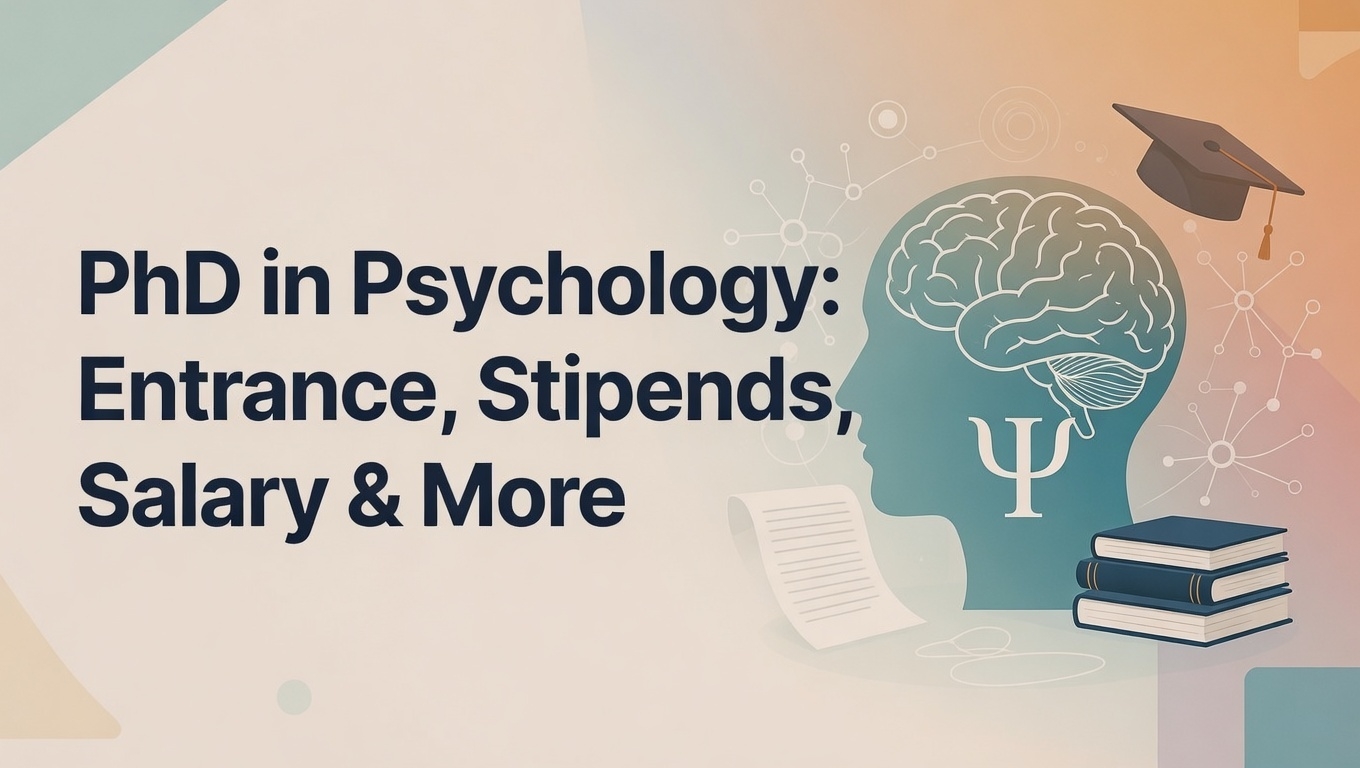
PHD in Psychology: Programs, Colleges, Fees, and Career Paths in India
A PhD in Psychology represents the highest level of educational qualification in the field. Find out complete details about the course, including fees, stipends, specialisations, jobs and more.
A PhD in Psychology is a doctoral-level degree for individuals passionate about understanding human behavior and mental processes. The program typically spans 3-5 years of full-time study and requires a Master’s degree in Psychology or a related field. Aspiring candidates can enroll with a minimum eligibility criterion of 55% or equivalent CGPA, often requiring an entrance exam such as CUET PG, UGC NET, or university-specific exams. Career opportunities for PhD holders in Psychology are diverse, ranging from professorships and research positions to clinical psychology and consulting roles.
🔔 PHD in Psychology Admission Alerts 2026
- NIMHANS: Applications for PhD Clinical Psychology opened on March 7, 2026.
- NIMHANS: Applications for PhD Clinical Psychology closed on March 10, 2026.
- IIT Kanpur: PhD Psychology is a 3-year, Full Time Degree program.
- PhD Psychology Eligibility: A master’s degree with 55% marks is required for admission.
This article explores PhD in Psychology programs in India, covering colleges, fees, syllabus, and placement opportunities. We will examine specializations like Clinical Psychology, Counseling Psychology, Developmental Psychology, Social Psychology, and Cognitive Psychology, each offering distinct career paths. The fee range varies, averaging from a few thousand to several lakhs of rupees per annum, depending on the institution and location. This guide provides a full understanding of pursuing a PhD in Psychology in India and navigating the admission process.
PhD in Psychology: Quick Overview
The PhD in Psychology program in India is a doctoral-level degree focusing on advanced research and study in psychology. Lasting 3-5 years, it’s offered by universities and colleges nationwide. Average fees range from INR 10,000 to INR 2,00,000 per year, depending on the institution (government or private). Here is a quick glance at this course:
| Degree Full Form | Doctor of Philosophy in Psychology |
| Degree Type | Doctoral |
| Typical Duration | 3 years (Full-time) |
| Eligibility (India) | Master’s degree in Psychology or related field with 55% marks |
| Common Entrance Exams (India) | University-specific entrance exams, JEST 2026 |
| Average Annual Fees (India) | ₹10,000 – ₹2,00,000 |
| Top Colleges | Jawaharlal Nehru University, University of Delhi, Jamia Millia Islamia, Central University of Rajasthan, NIMHANS, IIT Kanpur |
| Admission Process | Entrance Exam followed by Interview |
| Career Options | Professor, Researcher, Clinical Psychologist, Consultant, Counselor |
PhD in Psychology Eligibility Criteria in India
To be eligible for PhD in Psychology programs in India, you typically need a Master’s degree in Psychology or a related field with a minimum percentage or CGPA. Here is an overview of common eligibility criteria:
- Master’s degree (MA/MSc) in Psychology, Applied Psychology, or closely related field
- Minimum 55% marks (or equivalent CGPA) in Master’s; 50% for SC/ST/OBC (Non-Creamy Layer)/EWS/PwD categories.
- 4-year Bachelor’s (Honours/Research) with 75%+ marks allows direct PhD entry in some universities (NEP-aligned), but Master’s is standard.
- UGC NET qualification required (NET scores used for shortlisting, JRF holders get strong preference.)
- Mandatory interview – research proposal, interests, or PPT often required.
- University-specific entrance tests rare now; mostly only for non-NET cases or specialized institutes (e.g., NIMHANS).
PhD in Psychology Admission Process in India: A Step-by-Step Guide
The admission process for PhD in Psychology programs in India involves several steps, from application submission to final selection. Candidates must meet the minimum eligibility criteria, which typically includes a Master’s degree in Psychology or a related field with a minimum of 55%. Follow these steps:
- Check Eligibility: Ensure you meet the minimum educational qualifications, such as a Master’s degree in Psychology or a related field with 55% or equivalent CGPA.
- Entrance Exam Registration: Register for UGC NET (mandatory), or university-specific entrance registrations.
- Application Form Submission: Fill out the application form for the desired university/college, providing all necessary details and documents, including academic transcripts and research proposals.
- Entrance Exam Score Submission: Submit your entrance exam scores along with the application.
- Shortlisting: Universities shortlist candidates based on entrance exam scores and academic records.
- Interview/Viva-Voce: Shortlisted candidates are called for an interview or viva-voce, where they present their research proposals and answer questions from the panel.
- Final Selection: Final selection is based on a combination of entrance exam score, academic record, and performance in the interview, with the UGC guidelines ensuring transparency and fairness in the process.
- Document Verification: Selected candidates need to verify their documents, including degree certificates and mark sheets, to confirm their admission.
- Fee Payment: Pay the admission fee, which varies by university, such as INR 15,000 for Delhi University or INR 1,50,000 for Amity University, to confirm your seat.
- Research Proposal Evaluation: The research proposal is a critical component of the admission process, as it showcases the candidate’s research skills and interests, and is evaluated by the university’s research committee.
- UGC Guidelines Compliance: Universities ensure that their admission processes comply with UGC guidelines, which include regulations on eligibility, entrance exams, and reservation criteria.
Entrance Exams for PhD in Psychology in India
As per current UGC regulations (effective since 2024-25 and continuing into 2026), UGC NET is the primary national-level qualifier for most universities, with scores used for shortlisting (often 70% weightage) followed by an interview (30%). Specialized institutions may conduct their own tests, while university-specific entrances are now limited or supplementary:
| Entrance Exam | Conducting Body | Purpose / Applicability | Key Details (2026 Cycles) |
|---|---|---|---|
| UGC NET (Psychology) | NTA (National Testing Agency) | Primary national qualifier for PhD eligibility across most universities (JRF, Assistant Professor, or PhD-only categories) | 70% NET score + 30% interview in many places; JRF holders get strong preference/stipend. |
| NIMHANS Entrance Test | NIMHANS Bengaluru | For PhD in Clinical Psychology, Neuropsychology, etc., at NIMHANS (institute-specific). | 70% written test (100 MCQs, 90 mins) + 30% interview; M.Phil often preferred for clinical. |
| University-Specific Entrance (PET/RET/PhD Entrance) | Respective universities (e.g., BHU RET, AMU, Pondicherry Univ.) | Supplementary for non-NET candidates or specific cases; less common due to UGC NET focus. | Followed by interview; many exempt NET qualifiers. |
| GATE Psychology | IITs/IISc consortium | For interdisciplinary PhD (e.g., cognitive/behavioral sciences at IITs/IISc); not standard for traditional Psychology depts. | Useful for tech-aligned or neuroscience programs. |
| Other Institute/Private Tests (e.g., TISS RAT, Amity PET, LPUNEST PhD) | Private/Deemed universities (e.g., TISS, Amity, LPU, Christ) | For admission in private institutions; UGC NET often accepted/exempts. | Includes research aptitude; NET gives preference. |
Top Government Colleges for PhD in Psychology in India
The following table provides an overview of top government colleges in India offering PhD in Psychology programs, including their total fees, specialisations, admission modes and other details:
| College / University | Approximate Total Fees (INR) | Key Specializations Offered | Admission Mode |
|---|---|---|---|
| University of Delhi (DU), Delhi | ₹20,000 – ₹25,000 | Cognitive, Clinical, Organizational, Health, Positive, Environmental, Applied Social, Developmental | UGC NET (70% weightage) + Interview (30%); Research proposal mandatory |
| Jawaharlal Nehru University (JNU), New Delhi | ₹1,000 – ₹5,000 | Social, Applied, Interdisciplinary (behavioral sciences focus) | UGC NET + Interview; Highly competitive, limited seats |
| Banaras Hindu University (BHU), Varanasi | ₹30,000 – ₹35,000 | Clinical, Counseling, Organizational, Cognitive, Health | UGC NET / University RET (if applicable) + Interview |
| National Institute of Mental Health and Neurosciences (NIMHANS), Bengaluru | ₹30,000 – ₹80,000 (incl. Tuition/lab) | Clinical Psychology (strong focus), Neuropsychology, Psychopharmacology | Institute entrance test (70%) + Interview (30%); M.Phil often preferred for Clinical |
| Aligarh Muslim University (AMU), Aligarh | ₹40,000 – ₹80,000 | Clinical, Applied, General Psychology | University entrance / UGC NET + Interview |
| University of Calcutta, Kolkata | ₹10,000 – ₹30,000 | Applied Psychology, Clinical, Counseling | Research Eligibility Test (RET) / UGC NET + Interview |
| Jamia Millia Islamia (JMI), New Delhi | ₹10,000 – ₹20,000 | Applied Psychology, Clinical, Counseling, Organizational | UGC NET + Interview; Low fees, strong applied focus |
| Pondicherry University, Puducherry | ₹15,000 – ₹40,000 | Applied Psychology, Clinical, Industrial/Organizational, Counseling | UGC NET / University entrance + Interview |
| Maharaja Sayajirao University of Baroda (MSU Baroda), Vadodara | ₹20,000 – ₹50,000 | Clinical, Counseling, Educational, Industrial/Organizational | UGC NET / PET (PhD Entrance Test) + Interview |
| University of Hyderabad, Hyderabad | ₹10,000 – ₹30,000 | Health Psychology, Cognitive, Social, Applied | UGC NET + Interview |
| Tata Institute of Social Sciences (TISS), Mumbai | ₹50,000 – ₹2,20,000 (higher due to program structure) | Applied Psychology, Social/Community, Mental Health, Human Ecology | TISS RAT (Research Aptitude Test) or UGC NET + Interview |
| University of Mumbai, Mumbai | ₹10,000 – ₹30,000 | Applied Psychology, Clinical, General | UGC NET / University PET + Interview |
Top Private Colleges for PhD in Psychology in India
The following table lists top private colleges in India offering PhD in Psychology programs, along with their total fees, admission mode, specializations:
| College / University | Approximate Total Fees (INR) | Key Specializations Offered | Admission Mode |
|---|---|---|---|
| Amity University (Noida / various campuses) | ₹2,00,000 – ₹4,50,000 | Clinical, Counseling, Organizational, Cognitive, Forensic, Applied | Amity PET (university test) / UGC NET exemption for qualifiers + Interview; Research proposal required |
| Christ University (Deemed-to-be), Bangalore | ₹1,50,000 – ₹3,50,000 | Clinical, Counseling, Health, Industrial/Organizational, Neuropsychology | University entrance test (CU-RET) / UGC NET + Interview; Research aptitude assessment |
| Lovely Professional University (LPU), Punjab | ₹2,00,000 – ₹4,00,000 | Clinical, Counseling, Industrial, Sports, Positive Psychology | LPUNEST / UGC NET + Interview; Merit-based |
| SGT University (Shree Guru Gobind Singh Tricentenary), Gurugram | ₹3,00,000 – ₹6,00,000 | Clinical & Counseling (strong focus), Applied, Health | University entrance / UGC NET + Interview; Research experience emphasized |
| Galgotias University, Greater Noida | ₹2,00,000 – ₹3,50,000 | Clinical, Organizational, Applied Social, Cognitive | UGC NET / University test + Interview |
| Chandigarh University, Punjab | ₹2,00,000 – ₹4,00,000 | General, Clinical, Industrial/Organizational | University entrance / UGC NET + Interview; Research proposal |
| Manav Rachna International Institute of Research and Studies (MRIIRS), Faridabad | ₹2,50,000 – ₹4,50,000 | Applied, Clinical, Counseling | UGC NET / University entrance + Interview |
| Sharda University, Greater Noida | ₹2,00,000 – ₹3,50,000 | Clinical, Forensic, Organizational, Health Psychology | UGC NET / University test + Interview |
| NIILM University, Kaithal (Haryana) | ₹3,00,000 – ₹4,50,000 | General Psychology, Clinical, Applied | UGC NET / University entrance + Interview; Focus on research/publications |
| Maharishi Arvind University, Jaipur | ₹2,00,000 – ₹4,00,000 | Clinical, Counseling, General | UGC NET / University test + Interview |
| Parul University, Vadodara (Gujarat) | ₹2,00,000 – ₹3,50,000 | Clinical, Applied, Organizational | UGC NET / University entrance + Interview |
| Shoolini University, Solan (Himachal Pradesh) | ₹2,50,000 – ₹4,00,000 | General, Clinical, Research-oriented | UGC NET / University entrance + Interview; Strong research emphasis |
Colleges with Shortest PhD Psychology Programmes
Here is a list of Indian and foreign colleges offering the shortest PhD Psychology programmes:
| College Name | PhD Duration | PhD Fees (Approximate, Total/Annual) | Admission Mode |
|---|---|---|---|
| University of Delhi, Department of Psychology (Delhi, India) | Minimum 3 years (full-time) | ₹20,000–₹50,000 (total; low, public) | UGC-NET/JRF or DU entrance + interview |
| NIMHANS (Bengaluru, India) | Minimum 3 years (full-time) | ₹10,000–₹50,000 (total; government) | Institute entrance + interview; NET/JRF preferred |
| Jawaharlal Nehru University (New Delhi, India) | Minimum 3 years (full-time) | ₹20,000–₹40,000 (total; central university) | JNU entrance/UGC-NET + viva |
| University College London (UCL), Experimental Psychology (London, UK) | 3 years full-time (minimum) | £19,000–£38,000 annual (international; funding often available) | Application + research proposal + interview; Master’s required |
| University of Sussex (Brighton, UK) | Up to 3–4 years full-time | £20,000–£25,000 annual (international; scholarships common) | Application, Master’s equivalent, proposal; competitive |
| University of Bristol (Bristol, UK) | 4 years (often 3–4 in practice) | £27,000–£30,000 annual (international) | Application + proposal + references; strong academic background |
| University of New South Wales (Sydney, Australia) | 3–4 years full-time | A$40,000–A$50,000 annual (international; RTP scholarships possible) | Application + proposal; honors/Master’s + interview |
| The University of British Columbia (Vancouver, Canada) | 4–6 years (average ~5; minimum structured 4) | CAD 10,000 annual (international; funding packages common) | Application + GRE optional + references; research fit key |
PhD in Psychology Course Structure
As per the UGC guidelines, PhD Psychology education in India can be divided into two parts – Coursework and Research. While these vary with changing institutions, here is a broad structure:
Coursework Phase (First Year)
- Research Methodology in Psychology (Core: quantitative & qualitative methods, experimental design, statistics, data analysis tools like SPSS, R, etc.)
- Research and Publication Ethics (plagiarism, citation styles, intellectual property rights, ethical guidelines for human/animal research)
- Advanced Topics in Chosen Specialization (Review papers / seminars on core areas, e.g., Advanced Clinical Psychopathology, Cognitive Neuroscience, Organizational Behavior, Developmental Theories, Neuropsychology)
- Electives / Departmental Seminars (Institution-specific options, e.g., Health Psychology, Indigenous Psychology, Psychometrics, Psychoanalytic Approaches, Group Processes)
- Requirement to proceed Minimum 55% aggregate (or ‘B’ grade) in coursework; some universities include a qualifying exam or presentation.
Main Research Work Phase (Second Yar Onwards)
- Research Proposal / Synopsis Submission and defense/presentation before doctoral committee.
- Independent Research under Supervisor(s) Literature review, hypothesis formulation, data collection (empirical experiments, surveys, case studies, longitudinal studies, qualitative interviews, etc.).
- Periodic Progress Reviews Annual / half-yearly seminars and progress reports to the doctoral / research advisory committee.
- Publications Encouraged / required in many universities (typically 1–2 papers in UGC-CARE listed / Scopus-indexed journals before thesis submission).
- Thesis Preparation Original contribution (usually 150–300 pages); empirical, theoretical, or mixed-method research.
- Thesis Submission & Evaluation Submitted to university; evaluated by 2–3 external examiners.
- Viva Voce (Final Defense) Public oral examination / defense before a panel (supervisor, external examiners, chairperson).
PhD in Psychology: Major Specialisations in India
Take a look at some of the popular specialisations in PhD in Psychology in India below:
| Specialisation | Description | Top Colleges |
|---|---|---|
| Clinical Psychology | Focuses on assessment, diagnosis, treatment of mental health disorders, and psychotherapy research. | NIMHANS (Bengaluru), Central Institute of Psychiatry (Ranchi), Banaras Hindu University (BHU) |
| Counseling Psychology | Emphasizes therapeutic support for emotional, relational, and life challenges through counseling techniques. | University of Delhi (DU), Jamia Millia Islamia (JMI), Christ University (Bangalore) |
| Organizational / Industrial Psychology | Studies workplace behavior, leadership, motivation, and organizational dynamics for HR and productivity improvement. | University of Delhi (DU), Christ University (Bangalore), Banaras Hindu University (BHU) |
| Cognitive Psychology | Explores mental processes like perception, memory, attention, decision-making, and problem-solving. | University of Delhi (DU), Ashoka University, IITs (e.g., IIT Delhi or Ropar for interdisciplinary cognitive science) |
| Neuropsychology | Investigates brain-behavior relationships, neural mechanisms of cognition, and disorders like dementia or brain injury. | NIMHANS (Bengaluru), National Brain Research Centre (linked programs), University of Hyderabad |
| Developmental Psychology | Examines psychological growth, changes across lifespan from infancy to old age, including child and adolescent development. | University of Delhi (DU), Tata Institute of Social Sciences (TISS), Pondicherry University |
| Health Psychology | Researches psychological factors in physical health, illness prevention, stress management, and chronic disease coping. | Banaras Hindu University (BHU), University of Hyderabad, Chandigarh University |
| Forensic Psychology | Applies psychology to legal contexts, criminal behavior, offender profiling, eyewitness testimony, and court evaluations. | National Forensic Sciences University (Gujarat), Amity University (various campuses), University of Calcutta |
PhD in Psychology Fee Structure: Government vs Private Colleges in India
The fee structure for PhD in Psychology programs in India varies significantly between government and private colleges. Government colleges, such as the University of Delhi and Jawaharlal Nehru University, offer more affordable options, while private colleges like Amity University and Christ University charge higher fees. Here is a side by side comparison:
| Fee Component | Government Colleges | Private Colleges |
|---|---|---|
| Tuition/Academic Fee | ₹5,000 – ₹30,000 per year | ₹50,000 – ₹1,50,000 per year |
| Registration/Admission Fee | ₹300 – ₹1,000 (one-time) | ₹5,000 – ₹20,000 (one-time) |
| Security/Caution Deposit | ₹1,000 – ₹5,000 (refundable) | ₹10,000 – ₹20,000 (refundable) |
| Coursework/Exam/Thesis Fees | Included or nominal (₹5,000–₹20,000 total) | ₹10,000 – ₹50,000 additional |
| Total Approximate Program Fees (3-5 years) | ₹10,000 – ₹80,000 | ₹2,00,000 – ₹6,00,000+ |
| Other Potential Costs | Hostel (~₹5,000–₹30,000/year), minimal lab/misc | Hostel/lab/clinical facilities extra; higher overall |
What is a Dissertation in PhD in Psychology in India?
A dissertation in a PhD in Psychology in India is the culminating scholarly work of the doctoral program—an original, independent research document that represents a significant contribution to the field of psychology. It demonstrates your ability to identify a research gap, formulate a question or hypothesis, design and conduct rigorous empirical or theoretical research, analyze data, and draw meaningful conclusions that advance knowledge in areas like clinical, cognitive, organizational, developmental, or neuropsychology.
Under UGC guidelines, the dissertation, or thesis, is the final requirement for awarding the PhD degree. It must be:
- Original — Your own work, free from plagiarism, with proper ethical approvals (e.g., for human participants).
- Substantial — Typically 150–300 pages (50,000–100,000 words), including chapters like Introduction, Literature Review, Methodology, Results, Discussion, Conclusion, References, and Appendices.
- Empirical/Theoretical — Most psychology PhDs involve original data collection (experiments, surveys, case studies, qualitative interviews) or advanced theoretical synthesis, often using tools like SPSS, R, or NVivo.
- Evaluated rigorously — Submitted for review by external examiners (usually 2–3), followed by a mandatory viva voce (oral defense) before a panel.
The dissertation process begins after coursework clearance and involves years of supervised research, periodic progress reviews, and often 1–2 publications in UGC-CARE/Scopus journals as a prerequisite in many universities. It serves dual purposes: proving research competence and producing new insights.
In specialized programs (e.g., clinical at NIMHANS), it may include additional elements like case documentation or intervention studies. Approval leads to the PhD conferral, opening doors to academia, research, clinical practice (with RCI registration if applicable), or consulting.
Stipends/Support for PhD Psychology Students in India
PhD students in Psychology in India receive financial support primarily through government fellowships, which cover living expenses, research costs, and sometimes contingency grants. Some of the most accessible options include:
| Support Type | Monthly Stipend (₹) | Duration | Who Can Get It | Key Notes |
|---|---|---|---|---|
| UGC NET JRF (Junior Research Fellowship) | 37,000 (JRF) 42,000 (SRF) | Up to 5 years | Students who qualify UGC NET JRF | Most common & best support for Psychology |
| UGC Non-NET Fellowship | 8,000 | Up to 5 years | NET qualified but not JRF | Very limited amount |
| ICSSR Doctoral Fellowship | ~20,000–25,000 | 2–3 years | Social science research proposals | Competitive, good for applied Psychology |
| ICMR JRF | 37,000 – 42,000 | Up to 5 years | Health / mental health related research | Fewer seats, relevant for clinical areas |
| University / Institute Fellowship | 10,000–20,000 (varies) | Varies | Non-JRF students in many universities | Often available in central universities |
| Private University Scholarships | 10,000–50,000 (varies) | Varies | Merit-based or entrance performance | Offered by Amity, LPU, Christ, etc. |
| PMRF (Prime Minister’s Research Fellowship) | 70,000–90,000 | Up to 5 years | Top-performing students | Very competitive, rare in Psychology |
Preparation Tips for UGC NET
UGC NET is a mandatory requirement for students pursuing a PhD in Psychology. Here is a 5-point strategy to clear the exam:
- Master the Syllabus & Prioritize High-Weightage Topics: Download the latest UGC NET Psychology syllabus. Focus 60% effort on Research Methodology, Statistics, Biological Basis, Cognitive, Clinical, and Social Psychology — these units carry the most questions.
- Build Strong Conceptual Clarity with Standard Books: Read core books like Baron (Social), Ciccarelli (General), Sarason (Abnormal), and Trueman/Arihant for exam-oriented notes. Make short notes, diagrams, and theory comparisons for quick revision.
- Solve Previous Year Questions (PYQs) Religiously: Solve PYQs from 2018–2026 at least twice. Understand patterns, repeated topics, and correct reasoning. This improves accuracy and helps predict 30–40% of the paper.
- Practice Full-Length Mocks Weekly: Take 1–2 full-length timed mocks every week (Paper 1 + Paper 2). Analyze mistakes, track scores, and revise weak areas immediately. Aim for 180+ raw marks for JRF safety.
- Revise Smartly & Stay Consistent in Last 6–8 Weeks: Revise short notes, formulas, theories, and PYQs daily. Avoid new topics. Maintain 6–8 hours study routine, take short breaks, and stay calm — consistency beats intensity.
Popular Books for PhD Psychology Students/Aspirants
The table below lists some widely recommended and popular books for PhD students and aspirants in Psychology in India:
| Book Name | Author(s) / Editor(s) |
|---|---|
| Introduction to Psychology | Saundra K. Ciccarelli & J. Noland White |
| Social Psychology | Robert A. Baron & Nyla R. Branscombe (or Girishwar Misra edition for Indian context) |
| Abnormal Psychology: An Integrative Approach | David H. Barlow & V. Mark Durand |
| Research Methodology in Psychology | (Various; common: John W. Creswell’s Research Design or UGC NET-specific like Trueman’s) |
| Cognitive Psychology | Kathleen M. Galotti |
| Biopsychology | John P.J. Pinel (or Indian editions like Arvind Otta) |
| Man’s Search for Meaning | Viktor E. Frankl |
| Thinking, Fast and Slow | Daniel Kahneman |
| Diagnostic and Statistical Manual of Mental Disorders (DSM-5-TR) | American Psychiatric Association |
| The Craft of Research | Wayne C. Booth, Gregory G. Colomb, Joseph M. Williams |
Top Jobs & Salary Range After PhD in Psychology
A PhD in Psychology in India opens doors to advanced roles in academia, research, clinical practice, consulting, and industry. Here are top job opportunities, along with salary expectations:
| Job Role | Description (Simple One-Liner) | Salary Range (Annual, INR) |
|---|---|---|
| Professor / Assistant Professor | Teach psychology at universities/colleges, conduct research, mentor students, and publish papers. | ₹8–30 LPA |
| Clinical Psychologist | Diagnose and treat mental health disorders through therapy, assessments, and interventions in hospitals/clinics/private practice. | ₹6–20+ LPA |
| Researcher / Research Psychologist | Conduct studies, publish findings, work in labs, think tanks, or institutions on topics like cognition, behavior, or mental health. | ₹6–18 LPA |
| Consultant (Organizational/HR) | Advise companies on employee well-being, leadership, motivation, training, and workplace dynamics. | ₹10–25 LPA |
| Counselor / Counseling Psychologist | Provide emotional support, guidance, and therapy for personal, relational, or career issues in schools, NGOs, or private settings. | ₹5–15 LPA |
| Forensic Psychologist | Apply psychology to legal/criminal contexts, offender assessment, court evaluations, and profiling. | ₹6–18 LPA |
| Neuropsychologist | Study brain-behavior links, assess/treat neurological disorders like dementia or brain injury. | ₹10–25+ LPA |
| Health Psychologist | Focus on psychological aspects of physical health, stress management, behavior change for chronic illness prevention. | ₹7–18 LPA |
Top Recruiters in India for PhD in Psychology
A PhD in Psychology in India attracts recruiters from academia, healthcare/hospitals, corporate, government bodies, NGOs, and specialized mental health organizations. Here are the top employers across industries:
| Industry/Sector | Top Recruiters |
|---|---|
| Academia & Research Institutions | University of Delhi (DU), Jawaharlal Nehru University (JNU), Banaras Hindu University (BHU), Amity University, REVA University |
| Healthcare & Mental Health Hospitals/Institutes | NIMHANS (Bengaluru), Cadabams Group, Fortis Hospital, Tata Memorial Hospital, Sir H.N. Reliance Foundation Hospital |
| Clinical & Rehabilitation Centers | Cadabams Group, Amaha, Mantra Care, Rocket Health, MindPeers |
| Corporate & Organizational Consulting | KPMG, Tata Group, Accenture, Deloitte, Infosys, Stratygyn |
| Government & Public Sector Bodies | ICMR (Indian Council of Medical Research), ICSSR, AIIMS, Government Hospitals (e.g., via UPSC/SSC) |
| Private Universities & Education | Amity University, Christ University, Lovely Professional University (LPU), Shoolini University |
PhD vs PsyD vs EdD in Psychology
In the field of psychology, the three main doctoral degrees are the PhD (Doctor of Philosophy), PsyD (Doctor of Psychology), and EdD (Doctor of Education). Here is a side-by-side comparison of the three:
| Aspect | PhD in Psychology | PsyD in Psychology | EdD in Psychology |
|---|---|---|---|
| Full Name | Doctor of Philosophy in Psychology | Doctor of Psychology | Doctor of Education |
| Primary Focus | Research-oriented (scientist-practitioner model) | Practice-oriented (practitioner-scholar model) | Practice-oriented in education/leadership |
| Emphasis | Original research, publications, academia, and advancing psychological science | Hands-on clinical practice, assessment, intervention, and therapy | Educational leadership, program development, teaching, or school/organizational change |
| Typical Duration | 5–8 years | 4–6 years | 3–6 years |
| Dissertation/Thesis | Required (original empirical research, often publishable) | Required (may be applied/practice-based project, less rigorous research) | Required (often applied dissertation or capstone project in education) |
| Career Paths | Academia, research institutions, clinical roles, consulting, policy | Clinical practice, private practice, assessment roles | Educational leadership, policy in education, training roles |
| Licensure/Practice | Eligible for clinical licensure | Eligible for clinical licensure | Eligible for school/educational psychology roles; less common for general clinical practice |
| Availability in India | Widely available (e.g., DU, JNU, BHU, NIMHANS, many universities) | Limited (few RCI-approved programs, e.g., Amity Noida, Sweekaar Academy) | Rare in pure psychology; more common in education departments (e.g., counseling/educational psych programs) |
| Admissions Competitiveness | Highly competitive (often requires UGC NET/JRF, strong research background) | Moderately competitive | Varies; often for educators/professionals |
| Funding/Stipends | Often funded (JRF stipends, assistantships in India) | Less funded (higher tuition in many cases) | Variable; often self-funded or employer-sponsored |
| Salary Range (India, Annual INR, Approx. As of 2026) | ₹6–30+ LPA | ₹6–20+ LPA | ₹5–18 LPA |
Frequently Asked Questions (FAQs)
Q1. What is the duration of a PhD in Psychology program in India?
The duration of a PhD in Psychology program in India is 3-5 years for full-time students. This duration may vary depending on the institution and the student’s progress. The program is offered at the doctorate level, and students can expect to complete their degree within this timeframe.
Q2. What are the eligibility criteria for a PhD in Psychology in India?
To pursue a PhD in Psychology in India, candidates need a Master’s degree in Psychology or a related field with at least 55% marks (50% for reserved categories), plus UGC NET qualification and an interview.
Q3. What is the average annual fee for a PhD in Psychology program in a government college in India?
The average annual fee for a PhD in Psychology program in a government college in India is typically between ₹5,000 and ₹30,000, with many central universities charging around ₹10,000–₹20,000 per year.
Q4. What are the common entrance exams for a PhD in Psychology program in India?
The common entrance exams for a PhD in Psychology program in India are primarily the UGC NET, followed by university-specific tests (PET/RET) in some cases, and institute-specific exams like the NIMHANS entrance for clinical programs.
Q5. What are the career opportunities available to PhD holders in Psychology in India?
PhD holders in Psychology in India can pursue various career opportunities, including working as professors, researchers, clinical psychologists, and consultants. They can work in academic institutions, research organizations, hospitals, and private practices, among other settings.
Q6. Is PsyD or PhD better in Psychology?
In India, a PhD is generally better as it is more widely available, research-focused, and preferred for academia and clinical roles, while PsyD is rare and practice-oriented.
Q7. Can you teach with a PhD?
Yes, a PhD in Psychology qualifies you to teach at colleges and universities in India, especially with UGC NET qualification for Assistant Professor positions.
Q8. What is the fastest PhD in Psychology?
The fastest PhD in Psychology takes a minimum of 3 years full-time, including compulsory coursework, as per UGC regulations. Popular colleges include University of Delhi, NIMHANS, JNU, University College London and University of Sussex.
Q9. Can I do PhD without entrance?
No, most universities require UGC NET qualification or a university-specific entrance exam, though JRF holders may get exemptions from additional tests in some cases.
Q10. What are the subjects in PhD Psychology?
PhD Psychology has no fixed subjects like Master’s; it includes compulsory coursework in research methodology, ethics, advanced specialization topics, followed by independent thesis research.
Q: What are the top colleges for PHD in Psychology in India for 2026 admissions?
For 2026 admissions, top institutions offering a PHD in Psychology include the National Institute of Mental Health and Neurosciences (NIMHANS) Bangalore, University of Delhi, and Jamia Millia Islamia. These universities are renowned for their research facilities and faculty, often accepting a limited cohort of around 10-15 students annually for their Psychology PhD programs.
Q: What is the eligibility criteria for PHD in Psychology in India for 2026?
To be eligible for a PHD in Psychology in India for 2026, candidates typically need a Master’s degree in Psychology or a related field with a minimum of 55% aggregate marks (50% for reserved categories). Some universities may also require an M.Phil. degree. Additionally, successful completion of a national-level entrance exam or the university’s own entrance test is mandatory.
Q: What is the average salary after PHD in Psychology in India in 2026?
After completing a PHD in Psychology in India, the average starting salary in 2026 can range from ₹6 LPA to ₹12 LPA, depending on the specialization and sector. Clinical Psychologists in private practice or hospitals often earn higher, potentially reaching ₹15 LPA+ with 5-7 years of experience. Academic roles typically start around ₹7-9 LPA.
Q: What are the entrance exams for PHD in Psychology in India for 2026?
For a PHD in Psychology in India in 2026, key entrance exams include the UGC NET JRF, which is widely accepted for eligibility and junior research fellowships. Many universities also conduct their own entrance tests, such as the DUET (Delhi University Entrance Test) or JMI Entrance Exam. A strong score, often above 60-70%, is crucial for securing admission.
Q: What is the total fees for PHD in Psychology in India in 2026?
The total fees for a PHD in Psychology in India for 2026 vary significantly across institutions. Government universities typically charge between ₹10,000 to ₹50,000 per annum, making the total cost for a 3-5 year program around ₹30,000 to ₹2.5 Lakhs. Private universities, however, can charge upwards of ₹1 Lakh to ₹3 Lakhs per annum, totaling ₹3 Lakhs to ₹15 Lakhs for the entire PHD in Psychology program.
Q: What are the career options and abroad opportunities after PHD in Psychology?
A PHD in Psychology opens diverse career paths including clinical psychologist, research scientist, academician, and organizational psychologist. Post-PHD, many pursue post-doctoral fellowships abroad, particularly in the USA, UK, or Canada, where research grants can be substantial (e.g., $40,000-$60,000 annually). International roles often offer 20-30% higher salaries than in India, with opportunities in global research institutions and multinational corporations.