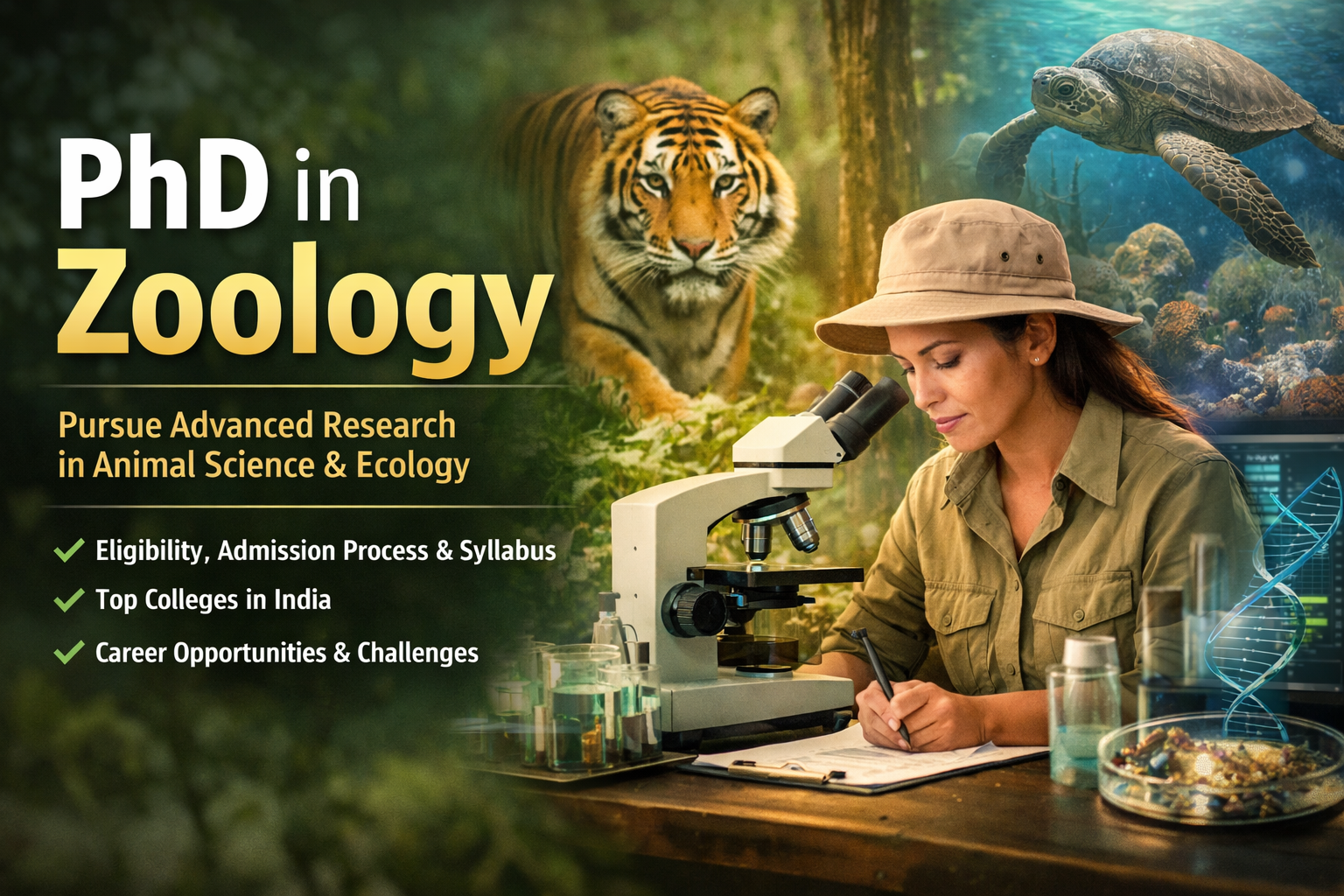
PhD in Zoology: Duration, Syllabus, Eligibility and Application
A PhD in Zoology is a doctoral-level program that focuses on advanced study and research about animals, their behavior, structure, evolution, genetics, and ecosystems. This course is ideal for students who are interested in wildlife, animal science, research, and teaching careers.
Zoology is an important branch of biological sciences that helps us understand how animals live, adapt, and interact with the environment. A PhD in Zoology allows students to specialize in a specific research area such as wildlife biology, marine biology, genetics, ecology, or animal physiology.
This program mainly focuses on research work, scientific experiments, and thesis writing. Students work under experienced professors and researchers while conducting detailed studies on selected topics.
The duration of the course usually ranges from 3 to 5 years, depending on the research area and university guidelines.
Why Study PhD in Zoology?
A PhD in Zoology is suitable for students who want to build careers in research, teaching, wildlife conservation, or scientific development. The program provides deep knowledge and practical research experience in animal science.
One major advantage of this course is that it opens opportunities in universities, research laboratories, environmental organizations, and government departments. Students also gain strong analytical and problem-solving skills through scientific research.
The course is also important for environmental protection because zoological research helps in wildlife conservation, biodiversity management, and ecosystem balance.
Students who enjoy fieldwork, laboratory experiments, and scientific discovery often find this program very interesting and rewarding.
PhD in Zoology: Key Highlights
PhD in Zoology Eligibility Criteria
The eligibility criteria for a PhD in Zoology are designed to ensure that students have strong academic knowledge and research ability before starting advanced scientific work. Since a PhD is a research-focused degree, universities select candidates who have a solid foundation in biological sciences and a clear interest in research.
Educational Qualification
Candidates must complete a Master’s degree in Zoology or a related life science subject such as Biology, Biotechnology, Environmental Science, or Life Sciences from a recognized university. This requirement ensures that students already understand basic zoological concepts like animal physiology, genetics, ecology, and evolution.
Students from related subjects are also eligible if they have studied zoology-related topics during their postgraduate program.
Minimum Marks Requirement
Most universities require at least 55% marks in the postgraduate degree. This percentage may vary slightly depending on the institution. For reserved category students (SC/ST/OBC/PwD), marks relaxation is usually provided according to government rules.
Strong academic performance improves admission chances, especially in top universities.
Entrance Exam Qualification
Many universities require candidates to qualify for national-level or university-level entrance exams. These exams test subject knowledge, research aptitude, and analytical skills. Qualifying for national exams also helps students receive research fellowships.
Interview and Research Proposal
Some universities conduct personal interviews to evaluate the candidate’s research interest and subject understanding. Students may need to present a research proposal, which explains their research topic, objectives, and methodology.
This stage helps universities select students who are serious about research.
Research Interest and Academic Background
Universities prefer students who have strong academic records and interest in research activities such as project work, internships, or research publications. Good knowledge of zoology fundamentals is very important for success in a PhD program.
Overall, the eligibility criteria ensure that students are prepared for advanced research and scientific work.
| Criteria | Details |
|---|---|
| Educational Qualification | Candidates must complete a Master’s degree in Zoology or related life science subjects such as Biology, Biotechnology, Environmental Science, or Life Sciences from a recognized university. |
| Relevant Subject Background | Students from related disciplines are eligible if they have studied zoology-related subjects like animal physiology, genetics, ecology, or evolution during postgraduate studies. |
| Minimum Marks Requirement | Most universities require at least 55% marks in the postgraduate degree. Marks relaxation is usually provided for SC/ST/OBC/PwD candidates as per government rules. |
| Entrance Exam Qualification | Candidates may need to qualify national-level or university-level entrance exams that test subject knowledge and research aptitude. |
| Interview Process | Many universities conduct personal interviews to assess subject understanding, research interest, and communication skills. |
| Research Proposal | Some institutes require students to submit or present a research proposal explaining their research topic, objectives, and methodology. |
| Academic Background | Universities prefer candidates with strong academic performance and knowledge of zoology fundamentals. |
| Research Experience (Preferred) | Project work, internships, or research publications improve admission chances but may not be mandatory in all universities. |
Admission Process for PhD in Zoology
The admission process for a PhD in Zoology usually includes multiple stages to select candidates with strong subject knowledge and research potential. Although the process may vary slightly between universities, most institutions follow a similar structure.
Step 1: Application Form
Students must first fill out the online application form through the official university website. The form requires academic details, personal information, and research interests. Candidates also need to upload important documents such as mark sheets, certificates, and identity proof.
Students should carefully check eligibility requirements before applying.
Step 2: Entrance Exam
Many universities conduct a PhD entrance examination to test knowledge of zoology subjects and research aptitude. The exam usually includes topics like animal physiology, genetics, ecology, molecular biology, and basic research methods.
Some universities may exempt candidates who have already qualified national-level exams.
Step 3: Interview Process
Candidates who clear the entrance exam are invited for a personal interview. During this stage, students may be asked questions about their academic background and research interests. Some universities also require a short presentation of the proposed research topic.
The interview helps faculty members evaluate the candidate’s research ability and communication skills.
Step 4: Final Selection
Final selection is based on a combination of:
-
Entrance exam marks
-
Academic performance
-
Interview performance
-
Research proposal quality
After selection, students are assigned a research supervisor who guides them throughout their PhD program.
Students then begin coursework followed by detailed research work.
Entrance Exams for PhD in Zoology in India
Entrance exams play an important role in PhD admissions because they help universities evaluate a student’s subject knowledge and research aptitude.
Some of the commonly accepted entrance exams include:
-
CSIR-UGC NET (Life Sciences)
-
UGC NET
-
GATE (Life Sciences)
-
University-level PhD entrance tests
These exams generally cover topics such as:
-
Cell biology
-
Genetics
-
Ecology
-
Animal physiology
-
Molecular biology
-
Biostatistics
Qualifying for national-level exams also helps students receive Junior Research Fellowship (JRF) or other scholarships, which provide financial support during the PhD program.
Students preparing for these exams should focus on basic zoology concepts and practice previous question papers.
PhD in Zoology Duration
The duration of a PhD in Zoology generally ranges between 3 to 5 years.
-
Coursework Stage (6 months to 1 year): Students study research methodology and advanced zoology topics.
-
Research Stage (2 to 4 years): Students conduct experiments, fieldwork, and data analysis.
-
Thesis Submission: Students prepare and submit their final research thesis.
The duration may vary depending on the complexity of the research topic and progress of the student.
PhD in Zoology Syllabus
| Stage / Semester | Subjects / Topics | Description |
|---|---|---|
| Coursework Semester 1 | Research Methodology | Introduction to research design, literature review, hypothesis formation, data collection methods, and scientific report writing. Helps students understand the basics of research work. |
| Advanced Animal Physiology | Study of advanced body systems in animals such as nervous, circulatory, and endocrine systems along with functional adaptations in different species. | |
| Molecular Biology | Concepts of DNA structure, gene expression, molecular techniques, and laboratory tools used in biological research. | |
| Biostatistics | Statistical tools and methods used for analyzing biological research data including probability, sampling methods, and data interpretation. | |
| Coursework Semester 2 | Genetics and Evolution | Study of heredity, genetic variation, mutation, natural selection, and evolutionary mechanisms in animals. |
| Ecology and Environmental Biology | Understanding ecosystems, biodiversity, population ecology, and environmental conservation methods. | |
| Laboratory Techniques in Zoology | Practical training in microscopy, molecular experiments, specimen handling, and laboratory safety procedures. | |
| Research Proposal Development | Preparation and presentation of a research proposal including topic selection, objectives, methodology, and expected outcomes. | |
| Research Phase (Year 2–4) | Literature Review | Detailed study of research papers and scientific journals related to the chosen research topic. Helps identify research gaps. |
| Field Work / Data Collection | Collection of samples or data through laboratory experiments, wildlife surveys, or environmental studies depending on specialization. | |
| Data Analysis | Use of statistical and computational tools to analyze research results and interpret findings. | |
| Research Publications | Writing and publishing research papers in national or international scientific journals. | |
| Final Stage | Thesis Writing | Preparation of detailed research thesis including introduction, methodology, results, discussion, and conclusion. |
| Thesis Submission & Viva Voce | Submission of thesis followed by oral examination (viva) where students present their research findings before an academic panel. |
Major Research Areas in PhD in Zoology
PhD students can choose from many specialized research areas depending on their interests.
Wildlife Biology
Study of wild animals, conservation techniques, and biodiversity protection.
Marine Biology
Research on ocean animals, aquatic ecosystems, and marine conservation.
Genetics and Molecular Biology
Study of genes, DNA, and hereditary characteristics in animals.
Ecology
Study of relationships between animals and their environment.
Entomology
Study of insects and their role in ecosystems and agriculture.
Animal Physiology
Study of body functions and biological processes of animals.
These research areas help students build expertise in specific scientific fields.
Top Colleges for PhD in Zoology in India
Many universities in India offer high-quality research facilities for PhD in Zoology.
| College / University | Location | Type | Entrance Exam Accepted | Major Research Areas | Approx. Annual Fees | Duration |
|---|---|---|---|---|---|---|
| University of Delhi | New Delhi | Central University | UGC NET / CSIR NET / University Test | Ecology, Genetics, Animal Physiology, Molecular Biology | ₹20,000 – ₹35,000 | 3–5 Years |
| Banaras Hindu University | Varanasi | Central University | UGC NET / CSIR NET / BHU RET | Wildlife Biology, Environmental Biology, Taxonomy | ₹25,000 – ₹40,000 | 3–5 Years |
| Jawaharlal Nehru University | New Delhi | Central University | JNU Entrance / CSIR NET | Molecular Biology, Evolutionary Biology, Ecology | ₹15,000 – ₹30,000 | 3–5 Years |
| University of Calcutta | Kolkata | State University | UGC NET / University Entrance | Animal Physiology, Genetics, Marine Biology | ₹20,000 – ₹30,000 | 3–5 Years |
| Indian Institute of Science | Bengaluru | Research Institute | GATE / CSIR NET | Molecular Zoology, Cellular Biology, Evolution | ₹35,000 – ₹60,000 | 4–5 Years |
| Aligarh Muslim University | Aligarh | Central University | UGC NET / AMU Entrance | Entomology, Wildlife Biology, Environmental Science | ₹20,000 – ₹35,000 | 3–5 Years |
| Pondicherry University | Puducherry | Central University | UGC NET / University Test | Marine Biology, Ecology, Molecular Biology | ₹18,000 – ₹30,000 | 3–5 Years |
| Christ University | Bengaluru | Private University | University Entrance / Interview | Environmental Biology, Genetics, Wildlife Studies | ₹60,000 – ₹1,20,000 | 3–5 Years |
| Amity University | Noida | Private University | NET / University Entrance | Biotechnology, Molecular Zoology, Ecology | ₹1,00,000 – ₹1,80,000 | 3–5 Years |
| Lovely Professional University | Jalandhar | Private University | LPUNEST / NET | Animal Biotechnology, Genetics, Environmental Biology | ₹90,000 – ₹1,50,000 | 3–5 Years |
Skills Required for PhD in Zoology
Students pursuing a PhD in Zoology should develop several important skills for successful research work.
-
Research and analytical skills
-
Observation and data interpretation
-
Scientific writing skills
-
Laboratory handling skills
-
Problem-solving ability
-
Fieldwork management
These skills help students perform experiments, analyze results, and complete research successfully.
Career Opportunities After PhD in Zoology
A PhD in Zoology offers many career opportunities in research, education, and environmental sectors.
Teaching Jobs
Students can become assistant professors or lecturers in colleges and universities.
Research Scientist
PhD graduates can work in research institutes conducting scientific studies.
Wildlife Biologist
Professionals work in wildlife conservation projects and forest departments.
Environmental Consultant
Experts help organizations manage environmental impact and biodiversity.
Zoologist
Zoologists study animals, their habitats, and behavior patterns.
Both government and private sectors offer employment opportunities.
Salary After PhD in Zoology
Salary depends on experience, job role, and organization.
-
Assistant Professor: ₹6–10 lakh per year
-
Research Scientist: ₹5–12 lakh per year
-
Wildlife Biologist: ₹4–8 lakh per year
-
Environmental Consultant: ₹5–9 lakh per year
With experience and research publications, salary packages increase significantly.
Advantages of Studying PhD in Zoology
A PhD in Zoology offers several academic and professional benefits.
-
Deep knowledge of animal science
-
Opportunities in research and teaching
-
Contribution to wildlife conservation
-
High-level career opportunities
-
International research exposure
Students also gain expertise in scientific writing and advanced research techniques.
Challenges in PhD in Zoology
A PhD in Zoology is a highly rewarding program, but it also comes with several academic, research, and practical challenges. Since this degree focuses on advanced scientific research, students must be prepared for long-term dedication, continuous learning, and problem-solving.
1. Extensive Research Work
PhD students must conduct original research, which often takes several years to complete. Experiments may fail, data collection can be slow, and results may require repeated testing. This makes patience and consistency very important.
2. Fieldwork Difficulties
Many zoology research areas require fieldwork in forests, wildlife areas, rivers, or remote locations. Travel, climate conditions, and safety issues can make field research physically demanding and time-consuming.
3. Complex Scientific Concepts
PhD-level zoology involves advanced topics such as molecular biology, genetics, bioinformatics, and evolutionary biology. Understanding these complex subjects requires strong academic background and continuous study.
4. Data Analysis and Technical Skills
Students must learn statistical tools, laboratory techniques, and research software. Handling large datasets and interpreting results accurately can be challenging, especially for beginners in research.
5. Long Duration of the Program
A PhD in Zoology usually takes 3 to 5 years, and sometimes longer. Maintaining motivation and focus over such a long academic period can be difficult for many students.
6. Research Funding and Resources
Some research projects require expensive equipment, laboratory materials, or travel for fieldwork. Limited funding or resource availability may slow down research progress.
7. Publication Pressure
Most universities require students to publish research papers in academic journals before thesis submission. Writing scientific papers and getting them accepted can be time-consuming and competitive.
8. Career Uncertainty
While a PhD opens many opportunities, academic and research positions can be competitive. Students need to plan their careers carefully and develop additional skills such as teaching, data analysis, or scientific writing.
How to Prepare for PhD in Zoology?
Students planning to pursue a PhD in Zoology should start preparation early.
-
Build strong knowledge in basic zoology subjects
-
Prepare for entrance exams like NET or GATE
-
Read research papers and scientific journals
-
Choose an interesting research area
-
Develop laboratory and research skills
Early preparation increases chances of admission to top universities.
Conclusion
A PhD in Zoology is an excellent choice for students interested in animal science, research, and environmental conservation. The course provides advanced knowledge, research experience, and strong career opportunities in teaching, research institutes, and wildlife organizations.
With growing environmental awareness and biodiversity conservation needs, zoology experts are becoming increasingly important worldwide. Students who are passionate about animals and scientific discovery can build a successful and meaningful career through this program.
FAQs
1. What is the duration of a PhD in Zoology?
The duration of a PhD in Zoology usually ranges from three to five years. It includes coursework, research work, field studies, and thesis submission depending on the university and research topic complexity.
2. What are the eligibility criteria for PhD in Zoology?
Students must complete a Master’s degree in Zoology or related subject with at least 55% marks. Many universities also require entrance exam qualification and interview for final selection.
3. Is NET required for PhD in Zoology?
NET is not always mandatory, but many universities prefer candidates who qualify UGC NET or CSIR NET because it improves admission chances and provides opportunities for research fellowships.
4. What are the subjects in PhD Zoology coursework?
Common subjects include research methodology, molecular biology, genetics, ecology, animal physiology, and biostatistics. These subjects help students develop strong research knowledge before starting their thesis work.
5. What are the career options after PhD in Zoology?
Career options include assistant professor, research scientist, wildlife biologist, zoologist, environmental consultant, and laboratory researcher in government and private organizations related to biological sciences.
6. What is the salary after PhD in Zoology?
The average salary after PhD in Zoology ranges between ₹4 lakh and ₹12 lakh per year depending on job role, experience, organization type, and research expertise.
7. Can I do PhD in Zoology after MSc Biology?
Yes, students with MSc in Biology or related life science subjects can apply for PhD in Zoology if they studied zoology-related subjects and meet the university eligibility requirements.
8. Is PhD in Zoology a good career option?
Yes, PhD in Zoology is a good career option for students interested in research, teaching, and wildlife conservation. It offers stable academic careers and opportunities in environmental and biological research fields.
9. What skills are required for PhD in Zoology?
Important skills include research ability, observation, data analysis, scientific writing, laboratory techniques, and patience. These skills help students successfully complete research and build strong scientific careers.
10. What is the scope of PhD in Zoology in India?
The scope of PhD in Zoology in India is growing due to increased focus on biodiversity, environmental protection, and research development. Opportunities are available in universities, research institutes, and government departments.