Photography Certificate Course in India: Colleges, Fees, Syllabus, and Career Opportunities
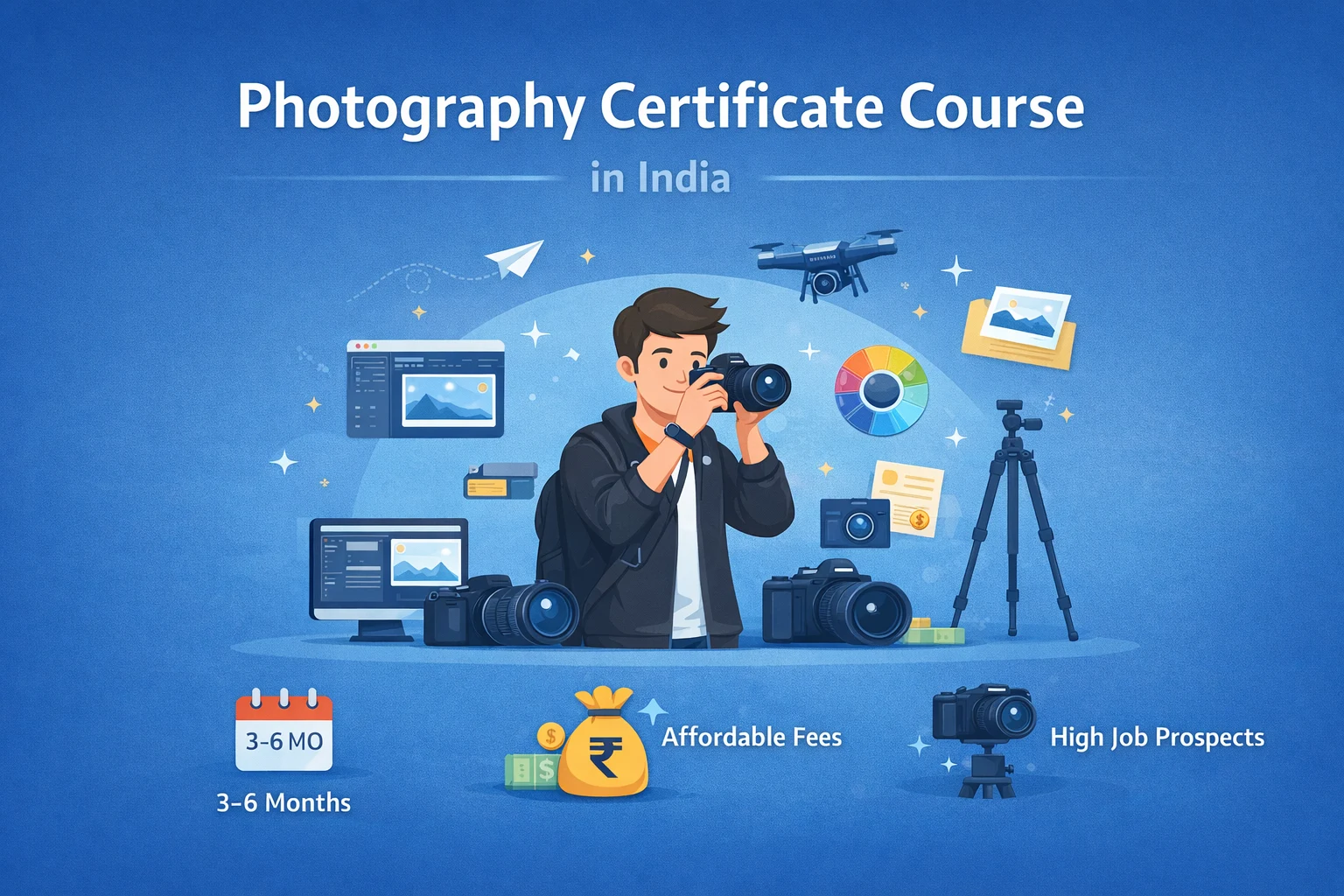
A Photography Certificate Course in India is a short-term program designed for beginners who want to build practical skills and start a creative career. Typically lasting 3–6 months, these courses cover photography techniques, camera handling, lighting, editing software, and current industry trends. Most institutes require 10+2 or equivalent qualification, while some may ask for basic computer knowledge, a portfolio, or an entrance test. Course fees generally range from ₹10,000 to ₹50,000, depending on the institute and facilities offered. After completion, students can explore roles such as photographer, photo editor, content creator, or freelance professional, with starting salaries usually between ₹2–5 LPA. This article provides a complete overview of photography certificate courses in India, including eligibility, admission process, fees, syllabus, top colleges, and career opportunities.
🔔 Photography Certificate Course in India Admission Alerts 2026
- IMTS Institute: Photography courses for 12th pass students are open for the 2027-26 academic year, apply before February 28, 2026.
- Subharti University: Admission portal for fine arts courses after 12th is open for 2026-27, apply until February 12, 2026.
- Direct Online Applications: The deadline for direct online applications for after-12th-grade fine arts certificate programs is February 14, 2026.
- National Testing Agency (NTA): Exact dates for MFA entrance exams will be announced one month before the exam.
Photography Certificate Course Overview
A Photography Certificate Course in India is a short-term, skill-focused program designed to build foundational photography and editing skills for beginners and enthusiasts. The course usually lasts 3–6 months and is open to candidates who have completed 10+2 or equivalent from a recognised board. Fees generally range between ₹10,000 and ₹50,000, depending on institute type, facilities, and course depth. Popular institutes include National Institute of Photography, Government Polytechnic colleges, and FTII (for specialised programs/workshops). Students can choose specialisations such as portrait, wildlife, fashion, sports, or photojournalism. After completion, graduates can work as photographers, photo editors, content creators, or freelancers, with typical starting salaries ranging from ₹2–5 LPA depending on skills and experience.
| Feature | Details |
|---|---|
| Course Name | Photography Certificate Course |
| Degree Type | Certificate Program |
| Typical Duration | 3-6 months |
| Eligibility (India) | 10+2 or equivalent from a recognized board |
| Admission Process 2026 | Direct application open until February 14, 2026 (for some programs); IMTS Institute applications open until February 28, 2026 for 2026-27 session |
| Average Annual Fees (India) | ₹10,000 – ₹50,000 |
| Career Options | Photographer, Photo Editor, Cinematographer, Director of Photography, Camera Operator, Visual Content Creator |
| Average Starting Salary (India) | ₹4 LPA – ₹10 LPA (depending on experience and certification) |
| Key Skills | Camera Operations, Composition, Exposure, Lighting, Editing |
| Industry Scope | Media, Advertising, E-commerce, Events, Filmmaking, Freelancing |
Photography Certificate Course Eligibility Criteria
Eligibility requirements for photography certificate courses are generally flexible and beginner-friendly. Most institutes require candidates to have completed 10+2 or equivalent from a recognised board, while some may specify minimum marks or conduct portfolio assessments for advanced courses. There is usually no upper age limit, and prior photography experience is optional. Candidates must submit valid academic documents and ID proof during admission. Requirements may vary across institutes and course specialisations.
| Criteria | Details | Specific Requirements |
|---|---|---|
| Minimum Education | 10+2 or equivalent | Passing marks as specified by institute |
| Age Limit | Usually no upper limit | Some institutes require minimum age (16–17 years) |
| Prior Experience | Not mandatory | Portfolio may be required for advanced courses |
| Required Documents | 10+2 marksheets, ID proof, photographs | Aadhaar or government-issued ID |
| Subject Requirement | Any stream accepted | No specific subjects required for basic courses |
| Entrance Exam | Only in select institutes | Basics of photography or creative aptitude |
| Interview | Rare; institute-specific | Used to assess creativity and interest |
| Physical Fitness | Not mandatory | General health recommended for field work |
| Language Skills | Basic English helpful | Communication skills beneficial |
| Computer Skills | Basic computer knowledge preferred | Familiarity with editing tools is an advantage |
Photography Certificate Course Admission Process
Admission to photography certificate courses varies by institute, with most offering merit-based admission, while some conduct portfolio reviews or entrance tests. The process typically involves submitting an application form, verifying eligibility, and completing document checks. Some institutes may conduct interviews to assess creativity and interest. Once selected, candidates must pay the course fee to confirm admission.
Admission Steps
- Application Submission: Fill out online/offline application with personal and academic details.
- Document Upload: Submit 10+2 marksheets, ID proof, photographs, and portfolio (if required).
- Merit List / Entrance Test: Institutes may shortlist candidates based on marks or creative aptitude tests.
- Interview / Portfolio Review: Conducted by some institutes to evaluate creativity and motivation.
- Fee Payment: Confirm admission by paying course fees (₹10,000–₹50,000 approx.).
- Document Verification: Original documents checked during admission.
- Admission Confirmation: Institute issues confirmation letter/email with course details.
After admission, students undergo training in camera techniques, lighting, editing software, and practical photography skills. Courses usually last 3–6 months, preparing students for roles such as photographer, photo editor, or freelancer, with entry-level salaries typically ranging from ₹2–5 LPA depending on skills and work experience.
Top Government Institutes for Photography Certificate Courses
Government photography institutes and public universities in India generally offer short-term photography certificate programs, workshops, or media/visual arts courses rather than full-time dedicated photography certificates in all cases. Institutes such as FTII, NIFT (Fashion Communication/Photography modules), and Government Polytechnic colleges provide structured training with affordable fees and practical exposure. Admission is typically merit-based, portfolio-based, or through institute-level entrance tests/interviews. Note that IITs, NITs, and JNU/DU usually do not offer dedicated photography certificate courses, though they may provide short workshops or media electives. Fees and course availability vary by institute and are subject to change.
| Institute Name | City | Approx. Course Fees (INR) | Admission Mode | Notes |
|---|---|---|---|---|
| Film and Television Institute of India (FTII) | Pune | ₹25,000 – ₹60,000 (short courses/workshops) | Entrance / Portfolio / Merit | Govt. media institute offering cinematography & photography workshops |
| National Institute of Fashion Technology (NIFT) | Multiple Cities | ₹50,000 – ₹1,20,000 (short-term programs) | Entrance / Merit | Fashion photography modules under fashion communication |
| Government Polytechnic Colleges (Selected) | Multiple Cities | ₹10,000 – ₹25,000 | Merit-based | Photography & multimedia certificate programs |
| Sir JJ School of Applied Arts (Govt.) | Mumbai | ₹15,000 – ₹40,000 | Merit / Entrance | Photography within applied arts & visual communication |
| State Fine Arts Colleges | Various States | ₹8,000 – ₹30,000 | Merit / Portfolio | Visual arts programs including photography training |
Top Private Institutes for Photography Certificate Courses
Private photography institutes in India provide industry-focused certificate programs with hands-on training, modern studios, and industry exposure. Admission is usually merit-based, portfolio-based, or through institute-level screening, rather than national entrance exams. Accreditation may vary, as many private academies operate as professional training institutes rather than UGC-affiliated colleges. Fees depend on course duration, infrastructure, and specialisations offered.
| Institute Name | City | Approx. Fees (INR) | Admission Mode | Accreditation / Recognition |
|---|---|---|---|---|
| Arena Animation | Multiple Cities | ₹30,000 – ₹60,000 | Merit / Interview | Private training institute (industry certification) |
| MAAC (Maya Academy of Advanced Cinematics) | Multiple Cities | ₹35,000 – ₹70,000 | Merit / Counselling | Private animation & media training institute |
| Whistling Woods International | Mumbai | ₹40,000 – ₹1,00,000 (short courses) | Entrance / Interview | Private film & media institute |
| Indian Institute of Photography | Delhi | ₹25,000 – ₹60,000 | Merit / Portfolio | Professional photography training institute |
| Light and Life Academy | Ooty | ₹30,000 – ₹80,000 | Entrance / Portfolio | Professional photography academy |
Photography Certificate Course Syllabus Structure
Photography certificate courses in India typically last 3–6 months, though some institutes offer 1-year diploma-style programs. The syllabus focuses heavily on practical training, covering camera handling, lighting, editing, composition, and portfolio development. Courses combine theory with extensive fieldwork, studio practice, and assignments to build real-world skills. The structure below represents a generalised syllabus format, as exact subjects vary by institute and course duration.
1-Year / Extended Certificate Program (4 Modules / Semesters)
| Module / Semester | Core Subjects | Elective Topics | Practical Weightage |
|---|---|---|---|
| Module 1 | Introduction to Photography, Camera Basics, Composition | Visual Arts Basics | 50% Practical |
| Module 2 | Lighting Techniques, Photo Editing, Studio Setup | Portrait / Landscape Photography | 60% Practical |
| Module 3 | Studio Photography, Outdoor Shoots, Photojournalism | Sports / Fashion Photography | 70% Practical |
| Module 4 | Advanced Editing, Portfolio Development, Photography Business | Wedding / Event / Travel Photography | 75–80% Practical |
6-Month Certificate Course Structure
| Module | Core Subjects | Electives | Practical Weightage |
|---|---|---|---|
| Module 1 | Camera Handling, Composition, Basic Lighting | Visual Arts Basics | 50% Practical |
| Module 2 | Editing Software, Studio Lighting, Outdoor Photography | Portrait / Landscape | 60–65% Practical |
3-Month Short-Term Certificate Structure
| Module | Core Subjects | Electives | Practical Weightage |
|---|---|---|---|
| Module 1 | Introduction to Photography, Camera Basics | Photography Fundamentals | 50% Practical |
| Module 2 | Lighting Basics, Composition, Basic Editing | Creative Photography | 60% Practical |
| Module 3 | Studio Practice, Outdoor Shoots | Specialised Mini Projects | 65–70% Practical |
Photography Certificate Course Fee Structure
The fee structure for a Photography Certificate Course in India varies depending on institute type, facilities, and course duration. Government institutes generally offer affordable programs with basic infrastructure, while private institutes may charge higher fees due to advanced studios, workshops, and industry exposure. Tuition fees typically range from ₹10,000–₹30,000 in government colleges and ₹30,000–₹50,000 in private institutes. Additional expenses may include hostel, exam, lab, and workshop charges. The overall course cost can range from approximately ₹16,000 to ₹82,000 or more, depending on facilities and specialization modules offered by the institute.
| Fee Component | Government Colleges (INR) | Private Colleges (INR) | Remarks |
|---|---|---|---|
| Tuition Fees | ₹10,000 – ₹30,000 | ₹30,000 – ₹50,000 | Core course fee |
| Hostel Fees (Optional) | ₹5,000 – ₹10,000 | ₹15,000 – ₹25,000 | Depends on campus facilities |
| Examination Fees | ₹500 – ₹1,000 | ₹1,000 – ₹2,000 | Semester/assessment charges |
| Other Fees | ₹500 – ₹2,000 | ₹1,000 – ₹5,000 | Lab, workshop, materials |
| Approx. Total Course Fees | ₹16,000 – ₹43,000 | ₹47,000 – ₹82,000 | May vary by institute & duration |
Career Scope and Salary after Photography Certificate Course in India
A Photography Certificate Course in India opens opportunities across media, advertising, fashion, events, and digital content industries. Entry-level roles typically include photographer, photo editor, and freelance photographer. With specialization and experience, professionals can move into advanced roles such as fashion photographer, drone photographer, or creative director. Salaries vary depending on skill level, specialization, client base, and geographic location. Freelance income can fluctuate based on projects and reputation. The growing demand for visual content in marketing, social media, and journalism continues to expand career opportunities for trained photographers.
| Job Role | Average Salary (INR per annum) | Potential Employers | Experience Level | Specialization |
|---|---|---|---|---|
| Photographer | ₹2.5 – ₹5 LPA | Media houses, advertising firms | 0–3 years | General photography, photojournalism |
| Photojournalist | ₹3 – ₹6 LPA | Newspapers, news platforms | 1–5 years | Documentary, news photography |
| Fashion Photographer | ₹4 – ₹10 LPA | Fashion brands, magazines | 2–6 years | Fashion, portrait photography |
| Wildlife Photographer | ₹3.5 – ₹7 LPA | Wildlife agencies, NGOs | 2–5 years | Wildlife, nature photography |
| Wedding Photographer | ₹3 – ₹6 LPA | Studios, event firms, freelance | 1–4 years | Event & wedding photography |
| Photo Editor | ₹2.5 – ₹5 LPA | Media platforms, publishers | 0–3 years | Editing & visual storytelling |
| Freelance Photographer | Project-based | Agencies, direct clients | 1–5 years | Multiple genres |
| Drone Photographer | ₹4 – ₹8 LPA | Film, construction firms | 2–5 years | Aerial photography |
| Food Photographer | ₹3 – ₹6 LPA | Restaurants, food brands | 1–4 years | Food & product photography |
| Portrait Photographer | ₹2.5 – ₹5 LPA | Studios, freelance clients | 0–3 years | Studio & portrait photography |
Frequently Asked Questions (FAQs)
Q1. What is the eligibility criteria for a Photography Certificate Course in India?
To be eligible for a photography certificate course in India, you need a 10+2 (or equivalent) from a recognized board, with the minimum passing marks specified by the institute. There is generally no age limit, but some institutes may have a minimum age requirement. Some institutes may also require a portfolio.
Q2. What is the average fee for a Photography Certificate Course in India?
The average fee for a photography certificate course in India ranges from INR 10,000 to INR 50,000, depending on the institute. Government colleges typically charge between INR 10,000 and INR 30,000, while private colleges charge between INR 30,000 and INR 50,000.
Q3. What are the core subjects covered in the Photography Certificate Course syllabus?
Core subjects in a photography certificate course include Introduction to Photography, Camera Handling, Basic Lighting Techniques, Advanced Lighting, Composition, and Photo Editing. Elective subjects such as Portrait Photography and Landscape Photography are also offered.
Q4. What are the average salary ranges for job roles after completing a Photography Certificate Course in India?
After completing a photography certificate course in India, expect average salary ranges of INR 2 LPA – INR 4 LPA as a Photographer, INR 2.5 LPA – INR 4.5 LPA as a Photo Editor. A Freelance Photographer’s salary varies based on projects.
Frequently Asked Questions — Photography Certificate Course in India 2026
Q: What is the average Photography Certificate Course in India fees in 2026?
The average Photography Certificate Course in India fees in 2026 can range from ₹30,000 to ₹1,50,000, depending on the institution and course duration. Shorter, introductory courses might be around ₹45,000, while more comprehensive programs with advanced equipment access could reach ₹1,20,000. These figures are for the entire course, not per semester.
Q: Are there any entrance exams for Photography Certificate Course in India admission in 2026?
Generally, there are no specific entrance exams for Photography Certificate Course in India admission in 2026. Most institutes offering the Photography Certificate Course in India admit students based on a merit list from their 10th or 12th-grade scores. Some premier institutes might conduct a basic aptitude test or a portfolio review, but this is less common for certificate-level programs. A minimum of 50% in 12th grade is often preferred.
Q: What is the eligibility criteria for Photography Certificate Course in India in 2026?
The eligibility criteria for a Photography Certificate Course in India in 2026 typically require candidates to have completed their 10+2 (or equivalent) education from a recognized board. Some institutes might also accept students who have completed their 10th grade, especially for shorter, foundational courses. There is usually no age limit, and a keen interest in photography is the primary prerequisite. A minimum aggregate of 45% in 12th standard is often sufficient.
Q: Which are the top colleges for Photography Certificate Course in India in 2026?
Some top colleges for a Photography Certificate Course in India in 2026 include the National Institute of Photography (Mumbai), Delhi College of Photography, and Light & Life Academy (Ooty). While not always “colleges” in the traditional sense, these institutions offer highly regarded certificate programs. Other notable options include Symbiosis School of Photography (Pune) and Pearl Academy (various locations), which offer excellent facilities and industry exposure, with courses typically lasting 6-12 months.
Q: What is the average salary after Photography Certificate Course in India in 2026?
The average salary after a Photography Certificate Course in India in 2026 can range from ₹2.5 LPA to ₹5 LPA for entry-level positions. A freelance photographer might earn more, potentially ₹30,000-₹70,000 per project, depending on their niche and experience. Specializations like wedding photography or product photography can command higher rates, with experienced professionals earning upwards of ₹7 LPA after 3-5 years. The initial 6-12 months often involve building a portfolio.
Q: Can I pursue photography abroad after completing a Photography Certificate Course in India?
Yes, you can definitely pursue photography abroad after completing a Photography Certificate Course in India. While the certificate itself might not directly qualify you for degree programs, it provides a strong portfolio and foundational skills. Many Indian photographers successfully work as freelancers or seek further specialization courses in countries like the UK, USA, or Canada. A strong portfolio showcasing 15-20 diverse projects is crucial for international opportunities and visa applications.