
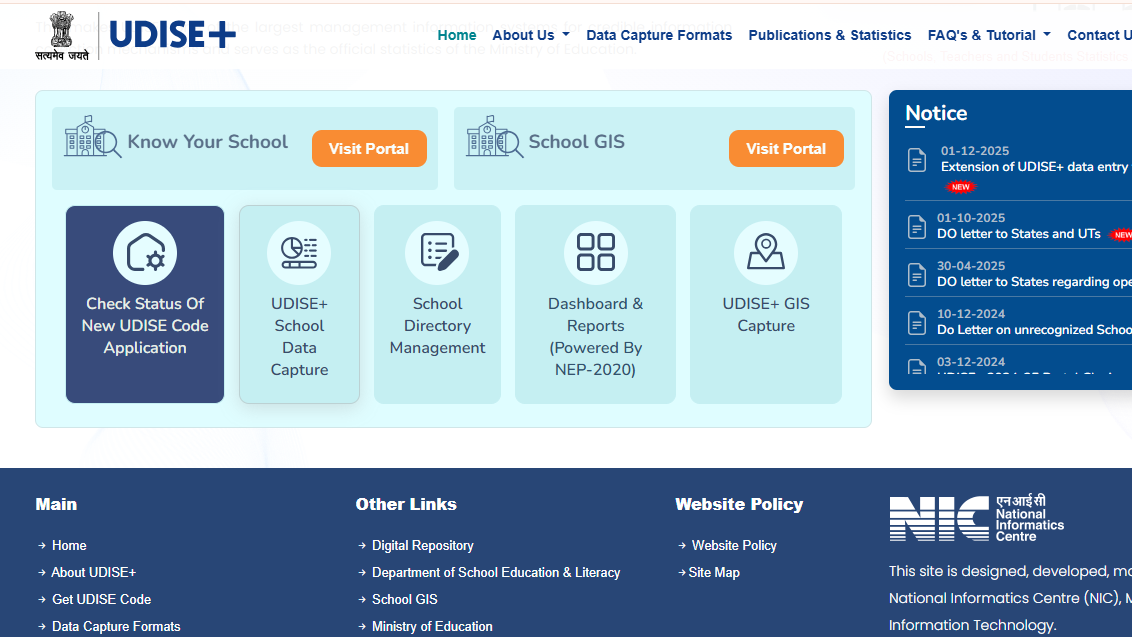
UDISE Plus Faqs: How to Find UDISE Code, Purpose, Teacher & Student Modules, PEN Number
The Unified District Information System for Education Plus (UDISE+), an initiative of the Ministry of Education, Government of India, is a pan-India database that collects and manages data on schools, teachers, and students to support policy-making and resource allocation. UDISE+ has extended its data entry period to December 15, 2026, allowing schools to update profiles, facilities, and modules accurately.
🔔 UDISE Plus Faqs Admission Alerts 2026
- UDISE+ 2026 Access: Login to the UDISE Plus portal is available for online data entry for teacher records and student module access.
- Andhra Pradesh Intermediate Admissions: The Board of Intermediate Education, Andhra Pradesh, announced the 2026-27 admission schedule for intermediate courses starting April 1.
- BIE AP Schedule Release: The Board of Intermediate Education (BIE), Andhra Pradesh, released the admission schedule for two-year Intermediate courses on Tuesday, March 24, 2026.
- UDISE+ Teacher Module: The Ministry of Education, Government of India, developed this online platform for teachers and school staff to manage and update their professional information.
- UDISE+ Student Module: This key component of the Student Database Management System (SDMS) enables schools across India to efficiently manage and update student-related information.
This system, upgraded from the original UDISE in 2018-19, ensures real-time, digital data collection for over 1.5 million schools, 9.6 million teachers, and 265 million students. It plays a important role in schemes like Samagra Shiksha, Mid-Day Meal, and NEP 2020 implementation. This article addresses common
FAQs on finding UDISE codes, the system’s purpose, differences from UDISE, data collected, modules in teaching, teacher/student modules, PEN number, and more. We also provide state-specific insights for Maharashtra, Uttar Pradesh, and Jharkhand, along with separate sections for student and teacher modules to make it helpful for users.
How to Find UDISE Code of School?
To find the UDISE code of a school, use the official UDISE+ portal’s search feature.
- Navigate to https://udiseplus.gov.in/ > “Know Your School” or “School Directory.”
- Enter the state, district, block, and school name or PIN code.
- The system will display the 11-digit UDISE code along with school details like infrastructure and enrollment.
- If you’re a student or parent, ask the school administration for the code from their report card or login credentials. For bulk searches, use the dashboard at https://dashboard.udiseplus.gov.in/ .
This method is quick and accurate, avoiding manual errors. In case of issues, contact the district education officer (DEO).
How Do I Find My School UDISE Code?
Your school’s UDISE code can be found on official documents like the school ID card, annual report card, or affiliation certificate.
- Online, visit https://kys.udiseplus.gov.in/ (Know Your School portal) and search by school name, location, or PIN code. Select “Advance Search” for precise results.
- If logged in as a school admin, access it via the school management module at https://udiseplus.gov.in/ud/mainhome .
- For parents, apps like Diksha or state education portals (e.g., UP’s Prerna app) often display it during student registration.
- If lost, email the state UDISE coordinator or use the helpline.
What is Your UDISE?
UDISE refers to the Unified District Information on School Education, now evolved into UDISE+. It’s India’s national EMIS for collecting school-level data. “Your UDISE” typically means your school’s UDISE code or profile.
For individuals, it’s not personal; schools have UDISE codes, while students/teachers have PEN. To view “your” (school’s) UDISE profile, use https://udiseplus.gov.in/ search tools.
It includes data on enrollment, infrastructure, and performance, helping in monitoring educational progress.
How Do I Find My UDISE ID and Password?
The UDISE ID is the school’s login username for the portal, separate from the UDISE code.
- To recover, go to https://sdms.udiseplus.gov.in/p0/v1/login > “Forgot Password.”
- Enter the UDISE code and registered mobile/email for OTP reset. New schools get ID during initial registration by the DEO.
- If unavailable, contact state MIS coordinator (list at https://educationforallinindia.com/udiseplus-state-union-territory-mis-coordinators/ ).
- Passwords are confidential; reset via OTP. Avoid sharing to prevent data tampering.
What is the 11-Digit UDISE Code?
The 11-digit UDISE code is a unique identifier for every school in India: Digits 1-2 (state code), 3-4 (district), 5-6 (block), 7-9 (village/cluster), 10-11 (school sequential). E.g., 09 (UP)/27 (Lucknow)/01 (Block)/001 (Village)/01 (School).
It’s permanent, used for all official transactions like grants and audits. Generated during school registration; unchangeable without approval. Essential for UDISE+ data entry and linking to PEN.
How Do I See My School Code?
The school code is the UDISE code. See it on the school’s main gate board, website footer, or annual report.
Online: https://schoolgis.nic.in/ Search by name/location for geo-tagged details including code.
State portals like:
- Maharashtra’s SARAL[](https://saral.maharashtra.gov.in/)
- UP’s UDISE section (https://www.upbasiceduboard.gov.in/ ) provide code lookup.
- For Jharkhand, use https://jharkhandeducation.net/ .
Is UDISE Mandatory for Schools?
Yes, UDISE+ is mandatory for all schools in India, including government, aided, private, and unrecognized ones seeking recognition. Non-compliance can result in grant withholding, derecognition, or exclusion from schemes like Mid-Day Meal.
Per RTE Act 2009 and NEP 2020, annual data submission by September 30 (extended to December 15, 2026, this year) is required. Mandatory for teacher/student modules too, ensuring national-level tracking.
What is the Purpose of UDISE Plus?
UDISE+ aims to create a real-time, accurate database for school education to support policy formulation, resource allocation, and monitoring.
It helps track SDG 4 goals, identify gaps in infrastructure/enrollment, and enable data-driven decisions. Upgraded from UDISE, it minimizes errors through digital entry.
What is the Use of UDISE Plus?
UDISE+ is used for generating reports like UDISE+ 2024-25 (released August 29, 2026), resource planning, and schemes like Samagra Shiksha. It aids in teacher recruitment, student tracking via PEN, and analytics for dropout reduction.
What is the Purpose of UDISE Number?
The UDISE number (code) uniquely identifies schools for data integration, tracking, and inter-state portability. It ensures no duplication and links to national databases like NSP for scholarships.
What is the Difference Between UDISE and UDISE+?
UDISE was paper-based, annual, prone to errors. UDISE+ (2018-19) is digital, real-time, with geo-tagging, modules, and API integration. UDISE+ reduces lags, improves accuracy (e.g., 98% in audits).
What are the Objectives of UDISE?
Objectives: Accurate data collection, transparency, SDG 4 monitoring, equitable resource distribution, AI-based analytics for forecasting (e.g., teacher shortages).
What Type of Data Does UDISE Collect?
Data types: School profile (infrastructure, location); enrollment (grade/gender/category); teachers (qualifications, training); academic (courses, medium); financial (grants). Geo-tagged for mapping.
UDISE+ in Maharashtra
In Maharashtra, UDISE+ is integrated with state systems like SARAL for seamless data flow. Schools log in at https://sdms.udiseplus.gov.in/p0/?state-id=127. Code search via https://education.maharashtra.gov.in/. Mandatory for 1.2 lakh schools; used for RTE admissions, teacher postings. PEN generation in modules for student tracking. Recent: Data entry extended to December 15, 2026.
UDISE+ in Uttar Pradesh
UP UDISE+ links to Prerna app for DBT scholarships. Login at https://sdms.udiseplus.gov.in/p0/?state-id=9. Code search at https://www.upbasiceduboard.gov.in/. Over 2.5 lakh schools; mandatory for Mid-Day Meal. Student module tracks 5 crore+ students via PEN. Extension to December 15, 2026, announced.
UDISE+ in Jharkhand
Jharkhand UDISE+ at https://sdms.udiseplus.gov.in/p0/?state-id=20. Code search via https://jharkhandeducation.net/ . 40,000+ schools; used for Jharkhand Academic Council (JAC) integrations.
PEN for student mobility. Data entry extended to December 15, 2026; focus on rural coverage.
UDISE+ Student Module
The UDISE+ Student Module (SDMS at http://sdms.udiseplus.gov.in/) manages student records: profiles, enrollment, dropouts, transfers, progression. Features: PEN generation (12-digit unique ID), Aadhaar linkage, academic tracking, migration handling. Schools enter data annually.
It helps in scholarships like NMMS. Login via school UDISE code; updates real-time. Benefits: Longitudinal tracking, accurate GER calculation. For 2026-27, extended entry to December 15.
UDISE+ Teacher Module
The Teacher Module: (https://udiseplus.gov.in/udiseteacher/ ) updates teacher details: profiles, qualifications, training, service history, postings.
Features:
- PEN for teachers, transfer management, training records.
- Schools log in to add/edit staff.
- Aids in HRMS integration for salaries.
For 2026-27, mandatory update by December 15. Example: Duplicate teacher resolution, training module linkage.
What is a Teacher Module?
A teacher module is a software component for managing teacher data in EMIS like UDISE+. In education, it means instructional units; in UDISE+, it’s administrative for profiles/training.
What are Modules in Teaching?
Modules in teaching are self-contained learning units with objectives, content, activities, assessments. In UDISE+, modules are functional sections like teacher/student data.
What is UDISE Teacher Module?
UDISE Teacher Module is for entering/updating teacher info: joining, qualifications, training. Login with UDISE code; mandatory for national database.
How Many Modules are in Teaching?
Varies by curriculum; e.g., CBSE Class 9 has 5-10 per subject. In UDISE+, “modules” are admin tools, not teaching units.
What Does Module Mean in Education?
Module in education is a structured learning segment. In UDISE+, it’s a software feature for data management.
How to Make a Teaching Module?
Steps: Set objectives, curate content, design activities, add assessments, evaluate. Use tools like PowerPoint or Moodle. Example: Math module on algebra.
Which is an Example of a Module?
Example: A science module on “Photosynthesis” with lessons, experiments, quizzes. In UDISE+, teacher module example: Updating service history.
What is the PEN Number in UDISE Plus?
Permanent Education Number (PEN) is a 12-digit unique ID for students/teachers in UDISE+, similar to Aadhaar. Tracks lifelong education, from school to higher ed.
What is the PEN Number in UDISE?
Same as above; UDISE+ version. Generated in modules for mobility and data linkage.
How Do I Get My PEN Number?
Students: From school admin in SDMS; check ID card. Teachers: In Teacher Module during profile. Lost: Recover via school login or DEO.
What is UDISE Pin No?
UDISE PIN is the login password for portals, reset via OTP. Not PEN or postal PIN.
Where is the School Pin Code?
School PIN code is the postal code in address, found on UDISE+ search or school website. Separate from UDISE code/PEN.
Q: What is the eligibility criteria for UDISE Plus Faqs courses in India?
To enroll in UDISE Plus Faqs courses, candidates typically need to have completed their 10+2 education from a recognized board with a minimum aggregate of 50%. Some advanced UDISE Plus Faqs programs might require a bachelor’s degree in a relevant field, such as education or statistics, with at least 55% marks. There are no specific age restrictions for most UDISE Plus Faqs certifications.
Q: What is the average course fee for UDISE Plus Faqs programs in India in 2026?
The average course fee for UDISE Plus Faqs programs in India in 2026 varies significantly. Basic certification courses can range from ₹5,000 to ₹15,000. More comprehensive diploma or advanced certificate programs, especially those offered by government-affiliated institutions, might cost between ₹20,000 and ₹50,000. Private institutes offering specialized UDISE Plus Faqs training could charge upwards of ₹75,000.
Q: Are there any entrance exams required for UDISE Plus Faqs courses in India?
Generally, there are no specific national-level entrance exams for UDISE Plus Faqs certification courses. Admissions to UDISE Plus Faqs programs are often merit-based, considering your 10+2 or graduation scores. However, some universities offering postgraduate diplomas or master’s degrees with a focus on educational data might require you to clear their institutional entrance exams, similar to those for M.Ed. or M.A. Education programs, which typically have a 2-hour duration.
Q: What are the top colleges or institutions offering UDISE Plus Faqs training in India?
While UDISE Plus Faqs itself isn’t a degree, several institutions offer excellent training in educational data management. Reputable government bodies like NCERT and NUEPA (National University of Educational Planning and Administration) often conduct workshops and short-term courses. Additionally, universities with strong education departments, such as Delhi University or IGNOU, might integrate UDISE Plus Faqs modules into their M.Ed. or PGDEMA programs, which typically run for 1-2 years.
Q: What is the career scope and average salary after UDISE Plus Faqs in India in 2026?
After completing UDISE Plus Faqs training, individuals can find roles as Data Entry Operators, Data Analysts, or Education Project Coordinators. The average starting salary in India in 2026 for such roles can range from ₹2.5 LPA to ₹4.5 LPA. With 3-5 years of experience and advanced analytical skills, professionals can earn upwards of ₹6 LPA, especially in government education departments or NGOs focusing on educational data management.
Q: Can I pursue UDISE Plus Faqs related careers abroad, and what are the opportunities?
While UDISE Plus Faqs is specific to the Indian education system, the data management and analysis skills acquired are highly transferable. Professionals with UDISE Plus Faqs expertise can pursue roles in international NGOs, research institutions, or educational consultancies focusing on global education data. Opportunities exist in countries like the UK, USA, or Canada, where data analysts in education can earn an average of $50,000-$70,000 annually, provided they also possess relevant international qualifications and experience of at least 2 years.






Useful stuff, Many thanks.
my blog post https://fintechbase.icu/