Online BBA vs Regular BBA: Fees Comparison & Cost Savings in 2026
Pursuing a Bachelor of Business Administration (BBA) remains one of the fastest routes for students and young professionals to build foundational skills in management, finance, and corporate strategy. However, modern learners face a dynamic higher education market where flexible, technology-driven degrees compete directly with traditional campus experiences.
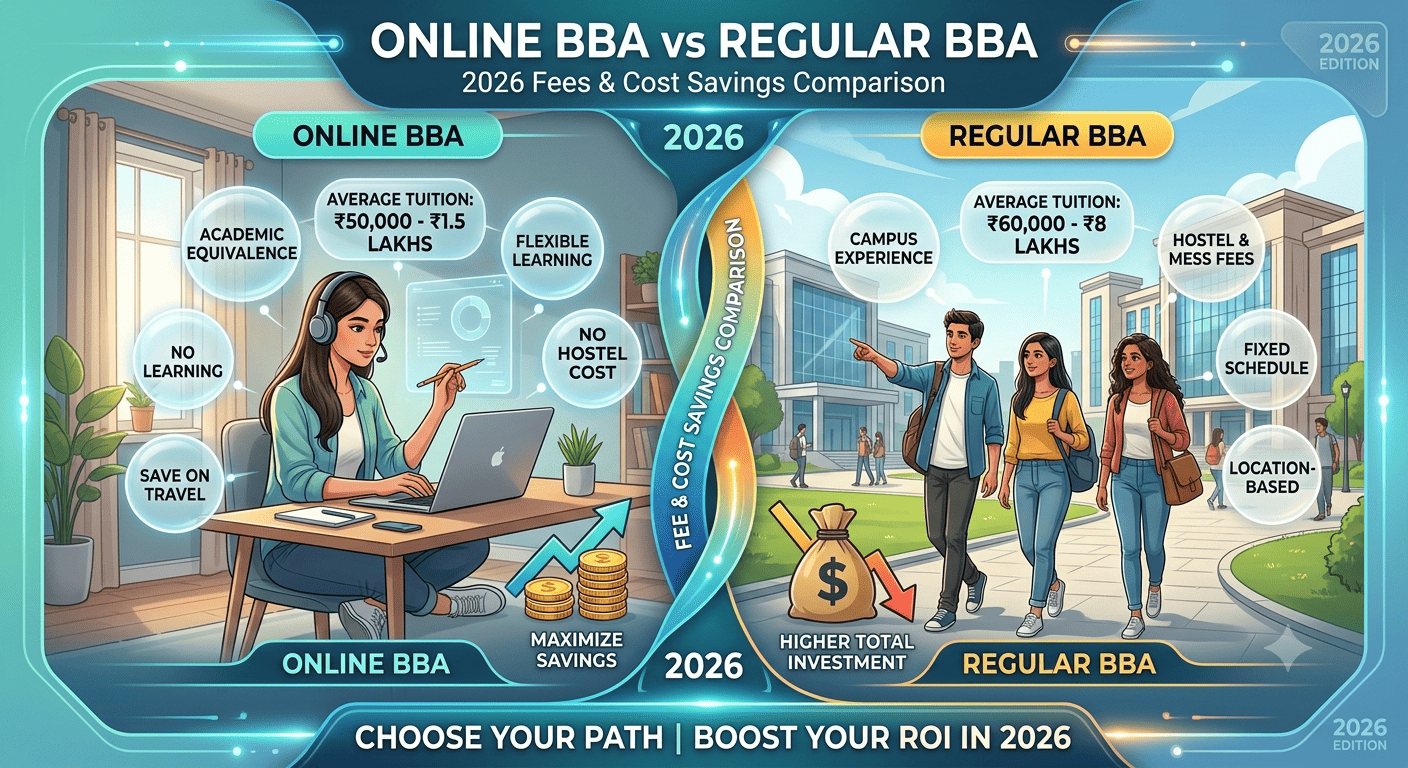
While the University Grants Commission (UGC) ensures academic equivalence between online and regular degrees, including the Online BBA, a notable divergence in fee structures persists. For 2026, the cost of an Online BBA in India averages between ₹50,000 and ₹1,50,000, significantly contrasting with Regular (Offline) BBA programs, which typically range from ₹60,000 to ₹8,00,000.
This financial disparity is evident across institutions; for instance, Amity University Online’s BBA totals approximately ₹1,54,000, and the DYP Online BBA Program Fees are around ₹1,11,000, underscoring the inherent cost-effectiveness of online education.
Online BBA vs Regular BBA: Average Total Fees 2026
When considering a BBA, understanding the financial commitment is crucial. The average total fees for an online BBA in 2026 range from ₹50,000 to ₹1,50,000, while a regular (offline) BBA can cost between ₹60,000 and ₹8,00,000.
| Feature | Online BBA | Regular (Offline) BBA |
|---|---|---|
| Learning Mode | 100% Online via LMS | On-campus and physical classrooms |
| Flexibility | Very High; you can study anytime or anywhere, without compromising your duties. | A regular BBA requires proper attendance and physical presence in the classrooms. |
| Average Total Fees | ₹50,000 – ₹1,50,000 | ₹60,000– ₹8,00,000 |
| Networking | Through virtual groups, online webinars & LinkedIn. | In-person peer interaction |
| Placement Support | Virtual job fairs | On-campus placement drives |
| Validity | Equal to Regular (UGC-Entitled) | Standard Recognition |
What Makes Online BBA Cheaper in 2026?
The price gap between an Online BBA (ranging from ₹50,000 to ₹1,80,000) and an On-Campus Regular BBA (ranging from ₹3,00,000 to ₹18,00,000+) is driven by core operational and structural differences. Universities leverage technological scalability and reduced overheads to offer online programs at a fraction of standard tuition costs.
Here are the key factors driving cost efficiencies for Online BBA degrees in 2026:
1. Minimal Physical Infrastructure & Maintenance Overheads
Traditional universities must maintain physical campuses, including lecture halls, air-conditioned auditoriums, sports facilities, administrative buildings, and land lease obligations. These heavy capital and operational expenditures (CapEx/OpEx) are built directly into standard tuition fees.
Online programs eliminate on-ground campus maintenance, utility bills, and physical security expenses, passing those structural savings directly to the student body.
2. High Student Scalability (Economies of Scale)
Physical classrooms have strict capacity limits due to seat availability, faculty-to-student ratio norms, and infrastructure constraints.
-
Regular BBA: A traditional batch is often capped at 60 to 120 students per classroom.
-
Online BBA: A single cloud-hosted Learning Management System (LMS) can support thousands of students simultaneously watching pre-recorded modules or attending high-capacity webinars.
By distributing fixed course creation costs across a much larger cohort of learners, universities lower the fee per individual student.
3. Digital Study Materials & Cloud Distribution
Printing, shipping, storing, and updating thousands of physical textbooks and workbooks adds substantial administrative cost to traditional degrees. Online BBA programs replace physical course material with digital e-books, open-source research papers, and cloud-hosted video libraries, driving instructional distribution costs close to zero.
4. Optimized Faculty & Administrative Utilization
In offline settings, professors spend significant hours delivering repetitive foundational lectures across multiple batches. Online BBA models utilize pre-recorded, high-production video lectures for core theoretical concepts, allowing faculty time to focus on live doubt-clearing sessions, virtual office hours, and grading. This automated delivery model maximizes teaching efficiency without requiring proportional hiring increases for every new batch.
5. Automated AI-Proctored Examination Systems
Conducting physical term-end examinations involves renting external testing centers, hiring invigilators, printing physical question/answer booklets, and managing physical logistics.
Modern Online BBA programs utilize web-based remote proctoring tools—incorporating facial recognition, screen locking, and AI monitoring—allowing students to complete proctored examinations from home at a lower administrative cost.
Online BBA Course Fees in India: University-Wise Range 2026
The cost of an Online BBA in India varies based on institutional accreditation (NAAC grade, NIRF rankings), specialization options, and digital learning infrastructure. Across major UGC-DEB approved institutions, the total 3-year tuition fee ranges from ₹50,000 to ₹1,80,000, with specialized or honors tracks going up to ₹2,40,000.
Below is a fee breakdown of top Indian universities offering Online BBA programs.
| University Name | NAAC / Accreditation | Total 3-Year Program Fee | Per Semester Fee (Approx.) | Key Highlights |
| Ignou / State Open Varsities | UGC-DEB Approved | ₹27,000 – ₹45,000 | ₹4,50,000 – ₹7,500 | Lowest total cost; suitable for self-study and upskilling |
| Lovely Professional University (LPU Online) | NAAC A++ | ₹75,000 – ₹90,000 | ₹12,500 – ₹15,000 | Affordable tier-1 private option with LMS and placement support |
| D.Y. Patil University Online | NAAC A++ | ₹1,20,000 – ₹1,30,000 | ₹22,000 – ₹25,000 | Covers exams in primary fee; strong industry-relevant curriculum |
| Online Manipal (MUJ) | NAAC A+ | ₹1,39,500 | ₹23,250 | High student portal engagement and virtual job fair access |
| NMIMS Online (CDOE) | NAAC A++ | ₹1,50,000 – ₹1,80,000 | ₹25,000 – ₹30,000 | Standard & Business Analytics tracks; top brand recall |
| Symbiosis Centre (SSODL) | NAAC A++ | ₹1,50,000 – ₹1,65,000 | ₹25,000 – ₹27,500 | Strong corporate network and flexible learning pathways |
| Amity University Online | NAAC A+ | ₹1,65,000 – ₹1,75,120 | ₹27,500 – ₹33,200 | Global accreditations (WASC, QAA) and one-time discount plans |
Online BBA vs Regular BBA: Hidden Costs & Savings Analysis 2026
While headline tuition figures highlight an initial price difference, evaluating the true cost of a BBA degree requires factoring in secondary campus expenses and missed income opportunities. The real financial disparity between an Online BBA and an On-Campus (Regular) BBA lies within indirect fees and opportunity costs accrued over the 3-year duration of the degree.
Hidden On-Campus Expenses: Hostels, Commutes, and Campus Surcharges
1. Accommodation & Living Expenses (Hostel/PG)
-
Regular BBA: Outstation students incur costs for university housing or private PG accommodations. Charges for lodging and mess facilities typically range between ₹1,00,000 and ₹2,50,000 per year, adding ₹3,00,000 to ₹7,50,000 in living expenses over three years.
-
Online BBA: Students complete coursework remotely, eliminating room, board, and relocation costs entirely.
2. Commute & Daily Travel
-
Regular BBA: Day scholars and off-campus residents encounter ongoing transportation costs—such as fuel, public transit passes, or auto-rickshaw fares—ranging from ₹15,000 to ₹40,000 annually (₹45,000 – ₹1,20,000 total).
-
Online BBA: Zero daily transit expenses.
3. Administrative, Campus, & Exam Fees
-
Regular BBA: Brick-and-mortar universities frequently levy recurring add-ons such as library access fees, laboratory charges, physical examination fees, campus activity funds, and mandatory uniform/study material fees. These routinely accumulate to an extra ₹15,000 to ₹50,000 over the course of the degree.
-
Online BBA: Fees are generally bundled into inclusive semester payments covering digital learning management systems (LMS), e-books, and proctored online exams, with minimal surprise surcharges.
Earning While Learning: The Opportunity Cost Factor and Net ROI
Beyond direct out-of-pocket savings, degree format impacts early earning potential and practical career entry points:
-
Concurrent Earnings (The Earning-While-Learning Advantage): The flexible schedule of an Online BBA allows students to pursue full-time internships, freelance work, or entry-level positions concurrently. A student earning a modest monthly stipend/salary of ₹15,000 to ₹25,000 over three years generates ₹5,40,000 to ₹9,00,000 in gross income prior to graduation.
-
Deferred Earnings: Regular BBA programs require full-time on-campus presence and strict attendance thresholds, restricting most students from taking on continuous paid work until graduation.
| Expense Category | Regular BBA (3-Year Avg. Extra Cost) | Online BBA (3-Year Avg. Cost) | Net Savings with Online BBA |
| Living & Hostel/Mess | ₹3,00,000 – ₹7,50,000 | ₹0 (Home-based) | ₹3,00,000 – ₹7,50,000 |
| Commute & Travel | ₹45,000 – ₹1,20,000 | ₹0 | ₹45,000 – ₹1,20,000 |
| Physical Books & Campus Surcharges | ₹15,000 – ₹50,000 | Included in Tuition / E-books | ₹15,000 – ₹50,000 |
| Opportunity Cost (Earned Income) | ₹0 (Full-time student focus) | ₹5,40,000 – ₹9,00,000 (Stipends/Jobs) | + ₹5,40,000 to ₹9,00,000 |
| Total Net Economic Advantage | — | — | ₹9,00,000 – ₹18,20,000+ |
Online BBA vs. Distance BBA: Fee Differences Explained 2026
While both Online BBA and Distance BBA allow you to earn a degree without attending daily campus classes, their delivery methods, learning technology, and pricing differ significantly.
Understanding these financial and structural differences helps clarify where your tuition money goes.
| Feature | Online BBA | Distance BBA |
| Average Total Fees (3 Years) | ₹50,000 – ₹1,80,000 | ₹30,000 – ₹90,000 |
| Learning Mode | Live lectures, recorded videos & digital platform (LMS) | Printed self-study books & occasional study center visits |
| Study Material | E-books, online libraries & digital notes | Physical books sent via post or collected from center |
| Exams | Online proctored exams from home | Written exams at assigned physical centers |
| Payment Options | Flexible semester plans & monthly EMI options | Annual or full program fee payments |
Why Does an Online BBA Cost More Than a Distance BBA?
A Distance BBA relies on traditional self-study models, whereas an Online BBA incorporates interactive technology. The price gap stems from key structural factors:
1. Digital Platform & Learning Portals (LMS)
-
Online BBA: Universities invest heavily in modern Learning Management Systems (LMS), mobile apps, cloud servers, and high-quality video content.
-
Distance BBA: Universities print physical books and mail them, avoiding software and server maintenance overheads.
2. Live Teaching & Support
-
Online BBA: Includes live interactive classes with professors, virtual doubt-solving sessions, and digital webinars.
-
Distance BBA: Primarily self-driven learning with optional weekend contact classes at local study centers.
3. Proctored Online Exams vs. Offline Centers
-
Online BBA: Uses AI-proctored software so you can safely take exams from home.
-
Distance BBA: Uses standard offline examination halls, keeping administrative technology costs minimal.
4. Virtual Placements & Career Guidance
-
Online BBA: Many modern online platforms offer dedicated placement assistance, resume-building workshops, and virtual job fairs.
-
Distance BBA: Placement support is rare or limited to basic job posting boards.
Which Option Offers Better Value?
-
Choose Distance BBA if: You want the absolute lowest cost, prefer physical reading materials, and only need a basic graduation degree for government exams or upskilling.
-
Choose Online BBA if: You want a modern, interactive learning environment, prefer online exams, need job placement assistance, and want to study flexibly on your phone or laptop while working.
FAQs
What Are the Main Fee Components for a Regular BBA Versus an Online BBA?
Online BBA fees are typically more affordable, ranging from INR 1,25,550 to INR 1,71,000 for full courses, while regular BBA includes higher fees, travel, and accommodation.
How Do the Total Costs of an Online BBA Compare to a Traditional BBA Program?
Online BBA programs typically cost ₹30,000 to ₹1.5 Lakhs for three years, significantly less than traditional programs due to no accommodation or travel charges.
Are There Hidden Fees in Online BBA Programs Compared to Regular BBA Courses?
Online BBA programs are generally more affordable, with total fees ranging from ₹1,30,000 to ₹1,39,500, and typically have no extra costs for travel or campus living.
What Payment Plans Are Typically Available for Online BBA Fees Versus Regular BBA?
Online BBA programs typically offer EMI, installment, and loan options. Regular BBA fees are generally higher and may include additional travel and accommodation costs.
Do Scholarships for Regular BBA Also Apply to Online BBA Tuition Fees?
Yes, scholarships for regular BBA programs, often based on qualifying exam scores like LPUNEST or CUET, generally apply to online BBA tuition fees. Many institutions, including CU Online, offer such plans.
How Does the Return on Investment for Online BBA Fees Compare to Regular BBA?
Online BBA is generally more affordable, offering a high ROI due to strong industry relevance and placement support, enabling quicker payback compared to regular BBA’s higher fees and associated costs.