LL.B. Qualification Criteria: Educational Requirements and Age Rules
Nishit Kumar is a senior EdTech industry leader with over a decade of experience in building and scaling education platforms, shaping their product, content, and growth strategy. At…
With government law college total course fees starting as low as ₹5,455 and at least 1,233 colleges offering legal education, understanding qualification rules, age relaxations, and entrance requirements helps candidates plan their admission route. Below is a detailed breakdown of eligibility criteria, fees, top colleges, entrance exams, and career scope.
| Parameter | Details |
|---|---|
| 3-Year LLB Educational Qualification | Graduation in any stream (BA, B.Com, B.Sc, BBA, BCA, B.Tech) from a recognized university |
| 5-Year Integrated LLB Educational Qualification | 10+2 (Class 12) from any recognized board in any stream (Arts, Commerce, Science) |
| Minimum Marks Threshold (General Category) | 45% aggregate in 10+2 or Graduation |
| Minimum Marks Relaxation (OBC / SC / ST) | 42% for OBC candidates; 40% for SC/ST candidates |
| Upper Age Limit | No upper age limit for 3-year or 5-year LLB (removed per Supreme Court / BCI guidelines) |
| Mandatory Practice Licensing Exam | All India Bar Examination (AIBE) conducted by BCI to practice as an advocate |
LLB Eligibility: Educational Requirements and Age Rules
The basic educational qualification for a 3-year LLB program requires a bachelor’s degree from a recognized university with a minimum aggregate score of 45% to 50% for general category applicants. Reserved category candidates receive mark relaxations, requiring 42% for OBC applicants and 40% for SC/ST applicants. Candidates appearing in the final year or final semester of their undergraduate degree are provisionally eligible to sit for entrance exams and apply for admission.
For 5-year integrated law courses, candidates must complete Class 12 (10+2) from a recognized central or state board with at least 45% marks (40% for SC/ST and 42% for OBC). Students from any academic stream—Arts, Commerce, or Science—are eligible for integrated law admissions.
Regarding age constraints, the Bar Council of India (BCI) removed the upper age bar for pursuing law degrees following Supreme Court intervention. Consequently, candidates of any age can seek admission to both 3-year and 5-year law courses in India.
Engineering graduates holding B.Tech or B.E. degrees with 45% to 50% aggregate marks are fully eligible to apply for 3-year LLB programs. However, B.Tech graduates cannot enroll in 5-year integrated law programs, as integrated tracks are reserved exclusively for students entering directly after Class 12.
Top Entrance Exams for LLB Admission
| Exam Name | Conducting Body / Scope | Accepted For | Format / Mode |
|---|---|---|---|
| AILET | NLU Delhi | 5-Year BA LLB at NLU Delhi | Institutional Test |
| DU LLB / CUET PG | National Testing Agency (NTA) | 3-Year LLB at Delhi University (Campus Law Centre, Law Centre I & II) | National Level |
| MH CET Law | State CET Cell, Maharashtra | 3-Year & 5-Year LLB across law colleges in Maharashtra | State Level Online CBT |
| SLAT AIAT | Symbiosis International University | 3-Year LLB at SLS Pune | University Level |
| PU LLB | Panjab University | 3-Year LLB at Panjab University Department of Law & affiliated colleges | Pen-and-paper (English, Hindi, Punjabi) |
| TS LAWCET | Osmania University (on behalf of TSCHE) | 3-Year & 5-Year LLB in Telangana | State Level Online Test |
| AP LAWCET | Acharya Nagarjuna University (on behalf of APSCHE) | 3-Year & 5-Year LLB in Andhra Pradesh | State Level Online Test |
India has over 1,700 law schools offering LLB courses approved by the Bar Council of India (BCI).
LLB Career Scope and Salary
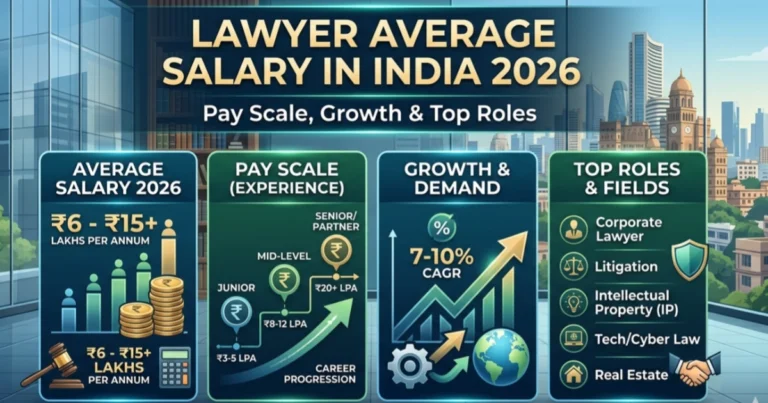
- Lawyer: The average starting salary of a lawyer in India is around INR 4.9 LPA to INR 5.3 LPA.
- In-House Legal Counsel: Roles average INR 8.3 LPA and can reach up to INR 29.7 LPA.
- Placement Package: Across 20 reporting colleges, the median average placement package is 3.0 LPA.
How to Apply for LLB Admission in 2026: Step by Step
- Check Eligibility Criteria: Verify that you have passed Class 12 with at least 45% (40% for SC/ST, 42% for OBC) for a 5-year integrated LLB, or possess a recognized Bachelor’s degree (BA, B.Com, B.Sc, B.Tech) with 45-50% aggregate marks for a 3-year LLB.
- Register for Law Entrance Examinations: Apply for relevant law entrance tests such as CLAT or AILET for 5-year NLU seats, or MH CET Law, PU LLB, DU LLB (CUET PG), TS LAWCET, or AP LAWCET for 3-year LLB admissions.
- Appear for Entrance Test / Check Merit Cutoffs: Sit for the entrance exam or apply directly on university portals offering merit-based admissions on qualifying degree scores.
- Participate in Counselling & Merit List Allocation: Register for central or institutional counselling sessions, submit college preferences, and secure seat allotment based on entrance rank or Class 12/Graduation merit.
- Complete Document Verification: Submit required documents including Class 10/12 marksheets, Graduation marksheet/degree (for 3-year LLB), entrance scorecard, category certificate (if applicable), transfer certificate, and migration certificate.
- Pay Admission Fees and Complete Enrollment: Pay tuition fees (ranging from INR 1,000–80 Lakh in government law colleges and INR 5,000–25.3 Lakh in private law institutions) to confirm enrollment.
| What to do | Where | Link |
|---|---|---|
| Compare colleges, fees and cutoffs | LLB colleges in India | findmycollege.com |
FAQs
What is the qualification required for LLB in India?
For a 3-year LLB, you need a graduation degree (BA, B.Com, B.Sc, B.Tech) with at least 45%–50% aggregate marks. For a 5-year integrated LLB, you need 10+2 with a minimum of 45% marks.
Is there any upper age limit for studying LLB?
No, the Bar Council of India (BCI) removed the upper age limit after Supreme Court intervention, so students of any age can enroll in 3-year or 5-year LLB courses.
Can I do a 3-year LLB after completing B.Tech or B.E.?
Yes, engineering graduates with a B.Tech or B.E. degree from a recognized university having at least 45% to 50% aggregate marks are fully eligible for a 3-year LLB program.
Can I get LLB admission with 40% marks?
If you belong to the SC or ST category, 40% aggregate marks in Class 12 or Graduation meet the Bar Council of India minimum threshold. General category students require at least 45%.
Can we do only a 3-year LLB right after 12th standard?
No, after 12th standard, you must join a 5-year integrated law course (such as BA LLB or BBA LLB). The 3-year LLB course requires prior completion of a bachelor’s degree.
What is the average lawyer salary in India after LLB?
The average salary of a lawyer in India is around INR 4.9 LPA to INR 5.3 LPA, while In-House Legal Counsel roles average INR 8.3 LPA and can reach up to INR 29.7 LPA.