MBA Subjects List and Semester Wise Course Syllabus
Nishit Kumar is a senior EdTech industry leader with over a decade of experience in building and scaling education platforms, shaping their product, content, and growth strategy. At…
- 2 Nov 2026NMAT by GMAC 2026 Exam Begins
The NMAT by GMAC 2026 examination window commenced on November 2, 2026. - 27 Oct 2026NTA Announces CUET PG 2027 Dates
National Testing Agency (NTA) has officially released the exam dates for CUET PG 2027. - 6 Oct 2026KMAT 2026 Exam Schedule Released
KMAT 2026 registration is open till October 31, 2026, with the exam scheduled for November 14, 2026. - 1 Oct 2026LPUNEST 2027 Registration Starts
LPUNEST 2027 application process is ongoing and candidates can register till January 15, 2027.
An MBA (Master of Business Administration) is a 2-year postgraduate programme divided into 4 semesters. The first-year MBA subjects cover core management topics such as Financial Accounting, Marketing Management, Microeconomics, and Organizational Behaviour, while the second year focuses on specialisation subjects (like Finance, HR, IT, and Marketing) along with summer internship projects.
At least 3,165 colleges offer MBA (General) degrees in India, featuring median course fees of ₹1.23 lakh in government institutions. Below is a comprehensive breakdown of the semester-wise syllabus, elective tracks, practical requirements, top colleges, and entrance exam structures to help you plan your management education effectively.
| Parameter | Details |
|---|---|
| Course Duration | 2 Years (4 Semesters) |
| Academic Level | Postgraduate |
| Eligibility Criteria | Bachelor’s degree in any discipline with minimum 50% aggregate (60% for IIMs) |
| Major Entrance Exams | CAT, MAT, XAT, CMAT, NMAT, SNAP, ATMA |
| Government College Fees | Rs. 50,000 to Rs. 4 Lakhs |
| Private College Fees | Rs. 20 Lakhs to Rs. 25 Lakhs |
MBA (General) Subjects Year-wise
| Semester 1 Subjects | Semester 2 Subjects |
|---|---|
| Principles of Marketing Management | Marketing Management |
| Principles of Accounting | Corporate Finance |
| Microeconomics | Macroeconomics |
| Corporate Social Responsibility | Business Law |
| Tools & Framework of Decision-making | Operations Management |
| Quantitative Methods and Statistics | Optimization and Project Research |
| Business Communication and Soft Skills | Project Management |
| Organizational Behaviour 1 | Organizational Behavior 2 |
The first year covers core management principles across two semesters. Semester 1 introduces accounting, economics, and decision-making tools, while Semester 2 expands into corporate finance, business law, and operations management.
| Semester 3 Subjects | Semester 4 Curriculum |
|---|---|
| Supply Chain Management | Internship Projects |
| Business Intelligence | Internship Projects |
| Marketing Research | Practical Case Studies |
| Corporate Governance & Business Ethics | Internship Projects |
| Corporate Finance 2 | Practical Case Studies |
The second year features specialized topics in Semester 3, including strategic management and business intelligence. Semester 4 focuses primarily on internship projects, practical case studies, and field applications.
MBA (General) Electives and Specialisations
During the second year of an MBA degree, students select specific functional domains to align with their career goals. Core topics in MBA Finance focus on financial planning, pricing policies, asset allocation, and capital cost optimization. MBA HR Management covers human resource development, performance systems, industrial relations, and strategic reward structures.
For technology and analytical tracks, MBA Information Technology covers software engineering, computer applications, web architecture, and database systems. MBA Business Analytics incorporates business statistics, AI/ML tools, and HR analytics. The MBA Marketing stream emphasizes long-term brand strategy, organizational marketing tactics, consumer psychology, and data-driven market insights.
| Specialisation | Core Subjects Covered |
|---|---|
| MBA Finance | Financial Management & Planning, Pricing Policies, Asset Management, Capital Cost |
| MBA HR Management | HR Management, Performance Management, Industrial Relations Management, Reward Management |
| MBA Information Technology (IT) | Software Engineering, Computer Applications, Web Design, Database Management Systems |
| MBA Marketing | Marketing Strategies, Organizational Strategies, Customer Behavior, Analysis of Data-Driven Insights |
| MBA Business Analytics | Business Statistics & Analytics, Artificial Intelligence & Machine Learning, HR Analytics |
Types of MBA Courses and Curriculum Structure
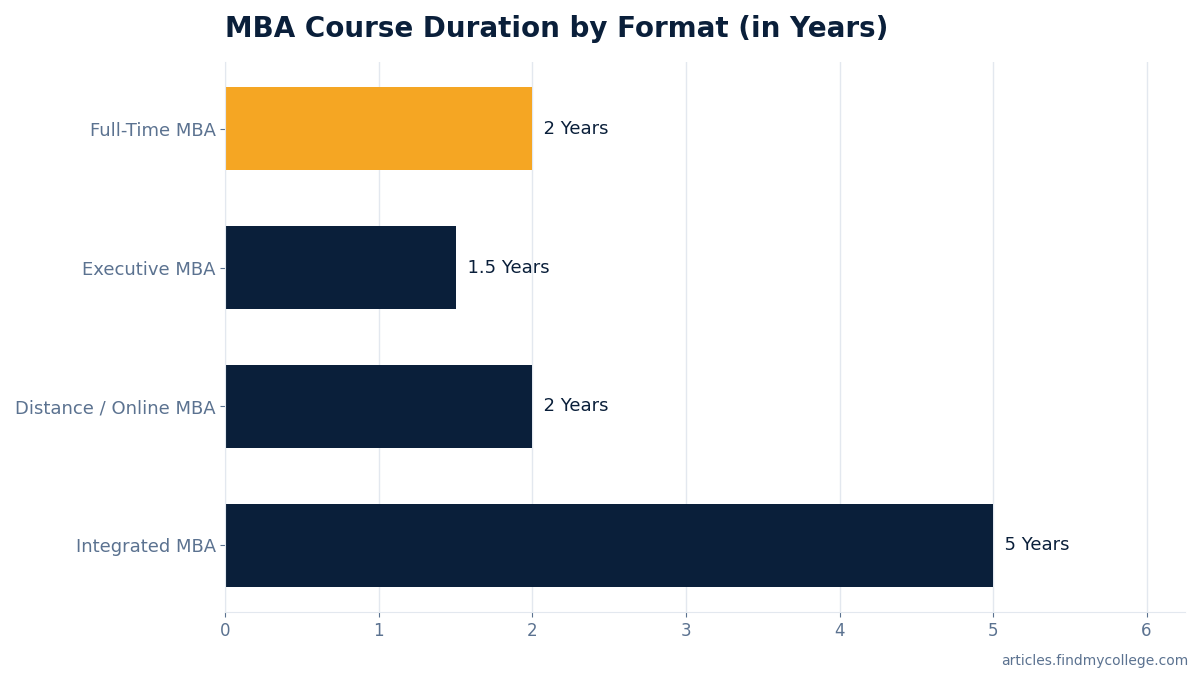
Management education in India is delivered through multiple formats tailored to students and working professionals. Executive MBA courses range between 1 year and 1.5 years, specifically structured for mid-career professionals holding 2 to 5 years of work experience.
Integrated MBA programs span 5 years straight after Class 12, combining undergraduate studies with advanced management coursework.
| MBA Format | Duration | Key Feature |
|---|---|---|
| Full-Time MBA | 2 Years (4 Semesters) | Includes core subjects, specialisation electives, and mandatory summer internships |
| Executive MBA | 1 to 1.5 Years | Tailored for working professionals with 2–5 years of work experience |
| Distance MBA | 2 Years | Theory-focused remote learning without mandatory classroom attendance or internships |
| Online MBA | 2 Years | Fully digital delivery of classes, online tests, and virtual guest lectures |
| Integrated MBA | 5 Years | Combines undergraduate degree with postgraduate management degree after Class 12 |
| Global MBA | 2 Years | Focuses on international business operations and global management perspectives |
Distance MBA vs Full-Time MBA Curriculum Differences
In contrast, the distance MBA curriculum focuses primarily on theoretical self-study modules without mandatory hands-on project work or internship requirements.
Prominent institutions offering distance MBA programs in India include IGNOU, NMIMS Mumbai, Annamalai University, Symbiosis, Andhra University, Anna University, Utkal University, Burdwan University, SMU, and ICFAI.
| Feature | Full-Time MBA Syllabus | Distance MBA Syllabus |
|---|---|---|
| Core Curriculum | Covers all theoretical subjects in depth | Covers theoretical core subjects |
| Practical Exposure | Compulsory practical classes, projects & workshops | Limited to self-learning theoretical modules |
| Internships | Mandatory summer internship project in final semester | No mandatory internship requirements |
| Pedagogy | Interactive classroom learning & team projects | Remote correspondence or online self-study |
MBA Entrance Examination Syllabus Breakdown
| Exam Section | Topics Tested |
|---|---|
| Quantitative Aptitude | Algebra, Arithmetic, Geometry, Statistics, and Numerical Problem Solving |
| Data Interpretation | Data analysis from Tables, Bar Graphs, and Charts |
| Logical Reasoning | Puzzles, Pattern Recognition, Rational Thinking, and Complex Problem Solving |
| Verbal Ability | Reading Comprehension, Grammar, Vocabulary, and Critical Reasoning |
| General Knowledge & Current Affairs | National & International Recent Events, History, Geography, and Science |
| Basic English Proficiency | Basic English Grammar, Sentence Structure, and Comprehension |
Key MBA entrance exams in India include CAT, MAT, XAT, CMAT, NMAT, SNAP, ATMA, MAH MBA CET, and KMAT. These tests evaluate candidates across quantitative aptitude, data interpretation, logical reasoning, verbal ability, current affairs, and English proficiency.
Top MBA Colleges, Fees, and State-wise Distribution
At least 3,165 colleges offer MBA (General) programs in India, comprising at least 96 government institutes and 1,459 private colleges. Government institutions maintain a median total course fee of ₹1.23 lakh, with the middle half ranging between ₹61,500 and ₹2.62 lakh (based on 86 colleges with fee data). Private colleges report a median course fee of ₹1.22 lakh, with the middle half falling between ₹82,000 and ₹2.17 lakh (across 1,226 colleges with fee data). Across 149 reporting institutions, the median average placement package stands at 3.44 LPA.
States with the highest concentration of MBA colleges include Tamil Nadu (402 colleges), Uttar Pradesh (342 colleges), Maharashtra (322 colleges), Karnataka (300 colleges), Andhra Pradesh (241 colleges), and Madhya Pradesh (201 colleges).
| College | City | Ownership | Total course fee | NIRF rank |
|---|---|---|---|---|
| Indian Institute of Technology Madras | Chennai | Government | ₹8.93 lakh | 1 (Overall, 2025) |
| Jawaharlal Nehru University | Delhi | Government | ₹6.04 lakh | 2 (Overall, 2025) |
| Punjab Agricultural University | Ludhiana | — | ₹3.15 lakh | 3 (Overall, 2025) |
| Indian Institute of Technology Bombay | Mumbai | Government | ₹7.16 lakh | 3 (Overall, 2024) |
| Manipal University Manipal | Manipal | — | ₹7.82 lakh | 3 (Overall, 2025) |
| Jamia Millia Islamia University | Delhi | Government | ₹53,750 | 4 (Overall, 2025) |
| Indian Institute of Technology Kanpur | Kanpur | Government | ₹4.74 lakh | 5 (Overall, 2025) |
| Delhi University | Delhi | Government | ₹2.43 lakh | 5 (Overall, 2025) |
| Indian Institute of Technology Roorkee | Roorkee | — | ₹4.51 lakh | 6 (Overall, 2025) |
| Banaras Hindu University | Varanasi | Government | ₹8,500 | 6 (Overall, 2025) |
| College | City | Ownership | Total course fee |
|---|---|---|---|
| University of Calcutta | Kolkata | Government | ₹5,488 |
| Muthurangam Government Arts College | Vellore | Government | ₹6,150 |
| Banaras Hindu University | Varanasi | Government | ₹8,500 |
| Gujarat University | Ahmedabad | Government | ₹9,050 |
| Government Post Graduate College Champawat | Champawat | Government | ₹18,000 |
| Maharani’s Arts, Commerce and Management College for Women | Bangalore | Government | ₹24,390 |
| Government First Grade College Vijayanagar | Bangalore | Government | ₹24,555 |
| Gujarat Technological University | Ahmedabad | Government | ₹26,250 |
| Islamia College of Science and Commerce | Srinagar | Government | ₹33,000 |
| Yashwantrao Chavan Maharashtra Open University | Nashik | Government | ₹39,036 |
How to Apply for MBA (General) Admission in 2026: Step by Step
- Check Eligibility Criteria: Ensure completion of a 3-year bachelor’s degree in any discipline with a minimum aggregate score of 50% (60% aggregate for top B-schools like IIMs).
- Register for Entrance Exam: Fill application forms and register for national/state MBA entrance exams such as CAT, MAT, XAT, CMAT, NMAT, SNAP, or MAH MBA CET.
- Appear for Entrance Test: Take the entrance examination testing Quantitative Aptitude, Logical Reasoning, Data Interpretation, Verbal Ability, and General Knowledge.
- Participate in Selection Rounds (GD-WAT-PI): Shortlisted candidates must attend Group Discussion (GD), Written Ability Test (WAT), and Personal Interview (PI) rounds conducted by B-schools.
- Final Merit Admission & Document Verification: Accept final seat allotment based on entrance exam scores, GD/PI scores, and academic merit, pay academic fees (ranging from Rs. 50,000 to Rs. 25 Lakhs), and complete verification.
| What to do | Where | Link |
|---|---|---|
| Compare colleges, fees and cutoffs | MBA (General) colleges in India | findmycollege.com |