Theology Courses in India: Degrees, Eligibility and Career Scope
Nishit Kumar is a senior EdTech industry leader with over a decade of experience in building and scaling education platforms, shaping their product, content, and growth strategy. At…
- 1 Oct 2026LPUNEST 2027 application process ongoing till Jan 15
LPUNEST 2027 registration is currently open for candidates until January 15, 2027.
Theology courses in India, primarily offered as a 3-year Bachelor of Theology (B.Th) degree, prepare students for pastoral ministry, biblical studies, and church leadership with total course fees ranging from INR 20,000 to INR 2.60 Lakh+. Admissions are conducted through institute-level entrance tests and interviews based on 10+2 qualifications, with graduates securing average starting salaries between INR 2 LPA and INR 3 LPA.
Students seeking a degree in theology can review complete details regarding academic eligibility, selection criteria, syllabus topics, institute fees, top seminaries, and future ministry career scope across Indian institutions.
| Parameter | Details |
|---|---|
| Course Duration | 3 Years (Semester-based) |
| Minimum Qualification | 10+2 / Equivalent from any stream (Arts, Science, Commerce) |
| Total Course Fees | Approx. INR 20,000 – INR 2.60 Lakh+ |
| Average Starting Salary | Approx. INR 2 LPA – INR 3 LPA |
| Admission Basis | 10+2 Merit / Institute Entrance Test + Personal Interview + Church Recommendation |
| National Entrance Exam | None (Institute-specific admissions) |
What is Theology
Bachelor of Theology (B.Th) is a 3-year undergraduate degree focused on Biblical Studies, Christian Theology, Church History, mission, pastoral ministry, and practical Christian service. The curriculum equips candidates with institutional biblical knowledge, theological research abilities, and practical leadership skills required for Christian ministry.
Educational institutions offer theological studies through two primary academic degrees: Bachelor of Theology (B.Th) and Bachelor of Arts in Theology (B.A. Theology). While B.Th programs concentrate heavily on pastoral preparation and ministry execution, B.A. Theology courses operate within a traditional university framework focus on theological humanities.
| Comparison Aspect | Bachelor of Theology (B.Th) | Bachelor of Arts in Theology (B.A. Theology) |
|---|---|---|
| Primary Focus | Ministry-oriented; focuses on biblical studies, practical Christian service, and church leadership. | Broader academic arts framework focused on theological humanities and general university curriculum. |
| Offering Institutions | Conducted primarily by seminaries and theological colleges. | Structured as a conventional university bachelor’s degree at arts colleges/universities. |
| Accreditation & Recognition | Varies by denominational accrediting bodies and specific institutional recognition. | Standard university degree recognition for general postgraduate and arts career pathways. |
Theology Eligibility
Candidates seeking admission to a degree in theology must complete 10+2 or an equivalent qualification from any recognized board. Students from Arts, Science, and Commerce streams are equally eligible to apply. Academic mark requirements range from a simple pass to 50%, depending on the specific institute, as there is no single national minimum percentage rule.
Alternative entry routes exist for applicants without traditional senior secondary schooling. Selected theological institutions accept Class 10 qualifications combined with a recognized 2-year Diploma in Theology. Mature-candidate entry options also allow older applicants with verified ministry experience to gain admission despite lower formal academic marks. Certain denominational seminaries mandate that applicants be at least 18 years old at the time of admission.
Denominational seminaries frequently mandate mandatory church documentation alongside academic records. Required documents typically include a baptism certificate, a recommendation letter from a pastor or church official, a personal testimony, and proof of ministry commitment.
Theology Admission Process
Admissions to theology courses in India do not rely on a common national or state-level entrance examination. Theological colleges and seminaries establish independent selection procedures to evaluate academic readiness and ministry alignment. The institutional application window generally opens between January and June each academic year.
Entrance tests and personal oral interviews take place between March and June, with academic sessions commencing between May and July. Selection processes evaluate candidate aptitude in Bible Knowledge, General Knowledge, and English proficiency.
| Admission Route | Target Applicants & Selection Details |
|---|---|
| Institute-Level Entrance Test | Applicants undergo college-specific tests in Bible Knowledge, General Knowledge, and English followed by oral interview. |
| 10+2 Merit / Application Screening | Selection based on 10+2 academic performance, application review, and institutional approval without national entrance tests. |
| Alternative Diploma Entry | Candidates with Class 10 plus a recognized 2-year Diploma in Theology or equivalent standard course. |
| Mature-Candidate Entry Route | Older candidates with practical ministry experience entering through institutional qualifying exams despite lower formal academic marks. |
| Church / Ministerial Screening | Mandatory submission of baptism certificate, pastor/church recommendation letter, personal testimony, and ministry evidence. |
Theology Syllabus and Subjects
- Biblical Studies
- Christian Theology
- Church History
- Missions
- Pastoral Ministry
- Church Leadership
- Christian Education
- Practical Christian Service
Bachelor of Theology (B.Th) is a 3-year undergraduate degree structured around core theological disciplines. The curriculum balances foundational academic subjects with practical Christian service and ministry preparation.
Theology Fees
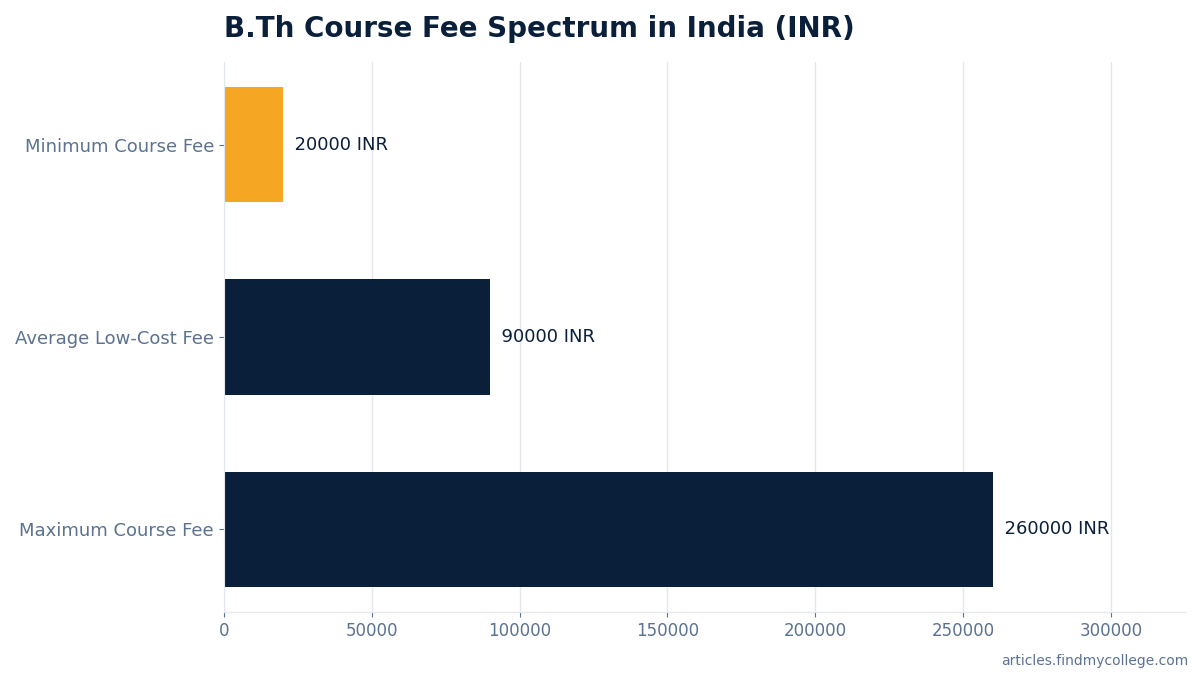
- Overall Fee Range: INR 20,000 to INR 2.60 Lakh+
- Some Theology Programs: Around INR 90,000 total
- Residential Seminary Programs: Can exceed INR 1 Lakh to INR 2 Lakh+ (excluding hostel and living expenses)
Total course fees for B.Th in India range from approximately INR 20,000 to INR 2.60 Lakh+. Some theology programs cost around INR 90,000 total, whereas residential seminary programs can exceed INR 1 Lakh to INR 2 Lakh+ excluding hostel and living expenses.
Theology Career Scope and Salary
Graduates with a Bachelor of Theology (B.Th) degree enter diverse professional roles within church organizations, Christian non-governmental institutions, educational bodies, and mission organizations. Primary vocational fields include Pastoral Ministry, Biblical Studies, Christian Education, Missions, and Church Leadership.
Average starting salary after completing a B.Th degree ranges between INR 2 LPA and INR 3 LPA. Career progression and salary growth depend on postgraduate specialisation, ministry experience, and institutional roles. Degree recognition and equivalence for government graduate-level jobs depend on specific employer, university, and accrediting system requirements.
How to Apply for Theology Admission in 2026: Step by Step
- Check Academic & Age Eligibility: Verify 10+2 pass or equivalent from any stream (Arts, Science, Commerce), or Class 10 with a 2-year Diploma in Theology. Confirm age requirements (at least 18 years at selected seminaries).
- Obtain Church Recommendations & Documents: Secure mandatory Church/Ministerial screening documents: baptism certificate, pastor or church recommendation letter, personal testimony, and ministry commitment proof.
- Submit College Application Form: Apply directly through the target seminary or theological college between January and June by submitting academic records, church documents, and application forms.
- Appear for Institute Entrance Examination: Take the college-level entrance exam covering Bible Knowledge, General Knowledge, and English (conducted between March and June; e.g., Wung Theological College requires min. 60%).
- Attend Personal & Oral Interview: Participate in the institutional oral interview and ministry screening conducted by seminary admission boards.
- Complete Document Verification & Fee Payment: Upon selection announcement, verify original certificates, pay course fees (ranging from INR 20,000 to INR 2.60 Lakh+ total), and join the academic session starting May–July.
| What to do | Where | Link |
|---|---|---|
| Compare colleges, fees and cutoffs | Theology colleges in India | findmycollege.com |
FAQs
How many years do you study theology in India?
A Bachelor of Theology (B.Th) degree takes 3 years to complete in India, structured primarily as a semester-based undergraduate programme offered by theological colleges and seminaries.
What is the eligibility criteria for a degree in theology?
Candidates require 10+2 or equivalent from any stream (Arts, Science, or Commerce). Alternatively, institutes accept Class 10 plus a 2-year Diploma in Theology, or offer mature-candidate entry for those with ministry experience.
Is there a national entrance exam for theology courses?
No, there is no common national entrance exam for B.Th. Admissions are conducted individually by theological colleges through institute-level written tests in Bible Knowledge, General Knowledge, English, and personal interviews.
What is the average starting salary after completing a B.Th degree?
Graduates holding a Bachelor of Theology degree earn an average starting salary ranging between INR 2 LPA and INR 3 LPA in roles across pastoral ministry, missions, and church leadership.
What is the difference between B.Th and B.A. Theology?
B.Th is a ministry-oriented degree offered by seminaries focusing on practical church leadership and biblical studies. B.A. Theology is structured as a conventional university bachelor’s degree under a broader academic arts framework.
Can Science and Commerce students apply for theology courses?
Yes, 10+2 graduates from Science, Commerce, and Arts streams are all eligible to apply for B.Th, provided they meet the institution’s eligibility and church recommendation criteria.