What is a Career Counselor: Role, Scope and Importance
A career counselor is a trained professional—typically holding a master’s degree in counselling psychology or applied psychology—who assists individuals in understanding themselves and the world of work to make informed career decisions. An individual spends approximately 90,000 hours at the workplace over a lifetime, making structured guidance essential for selecting appropriate academic and career paths.
| Parameter | Details |
|---|---|
| Typical Qualification | Master’s degree in Counselling Psychology or Applied Psychology |
| Core Skillset | Career development theories, counselling techniques, psychometric test administration & interpretation |
| Key Assessment Tools | MBTI, 16PF, DBDA, DAT |
| Target Beneficiaries | Class 11/12 students, college undergraduates, postgraduates, and professionals seeking career transitions |
| Lifetime Career Impact | Guides choices for an estimated 90,000 hours spent at work over a lifetime |
What is Career Counseling
| Pillar | Definition | Example |
|---|---|---|
| Ability | Something you can do well and easily | Numerical ability (solving math problems easily) |
| Interest | Something you like and enjoy doing | Playing sports, playing an instrument, painting/drawing |
| Personality | Social traits and motivations defining a person | Introvert vs extrovert, degree of sociability |
Career counselling is a systematic process that helps an individual understand self and the world of work to choose the right career path. The process consists of 4 main steps: Self-Awareness, Options Research, Matching Self with Options, and Action Plan.
Career Counseling Eligibility
| Aspect | Details / Requirements |
|---|---|
| Education Qualification | Master’s degree in Counselling Psychology or Applied Psychology |
| Theoretical Expertise | Proficiency in career development theories and counselling techniques |
| Assessment Proficiency | Administration and interpretation of standardized psychometric tests |
Career counsellors typically hold a master’s degree in counselling psychology or applied psychology. They must be proficient in applying career development theories, counselling techniques, psychometric assessments, and remain knowledgeable about industry trends.
Career Counseling Admission Process
| Aspect | Details / Requirements |
|---|---|
| Education Qualification | Master’s degree in Counselling Psychology or Applied Psychology |
| Theoretical Expertise | Proficiency in career development theories and counselling techniques |
| Assessment Proficiency | Administration and interpretation of standardized psychometric tests |
| Key Personal Traits | Keen observer, problem solver, knowledgeable about industry trends |
Career counsellors typically hold a master’s degree in counselling psychology or applied psychology to guide students and professionals. Standardized psychometric tests must be administered under controlled conditions and followed by a one-on-one counselling session.
Career Counseling Fees
| City | Colleges | Fee range | Well-known options |
|---|---|---|---|
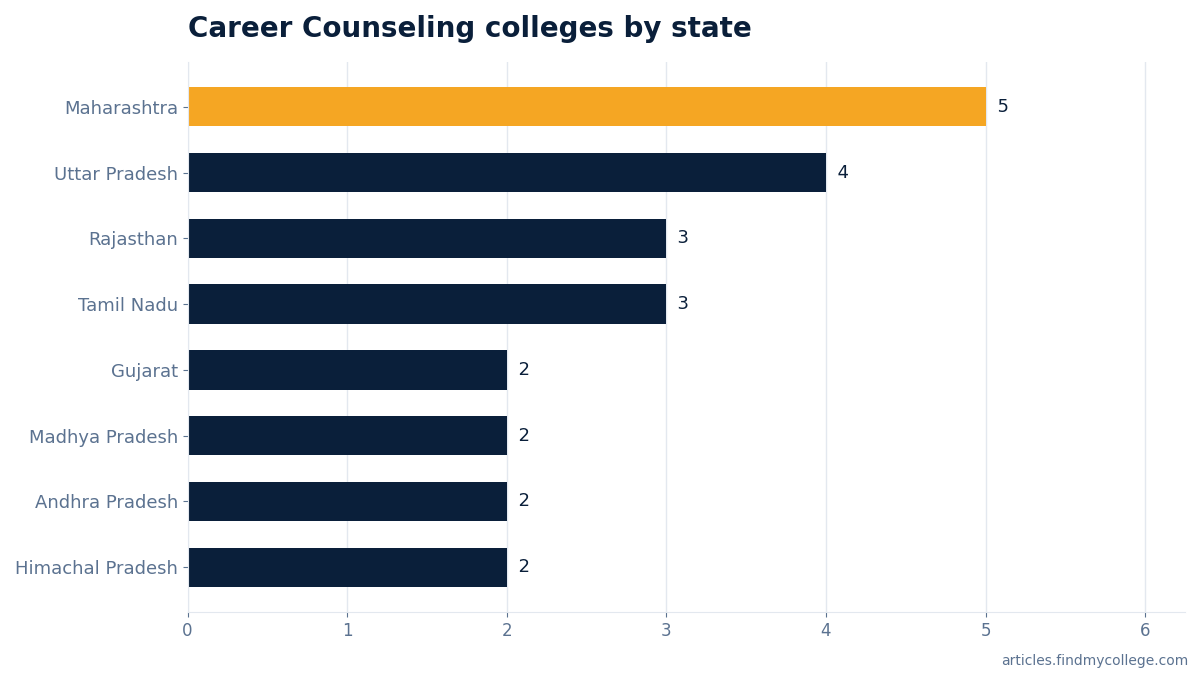
| Noida | 2 | ₹10,000 – ₹1.25 lakh | International Media Institute of India, Institute of Good Manufacturing Practices India |
| Solan | 2 | ₹5.32 lakh – ₹5.32 lakh | Faculty of Basic Sciences, Shoolini University, Shoolini University |
| Jaipur | 2 | — | University of Rajasthan, University Maharani College |
| Pune | 2 | ₹24,769 – ₹24,769 | Karve Institute of Social Service, Dr. DY Patil Medical College Hospital and Research Centre |
| Nashik | 1 | ₹50,000 – ₹50,000 | Maharashtra University of Health Sciences |
| Jamnagar | 1 | — | Gujarat Ayurved University |
| Lucknow | 1 | ₹18,000 – ₹18,000 | University of Lucknow |
| Itanagar | 1 | ₹17,000 – ₹17,000 | Himalayan University |
| College | City | Ownership | Total course fee | NIRF rank |
|---|---|---|---|---|
| College of Social Work Nirmala Niketan | Mumbai | Private (aided) | ₹19,900 | 57 (Overall, 2023) |
| Jain University | Bangalore | — | ₹92,500 | 62 (Overall, 2025) |
| Shoolini University | Solan | — | ₹5.32 lakh | 69 (Overall, 2025) |
| University of Lucknow | Lucknow | — | ₹18,000 | 98 (Overall, 2025) |
| College | City | Ownership | Total course fee |
|---|---|---|---|
| Indira Gandhi National Open University | Delhi | Government | — |
| Tamil Nadu Open University | Chennai | — | ₹10,450 |
| Madhya Pradesh Bhoj (Open) University | Bhopal | — | ₹17,000 |
Course fees for counseling programs range from ₹10,000 to ₹5.32 lakh across different institutes and formats. Distance learning options include Tamil Nadu Open University at ₹10,450 and Madhya Pradesh Bhoj (Open) University at ₹17,000.
How to Apply for Career Counseling Admission in 2026: Step by Step
- Complete Master’s Degree: Pursue and complete a master’s degree in Counselling Psychology or Applied Psychology.
- Master Counselling Theories & Techniques: Gain proficiency in applying career development theories and standard counselling techniques.
- Train in Psychometric Test Administration: Learn to administer and interpret standardized psychometric assessment tools like MBTI, 16PF, DBDA, and DAT.
- Develop Knowledge of Educational Boards & Careers: Build expertise across academic board systems (CBSE, ICSE, IGCSE, IB), college selection, foreign university admissions, and industry trends.
- Execute Structured Counseling Sessions: Administer controlled assessments and conduct one-on-one sessions to help students match self-awareness with action plans.
| What to do | Where | Link |
|---|---|---|
| Compare colleges, fees and cutoffs | Career Counseling colleges in India | findmycollege.com |
FAQs
What is a career counselor?
A career counselor is a trained professional who holds a master’s degree in counselling psychology or applied psychology and guides students and professionals to make informed career decisions based on their interests, skills, and personality.
What degree does a career counselor need?
Career counselors typically hold a master’s degree in counselling psychology or applied psychology and have expertise in career development theories, counselling techniques, and psychometric test interpretation.
What psychometric tests are used by career counselors?
Career counselors use standardized assessment tools such as MBTI (Myers – Briggs Type Indicator), 16PF (Cattell’s 16 Personality Factors), DBDA (David Battery of Differential Aptitudes), and DAT (Differential Aptitude Tests).
What is career counseling for?
Career counseling helps individuals analyze their strengths, interests, and abilities, resolve parent-child impasses, overcome low motivation, choose academic streams or college courses, and manage career transitions smoothly.
Is it worth going to a career counsellor?
Yes. Given that an individual spends approximately 90,000 hours at work over a lifetime, consulting a professional career counsellor helps prevent stress, dissatisfaction, and ill-suited career choices.