Jiwaji University Result 2026: Direct Links for UG, PG, Semester Exams
Jiwaji University's most recent results were published on 14th August 2026. These include results for BSc Hons Mathematics, BCom LLB, MSc Chemistry, MA Economics, BCA, MBA, MA Psychology and others subjects across various semesters.
Students awaiting their Jiwaji University Result 2026 can find direct result links and live status updates right here. Jiwaji University has been releasing results at a rapid pace throughout July and June 2026, with new results being added almost daily across UG, PG, Diploma, and Professional programmes. The university’s latest result announcement came on 14th August 2026. Most recent results announced by Jiwaji Univerity include BSc Hons Mathematics, BCom LLB, MSc Chemistry, MA Economics, BCA, MBA, MA Psychology and many other subjects. The latest results predominantly belong to 2nd, 4th and 6th semesters, with several results from other semesters as well.
This page is regularly updated with entrance test, subject-wise, and course-wise result links as soon as they are officially declared on the Jiwaji University result portal. Students can use the details mentioned on their Jiwaji University admit card to access their results. The university is progressively publishing results for a wide range of programmes, across all semesters from 1st to 8th. Students will also find guidance on downloading their marksheet, applying for revaluation, and checking results directly at jiwaji.edu.
Result URL for All Exams: Check Result Here
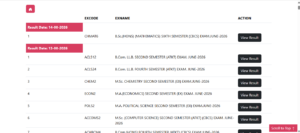
Jiwaji University Result 2026 — Latest Semester Results
Here is a curated list of the latest Jiwaji University results with their date, subject names, semesters and direct links:
| Course | Check Result | Result Date |
|---|---|---|
| B.Sc. (HONS) Mathematics: 6th Sem (CBCS) | Check Result | 14 August 2026 |
| B.Com. LL.B.: 2nd Sem (ATKT); 4th Sem (ATKT) | Check Result | 13 August 2026 |
| M.Sc. Chemistry: 2nd Sem (EX) | Check Result | 13 August 2026 |
| M.A. Economics: 2nd Sem (EX) | Check Result | 13 August 2026 |
| M.A. Political Science: 2nd Sem (EX) | Check Result | 13 August 2026 |
| M.Sc. Computer Science: 2nd Sem ATKT & 4th Sem (CBCS) | Check Result | 13 August 2026 |
| B.Com. (HONS): 4th Sem & 4th Sem ATKT (CBCS) | Check Result | 13 August 2026 |
| M.Com.: 4th Sem & 4th Sem ATKT (CBCS) | Check Result | 13 August 2026 |
| B.Com. Retail Operations Management: 2nd Sem (NEP) | Check Result | 13 August 2026 |
| M.Sc. Botany: 4th Sem (CBCS) | Check Result | 13 August 2026 |
| M.Sc. Environmental Chemistry: 4th Sem (CBCS) | Check Result | 13 August 2026 |
| M.Sc. Instrumentation & Commercial Methods: 4th Sem (CBCS) | Check Result | 13 August 2026 |
| M.Sc. Microbiology: 4th Sem (CBCS) | Check Result | 13 August 2026 |
| B.C.A.: 4th Sem Diploma Course (NEP) | Check Result | 12 August 2026 |
| M.Sc. Biochemistry: 4th Sem (CBCS) | Check Result | 12 August 2026 |
| B.Com. (HONS): 6th Sem & 6th Sem ATKT (CBCS) | Check Result | 12 August 2026 |
| M.Sc. Industrial Chemistry (Pharma): 2nd Sem ATKT & 4th Sem (CBCS) | Check Result | 12 August 2026 |
| M.B.A. Business Economics: 2nd Sem ATKT & 4th Sem (CBCS) | Check Result | 12 August 2026 |
| M.A. Psychology: 4th Sem (CBCS) | Check Result | 12 August 2026 |
| M.A. English: 2nd Sem ATKT (CBCS) | Check Result | 12 August 2026 |
| M.A. History: 2nd Sem ATKT (CBCS) | Check Result | 12 August 2026 |
| M.Sc. Instrumentation & Comm. Meth.: 2nd Sem ATKT (CBCS) | Check Result | 12 August 2026 |
| M.Sc. Mathematics: 2nd Sem ATKT (CBCS) | Check Result | 12 August 2026 |
| M.Sc. Microbiology: 2nd Sem ATKT (CBCS) | Check Result | 12 August 2026 |
| M.A. Yoga: 2nd Sem ATKT (CBCS) | Check Result | 12 August 2026 |
| M.Sc. Remote Sensing & GIS: 4th Sem (CBCS) | Check Result | 12 August 2026 |
| M.Sc. Geology: 4th Sem (CBCS) | Check Result | 12 August 2026 |
| Bachelor of Travel & Tourism Management: 6th Sem (CBCS) | Check Result | 12 August 2026 |
| Bachelor of Hotel Management & Catering Technology: 6th Sem (CBCS) | Check Result | 12 August 2026 |
| B.B.A.: 6th Sem (ATKT CBCS) | Check Result | 10 August 2026 |
| B.C.A.: 4th Sem Diploma (ATKT NEP) | Check Result | 10 August 2026 |
| B.B.A. & B.C.A.: 1st Year Certificate Course (NEP) | Check Result | 10 August 2026 |
| B.Sc.: 1st Year Certificate (Regular & Private NEP) | Check Result | 08 August 2026 |
| M.B.A. (Full Time / Pharma): 4th Sem & 2nd Sem ATKT (CBCS) | Check Result | 08 August 2026 |
| M.P.Ed.: 4th Sem & ATKT | Check Result | 08 August 2026 |
| M.P.Ed.: 4th Semester (CBCS) | Check Result | 07 August 2026 |
| M.Com.: 2nd Semester (NEP) | Check Result | 06 August 2026 |
| M.Sc.: Chemistry, Physics, Zoology — 4th Sem & ATKT (CBCS) | Check Result | 05 August 2026 |
| M.A.: English, Sanskrit, Yoga — 4th Sem & ATKT (CBCS) | Check Result | 05 August 2026 |
| B.Pharm.: 8th Sem & ATKT (CBCS) | Check Result | 04 August 2026 |
| B.E.: CS & Electronics 8th Sem | Check Result | 04 August 2026 |
| B.Ed.: 2nd Sem & ATKT | Check Result | 04 August 2026 |
| B.Ed. Special Ed (HI): 4th Sem | Check Result | 04 August 2026 |
| B.C.A.: 6th Sem & ATKT (CBCS) | Check Result | 04 August 2026 |
| P.G. Diploma: Guidance & Counselling, Museology — 2nd Sem (CBCS) | Check Result | 03 August 2026 |
| B.A. / B.Sc. (Honours): 4th Year NEP — Botany, English, Economics, Zoology, Chemistry, Hindi, Geography | Check Result | 03 August 2026 |
| B.A. / B.Sc. (Honours): 4th Year NEP — History, Math, Physics, Biotech, Sociology, CS, Sanskrit, Political Science | Check Result | 01 August 2026 |
| B.Sc. (Honours) Math: 4th Year (NEP) | Check Result | 31 July 2026 |
| M.A. / M.Sc. / M.Com: 2nd Sem EX & Private EX — Zoology, Sociology, Psychology, Political Science, M.Com, Hindi, Geography, Math, History, Ind. Chem, English, Botany | Check Result | 31 July 2026 |
| B.Ed. & M.Ed. Integrated: 2nd & 4th Sem | Check Result | 30 July 2026 |
| LL.M.: 2nd & 4th Sem | Check Result | 30 July 2026 |
| M.Sc. & M.A. CBCS: 2nd Sem ATKT — Biochemistry, Botany, Food Tech, Hindi, Jyotirvigyan | Check Result | 30 July 2026 |
| M.Com., M.A. Political Science, M.Sc. Zoology: 2nd Semester ATKT (CBCS) | Check Result | 28 July 2026 |
| M.J.M.C.: 4th Sem (CBCS) | Check Result | 27 July 2026 |
| LL.M.: 4th Sem (CBCS) | Check Result | 27 July 2026 |
| B.Sc. Home Science: 1st Year (NEP) | Check Result | 27 July 2026 |
| B.P.Ed.: 4th Sem (CBCS) | Check Result | 25 July 2026 |
| B.B.A.: 6th Sem (CBCS) | Check Result | 25 July 2026 |
| B.P.Ed.: Fourth Semester (Regular & ATKT) | Check Result | 24 July 2026 |
| B.Com.: First Year Distance Certificate Course (NEP) | Check Result | 22 July 2026 |
| B.Com.: 1st Year (NEP) | Check Result | 20 July 2026 |
| M.A.: Economics & Hindi — 4th Sem (CBCS) | Check Result | 20 July 2026 |
| M.Sc. Math: 4th Sem (CBCS) | Check Result | 20 July 2026 |
| LL.B. 3YDC: 6th Sem | Check Result | 18 July 2026 |
| M.A.: Urdu & Extension Ed. — 4th Sem | Check Result | 18 July 2026 |
| M.Sc. Biotech: 4th Sem | Check Result | 18 July 2026 |
| B.Com. LL.B.: Tenth Semester Exam | Check Result | 16 July 2026 |
| M.A.: AIHC & Archaeology, Public Admin, Political Science — 4th Sem (CBCS) | Check Result | 15 July 2026 |
| M.A. Geography: 2nd Sem (ATKT) Private | Check Result | 14 July 2026 |
| M.Sc. Mathematics: 2nd & 4th Sem (Private) | Check Result | 14 July 2026 |
| B.Ed.: Fourth Semester Exam (Regular & ATKT) | Check Result | 13 July 2026 |
| B.A. LL.B.: 10th Sem | Check Result | 10 July 2026 |
| M.A.: History & Sociology — 4th Sem | Check Result | 10 July 2026 |
| Distance M.A.: Geography, Drawing & Painting | Check Result | 10 July 2026 |
| Teacher Education Programs: B.A. B.Ed, B.Sc. B.Ed, B.Ed M.Ed, M.Ed | Check Result | 09 July 2026 |
| M.A. Private: History, Sociology | Check Result | 09 July 2026 |
| M.Com, M.A.: Music Vocal, Sociology | Check Result | 08 July 2026 |
| M.Sc.: Microbiology, Zoology — 2nd Sem ATKT | Check Result | 08 July 2026 |
| M.A. and M.Sc.: Various Courses — Even Semester Results | Check Result | 07 July 2026 |
| B.Ed.: Semester Results | Check Result | 25 June 2026 |
| M.Sc. Chemistry: Fourth Semester Exam June 2026 (Old and New Course) | Check Result | 24 June 2026 |
| M.A. Political Science (Private): Fourth Sem (ATKT) Exam June 2026 | Check Result | 22 June 2026 |
| M.A. Political Science (Private): Fourth Sem Exam June 2026 | Check Result | 22 June 2026 |
| M.Sc. Bio-Technology: Fourth Semester (ATKT) Exam June 2026 | Check Result | 20 June 2026 |
| M.Sc. Industrial Chemistry: Fourth Semester (ATKT) Exam June 2026 | Check Result | 20 June 2026 |
| M.Sc. Microbiology: Fourth Semester (ATKT) Exam June 2026 | Check Result | 20 June 2026 |
| M.Sc. Zoology: Fourth Semester (ATKT) Exam June 2026 | Check Result | 20 June 2026 |
| M.A. Political Science: Fourth Semester Exam June 2026 & (ATKT) | Check Result | 20 June 2026 |
| M.A. Geography: Fourth Semester Exam June 2026 | Check Result | 20 June 2026 |
Jiwaji University Entrance Test Result 2026
Jiwaji University has released its entrance test results for its UG and PG courses. The university has released the result PDF on their official website, which can be downloaded below:
| Entrance Test | Result PDF |
| UG Courses | Jiwaji University UG Entrance Result 2026 |
| PG Courses | Jiwaji University PG Entrance Result 2026 |
Jiwaji University Result 2026- Various Courses (June 2026)
| Course | Check Result | Result Date |
|---|---|---|
| M.Sc. Zoology Fourth Semester Exam June 2026 | Check Result | 19 Jun 2026 |
| M.Sc. Microbiology Fourth Semester Exam June 2026 | Check Result | 19 Jun 2026 |
| M.Sc. Industrial Chemistry Fourth Semester Exam June 2026 | Check Result | 19 Jun 2026 |
| M.Sc. Food Technology Fourth Semester Exam June 2026 | Check Result | 19 Jun 2026 |
| M.Sc. Bio-Technology Fourth Semester Exam June 2026 | Check Result | 19 Jun 2026 |
| B.A. Third Year (Degree Course) (Supp. II Chance) (NEP) Exam Mar. 2026 – Regular & Private | Check Result | 19 Jun 2026 |
| M.A. Dance & M.A. Drawing & Painting Fourth Semester Exam June 2026 | Check Result | 19 Jun 2026 |
| M.A. Music (Vocal) & M.A. Defence & Strategic Studies Fourth Semester Exam June 2026 | Check Result | 19 Jun 2026 |
| M.A. Psychology Fourth Semester Exam June 2026 | Check Result | 19 Jun 2026 |
Jiwaji University Result 2026 Status: UG, PG, Semester Wise Updates
Jiwaji University Result 2026 for various UG and PG courses has been officially declared, with the latest updates on April 13, 2026. Results are out for multiple semesters, covering recent exam sessions.
| Particular | Details |
|---|---|
| University Name | Jiwaji University |
| Result Year | Jiwaji University Results 2026 |
| Result Status | Out |
| Latest Result Announcement | 14 August, 2026 |
| Official Website | jiwaji.edu |
| Result Direct Link | https://univindia.com/JwgResult/yearlistresult.php |
| Courses Covered | UG and PG Courses |
| Result Types | Includes Regular, ATKT, Private, Supplementary, CBCS, NEP. |
| Semesters Released | First Year, 1st Semester, 3rd Semester, 5th Semester, 7th Semester, 8th Semester |
| Exam Sessions | EXAM.MAR-2024 and EXAM.DEC.-2025 |
How to Check Jiwaji University Results 2026: Step-by-Step Guide
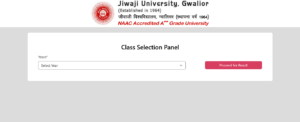
To check the Jiwaji University Result 2026, students must visit the official website, jiwaji.edu. Here is the step-by-step guide to accessing Jiwaji University Results 2026:
- Visit the official website and navigate to the result page. Alternative, visit the result page directly.
- Select the specific year for which you want to check the result.
- The portal will display the list of results with date, subject name and link.
- Click on the desired subject and view your result.
Eligible students can also download their Jiwaji University provisional degree using their enrollment number, roll number, mother’s/father’s name, exam and other details.
Jiwaji University B.Ed, M.Ed, MA Results 2026: Direct Download Links
The Jiwaji University Result 2026 for various B.Ed, M.Ed, MA, and other courses has been declared, with the main declaration date being March 13, 2026, and specific B.Ed results on April 4, 2026. Students extensively used Jiwaji University B.Ed previous year papers to prepare for the exam. The results can now be accessed using Roll Number or Registration Number details.
| Course/Exam Name | Result Date | Direct Link |
|---|---|---|
| Jiwaji University BEd, MEd, MA and Other Courses Results 2026 (General Link) | March 13, 2026 | Check Result |
| B.Ed First Semester (ATKT) Exam Dec 2025 | April 04, 2026 | Check Result |
| B.Ed Special Edu. (HI) First Semester (ATKT) Exam Dec 2025 | April 04, 2026 | Check Result |
| B.Ed Special Edu. (HI) Third Semester (ATKT) Exam Dec 2025 | April 04, 2026 | Check Result |
| B.Ed First Semester Exam Dec 2025 | April 04, 2026 | Check Result |
| B.Ed Special Edu. (HI) First Semester Exam Dec 2025 | April 04, 2026 | Check Result |
| B.Ed Spl.Education (HI) Third Sem Exam Dec 2025 | April 04, 2026 | Check Result |
| MA Dance First Sem. (ATKT) Exam. Dec-2025 | April 02, 2026 | Check Result |
| MA (English) First Semester (ATKT) Exam. Dec-2025 | April 02, 2026 | Check Result |
| MA (Hindi) First Semester (ATKT) Exam. Dec-2025 | April 02, 2026 | Check Result |
| MA Music Vocal First Semester (ATKT) Exam. Dec-2025 | April 02, 2026 | Check Result |
| MA Political Science First Semester (ATKT) Exam. Dec-2025 | April 02, 2026 | Check Result |
| MA(History) (Private) First Semester (ATKT) Exam.Dec.-2025 | April 02, 2026 | Check Result |
| MA Political Science First Semester (Private) (ATKT) Exam. Dec-2025 | April 02, 2026 | Check Result |
| MA Sociology (Private) First Semester (ATKT) Exam Dec.-2025 | April 02, 2026 | Check Result |
| MA Public Administration First Semester (NEP) (Sos) Exam.Dec.2025 | April 02, 2026 | Check Result |
| MA Defence & Strategic Studies First Semester (Private) (NEP) Exam.Dec.2025 | April 02, 2026 | Check Result |
| M.A. Sanskrit First Semester (ATKT) (CBCS) Exam, Dec 2025 | Declared | Check Result |
| M.A. Extension Education and Social Work First Semester (NEP) (SOS) Exam, Dec 2025 | Declared | Check Result |
| M.A. History First Semester (NEP) (SOS) Exam, Dec 2025 | Declared | Check Result |
| M.A. Economics (Private) First Semester (NEP) Exam, Dec 2025 | Declared | Check Result |
| M.A. Hindi (Private) First Semester (NEP) Exam, Dec 2025 | Declared | Check Result |
| M.A. History (Private) First Semester (NEP) Exam, Dec 2025 | Declared | Check Result |
| M.A. Philosophy (Private) First Semester (NEP) Exam, Dec 2025 | Declared | Check Result |
Jiwaji University UG/PG 1st, 3rd, 5th Semester Results 2026: Direct Download Links
Jiwaji University, Gwalior (Madhya Pradesh), has officially declared various UG and PG results for the 2026 academic session. Students can now check their Jiwaji University Result 2026 for the 1st, 3rd, 5th, and other semesters, covering examinations held in December 2025 and September 2025.
| Subject / Course Name | Result Date | Direct Link |
| M.B.A. (Full Time) Third Semester (CBCS) | April 06, 2026 | Check Result |
| B.Sc. (Hons) Biochemistry Fifth Semester | March 25, 2026 | Check Result |
| B.A. (Hons) Mass Communication Fifth Semester | March 25, 2026 | Check Result |
| B.Sc. (Hons) Mathematics Fifth Semester | March 25, 2026 | Check Result |
| M.A. Economics First Semester (Private) | April 06, 2026 | Check Result |
| M.Sc. Physics First Semester (NEP) | April 06, 2026 | Check Result |
| B.Com. LL.B. First Semester | March 25, 2026 | Check Result |
| LL.B. First Year (3YDC) First Semester | March 25, 2026 | Check Result |
| M.Com. First Semester (Private) | March 25, 2026 | Check Result |
| B.C.A. Fifth Semester (CBCS) | April 02, 2026 | Check Result |
Jiwaji University B.Pharm, BHMS, LLB Results 2026: Direct Download Link
The Jiwaji University exam time table also included B.Pharm, BHMS, and LLB exams. Results for these examinations are now accessible. Students can check their B.Pharm Third Semester results from December 2025, BHMS results from June 2023, and LLB results from December 2025 on the official website.
| Subject / Examination Name | Result Date | Direct Link |
| B.PHARM. THIRD SEMESTER (PCI) EXAM. DEC.-2025 | May 02, 2026 | Check Result |
| B.PHARM. FIRST SEMESTER (PCI) EXAM. DEC.-2025 | May 02, 2026 | Check Result |
| B.H.M.S. FOURTH PROF. EXAM. JUNE-2023 | April 28, 2026 | Check Result |
| B.H.M.S. THIRD PROF. EXAM. JUNE-2023 | April 22, 2026 | Check Result |
| B.H.M.S. SECOND PROF. EXAM. JUNE-2023 | April 22, 2026 | Check Result |
| B.H.M.S. FIRST PROF. EXAM. JUNE-2023 | April 22, 2026 | Check Result |
| LL.B. (3YDC) FIRST SEMESTER EXAM. DEC.-2025 | April 25, 2026 | Check Result |
| LL.B. (3YDC) THIRD SEMESTER EXAM. DEC.-2025 | April 25, 2026 | Check Result |
| LL.B. (3YDC) FIFTH SEMESTER EXAM. DEC.-2025 | April 25, 2026 | Check Result |
| B.A.LL.B. FIVE YEAR INTEGRATED FIRST SEM. | April 20, 2026 | Check Result |
| B.COM.LL.B. FIVE YEAR INTEGRATED FIRST SEM. | April 20, 2026 | Check Result |
Jiwaji University Recent Result Releases: Dec 2025 & April 2026 Exams
Jiwaji University has officially released a comprehensive set of results for the December 2025 and April 2026 examination cycles. This includes major notifications issued on March 11, March 25, April 4, April 6, and April 10, 2026, covering Undergraduate (UG), Postgraduate (PG), and Professional courses.
| Course | Semester/Year | Exam Type | Session | Result Date | Direct Link |
| B.PHARM. | Third Semester | CBCS / ATKT | Dec 2025 | April 29, 2026 | Check Result |
| B.PHARM. | First Semester | PCI (Regular/Ex) | Dec 2025 | April 29, 2026 | Check Result |
| M.P.Ed. | 1st & 3rd Sem | CBCS | Dec 2025 | April 10, 2026 | Check Result |
| MA Political Science | First Semester | Private (NEP) | Dec 2025 | April 06, 2026 | Check Result |
| MA English | First Semester | Private ATKT | Dec 2025 | April 06, 2026 | Check Result |
| MA English | First Semester | NEP | Dec 2025 | April 06, 2026 | Check Result |
| MA Economics | First Semester | Private ATKT | Dec 2025 | April 06, 2026 | Check Result |
| MBA (Full Time) | Third Semester | CBCS / ATKT | Dec 2025 | April 06, 2026 | Check Result |
| MSc Physics | First Semester | NEP (SOS) | Dec 2025 | April 06, 2026 | Check Result |
| B.Ed / B.Ed Spl (HI) | 1st & 3rd Sem | Regular / ATKT | Dec 2025 | April 04, 2026 | Check Result |
| M.Com. | First Semester | Regular/Private | Dec 2025 | March 25, 2026 | Check Result |
| LL.B. (3YDC) | First Semester | Regular | Dec 2025 | March 25, 2026 | Check Result |
| B.Com. LL.B. | First Semester | Regular | Dec 2025 | March 25, 2026 | Check Result |
| B.Sc. (Hons) Biochem | Fifth Semester | CBCS | Dec 2025 | March 25, 2026 | Check Result |
| B.A. (Hons) Mass Com | Fifth Semester | CBCS | Dec 2025 | March 25, 2026 | Check Result |
| B.Sc. (Hons) Math | 3rd/5th/7th Sem | CBCS / ATKT | Dec 2025 | March 25, 2026 | Check Result |
| B.Sc. (Hons) Zoology | 3rd/5th Sem | CBCS | Dec 2025 | March 25, 2026 | Check Result |
| M.A. Sanskrit | First Semester | ATKT (CBCS) | Dec 2025 | March 11, 2026 | Check Result |
| M.Sc. Biochemistry | First Semester | NEP (SOS) | Dec 2025 | March 11, 2026 | Check Result |
| M.A. History | First Semester | NEP (SOS) | Dec 2025 | March 11, 2026 | Check Result |
| M.A. Hindi/Philosophy | First Semester | Private (NEP) | Dec 2025 | March 11, 2026 | Check Result |
Jiwaji University Marksheet Download 2026 and Revaluation Process
To access your Jiwaji University Result 2026 and marksheet, students should utilize the official university websites. Besides the marksheet, students also have access to Jiwaji University migration certificate and degree certificate online. It is crucial to understand that online marksheets are provisional, and specific login details are required for successful download and access.
- Official Websites: jiwaji.edu, univindia.com
- Login Details: Registration Number, Date of Birth, Roll Number, or Name & Father’s Name.
- Online Marksheet Nature: Provisional.
- Official Use: Original marksheet required from respective departments.
- Discrepancies: Contact university examination authority/branch immediately.
- Revaluation Eligibility: Students not satisfied with their marks.
These details outline the primary methods for accessing your Jiwaji University Result 2026 and the initial steps for addressing mark-related concerns.
| Aspect | Details |
|---|---|
| Revaluation/Re-checking Procedure & Deadlines | To be announced by the university |
| Contact for Revaluation/Scrutiny Queries | University examination branch |
Frequently Asked Questions
What is the current status of Jiwaji University Result 2026?
Jiwaji University’s results are currentlyt ‘Out’ for various subjects and semesters. The latest result announcements came on 14th August 2026. Most recent results on Jiwaji University include BSc Hons Mathematics, BCom LLB, MSc Chemistry, MA Economics, BCA, MBA, MA Psychology and many other subjects.
Which UG and PG courses have had their results updated by Jiwaji University in 2026?
Numerous courses have been updated, including B.Ed, M.A. (English, Hindi, Sanskrit), M.Sc. (Physics, Biochemistry), B.Pharm, LL.B., and B.Com LL.B. These updates cover regular, private, ATKT, and NEP-based subjects across science, arts, commerce, and professional faculties.
Are there semester-wise updates available for Jiwaji University Results 2026?
Yes, semester-wise updates are available. The university has released results for the 1st, 3rd, 5th, 6th and 7th semesters. These updates primarily cover the December 2025 examination session for both CBCS and non-CBCS patterns, alongside some annual and supplementary results.
What is Jiwaji University Result 2026?
Jiwaji University Result 2026 refers to the official declaration of marks and qualifying status for students enrolled in undergraduate, postgraduate, and professional diploma programs. It serves as a provisional digital marksheet for exams conducted during the 2025-26 academic cycle.
What are the eligibility requirements for Jiwaji University Result 2026?
To access the result, students must have been officially registered for the relevant examination session (e.g., Dec-2025). Eligibility to view the marksheet requires valid login credentials, such as a Roll Number, Registration Number, or Date of Birth.
How can I check Jiwai University result 2026?
To check Jivaji University result, students must visit Jiwaji University’s official result portal, select the academic year and choose the desired subject from the list displayed.