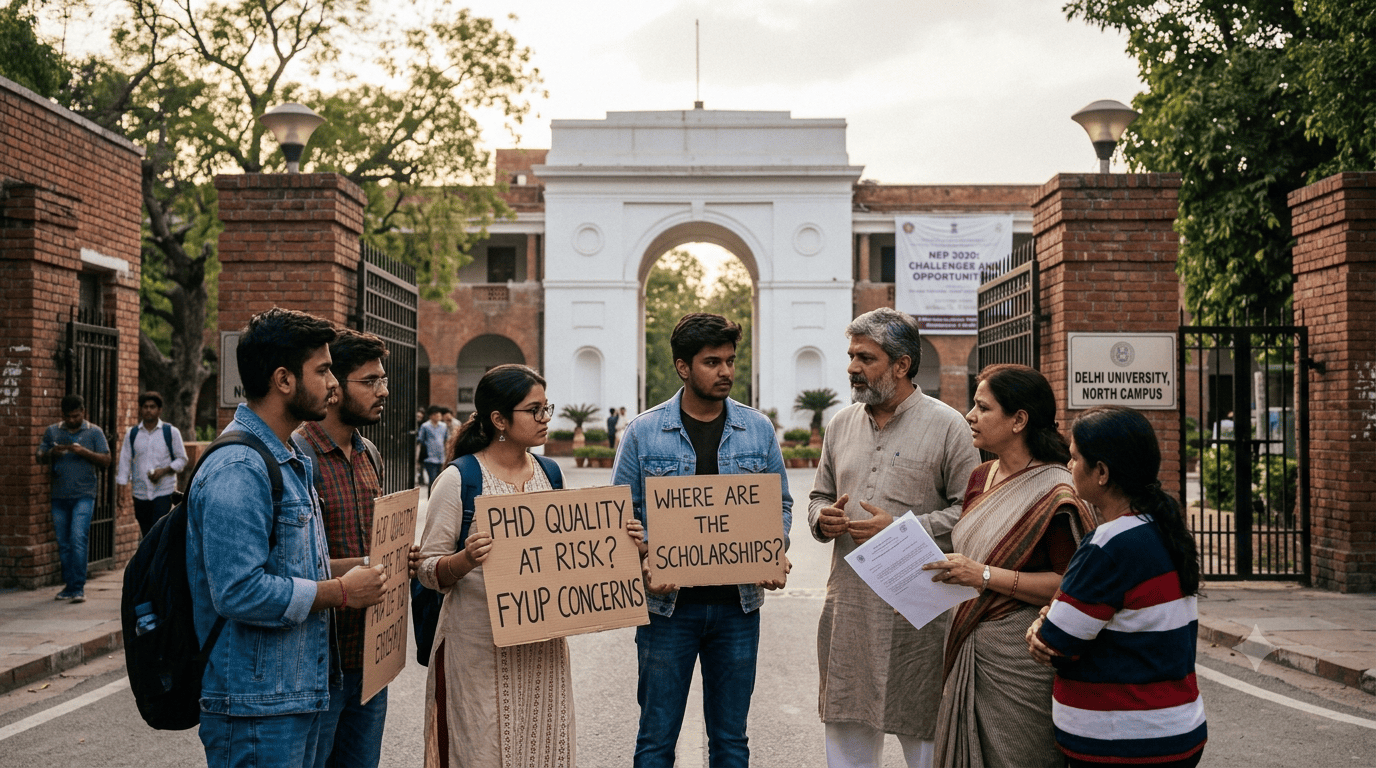
DU’s New PhD Admission Policy For FYUP Graduates Sparks Debate: NEP Alignment vs Research Quality
In a landmark structural shift aligned with the National Education Policy (NEP) 2020 and University Grants Commission (UGC) guidelines, Delhi University (DU) has officially approved amendments allowing Four-Year Undergraduate Programme (FYUP) graduates to enroll directly into PhD programmes. Bypassing the conventional mandatory Master’s or MPhil degree, this streamlined pathway fast-tracks research careers for eligible candidates.
However, the decision has sharply divided the academic fraternity, triggering intense debate among professors, Academic Council (AC) members, and educational experts over research quality, reservation equity, and scholarship funding.
The New Pathway: Eligibility & Key Criteria
Under the newly amended PhD Ordinance VI, ratified following recommendations from the university’s Research, Innovation and Entrepreneurship Council (RIEC), students completing a four-year Bachelor’s degree with a minimum aggregate of 75% marks (or 7.5 CGPA on a 10-point scale) are now eligible for direct doctoral entry.
Key eligibility highlights include:
-
Relaxation Criteria: A mandatory 5% relaxation in qualifying marks (lowering the threshold to 70% or 7.0 CGPA) is extended to candidates belonging to SC, ST, OBC (non-creamy layer), Economically Weaker Sections (EWS), and Differently-Abled categories.
-
National Screening: Direct applicants must qualify national-level eligibility tests, such as UGC-NET or CSIR-NET, and successfully clear a departmental interview.
-
Timeline: The updated framework coincides with the graduation of DU’s inaugural FYUP cohort—enrolled in the 2022–23 academic session under the Undergraduate Curriculum Framework (UGCF)—making them eligible starting from the 2026–27 PhD admission cycle.
Supporters Hail NEP-Driven Reform
Supporters of the amendment, including university administrators and college principals, have welcomed the reform as a progressive step that elevates undergraduate research and aligns DU with global academic standards.
-
Time-Saving Career Track: Fast-tracking high-performing students saves two vital years, enabling young scholars to enter post-doctoral positions and academic careers significantly earlier in life.
-
Strict Merit Safeguards: Proponents argue that the high 75% aggregate cutoff ensures direct entry remains a merit-based route restricted to exceptional students.
-
Incentives for Top Talent: New provisions allow top-performing undergraduates—particularly those with Scopus-indexed research publications—to access dedicated supernumerary seats for PhD entry.
-
Research Foundation: Supporters contend that structured research coursework and dissertations embedded in the fourth year of FYUP provide candidates with adequate methodological grounding, making a traditional Master’s degree optional for top academic performers.
Critics Warn of Foundation Gaps and Quality Dilution
Conversely, a substantial section of DU faculty members has expressed deep reservations, warning that bypassing postgraduate education could severely compromise doctoral research quality.
“Master’s degree programmes play an indispensable role in deepening conceptual understanding, theoretical maturity, and subject specialization before a student undertakes independent doctoral research.”
-
Rigor Concerns: Faculty members caution that undergraduate research, even within a four-year structure, cannot replace the academic rigor of postgraduate training.
-
Hiring Bottlenecks: Critics point out potential career disadvantages, noting that candidates who hold both a Master’s and a PhD may be naturally preferred during future Assistant Professor recruitment drives over those who skipped postgraduate education.
Reservation Equity and Fellowship Constraints Cause Friction
The proposal drew formal opposition during DU’s Academic Council meeting, where AC members Maya John and Latika Gupta submitted a joint dissent note citing serious policy lacunae.
1. Social Equity & Reservation Mapping
Dissenting members pointed out that applicants entering through the FYUP route and those applying via the traditional Master’s track form two parallel pools. Without clear administrative mechanisms detailing how category-wise seats will be mapped across these separate templates, candidates from marginalized communities could face systemic disadvantages during departmental selections.
2. Financial Fellowship Limits
Financial support is another major bone of contention. Currently, DU limits its Non-Junior Research Fellowship (Non-JRF) stipends to a fixed number of scholars per department. Critics argue that expanding PhD intake to direct undergraduate applicants without expanding university funding will dilute financial support, leaving many non-JRF scholars without crucial institutional stipends.
The Road Ahead
As Delhi University prepares to implement the new PhD guidelines, university leadership faces the task of addressing faculty apprehensions while carrying forward NEP 2020’s research vision. Resolving administrative ambiguities regarding seat reservation mapping and expanding financial fellowship structures will be critical to ensuring that this reform delivers on its promise of academic excellence and social equity.

📰 More Education News
- AIIMS M.Sc. Nursing 2026 Counselling Postponed Until Further Notice: Check Revised Schedule & Other UpdatesJul 29, 2026 • Aayush Kukreja
- BCECE 2026 Round 1 Seat Allotment Released for Nursing, Agriculture & Pharmacy: Check Full Schedule & Other UpdatesJul 29, 2026 • Aayush Kukreja
- BCECE Counselling 2026 Schedule Revised for PCM/PCM of PCMB GroupJul 29, 2026 • Aayush Kukreja
- MAH MBA CAP 2026: Maharashtra CET Cell Removes Women’s Quota, Issues Revised Seat MatrixJul 29, 2026 • Simran