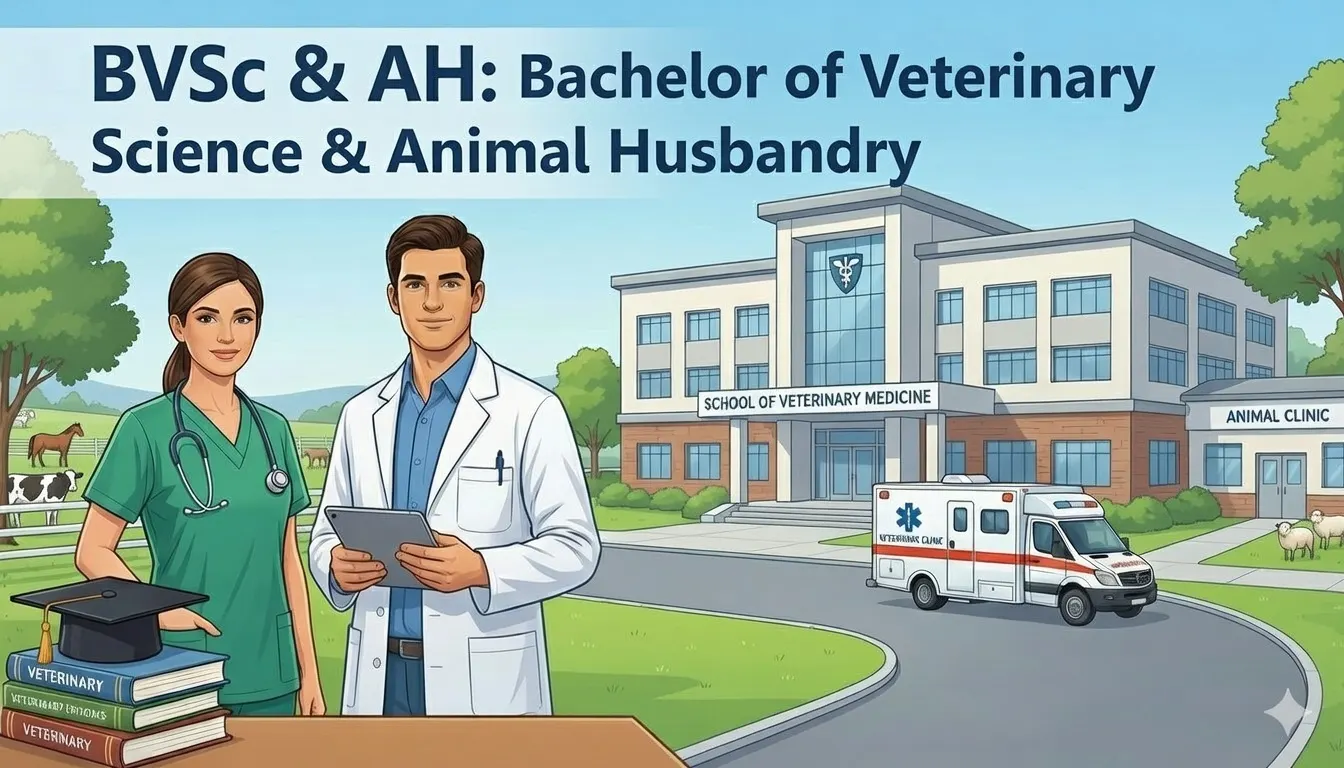
Bvsc & AH 2026: Course, Colleges, Fees, Eligibility, NEET Cutoff & Career India
A Bachelor of Veterinary Science & Animal Husbandry(BVSc & AV) is a professional degree that prepares students for a rewarding career in veterinary science and animal healthcare. This 5.5-year undergraduate program combines classroom learning with extensive clinical and field training in animal medicine, surgery, nutrition, breeding, and livestock management. Students develop practical skills in diagnosing diseases, preventive care, and public health related to animals. Graduates can pursue roles as veterinarians, livestock officers, researchers, animal welfare professionals, or entrepreneurs in dairy and poultry sectors. The course also opens pathways to higher studies such as MVSc, research programs, and specialised veterinary practice in India and abroad.
What is BVSc & AH?
The Bachelor of Veterinary Science & Animal Husbandry (BVSc & AH) is a 5.5-year undergraduate professional degree in India regulated by the Veterinary Council of India (VCI). The program includes 4.5 years of academic study plus a 1-year compulsory rotatory internship. It covers core subjects such as Veterinary Anatomy, Physiology, Biochemistry, Pathology, Pharmacology, Surgery, Medicine, Animal Nutrition, Livestock Production, and Public Health. The course prepares graduates for careers as veterinarians, veterinary officers, animal health inspectors, researchers, and livestock or dairy consultants in government, private, and entrepreneurial sectors.
| Feature | BVSc & AH | BSc Animal Husbandry / Animal Science | BSc Dairy Technology |
|---|---|---|---|
| Duration | 5.5 years (4.5 years academic + 1 year internship) | 3–4 years (varies by university) | 4 years |
| Focus | Veterinary medicine, surgery, and animal healthcare | Animal production, breeding, nutrition, farm management | Milk processing, dairy technology, food safety |
| Career Opportunities | Veterinarian, Veterinary Officer, Livestock Development Officer, Researcher | Livestock Manager, Animal Nutritionist, Farm Supervisor | Dairy Technologist, Quality Analyst, Dairy Plant Manager |
| Core Subjects | Anatomy, Physiology, Pharmacology, Pathology, Medicine, Surgery, Livestock Management | Animal Genetics, Nutrition, Production & Management | Dairy Engineering, Dairy Chemistry, Dairy Microbiology |
BVSc Eligibility
To be eligible for the BVSc & AH program, candidates must meet academic, entrance, and regulatory requirements set by the Veterinary Council of India (VCI) and participating universities. Admission is primarily based on NEET-UG scores followed by counselling under 15% All India Quota (AIQ) and 85% State Quota. Candidates must have completed 10+2 with Physics, Chemistry, Biology, and English from a recognised board. Physical fitness is generally required for clinical and fieldwork components, though exact standards vary by institution.
Key Eligibility Points
- Age Limit: Minimum 17 years as of 31 December of admission year; upper age limit may follow NEET rules (subject to regulatory updates).
- Entrance Exam: NEET-UG is mandatory for most recognised BVSc & AH colleges.
- Subjects Required: Physics, Chemistry, Biology, and English in 10+2.
- Minimum Marks: Typically 50% PCB (47.5% for OBC, 40% for SC/ST; may vary by institution/state).
- NEET Cutoffs: Vary annually based on seat availability and competition; fixed scores like 500+ are not guaranteed.
- Counselling: Conducted through All India Quota and respective state counselling authorities.
- Physical Fitness: Medical fitness certificate may be required during admission.
| Eligibility Criteria | Details |
|---|---|
| Entrance Exam | NEET-UG (mandatory for most VCI-approved colleges) |
| Age | Minimum 17 years; upper age as per NEET/VCI norms |
| Required Subjects | Physics, Chemistry, Biology, and English in 10+2 |
| Minimum Marks | Usually 50% PCB (relaxation for reserved categories as per norms) |
| Physical Fitness | Medical fitness certificate may be required |
| Counselling | 15% All India Quota + 85% State Quota counselling system |
Top BVSc Colleges
The following table lists top BVSc & AH colleges in India approved by the Veterinary Council of India (VCI). The BVSc & AH program is a 5.5-year course (including internship). Tuition fees in government colleges are generally low, while state universities may have moderate fees depending on domicile policies. NEET cutoffs are not fixed numbers and vary every year based on competition, category, and state quota. Placement outcomes differ widely — many graduates enter government veterinary services through state PSC exams, while others work in private clinics, livestock companies, dairy sectors, NGOs, and research organisations. Typical starting salaries range around ₹3–8 LPA, increasing significantly with experience, government roles, or specialisation.
| Top Colleges – Approx Tuition Fees | NEET Cutoff Trend (General Category – Varies Yearly) | Career / Placement Pathways (Typical Outcomes) |
|---|---|---|
| IVRI Bareilly (ICAR-IVRI) | ₹15,000 – ₹40,000 per year | High NEET ranks under AIQ; among most competitive BVSc colleges |
| TANUVAS Chennai | ₹20,000 – ₹50,000 per year | High to moderate NEET ranks depending on state quota |
| GADVASU Ludhiana | ₹40,000 – ₹70,000 per year | Moderate to high NEET ranks |
| KVASU Kerala | ₹30,000 – ₹60,000 per year | Moderate NEET ranks; strong state quota preference |
| BHU – Institute of Agricultural Sciences | ₹25,000 – ₹60,000 per year | High NEET ranks under central university counselling |
| College of Veterinary Science, Assam Agricultural University | ₹15,000 – ₹40,000 per year | Moderate NEET ranks (state quota heavy) |
| Bombay Veterinary College (MAFSU) | ₹40,000 – ₹80,000 per year | Moderate to high NEET ranks |
| Rajasthan University of Veterinary & Animal Sciences (RAJUVAS) | ₹25,000 – ₹50,000 per year | Moderate NEET ranks |
| Lala Lajpat Rai University of Veterinary & Animal Sciences (LUVAS) | ₹40,000 – ₹70,000 per year | Moderate to high NEET ranks |
| Nanaji Deshmukh Veterinary Science University (NDVSU) | ₹30,000 – ₹60,000 per year | Moderate NEET ranks |
BVSc & AH Syllabus
The Bachelor of Veterinary Science & Animal Husbandry (BVSc & AH) syllabus follows the Veterinary Council of India (VCI) Minimum Standards of Veterinary Education (MSVE) and spans 5.5 years, including a 1-year compulsory rotating internship (not six months). The curriculum progresses from basic veterinary sciences to para-clinical subjects, clinical veterinary practice, and livestock production & management. Training includes laboratory work, farm practice, field visits, and clinical exposure in veterinary hospitals. Rather than electives each semester, most universities follow a structured professional curriculum with integrated practical and clinical components.
| Professional Year | Typical Phase | Core Subjects / Training Areas |
|---|---|---|
| 1st Professional Year | Basic Veterinary Sciences | Veterinary Anatomy, Veterinary Physiology, Biochemistry, Livestock Production Management, Animal Nutrition Basics |
| 2nd Professional Year | Para-Clinical Sciences | Veterinary Microbiology, Veterinary Pathology, Veterinary Pharmacology & Toxicology, Animal Genetics & Breeding, Veterinary Public Health |
| 3rd Professional Year | Pre-Clinical & Intro Clinical | Parasitology, Livestock Products Technology, Animal Reproduction & Gynaecology (Intro), Veterinary Epidemiology, Animal Welfare & Ethics |
| 4th Professional Year | Clinical Veterinary Sciences | Veterinary Medicine, Veterinary Surgery & Radiology, Veterinary Gynaecology & Obstetrics, Veterinary Clinical Practice |
| 5th Professional Year | Advanced Clinical Training | Clinical Case Management, Herd Health, Livestock Extension, Diagnostic Imaging, Farm & Field Training |
| Internship (Final Year) | 12-Month Rotating Internship | Veterinary Hospitals, Livestock Farms, Poultry Units, Dairy Units, Veterinary Public Health Labs, Rural Veterinary Services |
Click here to get an overview of the syllabus for B.V.Sc. & A.H.
BVSc & AH Fees
BVSc & AH fees in India vary depending on whether the college is a central institute, state government university, or private veterinary college. Government veterinary colleges are usually highly subsidised, while private veterinary institutions have significantly higher tuition. Fees listed are approximate ranges and may vary based on domicile quotas, university policies, and facilities.
- Central Institutes / ICAR Institutes (e.g., IVRI): approx. ₹10,000 – ₹40,000 per year
- State Government Veterinary Colleges: approx. ₹15,000 – ₹60,000 per year
- Private Veterinary Colleges / Universities: approx. ₹1.5 lakh – ₹4 lakh per year
- Hostel Fees: approx. ₹30,000 – ₹90,000 per year (separate from tuition)
- Total Program Cost (Govt Colleges): approx. ₹1 lakh – ₹3 lakh for full course
- Total Program Cost (Private Colleges): approx. ₹8 lakh – ₹20 lakh+ for full course
- Scholarships: ICAR National Talent Scholarship, State Govt schemes, SC/ST/OBC fee concessions, merit scholarships, and livestock sector fellowships
| College Type | Course | Total Tuition Fees (Approx.) | Hostel Fees (Approx.) |
|---|---|---|---|
| ICAR-IVRI / Central Govt Institutes | BVSc & AH | ₹80,000 – ₹2 lakh total | ₹30,000 – ₹70,000 per year |
| State Govt Veterinary Colleges | BVSc & AH | ₹1 lakh – ₹3 lakh total | ₹35,000 – ₹80,000 per year |
| Private Veterinary Universities | BVSc & AH | ₹8 lakh – ₹20 lakh+ total | ₹60,000 – ₹1 lakh per year |
Career After BVSc & AH
A BVSc & AH degree opens career opportunities across government veterinary services, livestock & dairy industries, pharmaceuticals, research, wildlife conservation, academia, and private clinical practice. Salary ranges vary depending on experience, employer, state pay scales, and whether the professional works in public service or private practice. Government Veterinary Officers are commonly recruited through state public service commissions and central agencies. Private practice earnings vary widely based on clientele and specialization. Corporate roles in animal health companies and livestock management also offer competitive packages.
| Sector | Job Role | Salary Range (Approx.) |
|---|---|---|
| Government Veterinary Services | Veterinary Officer / Livestock Development Officer | ₹5 – ₹9 LPA (state pay scales with allowances) |
| Dairy & Livestock Industry | Dairy Farm Manager / Livestock Consultant | ₹4 – ₹8 LPA |
| Animal Health & Pharmaceuticals | Technical Officer / Veterinary Sales Executive | ₹4 – ₹10 LPA |
| Private Practice | Veterinary Clinician / Pet Surgeon | ₹4 – ₹12 LPA initially; ₹12 – ₹30 LPA+ (established clinics) |
| Research & Academia | Research Associate / Teaching Assistant | ₹4 – ₹7 LPA |
| NGOs & Wildlife Sector | Wildlife Veterinarian / Animal Welfare Officer | ₹3 – ₹6 LPA |
| Defence Services | Remount Veterinary Corps (Indian Army) | As per defence pay matrix |
BVSc Salary
BVSc & AH salary in India varies with sector, clinical specialization, location, experience level, and postgraduate qualifications (MVSc/PhD). Government roles follow structured pay scales, while private practice and industry roles may offer performance-based earnings.
- Government Veterinary Officer: approx. ₹5 – ₹9 LPA (Level-10 pay scale + allowances depending on state)
- Private Clinical Practice: approx. ₹4 – ₹8 LPA initially; ₹12 – ₹30 LPA+ for experienced or established veterinarians
- Dairy & Livestock Industry: approx. ₹3.5 – ₹8 LPA depending on farm size and experience
- Pharmaceutical / Animal Health Companies: approx. ₹4 – ₹10 LPA (entry to mid-level); ₹12 – ₹20 LPA+ for senior technical roles
- Research & Academia: approx. ₹4 – ₹7 LPA for JRF/Research Associate; ₹6 – ₹12 LPA+ for lecturers (after MVSc/PhD)
- Own Veterinary Clinic: income varies widely based on specialization, urban location, and clientele
- International Opportunities: approx. USD 50,000 – USD 110,000 annually after licensing/equivalency exams (country dependent)
Salary by Sector & Experience (Typical Trends)
- Entry-Level (0–2 years): approx. ₹3.5 – ₹6 LPA
- Mid-Level (3–7 years): approx. ₹6 – ₹12 LPA
- Senior / Specialist (8+ years): approx. ₹12 – ₹30 LPA+ (private practice or industry leadership roles)
MVSc & Further Studies
After completing BVSc & AH, graduates can pursue postgraduate and research pathways to specialise in veterinary sciences, move into academic careers, or enter advanced government and industry roles.
| Higher Study Option | Details |
|---|---|
| MVSc (Master of Veterinary Science) | 2-year postgraduate degree with specialization; admission mainly through ICAR AIEEA-PG or university exams |
| PhD in Veterinary Science | Research-focused program (3–5 years) for academic, research, and senior scientific roles |
| UPSC / State PSC Exams | Recruitment to central/state animal husbandry departments, research bodies, and policy roles |
| International Licensure / Studies | Practice or higher education abroad after country-specific licensing (NAVLE, RCVS, AVMA pathways etc.) |
Additional Academic & Professional Pathways
- MVSc Specializations: Veterinary Medicine, Surgery & Radiology, Pathology, Microbiology, Epidemiology, Animal Genetics & Breeding, Livestock Production & Management, Veterinary Public Health
- PhD Opportunities: Advanced research roles in universities, ICAR institutes, veterinary research centres, and biotechnology labs
- Research Fellowships: Junior Research Fellow (JRF), Senior Research Fellow (SRF), and ICAR-funded research projects at institutes such as IVRI and veterinary universities
- International Board Certifications: Diplomate programs through recognized international veterinary boards (country eligibility required)
- Advanced Certifications: Animal Behaviour, Small Animal Surgery, Wildlife Medicine, Veterinary Rehabilitation, Food Safety & Public Health
- Global Higher Education: Opportunities in the USA, UK, Canada, Australia, and EU countries subject to academic equivalency and licensing requirements
FAQs
Q1. What is the duration of the BVSc & AH course?
The BVSc & AH course lasts 5.5 years, including an internship, and focuses on veterinary medicine and animal management. Core subjects include Anatomy, Physiology, Pathology, and Surgery.
Q2. What are the eligibility criteria for BVSc admission?
To be eligible for BVSc admission, you need a NEET cutoff of 500+ (General Category), must be between 17-25 years old, and have studied Physics, Chemistry, and Biology in 10+2. Physical fitness as per VCI guidelines is also required.
Q3. What is the total fees for the BVSc & AH course in government colleges?
The total fees for the BVSc & AH course in government colleges is approximately INR 1-5 Lakhs. For IVRI (Government), the total fees are approximately INR 2 Lakhs.
Q4. What are the career opportunities after completing BVSc?
After completing a BVSc degree, you can find career opportunities in government, the dairy industry, pharmaceuticals, private practice, and research. Job roles include Veterinary Officer, Dairy Farm Manager, Veterinary Sales Representative, and Research Scientist. Salaries range from ₹4-24 LPA, depending on the sector and experience.
Q5. What are the higher study options after BVSc?
Higher study options after BVSc include MVSc (Master of Veterinary Science), PhD, and opportunities through UPSC (Union Public Service Commission). MVSc leads to specialization, while a PhD is research-oriented. UPSC offers opportunities in government services related to animal husbandry and veterinary science.