Bsc/b.optom (Optometry) 2026: Course, Colleges, Fees, Eligibility & Career India
Simran is currently working as a Senior Content Writer at Findmycollege , where she creates engaging and research-driven learning resources for students. She has completed her Graduation in…
B.Sc/B.Optom (Optometry) is a professional undergraduate program that prepares students for a career in eye care, vision science, and clinical optometry. With increasing awareness of eye health and rising vision-related issues, this course offers excellent opportunities in hospitals, clinics, research institutes, and community health programs. This blog gives a complete guide on B.Sc/B.Optom 2026, including course details, eligibility criteria, top colleges, fees, syllabus, career prospects, government jobs, and higher studies options in India.
🔔 Bsc/b.optom (Optometry) 2026 Admission Alerts 2026
- Eligibility: For BSc Optometry distance education, applicants must have completed 10+2 with at least 50% marks in Physics, Chemistry, and Biology.
- Application Fee (General): The approximate application fee for Bachelor of Optometry (B.Optom) is ₹1500.
- Application Fee (SC/ST/OBC-NCL/EWS/MOBC): The approximate application fee for Bachelor of Optometry (B.Optom) is ₹1200.
- Admission Criteria (Aditya Degree College, Vijayawada): BSc admissions are merit-based and offered in full-time mode.
- Entrance Exam (MUHS): MUHS accepts the NEET UG entrance exam for admission to the BSc in Optometry course.
What is B.Sc/B.Optom (Optometry)?
B.Sc/B.Optom (Bachelor of Science in Optometry) is an undergraduate degree program focused on the study of eye care and vision science. It combines theoretical knowledge with practical training to prepare students to diagnose and treat visual impairments, prescribe corrective lenses, and manage eye-related health issues.
The course covers subjects like anatomy of the eye, ocular diseases, contact lenses, vision therapy, and clinical optometry. Graduates can work in hospitals, eye clinics, optical stores, research, or even pursue higher studies in optometry and vision science.
This course is ideal for students interested in healthcare, science, and helping people improve their vision and eye health.
Why Choose B.Sc/B.Optom (Optometry)?
B.Sc/B.Optom (Optometry) is not just a degree; it is a gateway to a rewarding career in eye care and vision science. If you are passionate about healthcare and helping people improve their vision, this course offers excellent opportunities for growth, learning, and professional success. Here’s why students choose B.Sc/B.Optom:
-
High Demand Profession – With increasing awareness about eye health and a rise in vision-related problems, qualified optometrists are needed in hospitals, eye clinics, optical stores, and community health programs.
-
Diverse Career Opportunities – Graduates can work as optometrists, vision consultants, ophthalmic technicians, clinical researchers, or even educators in optometry, providing flexibility in career choices.
-
Impactful Role in Healthcare – Optometrists help diagnose vision issues, prevent eye diseases, and provide corrective treatments, making a direct and positive impact on people’s quality of life.
-
Strong Foundation for Higher Studies – After completing B.Sc/B.Optom, students can pursue M.Optom, M.Sc in Vision Science, or specialized training in areas like contact lenses, pediatric optometry, or low vision care.
-
Exposure to Advanced Technology – The course trains students in modern diagnostic tools, ocular imaging techniques, and the latest vision correction methods, keeping them at the forefront of technological advancements.
-
Professional Recognition – The degree is recognized by the Optometry Council of India, ensuring graduates can practice professionally anywhere in India.
-
Good Salary Prospects – Experienced optometrists enjoy competitive salaries and stable career options in hospitals, research institutes, clinics, and private practices.
B.Sc/B.Optom (Optometry) Course Highlights
| Course Feature | Details |
|---|---|
| Degree Full Form | Bachelor of Science in Optometry (BSc Optometry) / Bachelor of Optometry (B.Optom) |
| Degree Type | Undergraduate Degree |
| Typical Duration | Not specified in 2026 data, assumed 3-4 years |
| Eligibility (India) | 10+2 with at least 50% marks in Physics, Chemistry, and Biology |
| Common Entrance Exams (India) | NEET UG (accepted by MUHS), SSUHS CEE (for BSc Nursing, not directly Optometry but indicates state exams) |
| Average Annual Fees (India) | Application Fee: ₹1500 (General), ₹1200 (SC/ST/OBC-NCL/EWS/MOBC) |
| Mode of Study | Full-time, Distance Education (Subharti University, William Carey University) |
| Average Starting Salary (India) | INR 2-4 LPA (starting), INR 3-5 LPA (general range) |
| Career Options | Clinical Optometrist, Contact Lens Consultant, Ophthalmic Assistant, Refraction Specialist, Optical Store Manager, Researcher |
| Admission Process | Merit-based (Aditya Degree College), NEET UG cutoff 2025 ranged between 3236 and 24603 |
B.Sc/B.Optom (Optometry) Eligibility Criteria
To pursue B.Sc/B.Optom (Optometry), candidates must meet certain academic and age requirements. The eligibility ensures that students have a basic foundation in science subjects, which is essential for understanding eye anatomy, physiology, and vision science. Most colleges also conduct entrance exams or merit-based selection depending on the institution.
-
Candidates must have completed 10+2 (Senior Secondary) education from a recognized board.
-
Mandatory Subjects: Physics, Chemistry, Biology, and English.
-
Minimum aggregate marks required: usually 50–60%, depending on the college.
-
Some institutes may have age limits, usually between 17 to 25 years at the time of admission.
-
Admission may be based on merit, entrance exam, or both, depending on the university.
| Eligibility Parameter | Details |
|---|---|
| Educational Qualification | 10+2 (Physics, Chemistry, Biology, English) from a recognized board |
| Minimum Marks Required | 50–60% aggregate (varies by college) |
| Age Limit | 17–25 years (may vary by institute) |
| Selection Process | Merit-based, Entrance Exam, or both |
| Nationality | Indian/International students (depending on college policy) |
| Other Requirements | Some colleges may conduct interviews or aptitude tests |
B.Sc/B.Optom (Optometry) Admission Process
dmission to B.Sc/B.Optom (Optometry) is offered based on merit, entrance exams, or a combination of both, depending on the college or university. The process generally begins after the announcement of results for 10+2 examinations. Most colleges have an online application process, followed by counseling, document verification, and seat allocation.
-
Check Eligibility – Ensure that you meet the academic criteria (10+2 with Physics, Chemistry, Biology, and English, and minimum required marks).
-
Application Form – Apply online or offline through the college/university portal. Fill in personal, academic, and contact details. Some colleges may charge an application fee.
-
Entrance Exam (if applicable) – Many top optometry colleges conduct entrance exams such as AIIMS B.Sc/B.Optom Test, Manipal Entrance Test (MET), Bharati Vidyapeeth Entrance Exam, etc. Your score determines eligibility for the next round.
-
Merit List / Shortlisting – Colleges release a merit list or shortlisted candidates based on 10+2 marks or entrance exam results.
-
Counseling / Interview – Shortlisted candidates are called for counseling sessions, interviews, or practical assessments. Seats are allotted based on rank, availability, and reservation criteria.
-
Document Verification – Original certificates of 10+2, birth certificate, identity proof, and other relevant documents are verified during admission.
-
Admission Confirmation & Fee Payment – Once selected, students confirm admission by paying the course fees within the stipulated time.
| Step | Details |
|---|---|
| Eligibility Check | Ensure 10+2 with Physics, Chemistry, Biology, and English; minimum 50–60% marks |
| Application Form | Fill online/offline application form on college/university portal |
| Entrance Exam | Some colleges require exams like AIIMS B.Sc/B.Optom Test, MET, Bharati Vidyapeeth Exam |
| Merit List / Shortlisting | Based on 10+2 marks or entrance exam results |
| Counseling / Interview | Seat allocation through counseling, interviews, or practical tests |
| Document Verification | Verify original certificates and identity documents |
| Admission Confirmation | Pay fees and complete formalities to confirm admission |
B.Sc/B.Optom (Optometry) Syllabus
The B.Sc/B.Optom course is designed to provide students with both theoretical knowledge and practical skills in vision science and eye care. The syllabus covers subjects like ocular anatomy, optics, contact lenses, ocular diseases, and clinical practice. Typically, the course is spread over 4 years, including practical training and internship. Below is a semester-wise breakdown of the subjects.
First Year / Semester 1 & 2
| Semester | Subjects |
|---|---|
| Semester 1 | Human Anatomy & Physiology (with focus on Eye), General Optics, Basic Biochemistry, Introduction to Optometry, English / Communication Skills |
| Semester 2 | Ocular Anatomy & Physiology, Visual Optics, General Microbiology, Basic Psychology, Community Eye Health |
Focus: The first year emphasizes basic sciences, understanding the structure and function of the eye, and developing foundational skills in optometry.
Second Year / Semester 3 & 4
| Semester | Subjects |
|---|---|
| Semester 3 | Refraction Techniques I, Ocular Diseases I, Contact Lenses I, Visual Perception, Pharmacology for Eye Care |
| Semester 4 | Refraction Techniques II, Ocular Diseases II, Contact Lenses II, Binocular Vision, Low Vision Aids, Community Optometry |
Focus: The second year focuses on practical optometry skills, including refraction, early diagnosis of eye diseases, and application of contact lenses.
Third Year / Semester 5 & 6
| Semester | Subjects |
|---|---|
| Semester 5 | Advanced Clinical Optometry, Pediatric Optometry, Optometric Instruments, Eye Banking & Ocular Emergencies, Research Methodology |
| Semester 6 | Specialty Contact Lenses, Vision Therapy & Rehabilitation, Occupational Optometry, Clinical Internship / Practicals, Optometry Laws & Ethics |
Focus: The third year emphasizes advanced clinical skills, pediatric and specialized optometry, and introduces research and ethics in vision care.
Fourth Year / Internship / Practical Training
| Year | Details |
|---|---|
| Internship | 6–12 months hands-on training in hospitals, eye clinics, and community health centers; exposure to refraction, ocular disease management, contact lenses, low vision aids, and patient counseling |
Focus: The internship provides real-world exposure, helping students apply their theoretical knowledge in clinical settings under supervision.
Core Subjects in B.Sc/B.Optom (Optometry)
The B.Sc/B.Optom program is designed to provide students with a strong foundation in vision science, eye health, and clinical optometry. The core subjects focus on both theoretical concepts and practical skills required for diagnosing and managing eye-related problems. These subjects prepare students to become competent optometrists capable of working in hospitals, clinics, and research institutions.
Ocular Anatomy & Physiology
- Study of the structure and function of the eye and visual system.
- Covers topics like the cornea, retina, lens, optic nerve, and visual pathways.
Optics & Visual Science
- Basics of light, refraction, lenses, and the optical properties of the eye.
- Includes understanding visual perception and optical instruments.
Refraction Techniques
- Training in measuring visual acuity and correcting refractive errors like myopia, hypermetropia, and astigmatism.
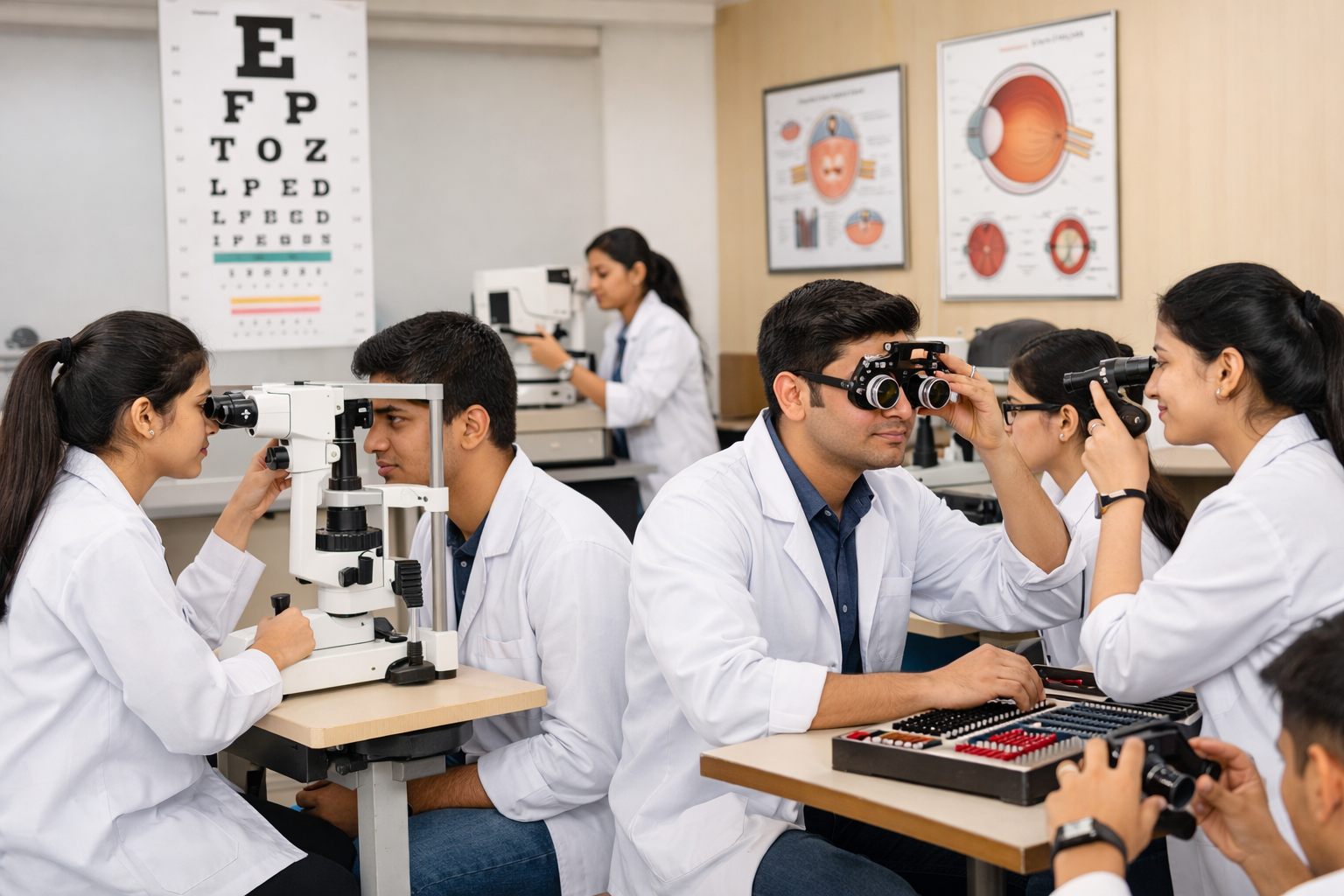
- Practical sessions on retinoscopy, subjective refraction, and use of phoropters.
Ocular Diseases
- Study of eye diseases such as glaucoma, cataract, diabetic retinopathy, and infections.
- Focus on diagnosis, management, and prevention of ocular disorders.
Contact Lenses
- Principles and practice of fitting contact lenses for various eye conditions.
- Covers specialty lenses, soft and rigid lenses, and troubleshooting.
Binocular Vision & Vision Therapy
- Study of eye coordination, depth perception, and treatment of binocular vision anomalies.
- Includes exercises and therapies to improve visual performance.
Low Vision Aids & Rehabilitation
- Techniques and devices to assist patients with impaired vision.
- Focus on improving quality of life for visually challenged individuals.
Community Optometry & Public Health
- Eye care in community settings, screening camps, and preventive eye care.
- Awareness programs for vision health and disease prevention.
Clinical Practice / Internship
- Hands-on training in hospitals and clinics.
- Practical exposure to refraction, ocular disease management, and patient counseling.
| Core Subject | Description |
|---|---|
| Ocular Anatomy & Physiology | Structure and function of the eye and visual system |
| Optics & Visual Science | Light, refraction, lenses, and optical properties of the eye |
| Refraction Techniques | Measuring visual acuity and correcting refractive errors |
| Ocular Diseases | Diagnosis and management of eye diseases like glaucoma, cataract, infections |
| Contact Lenses | Fitting and management of soft, rigid, and specialty contact lenses |
| Binocular Vision & Vision Therapy | Eye coordination, depth perception, and vision therapy techniques |
| Low Vision Aids & Rehabilitation | Devices and methods to assist patients with visual impairment |
| Community Optometry & Public Health | Eye care awareness, screening, and preventive programs in communities |
| Clinical Practice / Internship | Hands-on practical training in hospitals, clinics, and vision centers |
B.Sc/B.Optom (Optometry) Exam Pattern
The B.Sc/B.Optom course generally follows a semester-wise evaluation system, including theory exams, practical exams, and internal assessments. Each semester tests both conceptual understanding and practical skills in optometry. Most universities follow 100 marks per subject, with a combination of theory and practicals depending on the course module.
| Semester | Type of Exam | Marks Distribution | Duration | Description |
|---|---|---|---|---|
| Semester 1 | Theory | 70 Marks | 2–3 hours | Written exams on basic subjects like Anatomy, Physiology, Optics, Biochemistry |
| Practical | 30 Marks | 2–3 hours | Lab sessions, practical experiments, and skill demonstrations | |
| Semester 2 | Theory | 70 Marks | 2–3 hours | Ocular Anatomy, Visual Optics, Microbiology, Basic Psychology |
| Practical | 30 Marks | 2–3 hours | Refraction practice, microscopy, and clinical skills | |
| Semester 3 | Theory | 70 Marks | 2–3 hours | Refraction Techniques I, Ocular Diseases I, Contact Lenses I |
| Practical | 30 Marks | 2–3 hours | Clinical demonstrations and lab exercises | |
| Semester 4 | Theory | 70 Marks | 2–3 hours | Refraction Techniques II, Ocular Diseases II, Binocular Vision, Low Vision |
| Practical | 30 Marks | 2–3 hours | Patient handling, vision testing, and lens fitting | |
| Semester 5 | Theory | 70 Marks | 2–3 hours | Advanced Clinical Optometry, Pediatric Optometry, Research Methodology |
| Practical | 30 Marks | 2–3 hours | Clinical exposure, pediatric vision tests, research project assessment | |
| Semester 6 | Theory | 70 Marks | 2–3 hours | Specialty Contact Lenses, Vision Therapy, Occupational Optometry |
| Practical / Internship | 30 Marks | 2–3 hours | Internship assessment in hospitals/clinics and case studies |
Skills Required for B.Sc/B.Optom (Optometry) Students
To excel in B.Sc/B.Optom and build a successful career in optometry, students need a combination of technical, analytical, and interpersonal skills. Some of the key skills include:
-
Strong Scientific Knowledge – A good understanding of biology, anatomy, physiology, and optics is essential to study the eye and visual system effectively.
-
Analytical and Problem-Solving Skills – Ability to diagnose vision problems, interpret test results, and suggest appropriate treatments or corrective measures.
-
Practical & Technical Skills – Competence in handling diagnostic instruments, performing refractions, fitting contact lenses, and using vision correction tools.
-
Attention to Detail – Precision is crucial in measuring vision, prescribing lenses, and detecting early signs of ocular diseases.
-
Communication Skills – Explaining diagnoses, vision exercises, and treatment plans to patients in a clear and empathetic manner.
-
Patience and Empathy – Working with patients of all ages, including children and elderly, requires understanding and patience.
-
Time Management & Organizational Skills – Efficiently managing patient appointments, clinical tasks, and academic responsibilities.
-
Research & Learning Attitude – Ability to stay updated with advancements in optometry, new treatments, and technology.
Career Scope After B.Sc/B.Optom (Optometry)
B.Sc/B.Optom opens the door to a wide range of career opportunities in healthcare, research, and education. With the rising demand for eye care professionals, graduates can find roles in both urban and rural settings.
-
Clinical Optometrist – Working in hospitals, eye clinics, or private practice to examine, diagnose, and treat vision problems.
-
Vision Consultant / Eye Care Specialist – Advising patients on eye health, prescription glasses, and preventive care in optical stores or clinics.
-
Ophthalmic Technician / Assistant – Assisting ophthalmologists during eye surgeries, diagnostics, and patient care.
-
Contact Lens Specialist – Fitting and managing contact lenses for patients with refractive errors or specialty needs.
-
Pediatric Optometrist – Focusing on children’s vision care, detecting developmental or binocular vision problems early.
-
Low Vision Therapist / Rehabilitation Specialist – Helping visually impaired individuals improve quality of life with special aids and therapy.
-
Researcher / Academician – Engaging in vision science research, teaching optometry students, or working in clinical trials.
-
Government & Public Health Roles – Conducting eye camps, awareness programs, and preventive health initiatives in schools, NGOs, or public health departments.
-
Entrepreneurship Opportunities – Starting an independent optometry clinic, optical store, or vision care consultancy.
-
Higher Studies & Specializations – After B.Sc/B.Optom, students can pursue M.Optom, M.Sc in Vision Science, or certifications in specialty areas like pediatric optometry, low vision care, or contact lenses.
Salary Outlook: Entry-level optometrists can earn around ₹3–6 LPA, while experienced professionals or specialists may earn ₹8–12 LPA or more, depending on the sector and location.
Salary After B.Sc/B.Optom (Optometry)
B.Sc/B.Optom graduates have a promising career in the healthcare sector, especially with the growing demand for eye care specialists. The salary varies depending on experience, specialization, employer type, and location.
-
Entry-Level Salary – Fresh graduates working in hospitals, eye clinics, or optical stores can earn around ₹3–6 LPA per year. This usually involves performing basic eye exams, assisting senior optometrists, and handling patient consultations.
-
Mid-Level Salary – With 3–5 years of experience, professionals handling specialized procedures like refraction, contact lens fitting, and ocular disease management can earn ₹6–8 LPA. Experience in reputed hospitals or clinics can increase this further.
-
Specialist Salary – Optometrists with expertise in pediatric optometry, low vision rehabilitation, or specialty contact lenses can earn ₹8–12 LPA or more, especially in metropolitan cities and private hospitals.
-
Academic & Research Roles – Graduates working as lecturers, researchers, or clinical instructors in optometry colleges and research institutes can earn ₹4–10 LPA, depending on experience, institution, and research publications.
-
Private Practice / Entrepreneurial Roles – Setting up an independent clinic or optical store offers higher earning potential, which depends on patient volume, services provided, and location.
| Job Role | Description | Average Salary (India) | Experience Required |
|---|---|---|---|
| Entry-Level Optometrist | Basic eye exams, refraction, patient consultation | ₹3–6 LPA | Freshers / 0–1 year |
| Mid-Level Optometrist | Refraction, contact lens fitting, ocular disease management | ₹6–8 LPA | 3–5 years |
| Specialist Optometrist | Pediatric optometry, low vision rehabilitation, specialty lenses | ₹8–12 LPA | 3–7 years |
| Academic / Research Roles | Lecturer, researcher, clinical instructor | ₹4–10 LPA | 1–5 years |
| Private Practice / Clinic Owner | Independent eye care services, optical store | Variable (₹8–15 LPA or more) | N/A |
Higher Studies After B.Sc/B.Optom (Optometry)
Higher studies enhance knowledge, skills, and career opportunities in specialized areas of optometry. Graduates can pursue advanced degrees, diplomas, or certifications to increase employability and earning potential.
M.Optom (Master of Optometry)
-
-
Duration: 2 years
-
Specializations: Pediatric Optometry, Low Vision, Contact Lenses, Vision Therapy, Community Optometry
-
Career Scope: Senior clinical roles, teaching positions, research, and higher salary packages
-
M.Sc in Vision Science / Clinical Optometry
-
-
Duration: 2 years
-
Focus: Research in ocular diseases, vision therapy, optics, and innovations in eye care
-
Career Scope: Researcher, clinician, academician, or Ph.D. Eligibility
-
Diplomas & Certifications
-
-
Short-term courses in retinal imaging, corneal and contact lens specialty, low vision rehabilitation, ocular pharmacology
-
Career Scope: Specialized roles in clinics, hospitals, or optical stores
-
Ph.D. In Optometry / Vision Science
-
-
Duration: 3–5 years
-
Focus: Advanced research, innovation, and teaching in optometry
-
Career Scope: University professor, lead researcher, senior clinician in specialized institutes
-
International Higher Studies
-
-
Programs in USA, UK, Australia, Canada for advanced optometry or vision science
-
Career Scope: Global clinical practice, research, or academic positions
-
Benefits of Higher Studies:
-
Higher salary packages and advanced career positions
-
Opportunity to specialize in pediatric care, low vision, or ocular disease management
-
Eligibility for academic and research roles globally
| Higher Study Option | Focus / Specialization | Career Scope | Duration |
|---|---|---|---|
| M.Optom (Master of Optometry) | Pediatric Optometry, Low Vision, Contact Lenses, Vision Therapy | Senior clinical roles, teaching, research | 2 years |
| M.Sc in Vision Science / Clinical Optometry | Research in ocular diseases, vision therapy, optics | Researcher, academician, advanced clinical practice | 2 years |
| Ph.D. In Optometry / Vision Science | Advanced research, innovation, teaching | University professor, lead researcher, specialized clinician | 3–5 years |
| Diplomas & Certifications | Contact lenses, low vision rehabilitation, ocular pharmacology | Specialized roles in clinics, hospitals, optical stores | 6 months–1 year |
| International Studies (MS / Advanced Optometry) | Advanced optometry, vision science, global research | Global clinical practice, research, academic positions | 1–3 years |
Government Jobs After B.Sc/B.Optom (Optometry)
B.Sc/B.Optom graduates have multiple opportunities to work in the public healthcare sector. Government jobs in optometry are highly valued as they offer job security, fixed salary, and social impact. Optometrists can work in hospitals, research institutes, public health programs, and community eye care initiatives.
Hospital-Based Roles
-
-
Working in government hospitals, medical colleges, or eye care centers.
-
Responsibilities include performing eye exams, refraction, diagnosing ocular diseases, and assisting ophthalmologists in surgeries.
-
Public Health & Community Programs
-
-
Participating in government eye camps, vision screening programs, and awareness campaigns.
-
Role involves educating communities, conducting preventive eye care, and managing mobile clinics.
-
Research & Academic Positions
-
-
Joining government research institutes or optometry colleges.
-
Responsibilities include teaching, research in vision science, or clinical trials for ocular diseases.
-
Defense & Paramilitary Services
-
-
Opportunities in Indian Army, Navy, Air Force, or paramilitary medical corps.
-
Duties include vision testing, screening candidates, and providing eye care to personnel.
-
Government Optical Stores & Vision Centers
-
-
Managing state-run optical stores or community vision centers.
-
Role involves dispensing corrective lenses, contact lens fitting, and patient counseling.
-
| Job Role | Organization / Department | Job Description | Salary (Approx.) |
|---|---|---|---|
| Optometrist / Junior Optometrist | Government Hospitals, Medical Colleges | Eye exams, refraction, diagnosing ocular diseases, assisting surgeries | ₹4–6 LPA |
| Community Eye Care Officer / Vision Technician | National Health Mission, State Health Departments | Conduct eye camps, vision screenings, preventive eye care programs | ₹3–5 LPA |
| Research Assistant / Clinical Researcher | Government Research Institutes (AIIMS, ICMR) | Conduct research, assist in clinical trials, data collection | ₹4–8 LPA |
| Lecturer / Instructor | Government Optometry Colleges / Universities | Teach B.Sc/B.Optom students, supervise clinical practice, research | ₹4–10 LPA |
| Defense Optometrist / Medical Officer | Indian Army, Navy, Air Force | Vision screening, eye care for defense personnel, clinical assessments | ₹5–9 LPA |
| State Optical Store / Vision Center In-Charge | State Health Departments | Dispensing lenses, contact lens fitting, patient counseling | ₹3–5 LPA |
Top Colleges for B.Sc/B.Optom (Optometry) in India
B.Sc/B.Optom (Optometry) is offered by several reputed colleges and institutes across India, providing quality education, practical training, and excellent placement opportunities. These colleges are known for their experienced faculty, modern laboratories, and exposure to advanced eye care technologies.
| Rank | College / University | Location | Course Duration | Approx. Annual Fees | Highlights |
|---|---|---|---|---|---|
| 1 | All India Institute of Medical Sciences (AIIMS) | Delhi | 4 Years | ₹1–2 LPA | Top government institute, excellent clinical exposure, advanced research labs |
| 2 | Sankara Nethralaya College of Optometry | Chennai, Tamil Nadu | 4 Years | ₹1–1.5 LPA | Focus on clinical training, research-oriented curriculum, high-quality labs |
| 3 | Manipal Academy of Higher Education (MAHE) | Manipal, Karnataka | 4 Years | ₹3–4 LPA | Modern infrastructure, international collaborations, placement support |
| 4 | LV Prasad Eye Institute | Hyderabad, Telangana | 4 Years | ₹2–3 LPA | Specializes in research and advanced clinical practice in eye care |
| 5 | Bharati Vidyapeeth Deemed University | Pune, Maharashtra | 4 Years | ₹1–1.5 LPA | Offers hands-on training, community eye programs, and internships |
| 6 | Aligarh Muslim University (AMU) | Aligarh, Uttar Pradesh | 4 Years | ₹50,000–1 LPA | Government-funded, strong faculty, practical exposure in optometry |
| 7 | University of Hyderabad | Hyderabad, Telangana | 4 Years | ₹60,000–1.2 LPA | Focus on research, clinical training, and modern vision labs |
| 8 | Rajiv Gandhi University of Health Sciences | Bengaluru, Karnataka | 4 Years | ₹1–1.5 LPA | Government university, offers clinical exposure and community outreach |
| 9 | Amity University | Noida, Uttar Pradesh | 4 Years | ₹2–3 LPA | Private university with modern facilities, international collaborations |
| 10 | Christ University | Bengaluru, Karnataka | 4 Years | ₹1.5–2.5 LPA | Offers full curriculum with practical training and internships |
Advantages of Studying B.Sc/B.Optom (Optometry)
B.Sc/B.Optom (Optometry) is a professional course that opens doors to a rewarding career in eye care and vision science. Here are the key advantages of pursuing this program:
-
High Demand in Healthcare – Growing awareness of eye health and vision problems ensures consistent demand for qualified optometrists.
-
Diverse Career Opportunities – Work in hospitals, eye clinics, research institutes, optical stores, or pursue teaching roles.
-
Impactful Profession – Directly improve the quality of life for patients by diagnosing vision issues and providing treatments.
-
Technologically Advanced Field – Learn modern diagnostic tools, imaging techniques, and vision correction technologies.
-
Professional Recognition – Degree recognized by the Optometry Council of India, allowing nationwide practice.
-
Good Salary Prospects – Competitive pay for entry-level and experienced optometrists, with opportunities for growth.
-
Foundation for Higher Studies – Pathway to M.Optom, M.Sc in Vision Science, Ph.D., or specialized certifications.
Challenges in B.Sc/B.Optom (Optometry)
While B.Sc/B.Optom is rewarding, students may face some challenges that require dedication and perseverance:
-
Intensive Study Load – The course covers both theoretical subjects and extensive practical training.
-
Hands-On Clinical Training – Requires precision and patience while handling patients and performing clinical procedures.
-
High Responsibility – Mistakes in eye care can directly affect patients’ vision, requiring accuracy and alertness.
-
Competition in Jobs – Graduates may face competition in urban hospitals or specialized clinics, demanding additional skills or higher studies.
-
Continuous Learning Required – Optometry is a rapidly evolving field; professionals must keep updating their knowledge and technology skills.
-
Long Working Hours – Clinical roles, especially in hospitals and eye camps, may involve long or irregular hours.
FAQs
1. What is B.Sc/B.Optom (Optometry)?
B.Sc/B.Optom is a 4-year undergraduate program that trains students in eye care, vision science, and clinical optometry, preparing them for healthcare and research careers.
2. What is the eligibility for B.Sc/B.Optom?
Candidates must have completed 10+2 with Physics, Chemistry, Biology, and English, and typically require 50–60% marks. Some colleges may also conduct entrance exams.
3. What are the top colleges for B.Sc/B.Optom in India?
Top colleges include AIIMS Delhi, Sankara Nethralaya Chennai, MAHE Manipal, LV Prasad Eye Institute Hyderabad, and Bharati Vidyapeeth Pune.
4. What is the syllabus of B.Sc/B.Optom?
The syllabus includes ocular anatomy, physiology, optics, refraction, ocular diseases, contact lenses, binocular vision, low vision aids, vision therapy, and clinical training across four years.
5. What career options are available after B.Sc/B.Optom?
Graduates can become clinical optometrists, vision consultants, ophthalmic technicians, researchers, educators, or start their own eye clinics and optical stores.
6. What is the average salary after B.Sc/B.Optom?
Entry-level optometrists earn ₹3–6 LPA, specialists ₹8–12 LPA, and private practitioners or experienced clinicians can earn ₹12 LPA or more.
7. Can I pursue higher studies after B.Sc/B.Optom?
Yes, options include M.Optom, M.Sc in Vision Science, Ph.D. In Optometry, and international programs for advanced clinical and research opportunities.
8. Are there government jobs for B.Sc/B.Optom graduates?
Yes, graduates can work in government hospitals, research institutes, public health programs, defense medical services, and state-run optical stores or vision centers.
9. What skills are required for B.Sc/B.Optom students?
Key skills include scientific knowledge, analytical thinking, practical clinical skills, attention to detail, communication, empathy, time management, and continuous learning.
10. What are the advantages of studying B.Sc/B.Optom?
Advantages include high demand in healthcare, diverse career options, impact on patient vision, exposure to modern technology, professional recognition, and higher earning potential.
Q: What are the eligibility criteria for Bsc/b.optom (Optometry) 2026 admissions in India?
To be eligible for Bsc/b.optom (Optometry) 2026, students typically need to have completed 10+2 with Physics, Chemistry, and Biology/Mathematics as core subjects. A minimum aggregate score of 50% is generally required, though some top institutions might demand 60% or higher. Age limits can vary, but most colleges prefer candidates under 25 years old at the time of admission.
Q: What is the average fees for Bsc/b.optom (Optometry) 2026 in government vs private colleges in India?
The average fees for Bsc/b.optom (Optometry) 2026 vary significantly. Government colleges typically charge ₹30,000 to ₹80,000 per year. Private institutions, however, can range from ₹1,00,000 to ₹3,50,000 annually. These figures are for tuition only and do not include hostel or examination fees, which can add another ₹50,000 to ₹1,00,000 per year.
Q: Which are the top entrance exams for Bsc/b.optom (Optometry) 2026 admissions in India?
For Bsc/b.optom (Optometry) 2026, several state-level and university-specific entrance exams are prominent. AIIMS Paramedical Entrance Exam is highly competitive for AIIMS institutions. Other key exams include NEET (for some universities offering Optometry), IPU CET for GGSIPU affiliated colleges, and specific tests like MET for Manipal University. Many private universities conduct their own entrance exams, often focusing on Physics, Chemistry, and Biology.
Q: What is the career scope and average salary after Bsc/b.optom (Optometry) 2026 in India?
After completing Bsc/b.optom (Optometry) 2026, graduates have excellent career prospects. They can work as Optometrists in hospitals, optical stores, or establish private practices. The average starting salary for a Bsc/b.optom (Optometry) graduate in India in 2026 is expected to be around ₹3.5 LPA to ₹6 LPA. With 3-5 years of experience, this can rise to ₹7 LPA to ₹12 LPA, especially in metropolitan areas or specialized clinics.
Q: Can I pursue Bsc/b.optom (Optometry) abroad after completing it in India, and what are the options?
Yes, pursuing Bsc/b.optom (Optometry) abroad after completing it in India is a viable option. Many Indian graduates opt for Master’s or doctoral programs in countries like the USA, UK, Canada, and Australia. These countries offer advanced specializations and better research opportunities. Some universities may require a bridging program or specific licensing exams, like the OAT in the USA, to practice as an optometrist, with program durations typically ranging from 1 to 3 years.
Q: Which are the top colleges for Bsc/b.optom (Optometry) 2026 in India with good placement records?
For Bsc/b.optom (Optometry) 2026, some of the top colleges known for strong academics and placement records include AIIMS Delhi, Elite School of Optometry (Chennai), Manipal Academy of Higher Education, and Amity University. These institutions often boast placement rates exceeding 85%, with graduates securing positions in leading eye care hospitals, multinational optical companies, and research institutions. Their strong industry connections contribute to excellent career starts for Bsc/b.optom (Optometry) graduates.