Banker Salary in India 2026: Designation Wise Structure
- 6 Oct 2026KMAT 2026 Exam Registration Open Till Oct 31
KMAT exam dates released for MBA Banking & Finance aspirants. Register till 31st Oct for the exam on 14th Nov 2026. - 1 Oct 2026LPUNEST 2027 Registration Starts
LPUNEST 2027 registration for banking and management courses is ongoing until Jan 15, 2027.
Premium roles such as Investment Bankers earn between ₹23.1 LPA and ₹28.3 LPA, while SBI Probationary Officers receive packages ranging from ₹14.9 LPA to ₹16.9 LPA.
This complete breakdown details designation-wise salaries, grade structures across public and private sector banks, experience-based pay scales, entry-level qualifications, and strategies to maximize total compensation in the banking sector.
| Parameter | Details |
|---|---|
| Average Banker Salary | INR 3.76 LPA – INR 8.21 LPA |
| Fresher Monthly Salary | INR 25,000 – INR 40,000 per month |
| Highest-Paying Banking Role | Investment Banker (₹23.1 LPA – ₹28.3 LPA) |
| SBI PO Annual Package | ₹14.9 LPA – ₹16.9 LPA |
| RBI Grade B Officer Package | ₹9.4 LPA – ₹18.6 LPA |
| Highest Paying Banking Apex Institution | Reserve Bank of India (INR 1,00,000 – INR 1,50,000 per month) |
Banking Careers Salary in India
| Skill Domain | Average Annual Salary (INR) |
|---|---|
| Information Security | INR 6.08 LPA |
| Accounting | INR 5.52 LPA |
| Branch Banking | INR 5.29 LPA |
| Auditing | INR 4.60 LPA |
| Banking | INR 3.82 LPA |
| Customer Service | INR 3.10 LPA |
Postgraduate degree holders earn an average salary of INR 14.02 LPA compared to INR 9.11 LPA for undergraduates.
Banking Careers Salary by Experience
| Experience Band | Average Annual Salary (INR) |
|---|---|
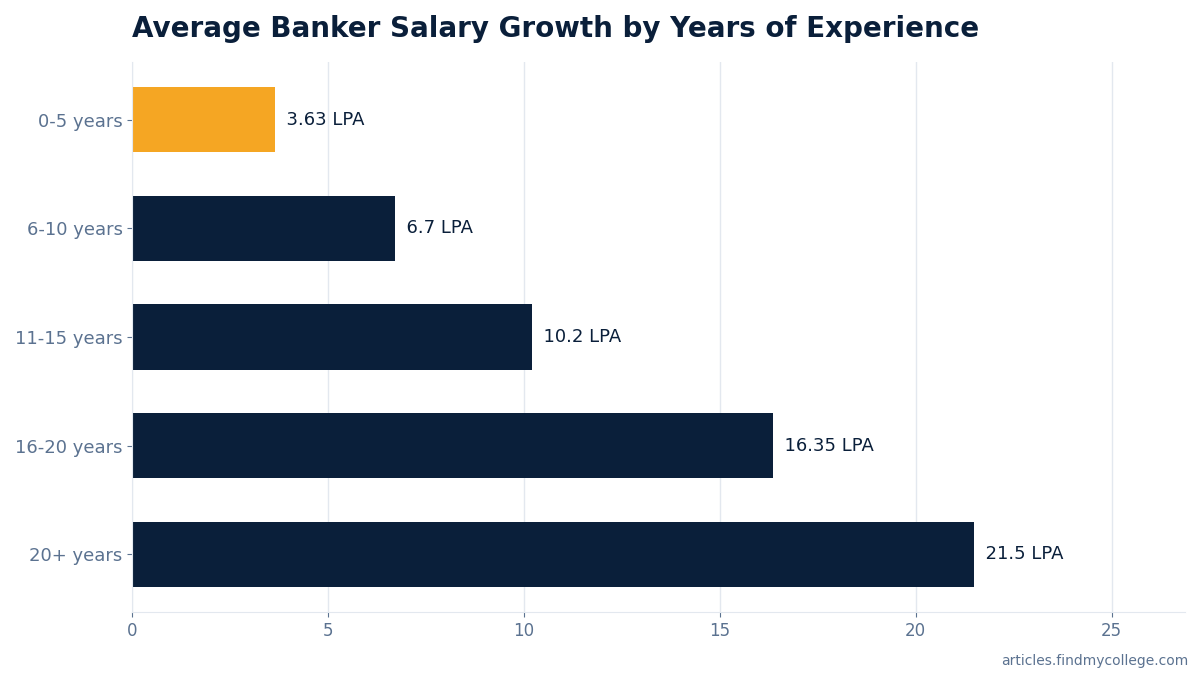
| 0 – 5 years | 3.63 Lakhs |
| 6 – 10 years | 6.70 Lakhs |
| 11 – 15 years | 10.20 Lakhs |
| 16 – 20 years | 16.35 Lakhs |
| 20 years & above | 21.50 Lakhs |
Bankers with over 10 years of experience earn between INR 10 LPA and INR 25 LPA, with average salaries reaching 21.50 Lakhs for those with 20 years & above of service. Entry-level professionals with 0 – 5 years of experience earn an average annual salary of 3.63 Lakhs.
Public Bank Post Name List and Scale Wise Salary Hierarchy
| Grade Code | Post Name | Management Level |
|---|---|---|
| JMGS-I | Assistant Manager / Probationary Officer (PO) | Junior Management |
| MMGS-II | Manager / Deputy Manager | Middle Management |
| MMGS-III | Senior Manager | Middle Management |
| SMGS-IV | Chief Manager | Senior Management |
| SMGS-V | Assistant General Manager (AGM) | Senior Management |
| TEGS-VI | Deputy General Manager (DGM) | Top Executive |
| TEGS-VII | General Manager (GM) | Top Executive |
| Top Management | Chief General Manager / MD / CMD / Chairman | Apex Leadership |
Public Sector Banks pay employees a monthly income of INR 50,000 to INR 70,000 with allowances like HRA, DA, and TA. For instance, SBI PO pay scales range from ₹48,480 to ₹85,920, offering total CTC between ₹14.9 LPA and ₹16.9 LPA.
Banking Careers Salary in Government vs Private Sector
| Bank Name | Entry-Level (1-3 Yrs) | Mid-Level (4-7 Yrs) | Senior-Level (8+ Yrs) |
|---|---|---|---|
| J.P. Morgan Private Bank | ₹10 – ₹15 Lakhs | ₹20 – ₹30 Lakhs | ₹40 – ₹60 Lakhs |
| Deutsche Bank India | ₹8 – ₹14 Lakhs | ₹18 – ₹28 Lakhs | ₹35 – ₹55 Lakhs |
| Standard Chartered Bank | ₹7 – ₹12 Lakhs | ₹15 – ₹25 Lakhs | ₹30 – ₹50 Lakhs |
| Citi India | ₹7 – ₹12 Lakhs | ₹15 – ₹25 Lakhs | ₹30 – ₹50 Lakhs |
| Kotak Mahindra Bank | ₹6 – ₹11 Lakhs | ₹13 – ₹22 Lakhs | ₹28 – ₹45 Lakhs |
| HDFC Bank | ₹5 – ₹10 Lakhs | ₹12 – ₹20 Lakhs | ₹25 – ₹40 Lakhs |
| ICICI Bank | ₹5 – ₹9 Lakhs | ₹12 – ₹18 Lakhs | ₹25 – ₹35 Lakhs |
| Axis Bank | ₹5 – ₹9 Lakhs | ₹11 – ₹19 Lakhs | ₹24 – ₹38 Lakhs |
Public Sector Banks pay INR 50,000 to INR 70,000 monthly with allowances like HRA, DA, and TA, while RBI pays INR 1,00,000 to INR 1,50,000 per month. Senior Private Bankers at Standard Chartered and Citi India earn ₹30 to ₹50 Lakhs per year.
Top Recruiters
Leading recruiters in the public banking sector include the Reserve Bank of India (RBI), State Bank of India (SBI), and Punjab National Bank (PNB). In the private sector, primary employers comprise HDFC Bank, ICICI Bank, Axis Bank, and Kotak Mahindra Bank alongside global firms like J.P. Morgan, Deutsche Bank, Standard Chartered, and Citi India.
For candidates seeking entry-level roles after Class 12, banks recruit for operational support profiles. Stenographer roles in banks offer an average salary of Rs. 3.5 lakhs per year, while Data Entry Operators earn an average annual salary of Rs. 2.3 lakhs.
How to Increase Banking Careers Salary
Acquiring higher academic qualifications directly improves initial placement pay. Candidates holding a postgraduate degree in banking achieve an average compensation of INR 14.02 LPA compared to INR 9.11 LPA for graduates.
Clearing professional certifications administered by IIBF, specifically JAIIB and CAIIB, serves as a direct accelerator for salary increments and fast-track promotion eligibility. Furthermore, building technical expertise in high-demand domains such as Information Security (INR 6.08 LPA) and Accounting (INR 5.52 LPA) provides a distinct salary edge.
How to Start Your Banking Careers Journey: Step by Step
- Register for Entrance Exams: Apply for national bank recruitment exams like IBPS PO, IBPS Clerk, SBI PO, or RBI Grade B Officer within official notification timelines.
- Appear for Preliminary Examination: Take the objective Phase 1 / Prelims exam testing Reasoning, Quantitative Aptitude, English, and General Awareness.
- Clear Main Examination: Qualify Phase 2 / Mains exam involving descriptive and objective papers (such as Economic & Social Issues and Finance & Management for RBI Grade B).
- Attend Group Discussion & Interview Round: Participate in the final selection interview panel round, which carries up to 20% weightage in final merit lists.
- Complete JAIIB / CAIIB Certification Enablers: After joining as a Probationary Officer (JMGS-I), clear IIBF certifications (JAIIB and CAIIB) held in May and November to fast-track increments and promotions.
| What to do | Where | Link |
|---|---|---|
| Compare colleges, fees and cutoffs | Banking Careers colleges in India | findmycollege.com |
FAQs
What is the per month salary of a banker in India?
A fresher banker in India starts with a monthly salary of INR 25,000 to INR 40,000. Employees in Public Sector Banks earn INR 50,000 to INR 70,000 monthly with allowances like HRA, DA, and TA, while experienced bankers earn upwards of INR 50,000 to INR 1,00,000 per month.
What is the salary of an SBI Officer?
State Bank of India Probationary Officers (SBI PO) receive a pay scale ranging from ₹48,480 to ₹85,920, with a total CTC between ₹14.9 LPA and ₹16.9 LPA.
Which government bank job has the highest salary in India?
The Reserve Bank of India (RBI) pays its employees between INR 1,00,000 and INR 1,50,000 per month. The RBI Grade B Officer post offers an average annual salary range of ₹9.4 LPA to ₹18.6 LPA.
Can a bank manager earn 1 lakh per month?
Yes. Branch Managers earn an average annual salary ranging from ₹10 LPA to ₹11.3 LPA. Additionally, experienced bankers with over 10 years of service earn between INR 10 LPA and INR 25 LPA.
Do bankers get pension after retirement?
Bank employees appointed after 2005 do not receive traditional government pensions. Instead, they are entitled to statutory monetary retirement benefits including Provident Fund and Gratuity.
Which private bank job has the highest salary in India?
Investment Banking and Private Banking roles for High-Net-Worth clients pay the highest packages. Senior Private Bankers at global and top private banks like J.P. Morgan, Deutsche Bank, and Standard Chartered earn between ₹30 Lakhs and ₹60 Lakhs per annum.