Banking Management Courses: Duration, Eligibility and Scope
Banking management courses in India range from short-term certificates (2 to 6 months) to 2-year postgraduate degrees such as MBA in Banking and Finance and PGDM in Banking Financial Services.
Students can choose from specialized degree programs, professional accounting charters, and fast-track diplomas based on their academic background and career goals. Below is a detailed guide covering the types of banking management courses, eligibility criteria, course fees, top colleges, expected salaries, and admission steps.
| Parameter | Details |
|---|---|
| PG Degree Duration | 2 Years (4 Semesters) |
| Short-Term Course Duration | 2 Months to 6 Months |
| CA Course Duration | 3.5 Years |
| 12th Aggregate for CA Eligibility | Minimum 50% |
| 12th Aggregate for CMA Eligibility | 40% to 50% |
| Average Salary (MBA Banking & Finance) | INR 7.01 LPA – 8 LPA |
List of Banking Management Courses
| Course Name | Course Type | Duration |
|---|---|---|
| MBA in Banking and Finance | Postgraduate Degree | 2 Years (4 Semesters) |
| M.Com in Banking and Finance | Postgraduate Degree | 2 Years |
| PGDM in Banking Financial Services | Postgraduate Diploma (AICTE Approved) | 2 Years |
| M.Voc in Banking, Stocks, and Insurance | Vocational Master’s Degree | 2 Years |
| Chartered Accountancy (CA) | Professional Course | 3.5 Years |
| Certified Management Accountant (CMA) | Professional Course | Cleared within 3 years of registration |
| Certificate Program in General Insurance (CPGI) | Certificate Program | 6 Months |
| Post Graduate Diploma in Banking Operations | Short-term PG Diploma | 6 Months |
| Post Graduate Diploma in Retail Banking (PGDRB) | Short-term PG Diploma | 3 Months Classwork + 3 Months Internship |
| Advanced Certificate in Banking Laws and Loan Management | Advanced Certificate | 3 Months |
| Professional Programme for Commercial Banking (PPCB) | Professional Certificate | 2 Months |
Options in banking management vary in duration, focus area, and structural design, ranging from 2-year postgraduate degrees to short-term certificates. Professional qualifications like CA and CMA prepare candidates for specialized auditing and accounting roles in banking.
Eligibility and Duration for Banking Programs
Eligibility requirements depend heavily on the qualification level. Entry into professional credentials like Chartered Accountancy (CA) requires a minimum of 50% aggregate in 12th board exams, whereas the Certified Management Accountant (CMA) pathway requires 40% to 50% aggregate in 12th boards. Postgraduate courses such as MBA, M.Com, or AICTE-approved PGDM programs require a completed bachelor’s degree, preferably in B.Com or a relevant discipline.
| Course Name | Minimum Eligibility Requirement | Exam / Certifying Body |
|---|---|---|
| Chartered Accountancy (CA) | 50% aggregate in 12th board exams | ICAI (CPT, IPCC, Final) |
| Certified Management Accountant (CMA) | 40% to 50% aggregate in 12th board exams | ICAI (Foundation, Inter, Final) |
| MBA / M.Com / PGDM in Banking & Finance | Graduation (B.Com or relevant discipline) | University / Institute (e.g. AICTE-approved IPE) |
| Certificate Program in General Insurance (CPGI) | Graduation + performance criteria for placement | IRDA Certification / SBI General Insurance |
Banking Management Course Fees and Top Colleges
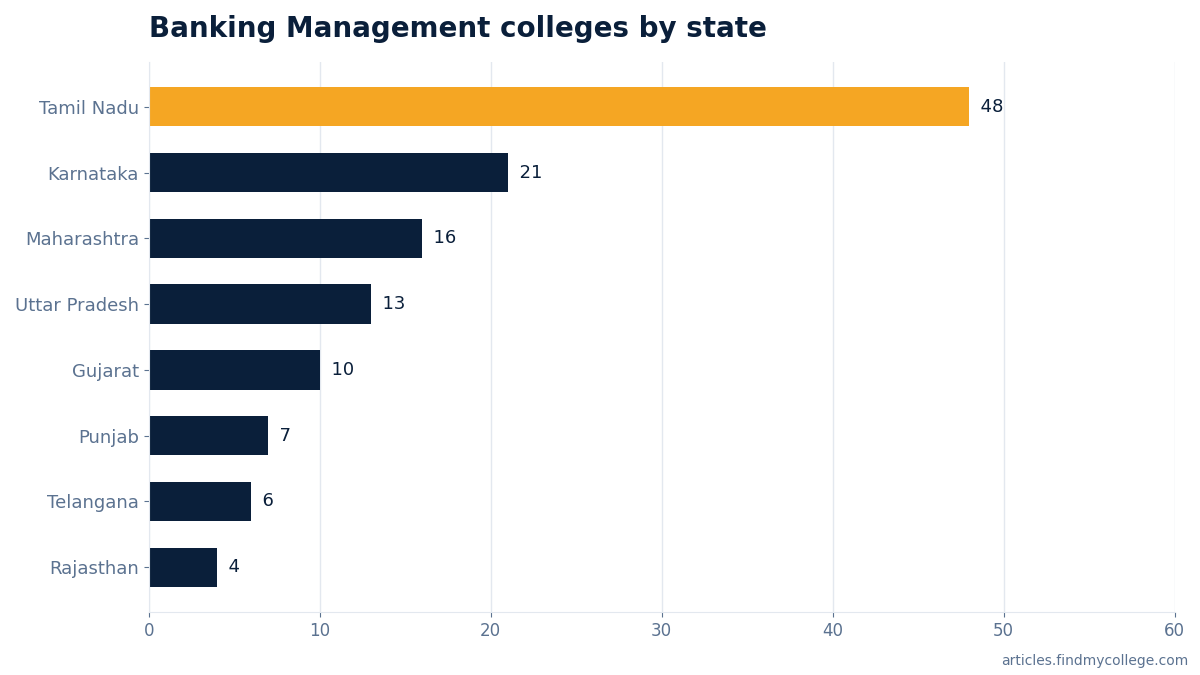
At least 152 colleges offer Banking Management programs in India, comprising at least 5 government colleges and 75 private institutes. Among private colleges with available fee data, the median total course fee is ₹1.11 lakh, with the middle half of colleges charging between ₹68,932 and ₹1.95 lakh. State-wise distribution shows Tamil Nadu leading with 48 colleges, followed by Karnataka with 21, Maharashtra with 16, Uttar Pradesh with 13, Gujarat with 10, and Punjab with 7. The median average placement package across reported colleges stands at 3.34 LPA.
| College | City | Ownership | Total course fee | NIRF rank |
|---|---|---|---|---|
| Banaras Hindu University | Varanasi | Government | ₹5,943 | 6 (Overall, 2025) |
| PSGR Krishnammal College for Women | Coimbatore | Private (aided) | ₹1.12 lakh | 9 (Overall, 2025) |
| Kerala Agricultural University | Thrissur | — | ₹54,480 | 12 (Overall, 2025) |
| Vellore Institute of Technology Vellore | Vellore | — | ₹2.70 lakh | 14 (Overall, 2025) |
| Guru Nanak Dev University | Amritsar | — | ₹45,245 | 48 (Overall, 2023) |
| Ethiraj College for Women | Chennai | Private (aided) | ₹1.26 lakh | 64 (Overall, 2025) |
| Goswami Ganesh Dutt Sanatan Dharama College | Chandigarh | Private | ₹85,020 | 70 (Overall, 2025) |
| Gujarat University | Ahmedabad | Government | — | 74 (Overall, 2025) |
| Guru Nanak College Chennai | Chennai | Private (aided) | ₹1.95 lakh | 89 (Overall, 2024) |
| College | City | Ownership | Total course fee | Average package |
|---|---|---|---|---|
| Siva Sivani Institute of Management | Hyderabad | Private | ₹8.40 lakh | 5.59 LPA |
| Accurate Institute of Management and Technology | Greater Noida | Private (aided) | ₹6.25 lakh | 4.35 LPA |
| Thiruthangal Nadar College | Chennai | Private | ₹1.11 lakh | 3.34 LPA |
| Pachaiyappa’s College | Chennai | Private (aided) | — | 3.02 LPA |
| Ethiraj College for Women | Chennai | Private (aided) | ₹1.26 lakh | 2.94 LPA |
| AM Jain College | Chennai | Private (aided) | ₹1.78 lakh | 2.58 LPA |
| City | Colleges | Fee range | Well-known options |
|---|---|---|---|
| Chennai | 28 | ₹48,000 – ₹6.00 lakh | Guru Nanak College Chennai, Ethiraj College for Women |
| Bangalore | 16 | ₹1.00 lakh – ₹11.10 lakh | Surana College, SJES College of Management Studies |
| Mumbai | 7 | ₹51,623 – ₹84,200 | HR College of Commerce and Economics, Prin. L. N. Welingkar Institute of Management Development & Research |
| Pune | 6 | ₹59,985 – ₹10.35 lakh | Dr. D.Y. Patil Arts, Science and Commerce College Pimpri, Dr. D. Y. Patil Unitech Arts, Commerce and Science College Tathawade |
| Surat | 4 | ₹1.27 lakh – ₹1.72 lakh | Sarvajanik University, Vidhyadeep Institute of Business Administration |
| Hyderabad | 4 | ₹7.00 lakh – ₹9.50 lakh | Institute of Public Enterprise, Siva Sivani Institute of Management |
| Coimbatore | 4 | ₹1.12 lakh – ₹1.50 lakh | PSGR Krishnammal College for Women, Nehru Group of Institutions |
| Greater Noida | 3 | ₹4.03 lakh – ₹10.20 lakh | Accurate Institute of Management and Technology, Lloyd Business School |
Career Options and Salary in Banking
| Program / Qualification | Primary Roles & Employment Sectors | Expected Salary / Job Outlook |
|---|---|---|
| MBA in Banking and Finance | Private & public sector banks, central banking, regulatory agencies | INR 7.01 LPA – 8 LPA average |
| Chartered Accountant (CA) | Bank auditing, tax & accounting operations | One of the highest-paid jobs in India |
| Certificate Program in General Insurance (CPGI) | Insurance operations, General Insurance roles | Assured placement with SBI General Insurance Co. Ltd. |
| B.Com | Sales executive for loans, insurance, and mortgages | Lucrative entry-level job roles in leading banks |
An MBA in Banking and Finance offers an average starting salary between INR 7.01 LPA and 8 LPA, while CPGI provides assured placement with SBI General Insurance Co. Ltd. Roles for graduates range from sales executives for loans, insurance, and mortgages to bank auditing and accounting operations.
How to Choose the Right Banking Course
- 2-Year Postgraduate Degrees: Programs like MBA or M.Com in Banking and Finance focus on systematic study of banking, finance, and modern economics.
- Professional Qualifications: CA takes 3.5 years (requiring 50% aggregate in 12th), while CMA requires 40% to 50% aggregate in 12th boards and three stages of exams cleared within three years of registration.
- Short-Term Certification: The Certificate Program in General Insurance (CPGI) runs for 6 months and offers assured placement with SBI General Insurance Co. Ltd. upon meeting performance criteria and achieving IRDA Certification.
Selecting the right program depends on your eligibility, timeline, and career ambitions. Short-term certifications offer fast-track entry, while degree and professional qualifications build deeper domain expertise.
How to Apply for Banking Management Admission in 2026: Step by Step
- Check eligibility criteria: Verify minimum board marks (e.g., 50% for CA, 40%-50% for CMA) or hold a relevant bachelor’s degree like B.Com for PG management courses.
- Register for professional entrance exams: For CA, register with ICAI for CPT, IPCC, and Final exams; for CMA, register for Foundation, Inter, and Final stage examinations.
- Apply to postgraduate banking programs: Apply for 2-year programs like MBA in Banking & Finance, M.Com, or AICTE-approved PGDM in Banking Financial Services.
- Complete practical training and internships: Fulfill required practical internship modules (e.g., 3-month internships in PGDRB/Banking Operations) and clear IRDA certification for insurance sector roles.
| What to do | Where | Link |
|---|---|---|
| Compare colleges, fees and cutoffs | Banking Management colleges in India | findmycollege.com |
FAQs
What are the popular banking management courses after B.Com?
Popular courses after B.Com include MBA in Banking and Finance, M.Com in Banking and Finance, PGDM in Banking Financial Services, CPGI, PG Certificate in Investment Banking, CA, CMA, and short-term PG diplomas in Retail Banking or Banking Operations.
What is the salary after completing an MBA in Banking and Finance?
Graduates completing an MBA in Banking and Finance can expect an average starting salary ranging between INR 7.01 LPA and 8 LPA, working in public/private sector banks, central banking, or regulatory agencies.
What is the eligibility for Chartered Accountancy (CA) and CMA courses?
For CA, students need a minimum of 50% aggregate in 12th board exams. For CMA, eligibility requires 40% to 50% aggregate in 12th board exams. Both require clearing stage-wise ICAI examinations.
What is the duration of short-term banking diploma courses?
Short-term banking programs range from 2 to 6 months.
Which course offers assured placement in the insurance banking sector?
The Certificate Program in General Insurance (CPGI) is a 6-month course that provides assured placement with SBI General Insurance Co. Ltd. upon meeting performance criteria and clearing IRDA certification.