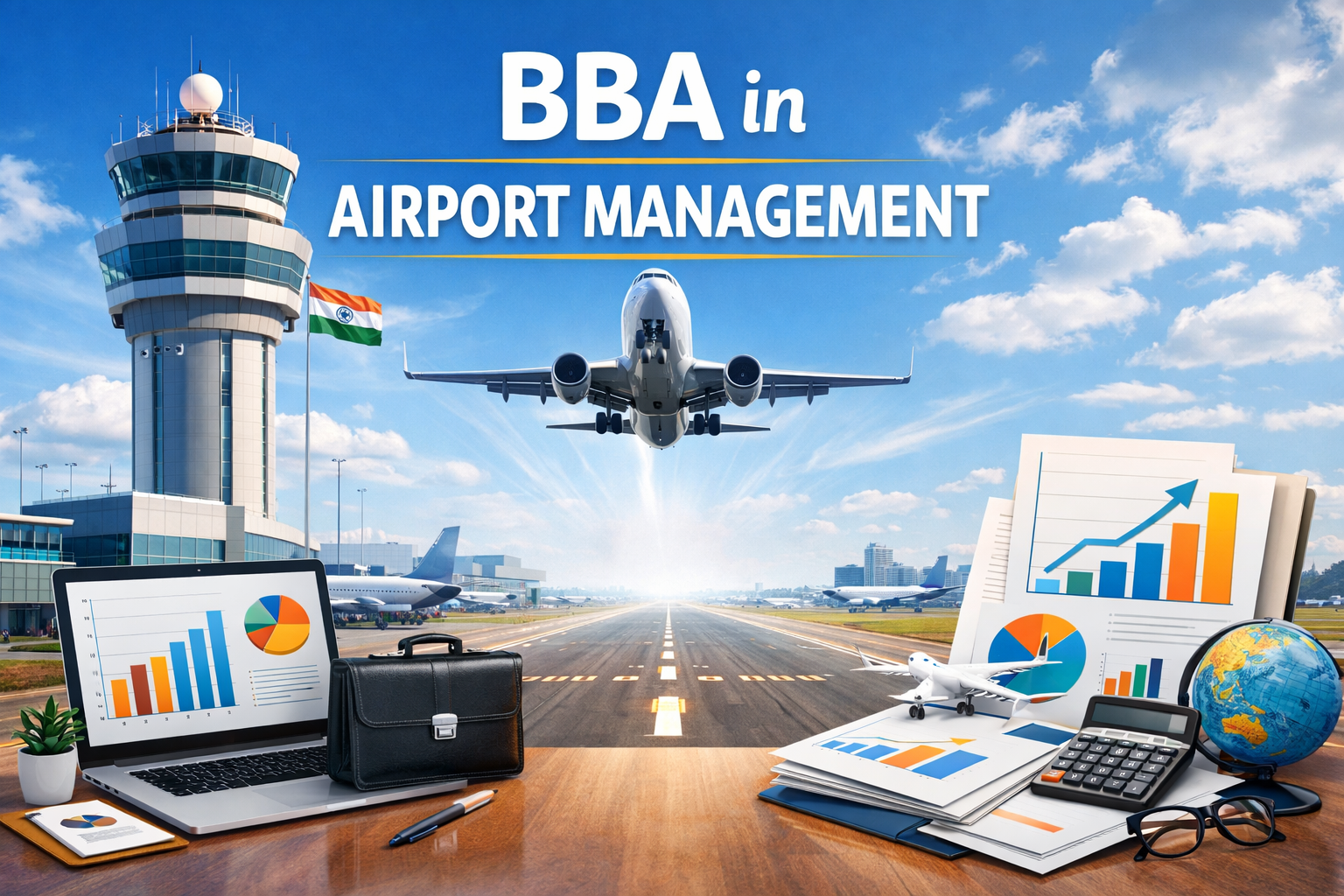
BBA in Airport Management: Course Details, Colleges, Fees, and Career Prospects in India
BBA in Airport Management is a professional undergraduate program in India designed for students aiming for a career in the aviation and airport industry. This course offers full knowledge of airport operations, airline management, logistics, safety procedures, and customer service.
With India’s aviation sector growing rapidly, a BBA in Airport Management opens doors to careers in airport authorities, airlines, cargo handling, and aviation administration. Combining theoretical learning with practical exposure, this program prepares students for diverse roles in the aviation industry.
In this blog, we will cover course details, top colleges, fees, and career prospects in India.
BBA in Airport Management: Overview
The BBA in Airport Management is a 3-year undergraduate program designed to provide students with the knowledge and skills to manage airport operations, ground staff, and aviation security. The curriculum offers a full understanding of the aviation industry, including airport planning, aviation law, and air traffic control. To be eligible, candidates need a 10+2 qualification with a minimum of 50% marks. The average annual course fees range from INR 50,000 to INR 2,00,000. Graduates can pursue careers in airport operations, ground staff management, and aviation security.
BBA in Airport Management is a three-year undergraduate program that focuses on developing managerial and operational skills for the aviation and airport sector. The course combines core business management principles with specialized knowledge of airport operations, airline management, logistics, cargo handling, customer service, and safety protocols. Students also learn about aviation regulations, airport security, and the latest technology used in airport management.
The program is designed to prepare graduates for a variety of roles in airport authorities, airlines, ground handling services, cargo management, and aviation administration. With the rapid growth of the aviation industry in India, demand for trained professionals in airport management is increasing. This makes the BBA in Airport Management a promising choice for students seeking a dynamic career in aviation.
| Course Feature | Details |
|---|---|
| Course Name | BBA in Airport Management |
| Duration | 3 years (6 semesters) |
| Eligibility | 10+2 in any stream with minimum 50% marks (varies by college) |
| Course Type | Undergraduate Program |
| Specialization | Airport Operations, Airline Management, Logistics, Customer Service |
| Top Skills Gained | Communication, Problem-Solving, Management, Aviation Safety, Logistics |
| Career Opportunities | Airport Manager, Ground Handling Executive, Cargo Manager, Airline Admin |
| Top Recruiters | Airports Authority of India (AAI), Indigo, Air India, GMR Airports, Cargo Companies |
| Average Fees | ₹1–3 Lakh per year (varies by college) |
| Mode of Study | Regular / Full-time |
BBA in Airport Management: Eligibility Criteria
To pursue a Bachelor of Business Administration (BBA) in Airport Management, candidates must meet the following standard eligibility requirements (these may vary slightly by institution):
Educational Qualification
- Must have passed 10+2 (Class 12) or equivalent examination from a recognized board (CBSE, ICSE, State Board, or equivalent).
- Open to students from any stream — Science, Commerce, or Arts (no specific subject combination required, though English is often preferred).
Minimum Marks Requirement
- Minimum aggregate marks in Class 12: 45% to 60% (most colleges require 50% or above; some relax to 45% for reserved categories or specific institutions).
Age Limit
- Typically 17 to 25 years at the time of admission (upper age limit may apply in certain programs).
Other Requirements
- Medical Fitness — Candidates should be medically fit (a medical certificate may be required in some colleges).
- Good command over English (written and spoken) is essential, as the course and industry involve strong communication skills.
Admission Process (Common Pathways)
- Merit-based — Based on Class 12 marks.
- Entrance Exam-based — Some institutions accept scores from exams like:
- AME CET
- SET
- IPU CET
- CUET
- AIMA UGAT
- Institution-specific tests
- Personal Interview / Group Discussion may also be conducted.
Note: Exact eligibility criteria, minimum percentage, and selection process can differ from one college to another. Always check the official website or prospectus of the specific institute you are applying to for the most accurate and updated information.
BBA in Airport Management: Admission Process
Getting admission into a BBA in Airport Management program requires careful planning and understanding of eligibility, entrance exams, and selection procedures. Here is a detailed step-wise guide to help aspirants navigate the admission process smoothly:
Step 1: Check Eligibility
Before applying, ensure you meet the basic eligibility criteria:
-
Completion of 10+2 (any stream) from a recognized board.
-
Minimum marks usually 50–60% aggregate, though it may vary by college.
-
Some universities require a good command of English, as communication skills are crucial in the aviation and airport industry.
-
Candidates with subjects like Commerce, Economics, or Business Studies may have an added advantage, but it is not mandatory.
Step 2: Research Colleges and Programs
Not all colleges offer BBA in Airport Management, so proper research is essential:
-
Identify reputed universities and colleges offering the course.
-
Compare course curriculum, fees, placements, internship opportunities, and faculty.
-
Check if the college has tie-ups with airlines or airport authorities, as practical exposure is important for this field.
Step 3: Application Process
-
Most colleges offer online and offline application forms.
-
Carefully fill the form with personal, academic, and contact details.
-
Upload documents such as:
-
10th and 12th mark sheets
-
Transfer certificate
-
Passport-size photographs
-
Identity proof (Aadhaar card, passport, etc.)
-
-
Pay the application fee, which may vary from ₹500–₹2000 depending on the college.
Step 4: Personal Interview / Group Discussion
-
Shortlisted candidates may be called for a personal interview or group discussion.
-
Purpose: Assess communication skills, confidence, problem-solving ability, and interest in the aviation sector.
-
Tips: Dress professionally, stay updated with aviation news, and practice answers for common interview questions related to airports and airlines.
Step 5: Merit List / Selection
-
Colleges release a merit list based on:
-
12th marks (for merit-based admission)
-
Entrance exam scores
-
Performance in interview or group discussion
-
-
Selected candidates receive an admission offer letter, usually via email or the college portal.
Step 6: Seat Confirmation and Fee Payment
-
To confirm the seat, candidates must pay the course fee within the given deadline.
-
Complete document verification, which usually includes:
-
10th & 12th mark sheets
-
Transfer certificate
-
Passport-size photographs
-
ID proof
-
-
Some colleges may also require a caution deposit or hostel fee, if applicable.
Entrance Exams for BBA in Airport Management Admission in India
Admission to a BBA in Airport Management program often requires entrance exams that assess a candidate’s aptitude, knowledge, and skills. Common entrance exams include national-level exams like CUET and state-level exams. Some colleges also conduct their own entrance exams. Some of these are:
| Exam Name | Conducting Body | Exam Type | Eligibility |
|---|---|---|---|
| CUET | NTA | National Level | 10+2 with minimum 50% marks |
| College-Specific Exams | Respective Colleges | College Level | Varies by college, typically 10+2 with minimum 50% marks |
| JEE Main | NTA | National Level | 10+2 with Physics, Chemistry, Math; minimum 75% aggregate |
| State-Level Exams | Respective State Governments | State Level | 10+2 with minimum 50% marks, domicile requirements may apply |
| UPSEE | AKTU | State Level | 10+2 with minimum 45% marks for general category, 40% for reserved categories |
| COMEDK | COMEDK | State Level | 10+2 with minimum 45% marks for general category, 40% for reserved categories |
| IPU CET | GGSIPU | University Level | 10+2 with minimum 50% marks, English as a compulsory subject |
BBA in Airport Management: Syllabus
The BBA in Airport Management program is a 3-year undergraduate course divided into six semesters. It is designed to give students a strong foundation in business management while equipping them with specialized knowledge in airport operations, airline management, logistics, and customer service. Along with theory, the syllabus emphasizes practical learning through case studies, internships, and projects, helping students gain real-world experience in the aviation sector.
Below is a semester-wise breakdown of core subjects:
| Semester | Core Subjects |
|---|---|
| Semester 1 | Principles of Management, Business Communication, Business Economics, Introduction to Aviation, Computer Applications |
| Semester 2 | Financial Accounting, Business Mathematics & Statistics, Organizational Behavior, Fundamentals of Airport Operations |
| Semester 3 | Marketing Management, Airline Management, Human Resource Management, Airport Safety & Security |
| Semester 4 | Operations Management, Aviation Law & Regulations, Cargo and Logistics Management, Customer Service Management |
| Semester 5 | Strategic Management, Airport Planning & Design, Aviation Finance, Internship/Project Work |
| Semester 6 | Research Methodology, Airport Operations Management, Airline Scheduling & Planning, Dissertation/Project Submission |
BBA in Airport Management: Exam Pattern
The exam pattern of BBA in Airport Management is designed to evaluate both theoretical knowledge and practical understanding of airport operations, airline management, and business administration. The course typically spans six semesters over three years, with evaluations conducted at the end of each semester. Students are assessed through a combination of written exams, practical assessments, projects, presentations, and internal assessments.
Understanding the exam pattern is important for students to plan their preparation and excel in both theory and practical components of the course.
1. Mode of Examination
-
Exams are usually offline (pen-and-paper), though some universities conduct online assessments.
-
Internal assessments, quizzes, assignments, and presentations contribute to the final grade.
2. Marking Scheme
-
Semester-end exams: 70–80% of total marks
-
Internal assessments: 20–30% of total marks
-
Internal assessments may include:
-
Assignments and case studies
-
Presentations and group discussions
-
Quizzes and practical exercises
-
3. Types of Questions
-
Objective Questions: Multiple Choice Questions (MCQs) on core management and aviation concepts.
-
Subjective Questions: Short answer and long answer questions to assess conceptual understanding.
-
Practical Questions / Case Studies: Real-life airport or airline scenarios to test problem-solving and analytical skills.
4. Semester-wise Exam Pattern
| Semester | Exam Type | Weightage | Focus Areas |
|---|---|---|---|
| Semester 1 | Written Exam + Assignments | 80% + 20% | Principles of Management, Business Communication, Introduction to Aviation, Computer Applications |
| Semester 2 | Written Exam + Practical / Projects | 75% + 25% | Financial Accounting, Business Math & Statistics, Fundamentals of Airport Operations |
| Semester 3 | Written Exam + Case Studies | 70% + 30% | Marketing Management, Airline Management, HR Management, Airport Safety & Security |
| Semester 4 | Written Exam + Presentations | 70% + 30% | Operations Management, Aviation Law, Cargo & Logistics, Customer Service |
| Semester 5 | Written Exam + Internship Evaluation | 60% + 40% | Strategic Management, Airport Planning, Aviation Finance, Internship / Project Work |
| Semester 6 | Dissertation / Project + Viva | 50% + 50% | Airport Operations Management, Airline Scheduling & Planning, Research Methodology, Dissertation |
Skills Required for BBA in Airport Management Students
A career in airport management demands a combination of management knowledge, technical understanding, and soft skills. To excel in the aviation and airport sector, students must develop a diverse skill set that helps them handle operations efficiently and provide excellent customer service.
1. Communication Skills
-
Effective verbal and written communication is essential for interacting with passengers, airline staff, and airport authorities.
-
Clear communication ensures smooth coordination in airport operations, customer service, and logistics management.
2. Organizational and Management Skills
-
Ability to plan, organize, and manage airport activities is critical.
-
Students must handle tasks such as scheduling flights, coordinating ground staff, and managing cargo operations efficiently.
3. Problem-Solving and Analytical Skills
-
Airport managers often face unexpected challenges such as flight delays, passenger issues, or security concerns.
-
Strong analytical and problem-solving abilities help students make quick and effective decisions.
4. Attention to Detail
-
Ensuring safety, security, and operational efficiency requires meticulous attention to detail.
-
Students must monitor processes carefully, including baggage handling, check-ins, and compliance with aviation regulations.
5. Customer Service Skills
-
Airports are customer-centric environments, making hospitality and interpersonal skills essential.
-
Students should be able to handle passenger queries, resolve complaints, and provide a positive travel experience.
6. Teamwork and Leadership
-
Airport operations involve working with pilots, ground staff, security personnel, and airline executives.
-
Ability to lead teams, coordinate tasks, and collaborate effectively is vital for smooth airport functioning.
7. Knowledge of Aviation and Technology
-
Familiarity with airport management software, aviation regulations, and modern technology is important.
-
Students should stay updated on industry trends, safety protocols, and operational innovations.
8. Time Management Skills
-
Airports operate 24/7, so managing schedules, deadlines, and multiple tasks simultaneously is crucial.
-
Strong time management ensures punctual operations and better efficiency.
Career Scope After BBA in Airport Management
A BBA in Airport Management opens up a wide range of career opportunities in India and abroad, thanks to the rapid growth of the aviation and airport sector. Graduates are equipped with management knowledge, aviation expertise, and operational skills, making them suitable for diverse roles in airlines, airports, cargo handling, and aviation-related organizations.
1. Airport Manager / Operations Manager
-
Responsible for managing daily airport operations, including passenger services, baggage handling, and coordination between airlines and ground staff.
-
Ensures safety, security, and smooth functioning of the airport.
2. Ground Handling Executive
-
Handles check-ins, boarding procedures, baggage handling, and customer service at the airport.
-
Works closely with airline staff to ensure efficient operations on the ground.
3. Cargo and Logistics Manager
-
Manages cargo shipments, documentation, logistics, and warehouse operations at airports.
-
Ensures timely movement of goods while complying with aviation safety standards.
4. Airline Operations Coordinator
-
Coordinates flight schedules, staff allocation, and passenger services for airlines.
-
Monitors on-time performance, flight disruptions, and customer satisfaction.
5. Airport Security Manager
-
Supervises security personnel and protocols, ensuring compliance with aviation safety regulations.
-
Implements emergency response plans and risk management strategies.
6. Customer Service Executive
-
Handles passenger inquiries, complaints, and assistance at ticket counters, lounges, and boarding gates.
-
Plays a key role in enhancing passenger experience.
7. Aviation Consultant
-
Advises airports, airlines, or government bodies on operations, efficiency, safety, and expansion projects.
-
Helps improve airport processes and overall performance.
8. Higher Studies / MBA in Aviation Management
-
Graduates can pursue an MBA in Aviation Management, Airport Management, or Logistics for higher positions.
-
Specialization enhances career growth, managerial roles, and salary prospects.
Salary After BBA in Airport Management
A BBA in Airport Management opens the door to a variety of career opportunities in the aviation and airport sector. The salary depends on factors like job role, experience, employer, and location. While fresh graduates may start with entry-level roles, career growth can be rapid for those who gain experience, pursue internships, and take higher studies or professional certifications.
1. Entry-Level Salary
-
Fresh graduates typically start as Ground Handling Executives, Customer Service Executives, or Operations Assistants.
-
The average starting salary ranges from ₹3 lakh to ₹5 lakh per annum.
-
Entry-level roles offer exposure to airport operations, logistics, and customer management.
2. Mid-Level Salary
-
After 3–5 years of experience, professionals can move into Airport Manager, Cargo Manager, or Airline Operations Coordinator positions.
-
The average mid-level salary ranges from ₹5 lakh to ₹10 lakh per annum.
-
At this stage, employees are responsible for planning, team management, and operational efficiency.
3. Senior-Level Salary
-
With 7–10+ years of experience, professionals can take up senior managerial roles in airports, airlines, or aviation consultancies.
-
Positions include Senior Airport Manager, Aviation Consultant, or Security Manager.
-
The average salary for senior roles ranges from ₹10 lakh to ₹20 lakh per annum, with high potential in metro city airports or international airlines.
4. Factors Affecting Salary
-
Employer type: Private airports, government authorities (AAI), or airlines may offer different pay scales.
-
Location: Salaries in metro cities like Delhi, Mumbai, or Bangalore are generally higher.
-
Skill set and certifications: Additional certifications in airport operations, logistics, or aviation safety can significantly increase earning potential.
-
Higher studies: An MBA in Aviation Management or related fields can boost salary and open top managerial roles.
| Job Role | Experience Level | Average Salary (INR per annum) | Key Responsibilities |
|---|---|---|---|
| Ground Handling Executive | Entry-Level (0–2 yrs) | ₹3–5 Lakh | Handling check-ins, baggage, and passenger services |
| Customer Service Executive | Entry-Level (0–2 yrs) | ₹3–5 Lakh | Assisting passengers, resolving queries and complaints |
| Cargo & Logistics Manager | Mid-Level (3–5 yrs) | ₹5–8 Lakh | Managing cargo operations, documentation, and logistics |
| Airline Operations Coordinator | Mid-Level (3–5 yrs) | ₹5–10 Lakh | Coordinating flight schedules, staff allocation, and operations |
| Airport Manager / Operations Manager | Senior-Level (5–10 yrs) | ₹10–15 Lakh | Managing daily airport operations and team coordination |
| Aviation Consultant / Senior Manager | Senior-Level (7–10+ yrs) | ₹12–20 Lakh | Advising on airport efficiency, safety, and operational improvements |
Higher Studies After BBA in Airport Management
After completing a BBA in Airport Management, students have multiple options for higher studies in aviation, management, and logistics, which can enhance their knowledge, skills, and career prospects. Pursuing further studies not only improves job opportunities but also opens doors to higher managerial positions, specialized roles, and international careers.
1. MBA in Airport / Aviation Management
-
An MBA in Airport or Aviation Management helps students gain advanced managerial skills tailored for the aviation sector.
-
Topics include airport operations, airline management, aviation law, logistics, and strategic planning.
-
Graduates can aim for senior-level managerial roles, such as Airport Manager, Airline Operations Manager, or Aviation Consultant.
2. MBA in Logistics and Supply Chain Management
-
Focuses on cargo handling, transportation, warehouse management, and supply chain strategies.
-
Ideal for students interested in the cargo and logistics segment of airports.
-
Increases earning potential and positions graduates for logistics manager or supply chain analyst roles.
3. Postgraduate Diploma in Aviation / Airport Management
-
Short-term programs (6 months to 1 year) designed for practical exposure to airport and airline operations.
-
Provides specialized knowledge in areas like airport safety, ground handling, and passenger services.
-
Suitable for those seeking hands-on skills quickly without pursuing a full MBA.
4. Certification Courses in Aviation / Airport Operations
-
Short-term certifications offered by institutes like IATA, GMR Aviation Academy, or Amity University.
-
Focus on airline ticketing, airport security, ground handling, and cargo management.
-
Helpful for upskilling and improving employability while working.
5. Higher Studies Abroad
-
Students may pursue Master’s programs in Aviation Management, Air Transport Management, or International Airport Management abroad.
-
Countries like USA, UK, Australia, and Singapore offer specialized courses with global exposure and internship opportunities.
-
Opens doors to international aviation careers and higher salary packages.
6. Research & Academic Careers
-
Graduates can opt for research programs or MPhil/PhD in Aviation Management, Logistics, or Business Administration.
-
Leads to careers in academia, consultancy, or aviation policy-making organizations.
| Higher Study Option | Duration | Focus Area / Specialization | Career Benefits |
|---|---|---|---|
| MBA in Airport / Aviation Management | 2 years | Airport operations, Airline management, Aviation law | Senior managerial roles, Airport Manager, Airline Operations |
| MBA in Logistics & Supply Chain Management | 2 years | Cargo handling, Supply chain, Transportation logistics | Cargo Manager, Logistics Executive, Supply Chain Analyst |
| Postgraduate Diploma in Aviation / Airport Management | 6 months – 1 year | Airport operations, Ground handling, Passenger services | Practical skills, Entry-level airport jobs |
| Certification Courses (IATA, GMR, Amity, etc.) | Few weeks – 6 months | Airline ticketing, Cargo management, Safety & Security | Skill enhancement, Improved employability |
| Master’s Abroad (Aviation / Airport Management) | 1–2 years | International airport operations, Air transport, Global aviation policies | International careers, Higher salary packages |
| Research Programs (MPhil / PhD) | 2–5 years | Aviation management, Business administration, Logistics | Academic roles, Consultancy, Policy-making |
Top Colleges for BBA in Airport Management in India
India offers several reputed colleges and universities for BBA in Airport Management. These institutions provide a mix of theoretical knowledge, practical training, and industry exposure. Here are some top colleges:
| College / University | Location | Average Fees (Per Year) | Highlights |
|---|---|---|---|
| Amity University | Noida, Uttar Pradesh | ₹2–3 Lakh | Offers internships with airlines and airports, industry-oriented curriculum |
| Pearl Academy | Delhi / Mumbai | ₹2–3 Lakh | Focuses on practical aviation training, airport operations modules |
| Manipal University | Manipal, Karnataka | ₹2–3.5 Lakh | Strong industry tie-ups, exposure to aviation management software |
| KIIT University | Bhubaneswar, Odisha | ₹1.5–2.5 Lakh | Offers specialized airport operations courses, internship opportunities |
| GD Goenka University | Gurugram, Haryana | ₹2–3 Lakh | Emphasis on airport management, logistics, and airline operations |
| Chandigarh University | Chandigarh | ₹1.5–2 Lakh | Provides hands-on training and airport visits, good placement support |
| Lovely Professional University (LPU) | Jalandhar, Punjab | ₹1.8–2.5 Lakh | Offers modern infrastructure and industry-oriented curriculum |
| Indian Institute of Airport Management (IIAM) | New Delhi | ₹2–3 Lakh | Specialized institute focusing on airport management and aviation studies |
Advantages of Studying BBA in Airport Management
Studying BBA in Airport Management provides students with a unique blend of business management skills and aviation-specific knowledge, making it a promising career path. Here are the key advantages in detail:
High Demand in Aviation Sector
-
-
With the rapid expansion of airports, airlines, and cargo operations in India, trained professionals are in high demand.
-
The growing aviation industry ensures job stability and long-term career opportunities for graduates.
-
Diverse Career Opportunities
-
-
Graduates can pursue multiple roles, such as Airport Manager, Ground Handling Executive, Cargo Manager, Airline Operations Coordinator, and Customer Service Executive.
-
The course prepares students for both administrative and operational roles in the airport and airline sectors.
-
Practical and Industry-Oriented Learning
-
-
The curriculum includes internships, industrial visits, and hands-on projects, allowing students to gain real-world exposure.
-
Learning by doing helps students understand airport operations, safety protocols, and passenger services effectively.
-
Professional Skill Development
-
-
Students develop essential soft skills like communication, leadership, teamwork, and problem-solving, which are highly valued in the aviation industry.
-
Technical skills such as logistics management, airline scheduling, and airport software usage are also acquired.
-
Pathway to Higher Studies
-
-
After BBA, students can pursue MBA in Aviation Management, Logistics, or Airport Management, enhancing their career prospects and salary potential.
-
Attractive Salary Packages
-
-
Entry-level roles offer salaries around ₹3–5 LPA, while mid-level and senior-level positions can range from ₹10–20 LPA, depending on experience and employer.
-
Opportunities for International Careers
-
-
Aviation is a global industry, so graduates may find opportunities abroad in international airports, airlines, and aviation consultancies.
-
Dynamic and Exciting Work Environment
-
-
Working in airports or airlines exposes professionals to a fast-paced, diverse, and interactive environment, making it an exciting career choice.
-
Challenges in BBA in Airport Management
While a BBA in Airport Management is a highly rewarding course that offers excellent career opportunities in the aviation industry, students and professionals may encounter several challenges throughout the program and their career. Understanding these challenges helps aspirants prepare better, manage expectations, and develop the skills required for success.
1. Highly Competitive Industry
-
The aviation and airport management sector is rapidly expanding, attracting numerous graduates every year.
-
Positions at top airports, airlines, and multinational aviation companies are limited, making the selection process highly competitive.
-
Students must excel academically, complete internships, and acquire certifications to stand out in the job market.
2. Demanding Work Schedule
-
Airports and airlines operate 24 hours a day, 7 days a week, including weekends and holidays.
-
Professionals may have to work rotational shifts, night duties, or extended hours, which can be physically and mentally demanding.
-
Students must be prepared for high-pressure work environments, particularly in operational roles.
3. Need for Continuous Skill Upgradation
-
The aviation industry is fast-evolving, with new technologies, airport management software, and safety protocols introduced frequently.
-
Professionals are expected to keep learning about modern aviation practices, software systems, and international aviation regulations.
-
Without continuous learning, it can be difficult to stay relevant and progress in the career.
4. High Responsibility Roles
-
Graduates often step into roles like Airport Manager, Operations Coordinator, or Cargo Manager, which involve managing teams, ensuring safety, and coordinating complex operations.
-
A single mistake can affect passenger safety, operational efficiency, or airport security, adding stress and responsibility.
5. Emphasis on Practical Experience
-
Employers prefer candidates with hands-on experience through internships or industrial training.
-
Students who focus only on theoretical learning may struggle to secure good placements or high-profile internships.
-
Practical training in airport operations, ground handling, and airline coordination is essential to bridge the gap between theory and real-world practice.
6. Stressful Customer Interactions
-
Working in airports or airlines involves constant interaction with passengers, who may have complaints about delays, baggage issues, or flight cancellations.
-
Professionals need strong interpersonal and problem-solving skills to handle situations calmly and maintain customer satisfaction.
7. Travel and Relocation Requirements
-
Many jobs in airport management require frequent travel or relocation, particularly for operations and managerial roles.
-
While this can provide exposure, it may be challenging for individuals seeking stability or those with personal constraints.
8. Pressure of Regulatory Compliance
-
Aviation is a highly regulated industry, and employees must adhere to strict rules regarding safety, security, and airport operations.
-
Non-compliance can lead to legal issues or safety incidents, creating constant pressure to follow protocols accurately.
9. Stressful Situations During Emergencies
-
Airports may face emergencies such as flight delays, technical failures, weather disruptions, or security threats.
-
Professionals must remain calm, make quick decisions, and coordinate effectively, which can be mentally taxing.
10. High Expectations from Employers
-
Employers in the aviation industry expect graduates to be multi-skilled, adaptive, and efficient from day one.
-
Students must balance knowledge of airport operations, airline management, customer service, and logistics to meet these expectations.
FAQs
1. What is BBA in Airport Management?
BBA in Airport Management is a three-year undergraduate program that teaches students about airport operations, airline management, logistics, customer service, safety protocols, and business management skills in the aviation sector.
2. What is the eligibility criteria for BBA in Airport Management?
Candidates must have completed 10+2 from a recognized board with minimum 50–60% marks. English proficiency is often required. Some colleges may also conduct entrance exams for selection.
3. How long is the BBA in Airport Management course?
The course duration is 3 years, divided into six semesters. Each semester includes theory, practical training, and internships to provide full knowledge of airport and airline operations.
4. Which are the top colleges for BBA in Airport Management in India?
Top colleges include Amity University (Noida), Pearl Academy (Delhi/Mumbai), Manipal University (Karnataka), KIIT University (Bhubaneswar), GD Goenka University (Gurugram), Chandigarh University, LPU (Punjab), and IIAM (New Delhi).
5. What subjects are included in the BBA Airport Management syllabus?
Core subjects include Principles of Management, Airport Operations, Airline Management, Cargo & Logistics, Customer Service, Aviation Law, Strategic Management, Operations Management, and Internship/Project work.
6. What career options are available after BBA in Airport Management?
Graduates can work as Airport Manager, Ground Handling Executive, Cargo Manager, Airline Operations Coordinator, Customer Service Executive, Aviation Consultant, or pursue higher studies like MBA in Aviation Management.
7. What is the average salary after BBA in Airport Management?
Entry-level salaries range from ₹3–5 LPA. Mid-level roles earn ₹5–10 LPA, and senior managerial positions or specialized roles can pay ₹10–20 LPA, depending on experience and employer.
8. Can I pursue higher studies after BBA in Airport Management?
Yes, graduates can pursue MBA in Airport/Aviation Management, Logistics & Supply Chain Management, PG Diplomas, certifications, or international Master’s programs in aviation, enhancing career prospects and salary potential.
9. Is practical training included in BBA Airport Management programs?
Yes, most colleges provide internships, industrial visits, and hands-on projects in airports or airlines, helping students gain real-world experience in operations, logistics, safety, and customer service.
10. What skills are required for BBA in Airport Management students?
Essential skills include communication, leadership, problem-solving, customer service, attention to detail, teamwork, analytical ability, time management, and knowledge of airport operations and aviation technology.