BBA in Aviation 2026: Course, Colleges, Fees, Eligibility, Syllabus & Career Scope India
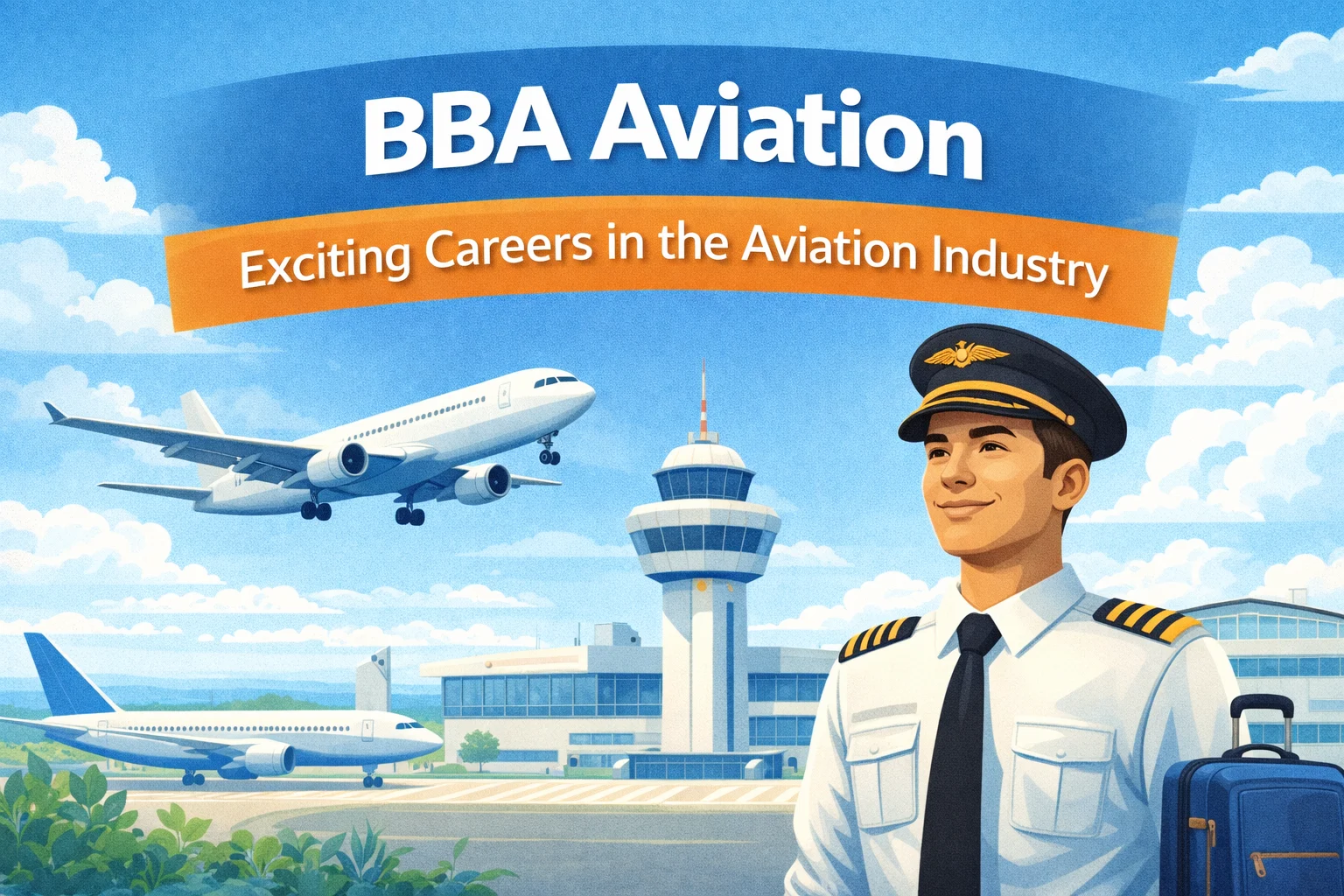
A BBA Aviation is a specialised 3-year undergraduate programme designed to build strong foundations in aviation management, airport operations, airline marketing, customer service, and hospitality. The course blends business administration concepts with industry-specific training, helping students understand airline operations, aviation safety, tourism management, and global aviation regulations. With India’s aviation sector projected to grow at nearly 15–20% annually, the demand for skilled aviation professionals is increasing across airlines, airports, and travel companies. Students also develop communication, leadership, and problem-solving skills through internships, live projects, and industry exposure. Graduates can explore careers in airport management, airline operations, ground handling, aviation customer service, cargo management, and aviation consultancy, making it a career-focused programme aligned with modern industry needs.
What is BBA Aviation?
BBA Aviation is a 3-year undergraduate programme that combines business management fundamentals with specialised aviation industry knowledge. The course covers Airport Operations, Airline Management, Air Cargo Management, Aviation Safety, Ground Handling, and Travel & Tourism. Students also learn communication skills, personality development, computer applications, and basic hospitality training to prepare for customer-facing aviation roles. India is among the fastest-growing aviation markets globally, expanding at around 15–20% annually, which creates strong demand for trained aviation management professionals. Compared to BSc Aviation (technical focus) and BBA General (core business focus), BBA Aviation emphasises management, airline operations, and service-oriented roles within airports, airlines, and tourism sectors.
| Feature | BBA Aviation | BSc Aviation | BBA General |
|---|---|---|---|
| Course Duration | 3 Years | 3 Years | 3 Years |
| Focus Area | Aviation Management & Operations | Technical & Aviation Science | Business Management |
| Key Subjects | Airline Mgmt, Airport Ops, Travel & Tourism | Aviation Physics, Navigation, Safety | Marketing, Finance, HR |
| Career Path | Airport/Airline Management | Technical Aviation Roles | Corporate/Business Roles |
| Industry Relevance | Aviation & Hospitality | Aviation Technical Sector | General Corporate Sector |
BBA Aviation Eligibility
To pursue BBA Aviation in India, candidates must have completed 10+2 from a recognised board with at least 50% aggregate marks. Students from any stream (Science, Commerce, or Arts) are generally eligible, although Commerce and Science backgrounds may be preferred by some institutes. Admission may be based on entrance exams such as AME CET, CUET-UG, or institute-level tests, while many private colleges also offer merit-based direct admission. Personal interviews or group discussions may be conducted during selection. The typical eligible age range is 17–25 years, though this may vary by college.
Eligibility & Admission Overview
| Criteria | Details |
|---|---|
| Basic Qualification | 10+2 from recognised board |
| Minimum Marks | Around 50% aggregate (varies by college) |
| Stream Requirement | Any stream; Commerce/Science preferred |
| Entrance Exams | AME CET, CUET-UG, College-level Tests |
| Admission Mode | Entrance-based or Merit-based |
| Selection Process | Application + Interview/GD (if applicable) |
| Age Limit | Usually 17–25 years (college-specific) |
Top BBA Aviation Colleges
Several colleges in India offer BBA Aviation programmes that combine academic learning with practical aviation and hospitality training. Total course fees generally range from around ₹3 lakh to ₹12 lakh, depending on the institution. Some colleges provide optional IATA-aligned certifications or aviation training modules, though official IATA partnerships may vary by campus and programme. Placement outcomes differ based on institute reputation, student skills, and industry exposure, with fresh graduates typically receiving entry-level roles in airlines, airports, ground handling, and travel management companies.
| Top Colleges – Approx. Total Fees | IATA / Aviation Certification | Placements (Typical Entry-Level Range) | Major Recruiters* |
|---|---|---|---|
| UPES Dehradun – ₹9–12 lakh | Aviation training modules; certification may be optional | ₹4–6 LPA | IndiGo, Air India, Aviation Service Firms |
| Chitkara University – ₹6–8 lakh | Aviation training/certification modules | ₹4–6 LPA | IndiGo, Air India, Travel & Aviation Firms |
| Hindustan Institute of Technology & Science – ₹5–7 lakh | Aviation training support; certification optional | ₹4–6 LPA | IndiGo, SpiceJet, Ground Handling Firms |
| Rajiv Gandhi National Aviation University – ₹3–5 lakh | No formal IATA tie-up | ₹3–5 LPA | Airport Operators, Aviation Agencies |
| Galgotias University – ₹4–6 lakh | Aviation certification modules available | ₹3–5 LPA | IndiGo, Aviation Service Companies |
| Amity University – ₹7–10 lakh | Aviation/IATA-aligned modules (programme-based) | ₹4–7 LPA | Airlines, Travel & Hospitality Firms |
| Indus University – ₹4–6 lakh | Aviation training modules available | ₹3–5 LPA | Aviation Service Providers |
| Kristu Jayanti College – ₹2–3 lakh total approx. | No IATA tie-up | ₹3–4 LPA | Travel Agencies, Aviation Firms |
| Presidency University – ₹6–8 lakh total approx. | Aviation certification modules | ₹3–5 LPA | Aviation & Travel Companies |
BBA Aviation Syllabus
The BBA Aviation syllabus combines core business management subjects with specialised aviation industry training. The three-year programme is typically divided into six semesters. The first year focuses on business fundamentals such as management principles, accounting, communication skills, and an introduction to aviation. The second year covers operational aspects including airport management, airline operations, aviation safety, cargo management, and tourism services. The final year introduces advanced topics such as ground handling, aviation law, revenue management, and customer relationship management, along with internships or industry projects for hands-on exposure. Some institutions may offer optional IATA-aligned certification modules or skill-based training depending on the programme structure.
| Year | Semester | Core Subjects | Electives / Practical Components |
|---|---|---|---|
| 1st Year | Semester 1 | Principles of Management, Business Communication, Financial Accounting, Introduction to Aviation | Personality Development / Computer Applications |
| 1st Year | Semester 2 | Business Mathematics, Business Statistics, Marketing Management, Organisational Behaviour | Travel & Tourism Basics |
| 2nd Year | Semester 3 | Airport Operations, Airline Management, Air Cargo Management, Aviation Safety | Foreign Language / Soft Skills |
| 2nd Year | Semester 4 | Tourism Management, Customer Relationship Management, Aviation Security, Ground Handling | Aviation Software / Case Studies |
| 3rd Year | Semester 5 | Aviation Law, Revenue Management, Airline Finance, Service Marketing | IATA-aligned Modules (if offered) |
| 3rd Year | Semester 6 | Strategic Management, Entrepreneurship, Aviation Operations | Internship / Industry Project |
Click here to get an overview of the syllabus for BBA Aviation.
BBA Aviation Fees
BBA Aviation programme fees in India vary widely based on institute type, infrastructure, and industry exposure. Premium private universities may charge between ₹8 lakh and ₹12 lakh for the entire course, while mid-range private colleges typically fall between ₹4 lakh and ₹7 lakh. Budget-friendly institutions or smaller private colleges may charge around ₹2 lakh to ₹4 lakh for the full programme. Optional aviation certifications such as IATA-aligned courses may add approximately ₹15,000–₹30,000 depending on the training provider. Many colleges offer merit-based scholarships, need-based concessions, and reserved-category fee relaxations.
| Institute Category | Approx. Total Fees (INR) | Scholarship Options |
|---|---|---|
| Premium Private Universities (e.g., UPES, Amity) | ₹8–12 lakh | Merit scholarships, entrance-based waivers |
| Upper Mid-Range Private Colleges (e.g., Chitkara, Hindustan) | ₹5–8 lakh | Merit / category-based scholarships |
| Mid-Range Colleges | ₹4–7 lakh | Institutional scholarships |
| Budget-Friendly Colleges | ₹2–4 lakh | Merit & need-based concessions |
| Optional Aviation / IATA Certifications | ₹15,000–₹30,000 extra | Programme-specific discounts |
Career After BBA Aviation
A BBA Aviation degree prepares graduates for roles across airlines, airports, ground handling agencies, and air cargo/logistics companies. Entry-level airline roles include Ground Staff (₹2.5–4 LPA), Customer Service Executives (₹3–5 LPA), and Cabin Crew (₹4–8 LPA). Airports recruit for operations, passenger services, and terminal management positions, typically offering ₹3–6 LPA at entry level. Government bodies such as the Airports Authority of India (AAI) may offer higher salary brackets based on recruitment exams and experience. Aviation logistics and cargo firms hire graduates for operations and supply chain roles with starting salaries of ₹3–6 LPA. With experience, professionals can move into supervisory and managerial roles across aviation operations and administration.
| Role | Sector | Average Salary (LPA) |
|---|---|---|
| Ground Staff / Passenger Service Executive | Airlines | ₹2.5–4 |
| Cabin Crew | Airlines | ₹4–8 |
| Airport Operations Executive | Airports | ₹3–6 |
| Air Cargo / Logistics Executive | Cargo & Logistics | ₹3–6 |
| Airline / Airport Supervisor | Aviation Operations | ₹5–8 |
BBA Aviation Salary
Salaries for BBA Aviation graduates vary depending on the institute, skill set, job role, and experience level. Freshers typically earn between ₹3–5 LPA in entry-level aviation or customer service roles. Graduates from reputed aviation institutes may start with packages ranging from ₹4–8 LPA, while exceptional candidates or specialised roles may reach ₹10–12 LPA after gaining experience. With 3–5 years of industry exposure, professionals can earn ₹6–12 LPA, and managerial or senior operational roles may offer ₹10–18 LPA or higher. International aviation companies, particularly Gulf-based airlines, may provide compensation packages significantly higher than comparable roles in India.
| Experience Level | Typical Salary Range |
|---|---|
| Freshers / Entry-Level | ₹3–5 LPA |
| Early Career (1–3 years) | ₹4–8 LPA |
| Mid-Level (3–5 years) | ₹6–12 LPA |
| Managerial Roles | ₹10–18 LPA+ |
| International Aviation Roles | 2–3× Indian salary (approx.) |
MBA & Further Studies
After completing BBA Aviation, graduates can pursue higher education or professional certifications to improve career prospects and move into managerial positions. A specialised MBA in Aviation or Airport Management is a popular choice, while a general MBA in Marketing, Operations, or Logistics is also valuable after gaining some work experience. Industry certifications such as IATA courses (Dangerous Goods Regulations, Air Cargo Management, Airport Operations) can enhance practical skills and employability. International aviation universities also offer advanced programmes for global exposure and specialised training.
| Area | Options | Details |
|---|---|---|
| Higher Studies | MBA in Aviation Management | Specialised aviation business and operations training |
| Higher Studies | MBA (General Management / Logistics / Marketing) | Suitable after 2–3 years of work experience |
| Certifications | IATA Certifications (DGR, Cargo, Airport Ops) | Skill enhancement and industry recognition |
| International Studies | Aviation Programmes Abroad | Advanced aviation management and global exposure |
Frequently Asked Questions (FAQs)
Q1. What is the duration of the BBA Aviation course?
The BBA Aviation course is a 3-year program focused on Aviation Management and Hospitality, designed to meet the needs of the rapidly evolving Aviation and Hospitality Industry.
Q2. What are the eligibility criteria for BBA Aviation admission?
BBA Aviation admission is based on entrance exam scores like AME CET, or college-specific tests, and may also consider academic merit. Some colleges require a minimum percentage and application form submission.
Q3. What is the fee structure for BBA Aviation courses?
BBA Aviation fees can range from INR 1,00,000 to INR 5,80,000, depending on the institution. Other aviation-related courses, like B.Tech Aviation Business Management Studies Engineering, have fees ranging from INR 30,000 to INR 5,80,000.
Q4. What are the career prospects after completing BBA Aviation?
After completing a BBA Aviation program, graduates can pursue roles such as Airport Operations Manager, Airport Planner, Air Cargo Manager, Airline Manager, and Credit Control Manager. Salaries can range from 4 LPA for an Airline Manager to 5 LPA for a Credit Control Manager.
Q5. What are the options for higher studies after BBA Aviation?
BBA Aviation graduates can pursue an MBA in Aviation Management for further specialization and career advancement in the aviation management field.