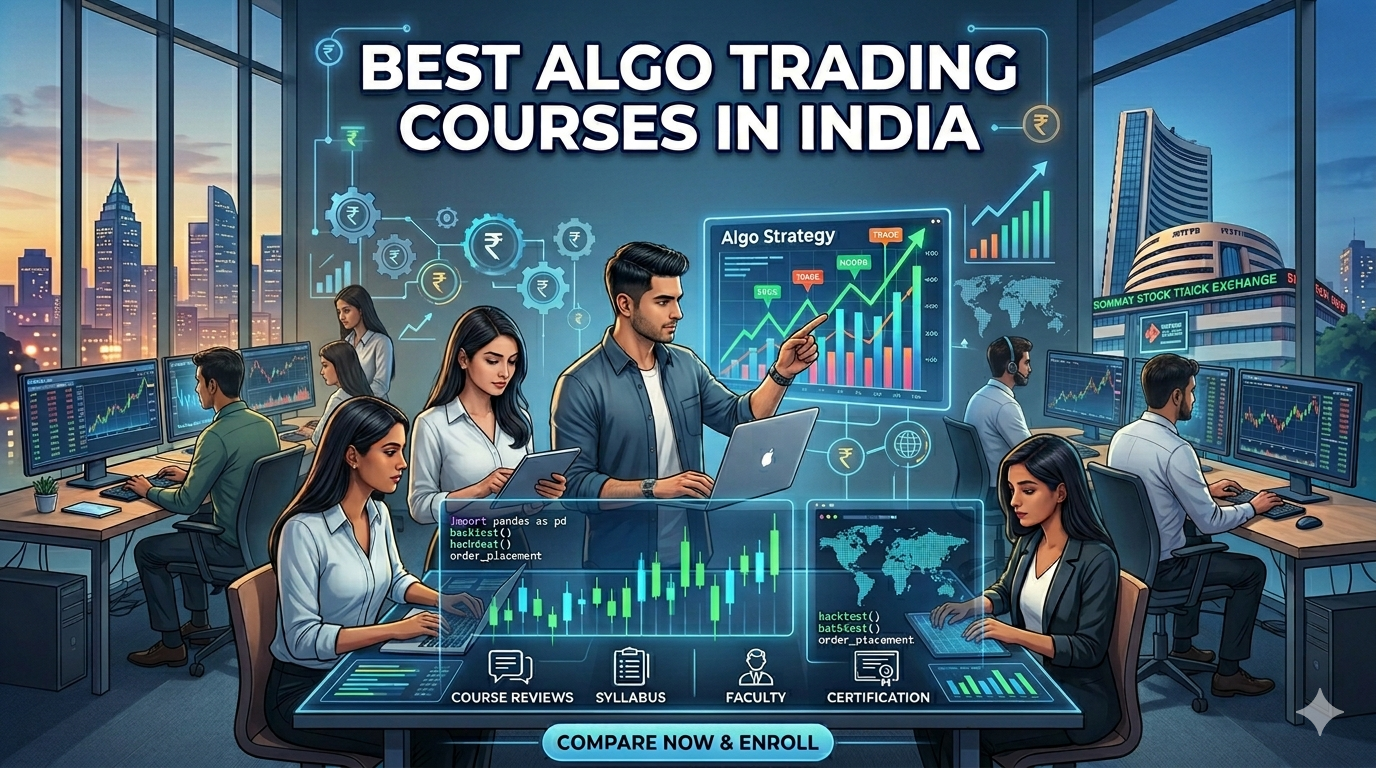
Best Algo Trading Courses Online in India: Top Picks 2026
Mastering algorithmic trading is essential for navigating India’s evolving financial markets, and choosing the right Algo Trading Course is your first step towards automating strategies and maximizing returns. With demand for skilled algo traders rapidly growing, specialized training in Python, backtesting, and data analysis is more vital than ever. This guide offers an updated comparison of the best online courses for 2026, including platforms like Coursera, NSE India, and Marketfeed, to help you select your ideal program.
Top Algorithmic Trading Courses Online: Updated Picks for 2026
For those seeking to master algorithmic trading, top-ranked programs like Oxford University’s Algorithmic Trading Programme offer executive-level insights. This section details leading Algo Trading Course options for 2026, alongside popular choices and key statistics on online offerings, helping you choose the best path.
| Rank | Course | Provider | Category | Duration | Level | Cost |
| 1 | Algorithmic Trading Programme | GetSmarter (Oxford) | Global Executive | 6 weeks | Advanced | ₹2.5–3.5L |
| 2 | EPAT | QuantInsti | India/Global Professional | 6 months | Advanced | ₹2.5L+ |
| 3 | AI for Trading | Udacity | Global Tech | 6 months | Intermediate | ₹1.5–2.2L |
| 4 | NCFM Algo Trading Module | National Stock Exchange of India | India Certification | Self-paced | Beginner | ₹7,670 |
| 5 | Machine Learning for Trading | Coursera | Academic | 3–6 months | Beginner | ₹3K–₹60K |
| 6 | PGPAT | Indian Institute of Quantitative Finance | India PG Program | 8 months | Intermediate | ₹1.58L |
| 7 | Algo Trading A–Z | Udemy | Global Skill Course | 10–30 hrs | Beginner | ₹500–₹5K |
| 8 | Algo Trading Basics | Marketfeed | India Beginner | 2–4 weeks | Beginner | Free–₹2K |
Popular Algo Trading Courses in India
These popular courses cover a range of topics from foundational trading algorithms and GenAI applications to advanced strategies and machine learning for trading.
| Course Name | Provider | Duration | Cost (Approx.) | Type |
| Trading Algorithms | Indian School of Business (via Coursera) | 1–2 weeks (10–15 hrs) | ₹3,000 – ₹60,000 (Coursera subscription/paid cert) | Online course |
| GenAI for Algorithmic Trading | Coursera | ~3 hours | ₹3,000 – ₹60,000 (subscription-based access) | Beginner course |
| Advanced Elliott Wave Trading Strategies | EDUCBA | 6–10 hours | ₹500 – ₹2,500 | Self-paced video course |
| Machine Learning for Trading | Google (Google Cloud / partners) | 3–4 months | ₹30,000 – ₹1,20,000 | Professional ML course |
| Practical Guide to Trading | Interactive Brokers | 2–5 hours | Free | Educational module |
| Financial Engineering & Risk Management | Columbia University (Coursera) | 3–6 months | ₹5,000 – ₹70,000 | University specialization |
| Trading Strategies in Emerging Markets | Indian School of Business | 1–2 weeks | ₹3,000 – ₹60,000 | Coursera specialization course |
| Advanced Trading Algorithms | Indian School of Business | ~1 week | ₹3,000 – ₹60,000 | Intermediate course |
| TradeStation EasyLanguage for Algorithmic Trading | Packt | 6–10 hours | ₹500 – ₹2,000 | Skill-based programming course |
| Apply Technical Analysis & Market Models | EDUCBA | 5–8 hours | ₹500 – ₹2,500 | Technical analysis course |
Essential Skills & Tools: Python, Backtesting, Data Analysis in 2026
Python is the most preferred language for algorithm trading, especially among retailers and quants in India, due to its simplicity and versatility. This section explores essential Python tools, libraries, and skills crucial for effective backtesting and data analysis in algo trading, highlighting its importance for future success.
| Category | Key Details |
| Role of Python in Algo Trading | Most preferred language among retail traders and quants in India due to simplicity, versatility, and strong financial ecosystem. Forms the foundation for trading automation and strategy development. |
| Python Advantages | Easy learning curve, extensive libraries, strong community support, and high flexibility for building trading systems and quantitative models. |
| Core Python Libraries | Pandas, NumPy (data analysis), TA-LIB (technical indicators), Scikit-learn (ML models), Matplotlib (visualization), Keras & TensorFlow (deep learning). |
| Backtesting Frameworks | Backtrader, Zipline, QuantConnect used to test strategies on historical market data and evaluate performance before live deployment. |
| API Integration | Enables automated trading via broker APIs such as Zerodha, Groww, Upstox for real-time execution and strategy automation. |
| Importance of Backtesting | Essential for validating strategies, analyzing behavior under different market conditions, and reducing real capital risk exposure. |
| Technical Setup | Python 3.8+, Jupyter Notebook, Visual Studio Code, PyCharm; cloud platforms like Google Colab and AWS for scalable computing. |
| Data Analysis Role | Core function in algorithmic trading using Pandas for cleaning market data, generating indicators, and building trade logic systems. |
| Key Skills Gained (2026) | Python programming, algorithm design, financial trading, AI & machine learning, market data analysis, portfolio management, risk management, technical analysis, time series forecasting, automation, and deep learning. |
| Regulatory Context (India) | SEBI regulates algorithmic trading; broker approval required for deployment. Compliance with 2025–2026 SEBI guidelines is mandatory for live trading systems. |
| Future Learning Path | Mastery of Python + backtesting is foundational; advanced Algo Trading Courses further build skills in strategy design, ML integration, and regulatory compliance. |
Python Algo Trading Courses in India: Live Classes & Certificates 2026
Explore top Python Algo Trading Course options in India for 2026, offering live classes and certifications. This section details programs from leading providers like NSE Academy, IIQF, and QuantInsti, focusing on practical implementation, real-time strategies, and advanced data analytics for algorithmic trading.
| Course Name | Provider | Duration | Mode | Key Focus | Certification / Notes |
| Algorithmic Trading & Computational Finance Using Python & R | National Stock Exchange of India (NSE Academy + Trading Campus) | Not fixed (modular/self-paced) | Online | Practical Python & R implementation, real-time trading systems, trading engine development | Certified Algo Trading Course (2026 offering) |
| Post Graduate Program in Algorithmic Trading (PGPAT) | Indian Institute of Quantitative Finance | 8 Months | Live online (weekend instructor-led) | Python-based algo strategy development, quantitative trading systems | CPD-accredited by LIBF |
| Executive Programme in Algorithmic Trading (EPAT®) | QuantInsti | 6 Months | Online + Live lectures | Python algo trading, quantitative finance, live project execution | 120+ hours live training + mentorship |
Coursera vs NSE India vs Marketfeed: Algo Trading Course Comparison 2026
Coursera, NSE India, and Marketfeed provide diverse Algo Trading Course options for aspiring traders in 2026. This comparison highlights key features, costs, and durations across their offerings, ranging from university-designed courses to specialized modules and beginner video tutorials.
| Platform | Course Name | Type | Duration | Cost | Reviews | Key Features/Focus |
| Coursera | Trading Algorithms (Indian School of Business) | Course | 1 – 4 Weeks | Free Trial | 1.1K | Financial Trading, Financial Analysis, Market Trend, Statistical Hypothesis Testing |
| Coursera | GenAI for Algorithmic Trading (Coursera) | Course | 1 – 4 Weeks | Free Trial | 15 | Generative AI, Financial Trading, Market Data, Portfolio Management, Python Programming |
| Coursera | Machine Learning for Trading (Multiple educators) | Specialization | 1 – 3 Months | Free Trial | 1.2K | Tensorflow, Keras, Machine Learning Methods, Google Cloud Platform, Deep Learning, Portfolio Management |
| NSE India | Algorithmic Trading Module (NCFM) | Self-study Module | N/A (Self-paced) | ₹7,670 | N/A | NCFM Certification, 100 objective questions (60 min, 60% pass, 0.25% negative marking), Risk Management, Audit & Compliance |
| NSE India | Algorithmic Trading and Computational Finance Using Python and R | Certified Course | N/A | N/A | N/A | Practical Python & R implementation, real-time trading strategies, advanced data analytics |
| Marketfeed | Algo Trading for Beginners by Pushkar Raj | Video Tutorial | N/A | Free (implied) | N/A | Basics, strategy creation, backtesting, automation, specific intraday option selling strategy for Bank Nifty |
Building & Automating Trading Strategies: Practical Course Outcomes 2026
Courses in 2026 prioritize teaching students to build automated trading systems using Python, machine learning, and broker APIs. These practical Algo Trading Course outcomes focus on mastering backtesting, technical analysis, and quantitative strategies for various markets, enabling faster, rule-based trade execution.
- Core Outcomes: Courses teach building automated systems with Python, ML, and broker APIs.
- Learning Journey: Practical journey spans six stages, from fundamentals to live strategy monitoring.
- Key Skills: Skills gained include Python, ML, AI, risk management, and technical analysis.
- Coding Role: Coding (Python/C++) offers full control; visual builders also support automation.
- Post-Course Tools: Essential tools are SEBI-compliant broker APIs and reliable algo trading software.
- Mastery Duration: Mastering strategy design and disciplined execution typically requires months of practice.
How to Select the Right Algo Trading Course for Beginners in 2026
Selecting the right Algo Trading Course for beginners in 2026 requires careful consideration of your starting point and goals. This guide outlines essential steps, from defining your motivation to evaluating specific beginner-friendly options, ensuring you build a strong foundation in algorithmic trading.
- Define Goals: Assess current knowledge, financial goals, and desired technical depth for an Algo Trading Course.
- Prioritize Beginner: Seek courses explicitly labeled ‘Beginner’ or ‘beginner-accessible’ requiring no prior background.
- Foundational Skills: Ensure courses cover core algorithmic trading concepts and how automated strategies work.
- Key Topics: Look for platform setup, expert advisor connection, backtesting, and basic risk management.
- Test Interest: Utilize free options, like ‘Algo Trading for Beginners’ from Algo Trading Space, to explore interest.
- Plan Progression: Beginner courses provide a foundation; advanced topics like MQL/EA development require further study.
Frequently Asked Questions
What exactly is an Algo Trading Course and what does it cover?
An Algo Trading Course teaches automated trading using Python, data analysis, backtesting, and strategy building. It also covers AI, machine learning, risk management, and real-time market execution systems.
Who is eligible to enroll in this Algo Trading Course?
Eligibility varies by program, but most courses accept beginners, graduates, traders, and professionals interested in finance, programming, or data science. Some advanced programs require basic Python or math knowledge.
What career opportunities are available after completing the Algo Trading Course?
After completion, learners can pursue roles like quantitative analyst, algorithmic trader, financial data analyst, or trading strategist in hedge funds, fintech firms, investment banks, and brokerage companies.
How does this Algo Trading Course compare to other finance programs?
Unlike traditional finance programs, algo trading courses focus on coding, automation, AI, and real-time execution. They emphasize practical strategy building rather than purely theoretical financial or accounting concepts.
When do new batches for the Algo Trading Course typically start?
Batch timings vary by provider. Platforms like Coursera offer flexible self-paced learning, while institutes such as QuantInsti and IIQF run scheduled online batches throughout the year, often monthly or quarterly.