Best Courses After BiPC: Career Options, Scope, and Degrees
Students completing Intermediate BiPC can evaluate diverse undergraduate degrees, short-term diplomas, entrance requirements, fee ranges, and salary packages across clinical, pharmaceutical, agricultural, and non-medical streams.
| Parameter | Details |
|---|---|
| Stream Acronym | BiPC (Biology, Physics, Chemistry) |
| Minimum Eligibility | 10+2 passed with Physics, Chemistry, and Biology (min. 50% marks for MBBS) |
| Primary Medical Entrance Exam | NEET UG |
| Non-NEET Entrance Exams | EAMCET, CUET, State CETs, ICAR |
| Top Medical Degrees | MBBS (5.5 years), BDS (5 years), BHMS / BAMS (5.5 years) |
| Top High-Salary Non-NEET Courses | BSc Biotechnology, BSc Nursing, B.Pharmacy, BPT, BSc Agriculture |
List of Courses after 12th Science BiPC
BiPC stream graduates can pick from undergraduate degrees and specialized diploma courses across medical, allied health, engineering, and agricultural domains. Below is the full breakdown of available qualification paths:
- Clinical & AYUSH Medical Degrees: Bachelor of Medicine and Bachelor of Surgery (MBBS), Bachelor of Dental Surgery (BDS), Bachelor of Homoeopathic Medicine and Surgery (BHMS), and Bachelor of Veterinary Science (BVSc).
- Allied Healthcare & Nursing: Bachelor of Physiotherapy (BPT), BSc Nursing, and BSc Radiology / MLT (Medical Laboratory Technology).
- Pharmaceutical & Applied Life Sciences: B.Pharmacy, BSc Biotechnology, and BSc Agriculture.
- Engineering & Technology Tracks: BiPC students can enter medical engineering fields by pursuing BTech Biotechnology, BTech Food Technology, and BTech Biomedical Engineering.
- Diploma Courses: Diploma in Forensic Sciences-Cyber Crime, Diploma in X-Ray Technology, Diploma in Health Information Management, and Diploma in Ayurvedic Pharmacy.
Eligibility and Duration
To secure admission into BiPC courses, candidates must complete 10+2 with Physics, Chemistry, and Biology from a recognised board, securing at least 50% aggregate marks for medical eligibility. Individual course durations vary depending on clinical internship mandates and program design:
- MBBS: 5.5-year undergraduate degree program comprising 4.5 years of academic study and 1 year of compulsory rotational internship.
- BDS: 5-year degree program (4 years academic + 1 year internship) covering oral health, diagnosis, and surgical treatments.
- Bachelor of Physiotherapy (BPT): 4.5-year professional healthcare course including clinical training.
- B.Pharmacy, BSc Agriculture, & BSc Nursing: 4-year undergraduate professional degree programs.
- BSc Biotechnology & BSc Radiology / MLT: 3 to 4-year undergraduate science degree options.
Fees
| Course Name | Average Fee Range |
|---|---|
| BDS (Dental Surgery) | INR 80,000 – INR 5,00,000 |
| BHMS (Homoeopathy) | INR 80,000 – INR 5,50,000 |
| BSc Nursing | INR 50,000 – INR 3,00,000 |
| BSc Agriculture | INR 50,000 – INR 2,00,000 |
| Bachelor of Physiotherapy (BPT) | INR 2,00,000 – INR 5,00,000 |
| BSc Biotechnology | INR 30,000 – INR 13,00,000 |
Tuition fees for BiPC courses vary significantly based on whether an institution is government-funded or privately managed. Core clinical degrees like MBBS show the widest variation, while non-NEET healthcare and science courses feature more structured cost ranges.
Career Options and Salary
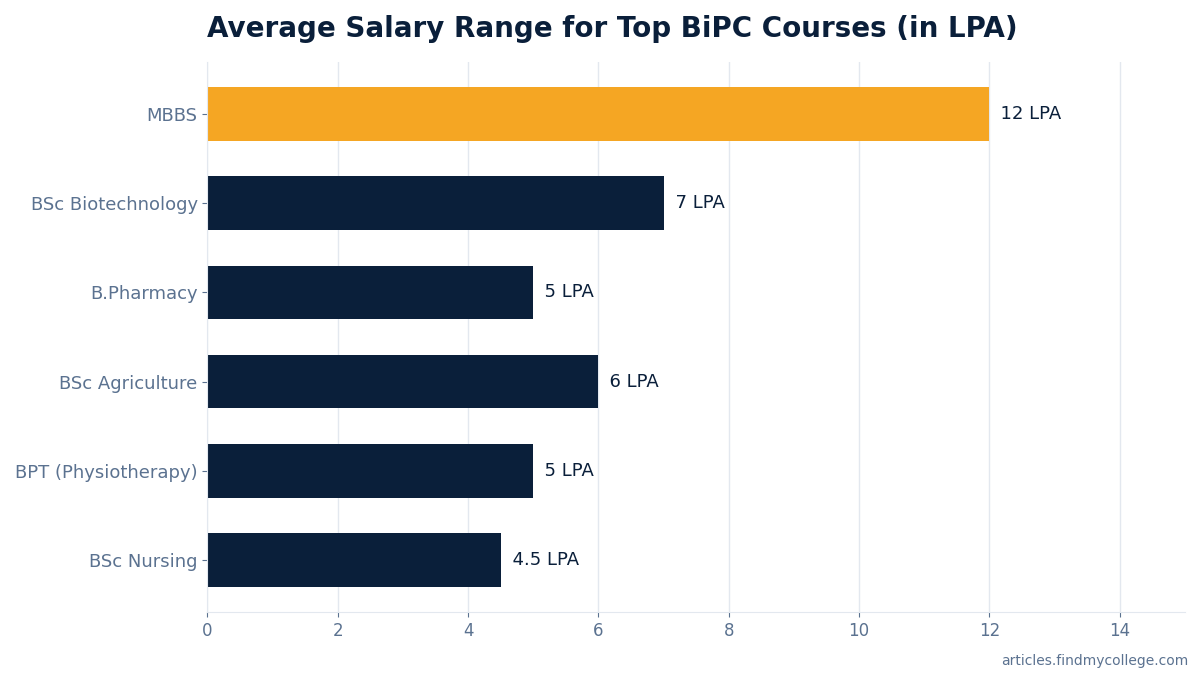
Graduates from the BiPC stream enjoy high career versatility across clinical healthcare, diagnostic centers, pharmaceutical research firms, and agribusiness enterprises. Initial compensation packages reflect specialized skill sets and industry demand.
In the allied and non-NEET domain, B.Pharmacy graduates earn starting salaries of INR 3 LPA to INR 7 LPA working with top pharmaceutical firms like Sun Pharma, Cipla, and Lupin. BSc Agriculture graduates receive starting packages of INR 4 LPA to INR 8 LPA in roles with NABARD, ITC, and agribusiness firms.
| Degree Program | Duration | Entrance Exam | Top Recruiters | Average Salary Range |
|---|---|---|---|---|
| B.Pharmacy | 4 Years | EAMCET / State CET | Sun Pharma, Cipla, Lupin | INR 3 – 7 LPA |
| BSc Agriculture | 4 Years | EAMCET / ICAR | NABARD, ITC, Agribusiness firms | INR 4 – 8 LPA |
| BSc Radiology / MLT | 3-4 Years | State CET / Merit | Apollo, SRL Diagnostics, Thyrocare | INR 3 – 5 LPA |
How to Choose
Selecting the right course after Intermediate BiPC requires balancing career preferences, entrance examination readiness, program duration, and budget constraints. Students aiming for doctor credentials must focus on clearing NEET UG for clinical entry into MBBS, BDS, or BHMS programs.
If you prefer non-clinical healthcare or wish to avoid NEET, evaluating entrance exams such as EAMCET, ICAR, or CUET opens doors to 4-year degree programs like B.Pharmacy and BSc Agriculture. Consider total financial investment, as private MBBS degrees can cost up to INR 50,00,000 while non-clinical programs offer strong career returns at lower overall fees.
How to Apply for Courses after 12th Science BiPC Admission in 2026: Step by Step
- Check Minimum Academic Eligibility: Complete 10+2 with Physics, Chemistry, and Biology from a recognised board, securing at least 50% aggregate marks for medical courses such as MBBS.
- Register for Entrance Examinations: Apply for applicable entrance tests such as NEET UG for medical and dental courses, or EAMCET, State CET, ICAR, and CUET for pharmacy, agriculture, and biotechnology.
- Appear for Entrance Tests: Sit for the required entrance exam based on your chosen career stream, such as NEET UG for clinical medical programs or EAMCET and State CETs for pharmacy and allied fields.
- Evaluate Course Duration and Fees: Compare undergraduate degrees of 3 to 5.5 years with diploma options lasting 6 months to 2 years, considering fee differences between government and private institutions.
- Select Specialisation and Career Path: Choose a program across healthcare, pharmacy, biotechnology, research, or agriculture aligned with your preferences and salary expectations.
- Finalise Admission and College Enrollment: Complete enrollment in government or private institutes by meeting specific academic eligibility criteria and entrance exam scores.
| What to do | Where | Link |
|---|---|---|
| Compare colleges, fees and cutoffs | Courses after 12th Science BiPC colleges in India | findmycollege.com |
Selecting the right course after 12th BiPC depends on academic eligibility, entrance exam requirements, program duration, and long-term career goals across medical and non-medical streams. Government colleges generally offer lower fee structures than private institutes for both medical and allied programs.
FAQs
-
What are the top 3 courses after 12th BiPC?
The top medical courses after BiPC requiring NEET UG are MBBS, BDS, and BHMS. Popular non-NEET options include BSc Biotechnology, BSc Agriculture, and B.Pharmacy.
-
Can I join BTech after 12th BiPC?
Yes, BiPC students can pursue selective BTech programs such as BTech Biotechnology, BTech Food Technology, and BTech Biomedical Engineering.
-
After BiPC which course is best in EAMCET?
Prominent courses available through EAMCET for BiPC students include B.Pharmacy and BSc Agriculture.
-
What non-NEET courses are available after 12th BiPC?
Non-NEET options include BSc Nursing, BSc Biotechnology, BSc Agriculture, B.Pharmacy, Diploma in Forensic Sciences-Cyber Crime, and Diploma in Health Information Management.
-
What are the best colleges for BiPC medical and biotechnology courses?
Top medical colleges offering MBBS include AIIMS Delhi, CMC Vellore, and JIPMER Puducherry. For biotechnology programs, top institutions include Thapar Institute of Engineering and Technology, NIT Warangal, and Manipal University.