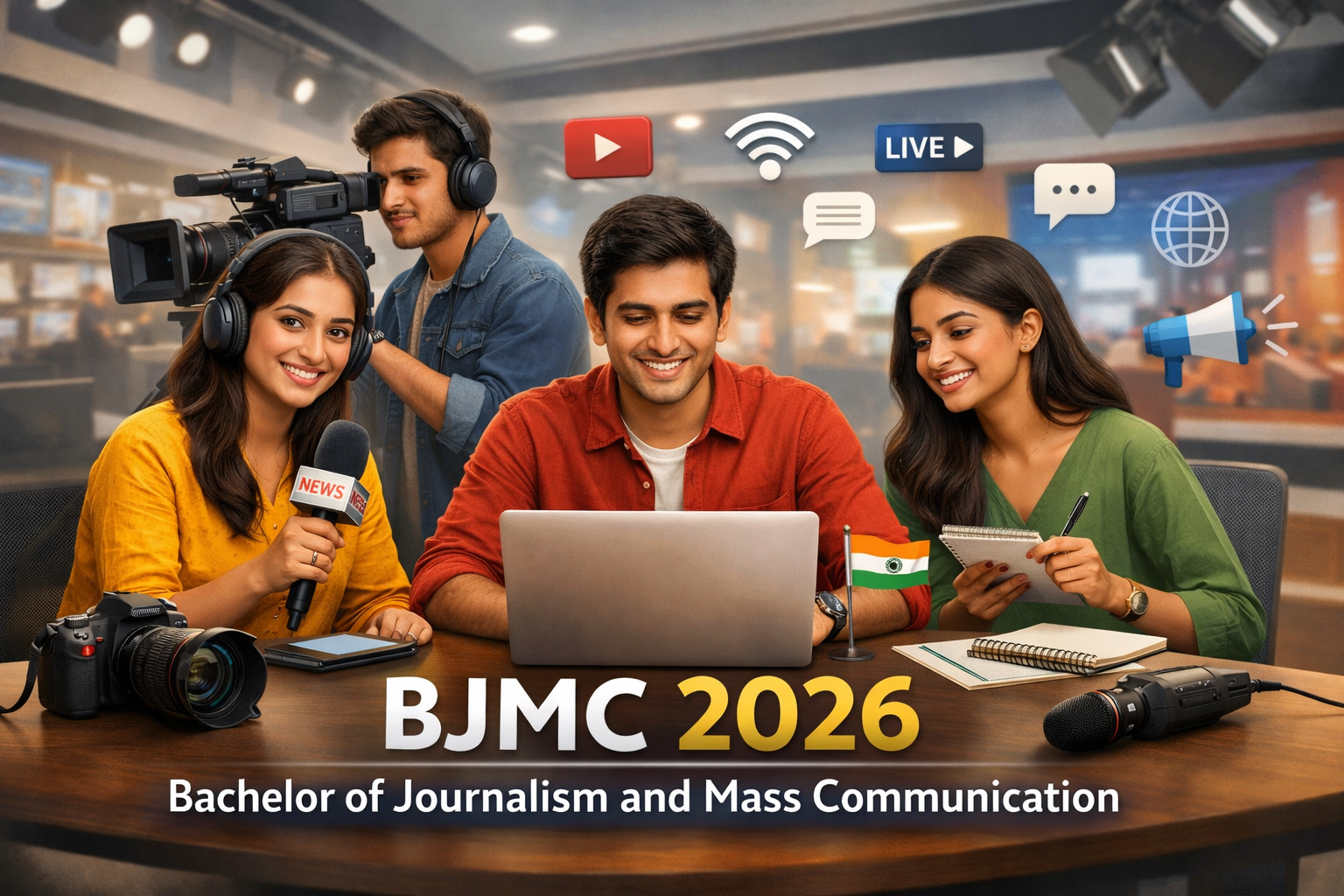
BJMC 2026: Course, Colleges, Fees, Eligibility, Syllabus & Career Scope India
BJMC 2026, or Bachelor of Journalism and Mass Communication, is a popular undergraduate program for students aspiring to build a career in media, journalism, public relations, and digital communication.
The course focuses on developing skills in reporting, editing, content creation, media ethics, and communication strategies across print, broadcast, and digital platforms. With the rapid growth of media and entertainment industries in India, BJMC offers ample career opportunities in journalism, advertising, public relations, social media, and corporate communications.
In this blog, we will cover the course details, top colleges, fees, eligibility, syllabus, and career scope in India.
What is BJMC?
BJMC, or Bachelor of Journalism and Mass Communication, is a three-year undergraduate program designed for students interested in the fields of media, journalism, public relations, and digital communication. The course equips students with practical and theoretical knowledge about reporting, editing, media ethics, advertising, and content creation for print, television, radio, and online platforms. BJMC focuses on developing strong communication, analytical, and creative skills, preparing students to thrive in the dynamic media and entertainment industry, both in India and globally.
BJMC Course Highlights
| Feature | Details |
|---|---|
| Full Form | Bachelor of Journalism and Mass Communication |
| Duration | 3 Years (6 Semesters) |
| Eligibility | 10+2 in any stream from a recognized board; some colleges may require a minimum percentage |
| Course Type | Undergraduate Degree |
| Medium of Instruction | English / Hindi (varies by college) |
| Specializations | Print Media, Electronic Media, Digital Media, Advertising, Public Relations |
| Skills Developed | Writing, Reporting, Editing, Communication, Media Management, Digital Marketing |
| Career Opportunities | Journalist, Reporter, Content Writer, PR Executive, Social Media Manager, Media Planner |
Why Choose BJMC?
Choosing BJMC (Bachelor of Journalism and Mass Communication) can be a game-changer for students passionate about media, storytelling, and communication. Here’s why this course is highly sought after:
Diverse Career Opportunities
BJMC opens doors to multiple career paths in journalism, public relations, advertising, digital media, content writing, television, radio, and corporate communications. Graduates can work in both traditional and digital platforms, making it a versatile degree.
Skill Development
The program emphasizes practical skills like reporting, editing, media planning, video production, photography, and digital marketing. It also strengthens communication, critical thinking, and creative problem-solving, which are highly valued in the media industry.
Exposure to Modern Media
With the rise of online news, social media, and digital marketing, BJMC provides hands-on experience with the latest tools, platforms, and trends in media, preparing students for real-world challenges.
Industry-Relevant Curriculum
The course syllabus is designed to blend theory with practice. Students learn media ethics, journalism laws, advertising strategies, PR campaigns, and media management, making them industry-ready upon graduation.
Networking and Internship Opportunities
Many colleges offer internships with media houses, news channels, advertising agencies, and PR firms, giving students valuable industry exposure and connections for future career growth.
Creative Freedom and Personal Growth
BJMC allows students to explore their creativity through writing, video production, and content creation. It also boosts confidence, public speaking skills, and professional presentation abilities.
High Demand in India and Abroad
With the media and entertainment sector booming in India, and the global rise of digital content, skilled BJMC graduates are in high demand across industries, ensuring strong career prospects.
BJMC Eligibility Criteria
To pursue BJMC (Bachelor of Journalism and Mass Communication), candidates must meet certain academic and age-related requirements. These criteria ensure that students have the foundational knowledge and skills to succeed in this media-focused undergraduate program.
-
Candidates must have completed 10+2 or equivalent from a recognized board in any stream (Science, Commerce, or Arts).
-
Most colleges require a minimum aggregate of 50% marks in the qualifying examination. Some top universities may have higher cut-offs.
-
Certain institutions may conduct entrance exams or personal interviews as part of the selection process.
-
There is generally no age limit, but candidates should check individual college guidelines.
| Criteria | Details |
|---|---|
| Educational Qualification | 10+2 from a recognized board in any stream (Science, Commerce, Arts) |
| Minimum Marks | Usually 50% aggregate; varies by college/university |
| Entrance Exam | Some colleges/universities conduct entrance exams or personal interviews |
| Age Limit | Typically no age restriction; check specific college rules |
| Skills Required | Strong communication, writing, creativity, and analytical skills |
| Nationality | Indian and in some cases, foreign students may be eligible |
BJMC Admission Process
Admission to BJMC (Bachelor of Journalism and Mass Communication) varies across colleges and universities in India. Generally, it involves a combination of merit-based selection, entrance exams, and personal interviews. Here’s a step-by-step overview of the typical admission process:
-
Eligibility Check – Candidates must meet the 10+2 qualification and minimum percentage criteria.
-
Application Form – Fill out the application form online/offline on the college/university website.
-
Entrance Exam (if applicable) – Some top colleges conduct entrance tests to assess communication, general knowledge, and analytical skills.
-
Personal Interview/Group Discussion – Shortlisted candidates may appear for interviews or group discussions to evaluate personality, communication skills, and media awareness.
-
Merit List/Selection – Final selection is based on marks in qualifying exams, entrance exams, and performance in interviews/ GD.
-
Admission & Fee Payment – Selected candidates complete the admission formalities by paying the fee and submitting required documents.
| Step | Details | Example/Notes |
|---|---|---|
| 1. Eligibility Check | Verify 10+2 qualification and minimum marks | Usually 50% aggregate; may vary by college |
| 2. Application Form | Submit online/offline application form | Check college website for deadlines |
| 3. Entrance Exam | Conducted by some universities/colleges | Examples: IP University, Banaras Hindu University, Delhi University |
| 4. Personal Interview / Group Discussion | Assesses personality, communication, and media awareness | Shortlisted candidates only |
| 5. Merit List / Selection | Final selection based on combined scores | Entrance exam + 10+2 marks + interview/GD |
| 6. Admission & Fee Payment | Complete admission formalities | Submit documents and pay course fees to confirm seat |
BJMC Syllabus
The BJMC (Bachelor of Journalism and Mass Communication) syllabus is designed to provide a balanced mix of theoretical knowledge and practical skills in media, journalism, and communication. Spread over 3 years (6 semesters), the course exposes students to print, electronic, and digital media, along with public relations, advertising, and communication strategies.
Semester-wise BJMC Syllabus Overview
Semester 1:
-
Fundamentals of Communication
-
Introduction to Journalism
-
English Language & Communication Skills
-
Media Ethics and Law
-
Basics of Photography
Semester 2:
-
Reporting and Editing for Print Media
-
News Writing & Feature Writing
-
History of Media
-
Computer Applications in Media
-
Introduction to Advertising
Semester 3:
-
Broadcast Journalism (Radio & TV)
-
Script Writing & Storytelling
-
Media Research Methods
-
Public Relations Fundamentals
-
Graphic Design & Visual Communication
Semester 4:
-
Digital Media & Social Media Management
-
Media Laws and Ethics
-
Advertising & Marketing Communication
-
Photojournalism & Video Production
-
Event Management Basics
Semester 5:
-
Advanced Reporting Techniques
-
Media Management and Production
-
Crisis Communication & PR Campaigns
-
Media Analytics & Audience Research
-
Internship / Practical Training
Semester 6:
-
Specialized Electives (e.g., Political Reporting, Sports Journalism, Entertainment Media)
-
Media Project / Capstone Project
-
Seminar & Workshops
-
Dissertation / Research Paper
-
Industry Internship / Practical Experience
Core Subjects in BJMC
| Semester | Core Subjects | Practical / Skill Component |
|---|---|---|
| Semester 1 | Fundamentals of Communication, Introduction to Journalism, English Language & Communication Skills, Media Ethics and Law | Basic photography exercises, writing short news articles |
| Semester 2 | Reporting and Editing for Print Media, News Writing & Feature Writing, History of Media, Computer Applications in Media, Introduction to Advertising | Hands-on editing, news reporting practice, basic computer applications in media |
| Semester 3 | Broadcast Journalism (Radio & TV), Script Writing & Storytelling, Media Research Methods, Public Relations Fundamentals, Graphic Design & Visual Communication | Radio/TV script exercises, video production, graphic design projects |
| Semester 4 | Digital Media & Social Media Management, Media Laws and Ethics, Advertising & Marketing Communication, Photojournalism & Video Production, Event Management Basics | Social media campaign creation, photography & videography assignments, small-scale event planning |
| Semester 5 | Advanced Reporting Techniques, Media Management and Production, Crisis Communication & PR Campaigns, Media Analytics & Audience Research, Internship / Practical Training | Internship in media houses, advertising/PR projects, audience research report |
| Semester 6 | Specialized Electives (Political Reporting, Sports Journalism, Entertainment Media), Media Project / Capstone Project, Seminar & Workshops, Dissertation / Research Paper, Industry Internship | Capstone project, dissertation, hands-on media production, final internship experience |
BJMC Exam Pattern
The BJMC (Bachelor of Journalism and Mass Communication) exam pattern is designed to evaluate both theoretical knowledge and practical skills of students across different media domains. Exams are usually conducted semester-wise, combining written tests, project work, assignments, and practical assessments. The pattern may vary slightly across colleges, but most universities follow a similar structure to assess understanding in journalism, mass communication, digital media, advertising, and public relations.
| Component | Details | Marks / Weightage | Mode |
|---|---|---|---|
| Theory Papers | Covers core subjects like Reporting, Media Laws, Advertising, PR, and Communication Theories | 50–70% | Written / Online |
| Practical / Lab Work | Includes Photography, Videography, Editing, Graphic Design, and Broadcast Exercises | 15–25% | Hands-on / Lab |
| Assignments / Project Work | Research papers, case studies, media projects, or social media campaigns | 5–15% | Submission-based |
| Semester-end Exam | Combination of objective & descriptive questions from all subjects | 40–60% | Written / Online |
| Internal Assessment | Participation in workshops, seminars, presentations, and classroom activities | 10–20% | Continuous Assessment |
| Internship Evaluation | Performance in internships at media houses, PR firms, or digital agencies | 5–10% | Internship Report + Feedback |
Skills Required for BJMC Students
Pursuing BJMC (Bachelor of Journalism and Mass Communication) requires more than academic knowledge. Students need a blend of creative, analytical, and technical skills to excel in media, journalism, public relations, and digital communication. The dynamic nature of the media industry demands versatility and adaptability.
-
Effective Communication Skills: Strong verbal and written communication is essential for reporting, scripting, content writing, and public relations. Clear expression helps convey messages accurately and professionally.
-
Creativity and Innovation: Creativity is crucial for producing engaging stories, advertisements, campaigns, and digital content. Innovative thinking sets students apart in competitive media roles.
-
Analytical and Research Skills: Students must be able to analyze information, conduct media research, and interpret audience data to create informed content and strategies.
-
Technical Proficiency: Knowledge of photography, videography, video editing, graphic design, and digital media tools is vital for hands-on media production and digital campaigns.
-
Critical Thinking: The ability to evaluate information, identify biases, and make ethical decisions is important for journalism, media reporting, and PR work.
-
Interpersonal Skills: Networking, teamwork, and collaboration are key for working with colleagues, media houses, clients, and interviewees.
-
Adaptability and Learning Agility: The media industry is constantly evolving with new technologies and platforms. Students must be adaptable and willing to learn continuously.
-
Time Management and Multitasking: Handling multiple assignments, deadlines, interviews, and live reporting requires excellent time management and multitasking abilities.
-
Social Media Savviness: Understanding social media trends, engagement strategies, and digital content creation is increasingly important for modern journalists and PR professionals.
-
Ethical Awareness: Knowledge of media laws, ethics, and professional standards ensures responsible journalism and communication.
Career Scope After BJMC
A BJMC (Bachelor of Journalism and Mass Communication) degree opens up a wide range of career opportunities in the fast-growing media, entertainment, advertising, and digital communication sectors. With strong theoretical knowledge, practical skills, and industry exposure, BJMC graduates can explore roles in both traditional and digital media, as well as corporate communication.
| Job Role | Job Description | Average Salary (India) | Key Skills Required |
|---|---|---|---|
| Journalist / Reporter | Cover news, events, and stories for print, TV, radio, and online platforms | ₹3–6 LPA (entry-level) | Reporting, writing, communication, research |
| Content Writer / Editor | Create and edit engaging content for websites, blogs, magazines, and social media | ₹2.5–5 LPA | Writing, editing, creativity, SEO |
| Public Relations (PR) Executive | Manage public image, media relations, and PR campaigns for organizations | ₹3–6 LPA | Communication, networking, event planning, media relations |
| Digital Media Specialist / Social Media Manager | Plan and execute digital marketing campaigns and manage social media platforms | ₹3–7 LPA | Social media marketing, analytics, content creation |
| Broadcast Journalist / Anchor | Present news, conduct interviews, and report on television or radio | ₹3–8 LPA | Speaking, presentation, live reporting, research |
| Advertising Executive / Media Planner | Create advertising campaigns, plan media strategy, and manage brand promotions | ₹3–6 LPA | Creativity, marketing knowledge, media planning |
| Event Manager / Corporate Communications Executive | Organize events and manage corporate communications and branding | ₹3–6 LPA | Organization, communication, public speaking, planning |
| Video Editor / Photojournalist | Produce visual content through photography, videography, and editing | ₹2.5–5 LPA | Photography, videography, editing software, creativity |
| Research Analyst / Media Analyst | Conduct media research, audience analysis, and trend forecasting | ₹3–6 LPA | Research, analytics, critical thinking |
| Freelance Media Professional | Work independently in writing, photography, videography, or digital content creation | Varies widely | Self-motivation, creativity, networking, technical skills |
Salary After BJMC
A BJMC (Bachelor of Journalism and Mass Communication) degree offers promising salary prospects, depending on the job role, experience, and industry. Graduates can work in journalism, advertising, public relations, digital media, corporate communications, and broadcasting. The salary varies widely for entry-level positions, mid-level professionals, and experienced experts.
Salary Overview for BJMC Graduates in India:
Entry-Level Salary: Fresh graduates can expect a starting salary of ₹2.5–4 LPA (Lakhs Per Annum) in media houses, advertising agencies, or PR firms. Entry-level roles include content writer, junior reporter, social media executive, or trainee journalist.
Mid-Level Salary: With 3–5 years of experience, BJMC professionals can earn around ₹4–8 LPA. Roles include senior reporter, PR executive, digital marketing specialist, or media analyst.
Senior-Level Salary: Experienced professionals with 5–10 years or more can earn ₹8–15 LPA or higher, depending on the organization and profile. Senior roles include editorial manager, media manager, PR manager, creative head, or digital media strategist.
Freelance / Independent Work: Freelancers such as writers, photographers, videographers, or digital content creators can earn ₹1.5 LPA to ₹10+ LPA, depending on projects, client base, and experience.
| Job Role | Average Salary (India) | Growth Potential | Notes |
|---|---|---|---|
| Journalist / Reporter | ₹3–6 LPA (entry-level) | High with experience & specialization | Salaries increase with seniority, reputation, and media house |
| Content Writer / Editor | ₹2.5–5 LPA | Moderate to High | Experienced editors and digital content managers earn more |
| Public Relations (PR) Executive | ₹3–6 LPA | High | PR managers in top firms can earn ₹10+ LPA |
| Digital Media Specialist / Social Media Manager | ₹3–7 LPA | Very High | Expertise in analytics & campaigns boosts salary significantly |
| Broadcast Journalist / Anchor | ₹3–8 LPA | High | Senior anchors or correspondents in big channels earn more |
| Advertising Executive / Media Planner | ₹3–6 LPA | High | Growth with experience in creative or media strategy roles |
| Event Manager / Corporate Communications Executive | ₹3–6 LPA | Moderate to High | Salary increases with large-scale event management experience |
| Video Editor / Photojournalist | ₹2.5–5 LPA | Moderate | Freelance projects can significantly increase income |
| Research Analyst / Media Analyst | ₹3–6 LPA | High | Specialized analysts in media houses or agencies earn more |
| Freelance Media Professional | ₹1.5–10+ LPA | Very High | Earnings depend on portfolio, client base, and project volume |
Top-Paying Sectors for BJMC Graduates
-
Television & Radio Channels
-
Digital Media & OTT Platforms
-
Advertising & Marketing Agencies
-
Public Relations Firms
-
Corporate Communication Departments
-
Event Management & Media Consulting
Higher Studies After BJMC
After completing BJMC (Bachelor of Journalism and Mass Communication), students have numerous options for postgraduate education to specialize in media, communication, and allied fields. Pursuing higher studies can enhance career prospects, increase earning potential, and provide opportunities for research or managerial roles in the media industry.
| Course Name | Duration | Focus Area | Career Opportunities |
|---|---|---|---|
| MJMC / MA in Journalism & Mass Communication | 2 years | Advanced journalism, media research, digital communication, PR | Senior journalist, media manager, research analyst, academic roles |
| MBA in Media & Communication / Marketing Communication | 2 years | Media management, advertising, PR, digital marketing | Media planner, PR manager, marketing communication executive, brand manager |
| MA in Advertising & Public Relations | 2 years | Branding, advertising strategies, PR campaigns, media planning | Advertising executive, PR specialist, brand strategist, campaign manager |
| MA / MSc in Digital Media / Digital Marketing | 1–2 years | Social media marketing, SEO, content creation, analytics | Digital marketing manager, social media strategist, content strategist |
| PG Diploma / Certification Courses | 6 months – 1 year | Specialized media skills: filmmaking, photography, content writing, broadcast journalism | Freelance media professional, content creator, video editor, broadcast journalist |
| PhD in Journalism and Mass Communication | 3–5 years | Research, teaching, advanced studies in media and communication | Professor, research scholar, media consultant, policy analyst |
| Professional Courses (Event Management, Filmmaking, Creative Writing) | 6 months – 1 year | Niche skills in media and communication | Event manager, filmmaker, creative writer, media consultant |
Government Jobs After BJMC
A BJMC (Bachelor of Journalism and Mass Communication) degree not only opens doors in the media and corporate sectors but also makes candidates eligible for various government jobs in media, information, and communication departments. These roles are ideal for students seeking stable careers, good salaries, and growth in the public sector.
-
Press/Media Officer: Work in ministries, government departments, or public sector organizations managing press releases, media relations, and internal communication.
-
Public Relations Officer (PRO): Handle public relations, press conferences, and social media for government organizations, maintaining their public image and communication strategy.
-
Broadcast Journalist in Doordarshan / All India Radio (AIR): Join state or national television/radio channels to report, present, and produce news and programs.
-
Content Writer / Copywriter for Government Portals: Write content for official websites, campaigns, and digital initiatives by various ministries and government bodies.
-
Social Media Executive / Digital Media Officer: Manage social media handles, campaigns, and online communication for government departments and public initiatives.
-
Information Officer: Work with the Ministry of Information & Broadcasting or other government organizations to disseminate information to the public and media.
-
Research Analyst / Media Analyst in Government Agencies: Analyze media trends, audience engagement, and public opinion for planning campaigns and policy communication.
Benefits of Government Jobs After BJMC
-
Stable career with regular pay and benefits
-
Opportunity to work in national media or public sector communication
-
Growth potential through promotions and senior roles
-
Exposure to policy-making, media planning, and public communication
Top Government Employers for BJMC Graduates
-
Doordarshan (DD) – National TV channel
-
All India Radio (AIR) – Radio broadcasting
-
Press Information Bureau (PIB) – Government press releases and media coordination
-
Ministry of Information & Broadcasting – Communication and media management
-
State Government Media Departments – State TV, Radio, and Public Relations
-
Public Sector Units (PSUs) – Corporate communications and PR roles
Top Colleges for BJMC in India
Choosing the right college for BJMC (Bachelor of Journalism and Mass Communication) is crucial for gaining quality education, practical exposure, and strong industry connections. Here’s a list of the top BJMC colleges in India along with their location, fees, and notable features:
| College Name | Location | Course Duration | Average Fees (Per Year) | Notable Features |
|---|---|---|---|---|
| Delhi University (DU) – Department of Journalism | Delhi | 3 Years | ₹40,000 – ₹60,000 | Prestigious college, strong faculty, excellent media exposure |
| Banaras Hindu University (BHU) – Faculty of Arts | Varanasi, UP | 3 Years | ₹20,000 – ₹50,000 | High academic standards, practical journalism training |
| Christ University | Bangalore, Karnataka | 3 Years | ₹1.5 – 2.5 LPA | Industry-oriented curriculum, internships, multimedia focus |
| Jamia Millia Islamia (JMI) – AJK Mass Communication Research Centre | Delhi | 3 Years | ₹50,000 – ₹1 LPA | Specialized media programs, top placements in media houses |
| Symbiosis Institute of Media & Communication (SIMC) | Pune, Maharashtra | 3 Years | ₹2 – 3 LPA | Strong emphasis on advertising, PR, digital media |
| St. Xavier’s College | Mumbai, Maharashtra | 3 Years | ₹60,000 – ₹1 LPA | Renowned college, good industry connections and internships |
| Amity University | Noida, UP | 3 Years | ₹1.5 – 2 LPA | Modern infrastructure, practical training, media labs |
| Christ Academy Institute of Media & Communication | Bangalore, Karnataka | 3 Years | ₹1.5 – 2 LPA | Multimedia focus, digital media and PR specialization |
| Indian Institute of Mass Communication (IIMC) | Delhi / Regional Centres | 3 Years | ₹1 – 1.5 LPA | Government-affiliated, excellent research & placement opportunities |
| Lady Shri Ram College (LSR), Delhi University | Delhi | 3 Years | ₹50,000 – ₹70,000 | Reputed college, strong academic and extracurricular support |
Advantages of Studying BJMC
Studying BJMC (Bachelor of Journalism and Mass Communication) offers numerous benefits for students aiming for a career in media, communication, and journalism. Key advantages include:
-
Wide Career Opportunities: Work in print, broadcast, digital media, advertising, PR, and corporate communication. Multiple career paths are available for skilled graduates.
-
Skill Development: Develop strong communication, writing, reporting, editing, digital media, and research skills that are highly valued in the industry.
-
Practical Exposure: Gain hands-on experience through internships, workshops, and projects in media houses, PR firms, and advertising agencies.
-
Creativity and Innovation: Enhance creative thinking by producing content, multimedia projects, and advertising campaigns.
-
Industry-Relevant Knowledge: Learn current media trends, social media strategies, digital marketing, broadcasting, and media analytics.
-
Networking Opportunities: Connect with media professionals through seminars, internships, and events, building valuable industry relationships.
-
Higher Studies Prospects: Eligible for MJMC, MBA in Media & Communication, digital media courses, or PhD programs to expand career scope.
Challenges in BJMC
While BJMC opens doors to exciting careers, students may face certain challenges. Being aware of these helps in better preparation and career planning:
-
Highly Competitive Industry: Many graduates compete for limited positions; continuous skill development is essential.
-
Demanding Deadlines: Journalism, reporting, and content creation involve tight schedules, long hours, and high-pressure work environments.
-
Constant Skill Updates Required: Rapidly changing media technologies require ongoing learning of new tools, software, and trends.
-
Low Entry-Level Salaries: Starting positions, especially in print media or small agencies, may offer modest pay.
-
Unpredictable Work Environment: Roles in media or PR may involve travel, night shifts, or on-field reporting.
-
Ethical and Social Responsibility Pressure: Professionals must adhere to ethics, fact-checking, and responsible reporting in fast-paced situations.
-
Work-Life Balance Challenges: Deadlines, events, or breaking news coverage can make maintaining personal balance difficult.
BJMC vs BA in Mass Communication
| Feature | BJMC (Bachelor of Journalism & Mass Communication) | BA in Mass Communication |
|---|---|---|
| Full Form | Bachelor of Journalism and Mass Communication | Bachelor of Arts in Mass Communication |
| Course Duration | 3 Years (6 Semesters) | 3 Years (6 Semesters) |
| Focus Area | Journalism, media reporting, content creation, PR, advertising, broadcast & digital media | Broad communication skills, media studies, advertising, public relations, film & digital media |
| Curriculum | Emphasizes journalism, news reporting, editing, broadcasting, media law, PR, and digital media | Covers mass media theories, advertising, media research, film studies, digital communication, PR, and communication skills |
| Skill Development | Strong focus on reporting, writing, content editing, media production, broadcast journalism, and digital tools | Focuses on communication, creative media, research, advertising campaigns, content creation, and multimedia skills |
| Career Opportunities | Journalist, reporter, editor, anchor, PR executive, social media manager, content writer, media analyst | Media planner, content creator, advertising executive, public relations officer, digital marketer, filmmaker, event manager |
| Higher Studies Options | MJMC, MBA in Media & Communication, MA in Digital Media, PG Diplomas, PhD in Media & Communication | MA in Mass Communication, MBA in Media & Marketing, Digital Media courses, PG Diplomas, Film-making, PhD in Communication |
| Entrance Exam / Admission | Some universities require entrance tests (e.g., DU, JMI, BHU), others based on merit | Mostly merit-based; some colleges may conduct interviews or entrance exams |
| Ideal For | Students specifically aiming for journalism, news reporting, or broadcast careers | Students interested in broad communication roles in media, advertising, PR, or film |
| Industry Relevance | High demand in news media, broadcast, digital journalism, and corporate communication | High demand in advertising, media planning, digital marketing, PR, and creative communication sectors |
| Salary Scope | ₹2.5–15 LPA depending on role and experience | ₹2.5–12 LPA depending on role and experience |
FAQs
1. What is BJMC and what does it involve?
BJMC, or Bachelor of Journalism and Mass Communication, is a three-year undergraduate program that focuses on journalism, media studies, digital communication, advertising, and public relations, preparing students for careers in print, broadcast, and digital media.
2. What is the eligibility criteria for BJMC?
Candidates must have completed 10+2 from a recognized board in any stream, typically with at least 50% aggregate marks. Some colleges may conduct entrance exams or interviews for final selection.
3. How long is the BJMC course?
The BJMC program is a 3-year undergraduate course divided into six semesters. It combines theoretical knowledge, practical assignments, internships, and projects to prepare students for media and communication careers.
4. Which subjects are taught in BJMC?
Core subjects include journalism, reporting, editing, media ethics and law, advertising, public relations, broadcast journalism, digital media, social media management, photography, video production, and media research, along with practical training and projects.
5. What skills are developed in BJMC?
BJMC develops communication, writing, editing, reporting, digital media, content creation, social media management, research, critical thinking, creativity, and interpersonal skills, making graduates industry-ready for journalism, PR, and digital media roles.
6. What are the career opportunities after BJMC?
Graduates can become journalists, reporters, content writers, editors, PR executives, social media managers, digital marketers, anchors, media analysts, advertising executives, or freelancers in media, corporate communication, and digital content industries.
7. What is the average salary after BJMC?
Entry-level salaries range from ₹2.5–4 LPA, mid-level professionals earn ₹4–8 LPA, while experienced media or PR professionals can earn ₹8–15 LPA. Freelancers may earn higher depending on clients and projects.
8. Can I pursue higher studies after BJMC?
Yes, graduates can pursue MJMC, MA in Mass Communication, MBA in Media & Communication, Digital Media courses, PG Diplomas, or even PhDs, enhancing career prospects in journalism, corporate communication, or media research.
9. Which are the top colleges for BJMC in India?
Top BJMC colleges include Delhi University, Banaras Hindu University, Jamia Millia Islamia, Christ University, Symbiosis Institute of Media & Communication, St. Xavier’s College Mumbai, Amity University, and IIMC. Fees and entrance requirements vary.
10. What are the advantages and challenges of studying BJMC?
Advantages include diverse career options, practical exposure, creativity development, networking, and skill enhancement. Challenges include high competition, demanding deadlines, constant skill updates, low starting salaries, and maintaining work-life balance in media careers.