Blood Test Course Name and Details: Scope and Eligibility
Course durations range from 6 months for certificate programs, 2 years for DMLT, to 3 years for BSc MLT, with average fees spanning INR 10,000 to INR 3,00,000 depending on whether you study at government or private institutions.
Below, prospective students can explore eligibility rules after Class 10th and 12th, entrance examination requirements, fee structures across top colleges, specialized diploma branches, job profiles, starting salary expectations, and step-by-step application procedures.
| Parameter | Details |
|---|---|
| Primary Course Names | DMLT (Diploma in Medical Laboratory Technology), BSc MLT / BMLT (Bachelor in Medical Laboratory Technology) |
| Course Duration | 6 months–2 years (Diploma/Certificate), 3 years (BSc MLT/BMLT) |
| Minimum Eligibility | 10th pass with 50% in PCB (for DMLT after 10th) or 10+2 Science with 45%-50% aggregate (for DMLT/BSc MLT) |
| Common Entrance Exams | NEET, KEAM, MET, Jamia Hamdard Entrance Test, AP EAMCET |
| Average Fee Structure | DMLT: INR 20,000 – INR 1,50,000; BSc MLT: INR 1,00,000 – INR 3,00,000 |
| Starting Average Salary | INR 2 LPA to INR 5 LPA |
| Mandatory Internship | 6 months to 1 year clinical internship in accredited diagnostic labs or hospitals |
What is Medical Lab Technology (DMLT/BMLT)
Medical Laboratory Technology is a allied health sciences branch focused on diagnostic testing and disease detection. Blood test lab technicians analyze blood, urine, tissue, and biological fluids to help doctors diagnose, treat, and prevent medical conditions. They handle critical diagnostic machinery, maintain sample records, and perform chemical, microscopic, and bacteriological tests.
To ensure high testing accuracy and safety across diagnostic centers and hospital laboratories, lab operations and diagnostic reporting procedures in accredited facilities follow NABL (National Accreditation Board for Testing and Calibration Laboratories) quality standards. Students can enter this field via short-term certificates, 2-year undergraduate diplomas (DMLT), or 3-year bachelor degree programs (BSc MLT / BMLT).
Blood Test Course Name & Levels: DMLT, BMLT, and Certificate Options
Depending on your educational background and career goals, multiple qualification levels are available for blood testing and laboratory technology training in India. Options range from short-term certificate courses focused on basic specimen handling to full-fledged 3-year undergraduate degree programs.
| Course Level | Official Course Name | Duration | Minimum Eligibility Criteria | Average Fee Range |
|---|---|---|---|---|
| Certificate | Certificate in MLT / Specialised Lab Testing | 6 Months – 1 Year | 10th or 10+2 Pass | INR 20,000 – INR 50,000 |
| Diploma (After 10th) | Diploma in Medical Laboratory Technology (DMLT) | 2 Years | 10th with 50% in PCB | INR 10,000 – INR 80,000 |
| Diploma (After 12th) | Diploma in Medical Laboratory Technology (DMLT) | 2 Years | 10+2 Science (PCB/PCM) with 45% aggregate | INR 50,000 – INR 1,50,000 |
| Undergraduate Degree | BSc in MLT / BMLT | 3 Years | 10+2 Science (PCB/PCM) with 50% aggregate (45% for SC/ST/OBC) | INR 1,00,000 – INR 3,00,000 |
| Postgraduate Degree | MSc in MLT / Specialisation | 2 Years | BSc MLT or equivalent graduate degree | Varies by University |
Medical Lab Technology (DMLT/BMLT) Eligibility
- DMLT after 10th: Candidates must pass Class 10th with at least 50% aggregate marks with Physics, Chemistry, and Biology as core subjects.
- DMLT after 10+2: Candidates must pass 10+2 Science with at least 45% aggregate marks, majoring in Physics, Chemistry, and Biology or Mathematics.
- BSc MLT / BMLT Degree: Eligibility requires passing 10+2 Science (PCB/PCM) with a minimum of 50% aggregate marks. Reserved category candidates (SC/ST/OBC) receive a 5% relaxation, requiring a minimum of 45% aggregate marks.
- Age Limit: Candidates must be at least 17 years old at the time of admission to diploma and degree programs in Medical Laboratory Technology.
Candidates must fulfill specific academic qualifications and age criteria based on the program level. Category-based score relaxations apply as per institutional and state guidelines.
People Also Read


Specialised Diplomas in Blood Banking, Biochemistry, and Cytotechnology
| Course Name | Duration | Target Job Roles | Higher Education Pathways |
|---|---|---|---|
| Diploma in Medical Laboratory Technology (DMLT) | 2 Years | Medical Lab Technician, Phlebotomist, Lab Supervisor | BSc MLT, BSc Medical Imaging Technology |
| Diploma in Cytotechnology | 1 Year | Cytotechnologist, Cytology Lab Supervisor | BSc / MSc in Cytotechnology |
| Diploma in Histopathology Techniques | 1 Year | Histopathology Technician, Histopathology Assistant | BSc / MSc in Histopathology Techniques |
| Diploma in Microbiology | 1 Year | Microbiology Technician, Microbiology Assistant | BSc / MSc in Microbiology |
Top specialised diploma programs include Diploma in Blood Banking Technology (2 years), Diploma in Clinical Biochemistry (1 year), Diploma in Cytotechnology (1 year), and Diploma in Histopathology Techniques (1 year). Higher study options after DMLT include BSc MLT, BSc Medical Imaging Technology, and PG Diplomas in Laboratory Services.
Medical Lab Technology (DMLT/BMLT) Admission Process
Admission to medical laboratory technology courses is conducted through both merit-based screening and entrance examinations depending on the college and program level. Diploma admissions after Class 10th or 12th are largely based on the candidate’s aggregate marks in qualifying science subjects.
For BSc MLT degree programs, many state medical boards and central/deemed universities shortlist applicants using entrance test ranks. Key university and entrance exams for BSc MLT include NEET, KEAM, MET, Jamia Hamdard Entrance Test, and AP EAMCET. Following entrance exam results or merit list publication, candidates participate in centralized seat allocation counseling.
Medical Lab Technology (DMLT/BMLT) Fees
Course tuition varies significantly between state-run public institutions and private paramedical colleges. For DMLT programs pursued right after Class 10th, average annual fees range between INR 10,000 and INR 80,000, while overall diploma course fees across private institutes range from INR 20,000 to INR 1,50,000.
For 3-year BSc MLT undergraduate degree programs, total tuition fees across government and private institutions in India typically range from INR 1,00,000 to INR 3,00,000.
Top Medical Lab Technology (DMLT/BMLT) Colleges
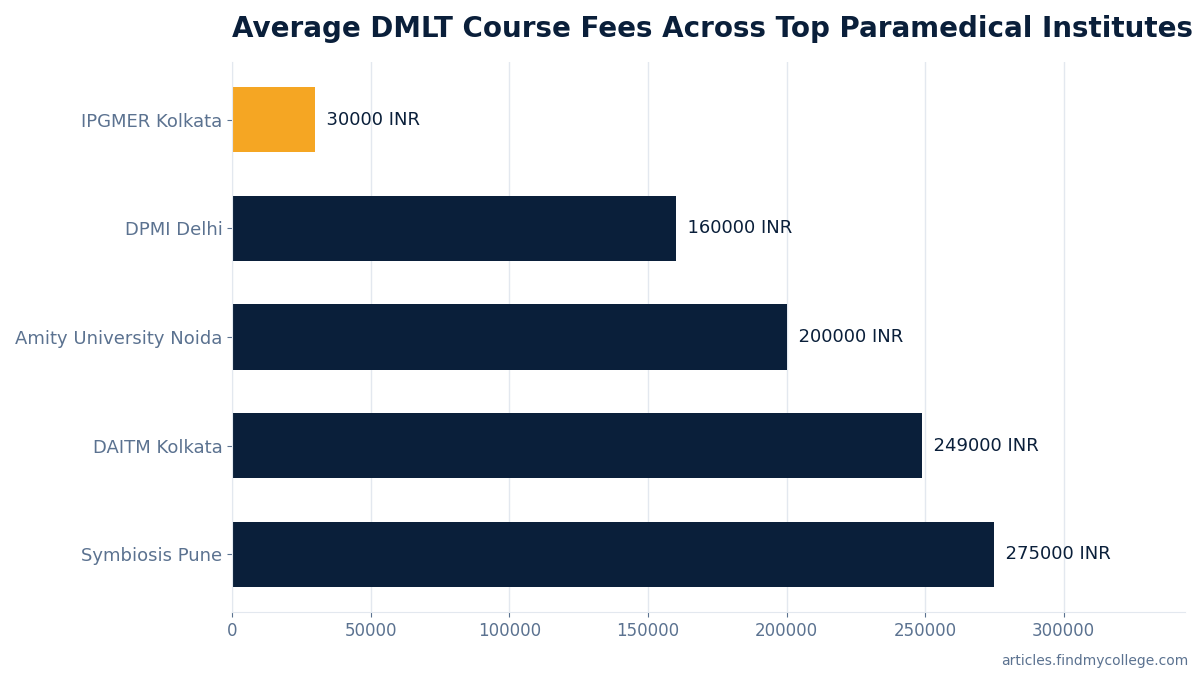
Institutions offering paramedical and diagnostic training include government medical colleges, dedicated management institutes, and private universities. Below is an overview of top colleges offering MLT programs alongside their average fee structures:
| College Name | Location | Average Course Fees |
|---|---|---|
| Institute of Postgraduate Medical Education and Research (IPGMER) | Kolkata, West Bengal | INR 30,000 |
| Delhi Paramedical And Management Institute (DPMI) | Delhi | INR 1,60,000 |
| Amity University | Noida, Uttar Pradesh | INR 2,00,000 |
| Dinabandhu Andrews Institute of Technology and Management | Kolkata, West Bengal | INR 2,49,000 |
| Symbiosis Institute of Health Sciences | Pune, Maharashtra | INR 2,75,000 |
Medical Lab Technology (DMLT/BMLT) Career Scope and Salary
Graduates of DMLT and BMLT programs must complete a compulsory 6-month to 1-year clinical internship in accredited diagnostic centers or affiliated hospitals to gain hands-on equipment exposure. To practice legally as a Medical Lab Technician in diagnostic setups, candidates must register with the respective State Paramedical Council or Medical Board to obtain a unique registration number.
The average starting salary for medical laboratory professionals ranges from INR 2 LPA to INR 5 LPA. Graduates can secure employment across private diagnostic chains, multi-specialty hospitals, blood banks, and public sector healthcare facilities. DMLT graduates can also secure government jobs in public sector hospitals, diagnostic labs, and public health agencies upon registering with state paramedical councils.
For further career advancement, higher study options after DMLT include BSc MLT, BSc Medical Imaging Technology, and PG Diplomas in Laboratory Services. Higher study options after BSc MLT include MSc MLT, MSc Microbiology, MSc Biochemistry, and specialized post-graduate diplomas.
How to Apply for Medical Lab Technology (DMLT/BMLT) Admission in 2026: Step by Step
- Verify Eligibility Criteria: Ensure completion of Class 10th (minimum 50% in PCB) for post-10th DMLT, or 10+2 Science (PCB/PCM with 45%-50% aggregate) for 10+2 DMLT/BSc MLT. Minimum age must be 17 years.
- Select Course Level & Specialisation: Choose between a Certificate course (6–12 months), Diploma in MLT/Blood Banking (1–2 years), or BSc MLT degree (3 years) based on career goals.
- Appear for Entrance Examinations (If Applicable): For BSc MLT degree programs, register and appear for university or national/state level entrance tests like NEET, KEAM, MET, Jamia Hamdard Entrance Test, or AP EAMCET.
- Submit Application Form: Fill out the online or offline application form of chosen colleges/universities and upload Class 10th and 12th marksheets along with identity proofs (Aadhaar card/Passport).
- Participate in Merit List & Counselling: Attend seat allocation counselling rounds conducted on the basis of 10+2 merit percentage or entrance exam ranks.
- Complete Practical Clinical Internship: Undergo mandatory 6-month to 1-year clinical internship in affiliated hospitals, diagnostic centres, or blood banks to gain real diagnostic equipment exposure.
- Register with State Paramedical Council: Apply to the relevant State Paramedical Council or Medical Board after internship completion to obtain professional registration and certification number.
| What to do | Where | Link |
|---|---|---|
| Compare colleges, fees and cutoffs | Medical Lab Technology (DMLT/BMLT) colleges in India | findmycollege.com |
FAQs
What is the official course name for blood test training in India?
The official course names are Diploma in Medical Laboratory Technology (DMLT) and Bachelor of Science in Medical Laboratory Technology (BSc MLT / BMLT). Specialised options include Diploma in Blood Banking Technology.
What is the course duration of DMLT?
DMLT course duration is typically 2 years. Specialised diploma or certificate variants in allied laboratory techniques range from 6 months to 2 years.
Which is better, DMLT or BMLT?
BMLT (BSc MLT) offers broader career growth, higher starting positions, and better eligibility for MSc and international jobs, whereas DMLT is a shorter, lower-cost 2-year entry-level program.
What is the starting salary after completing an MLT or DMLT course?
The average starting salary for medical lab technicians ranges from INR 2 LPA to INR 5 LPA, depending on job profile, institute reputation, and experience level.
Can I get a government job after DMLT?
Yes, DMLT graduates can secure government jobs in public sector hospitals, diagnostic labs, blood banks, and public health agencies upon registering with state paramedical councils.
Lab technician course in Hindi me kya kehte hain aur eligibility kya hai?
Lab technician courses ko Medical Lab Technology (DMLT ya BSc MLT) kehte hain. Iske liye 12th Science (PCB/PCM) me minimum 45%-50% marks aur 17 saal ki umar honi chahiye.