BSc Agriculture Subjects & Syllabus 2026: Semester-wise Breakdown
Aayush is a writer and content strategist who turns personal stories into brand narratives. With an experience spanning diverse industries, rely on his writing for simplifying complex subjects…
BSc Agriculture is a 4-year course with theory and practical subjects. Find out the detailed BSc syllabus with semester-wise breakdown in this article.
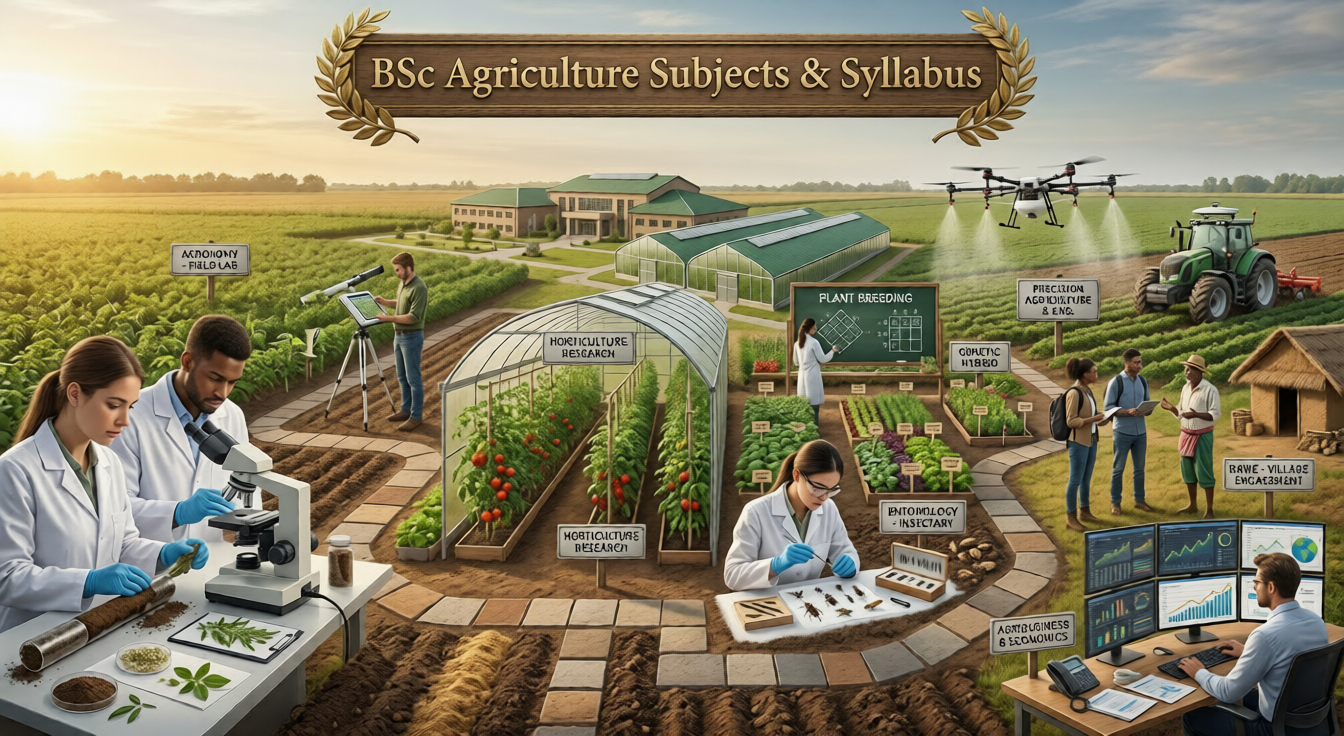
The BSc Agriculture subjects encompass a dynamic blend of scientific principles and practical applications, preparing students for a vital role in modern food production and sustainable resource management. This four-year undergraduate program integrates disciplines from agronomy and soil science to agricultural economics and biotechnology. Understanding this comprehensive curriculum is key to academic success and a thriving career in the agricultural sector. This article provides a detailed, semester-wise breakdown of the 2026 syllabus, including ICAR guidelines, elective options, and university-specific comparisons.
BSc Agriculture Core Subjects & Key Learning Areas 2026
The BSc Agriculture program, a 4-year undergraduate course, features a 2026 syllabus designed under ICAR guidelines and NEP 2020. It emphasizes practical learning, with 60% focus on skill-based training and mandatory field exposure annually. The curriculum for BSc Agriculture Subjects integrates comprehensive core and elective studies, complemented by a structured evaluation system.
| Category | Details |
| Core Subjects (Compulsory) | Agronomy, Soil Science, Horticulture, Plant Pathology, Entomology, Genetics & Plant Breeding. |
| Additional Core Subjects | Crop Physiology, Microbiology, Water use & irrigation methods, Basics of farm tools & machinery, Seed Technology, Agricultural Economics, Extension Education, Agricultural Botany, Animal Husbandry, Biotechnology, Agricultural Engineering. |
| Elective Subjects (Optional) | Organic Farming, Dairy Technology, Post-Harvest Technology, Agri-Business Management, Sustainable Agriculture, Food Processing. |
| Practical Evaluation (2026) | Theory Exam: 60%, Practical Exam: 30%, Internal Assessment: 10%. Marks based on field performance, laboratory records, internship, and training reports. |
BSc Agriculture Semester-wise Syllabus Breakdown 2026
The BSc Agriculture Syllabus 2026 has been significantly refined to align with NEP 2020 and ICAR guidelines, meticulously divided into eight semesters. This updated curriculum focuses on integrating modern technology with sustainable farming practices, ensuring a comprehensive understanding of key BSC Agriculture Subjects.
| Year | Semester | Subjects |
| Year 1: The Foundational Phase | Semester I | Fundamentals of Soil Science, Fundamentals of Horticulture, Rural Sociology & Educational Psychology, Introduction to Forestry, Comprehension & Communication Skills in English |
| Semester II | Fundamentals of Genetics, Agricultural Microbiology, Soil and Water Conservation Engineering, Fundamentals of Crop Physiology, Fundamentals of Agricultural Economics, Fundamentals of Plant Pathology | |
| Year 2: Technical Specialization | Semester III | Crop Production Technology – I (Kharif Crops), Fundamentals of Plant Breeding, Agricultural Finance and Cooperation, Agri-Informatics and Computer Applications, Farm Machinery and Power, Environmental Studies and Disaster Management |
| Semester IV | Crop Production Technology – II (Rabi Crops), Principles of Seed Technology, Problematic Soils and Their Management, Renewable Energy and Green Technology, Production Technology for Fruit and Plantation Crops, Introductory Agro-meteorology & Climate Change | |
| Year 3: Applied Agricultural Science | Semester V | Pests of Crops and Stored Grain and their Management, Diseases of Field and Horticultural Crops – I, Crop Improvement – I (Kharif Crops), Entrepreneurship Development and Business Communication, Geoinformatics and Precision Farming, Practical Crop Production – I |
| Semester VI | Rainfed Agriculture & Watershed Management, Post-harvest Management and Value Addition, Management of Beneficial Insects, Crop Improvement – II (Rabi Crops), Principles of Organic Farming, Farm Management, Production & Resource Economics | |
| Year 4: Professional Training & RAWE | Semester VII | Rural Agricultural Work Experience (RAWE) and Agro-Industrial Attachment (AIA) |
| Semester VIII | Experiential Learning Programme (ELP) / Modules for Skill Development (e.g., Commercial Horticulture, Bio-fertilizer Production) |
BSc Agriculture Theory vs Practical Subjects
BSc Agriculture is structured to balance theoretical agricultural science concepts with hands-on field and laboratory training. Across most Indian universities (as per ICAR-based curricula), every major subject includes both a classroom theory component and a corresponding practical component to build applied skills in farming and research systems.
Here is a clear separation of Theory vs Practical Subjects commonly followed in the BSc Agriculture curriculum:
| Theory Subjects (Classroom Learning) | Practical Subjects (Lab/Field Work) |
| Fundamentals of Agronomy (crop production principles, cropping systems) | Agronomy practical (field crop sowing, spacing, fertilizer application) |
| Fundamentals of Soil Science (soil properties, fertility, chemistry) | Soil Science practical (soil sampling, pH testing, nutrient analysis) |
| Plant Physiology (plant functions, growth processes) | Plant physiology lab experiments (growth measurement, tissue studies) |
| Genetics & Plant Breeding (inheritance, crop improvement theory) | Plant breeding practical (hybridization techniques, field selection) |
| Agricultural Entomology (pest classification, insect biology) | Entomology practical (pest identification, insect specimen study) |
| Plant Pathology (disease-causing organisms, plant diseases) | Pathology lab (disease diagnosis, slide preparation, culture techniques) |
| Agricultural Economics (farm economics, markets, pricing systems) | Economics practical (farm budgeting, market surveys, data analysis) |
| Agricultural Extension Education (rural communication methods) | Extension practical (field visits, farmer interaction programs) |
| Horticulture (fruit, vegetable, and plantation science concepts) | Horticulture practical (nursery work, grafting, pruning, plantation techniques) |
| Agricultural Engineering basics (farm machinery principles) | Engineering practical (tractor operation, irrigation system setup) |
| Crop Production Technology (principles of cultivation) | Field work (irrigation, sowing, harvesting, post-harvest handling) |
| Biochemistry & Biotechnology (molecular and biochemical processes) | Lab work (microscopy, enzyme tests, lab-based experiments) |
BSc Agriculture Elective Subjects & Specialization Options
Students pursuing a BSC Agriculture degree can explore diverse specialization options, each with a unique set of core subjects. This section details various specialization areas and the foundational courses associated with them, providing insight into the academic pathways available.
| BSc Agriculture Specialization | Subjects |
| Humanities and Basic Sciences | English Language Comprehension and Communication Abilities Rural Sociology and India’s Constitution Psychology in Education Computer Application Introduction |
| Agriculture Science (Agricultural Economics) | Agricultural Economics Principles Financial and Cooperative Principles Production Economics and Farm Management Essentials of Agricultural Business Management |
| Agricultural Engineering | Engineering Theory for Soil and Water Farm Equipment and Labor Protected Agricultural Structures and Processing Sources of Energy and how they are used in Agriculture |
| Agricultural Entomology | Entomology in General Economics of Insects Crop Pests and how to control them Sericulture |
| Agricultural Extension Education | Extension Education Principles, Rural Development, Agricultural Communication Techniques, Training & Visit System, Transfer of Technology in Agriculture |
High-Weightage BSc Agriculture Subjects for Entrance & Career
Focusing on high-weightage subjects is essential for excelling in competitive entrance exams like ICAR AIEEA and securing specialized roles in the public and private sectors. The following table highlights the core pillars of the curriculum that carry the most significant academic and professional value.
| Subject Category | Key High-Weightage Topics |
| Agronomy | Crop production (Kharif/Rabi), weed management, irrigation water management, and sustainable agriculture. |
| Genetics & Plant Breeding | Principles of heredity, molecular biology, hybrid seed production, and crop improvement techniques. |
| Soil Science | Soil fertility, nutrient management (NPK), pedology, and soil chemistry. |
| Entomology & Pathology | Identification of pests and pathogens, Integrated Pest Management (IPM), and pesticide toxicology. |
| Agricultural Economics | Farm management, production economics, agricultural marketing, and trade finance. |
| Agricultural Extension | Rural development programs, diffusion of innovations, and communication technology in farming. |
| Plant Physiology | Photosynthesis, respiration, plant growth regulators, and nutrient absorption. |
| Horticulture | Production technology of fruit, vegetable, and spice crops, including post-harvest management. |
TNAU vs UBKV vs Kumaraguru: BSc Agriculture Syllabus Comparison 2026
Tamil Nadu Agricultural University (TNAU), Uttar Banga Krishi Viswavidyalaya (UBKV), and Kumaraguru Institute of Agriculture (KIA) have updated their 2026 curricula to align with the ICAR VI Deans’ Committee and NEP 2020 guidelines. The new framework shifts the weightage toward a 60:40 practical-to-theory ratio, introducing a multi-exit system (Certificate, Diploma, or Degree) and mandatory skill-based modules.
| Feature | TNAU (Tamil Nadu) | UBKV (West Bengal) | Kumaraguru (KIA – TNAU Affiliate) |
| Core Framework | ICAR VI Deans’ Committee + NEP 2020. | ICAR VI Deans’ Committee + NEP 2020. | TNAU Affiliated (Follows TNAU 2026 Syllabus). |
| Practical Weightage | 60% Practical / 40% Theory; emphasis on drone tech and precision farming. | 60% Practical / 40% Theory; focus on North Bengal specific cropping & AI. | Identical to TNAU; heavy focus on Industry 4.0 in Agriculture. |
| New 2026 Subjects | Climate-Smart Ag, Digital Agronomy, and Drone Applications. | Watershed Management, Organic Farming, and AI in Agriculture. | Precision Farming, Agribusiness Analytics, and Sustainable Tech. |
| Skill Enhancement | Commercial Nursery, Hybrid Seed Production, and Bio-pesticides. | Mushroom Cultivation, Apiculture, and Post-Harvest Tech. | Integrated Farming Systems and Value Addition modules. |
| Field Training | RAWE & AIA (7th Sem); 10-week village stay + Industrial tie-ups. | RAWE (7th Sem); focus on tea/jute plantation ecosystems. | RAWE (7th Sem); integrated with rural development projects. |
| Exit Options | Certificate (1yr), Diploma (2yrs), Degree (3yrs), Honours (4yrs). | Certificate (1yr), Diploma (2yrs), Degree (3yrs), Honours (4yrs). | Standard 4-year Honours (aligned with TNAU exit policy). |
| Evaluation Method | 50% External Final / 50% Internal (Practical + Mid-term). | 50% External Final / 50% Internal (Practical + Mid-term). | 50% External Final / 50% Internal (Practical + Mid-term). |
BSc Agriculture Evaluation Process
Here is a breakdown of the evaluation process for most BSc Agriculture course:
| Component | Weightage | Evaluation Criteria |
| External Theory Exam | 50% | Comprehensive end-semester exam conducted by the University. |
| Internal Practical Exam | 20% | Evaluation of laboratory skills, field performance, and viva-voce. |
| Mid-Term Theory | 20% | Internal assessment conducted halfway through the semester. |
| Practical Records | 5% | Consistent maintenance and quality of field/lab observation books. |
| Assignments/Seminars | 5% | Evaluation of research papers, presentations, and individual projects. |
| RAWE / ELP (Year 4) | 100% | Performance-based grading for village stays and industrial internships. |
| Attendance | Mandatory | Minimum 75–80% required to qualify for the examination cycle. |
| Passing Standard | 50% | Minimum marks required in Theory and Practical separately to pass. |
How to Download Official BSc Agriculture Syllabus PDFs 2026
To download the official BSC Agriculture Subjects syllabus for 2026, students should primarily consult most university websites and the official ICAR portal. Here is a step by step guide:
Step 1: Identify Your University or Admission System: You must first confirm the university you are enrolled in or targeting, as BSc Agriculture syllabi differ across State Agricultural Universities, Central Universities, and ICAR-affiliated institutions.
Step 2: Visit the ICAR Official Website: Check the ICAR portal to understand the standard curriculum framework used as a reference by most agricultural universities in India.
Step 3: Locate Curriculum or Education Section: On the ICAR website, navigate to the Education or Curriculum section and look for the latest Deans’ Committee Report, which outlines the official syllabus structure and credit system.
Step 4: Visit Your University’s Official Website: Go to your respective university’s official portal and search for the Agriculture faculty or Academics section where the official syllabus PDFs are usually published.
Step 5: Download Semester-wise or Program-wise PDFs: Most universities provide syllabus files separated by semesters or academic years, so you may need to download multiple PDFs instead of a single document.
Step 6: Verify ICAR Compliance: Ensure the downloaded syllabus matches ICAR guidelines in terms of subjects, credit structure, and practical components to confirm it is the updated and valid version.
Step 7: Check Alternative Official Sources if Needed: If the syllabus is not available online, refer to the university prospectus, admission brochure, or contact the academic office for the official updated syllabus PDF.
Frequently Asked Questions
What core subjects are covered in a typical BSC Agriculture program?
BSc Agriculture includes core subjects like Agronomy, Soil Science, Horticulture, Genetics and Plant Breeding, Plant Pathology, Entomology, Agricultural Economics, and Extension Education, focusing on crop production, plant science, soil health, and sustainable farming systems.
What career opportunities open up after completing BSC Agriculture subjects?
Graduates can work in government agriculture departments, ICAR research institutes, banks like NABARD, agribusiness firms, and NGOs. Common roles include agricultural officer, field officer, agronomist, farm manager, and agri-entrepreneurship opportunities.
How do BSC Agriculture subjects differ from a general BSC in Horticulture?
BSc Agriculture covers broader areas like agronomy, soil science, economics, and engineering, while BSc Horticulture focuses specifically on fruits, vegetables, floriculture, and plantation crops, making agriculture more diverse and horticulture more specialized.
How can I choose the best specialization subjects within BSC Agriculture?
Select specialization based on interest and career goals. Research-oriented students prefer genetics or plant pathology, business-oriented students choose agribusiness or agricultural economics, while field-focused students prefer agronomy, horticulture, or crop production disciplines.