BSc Anthropology in India: Course Details, Eligibility, Syllabus, Colleges, Career Scope and Salary
BSc Anthropology is a unique undergraduate program that studies human beings from scientific, cultural, and historical perspectives. The course explains how humans evolved, how societies developed, and how different cultures shaped the modern world. Anthropology connects subjects like biology, sociology, history, archaeology, and environmental studies, making it an interdisciplinary course.
In India, anthropology is an important academic field because the country has rich cultural diversity, tribal communities, and historical heritage. Students who choose BSc Anthropology learn both theory and practical research methods such as fieldwork, surveys, and laboratory analysis.
This detailed guide explains all aspects of BSc Anthropology in India, including course structure, eligibility, syllabus, top colleges, skills required, career opportunities, salary, and future scope.
What is BSc Anthropology?
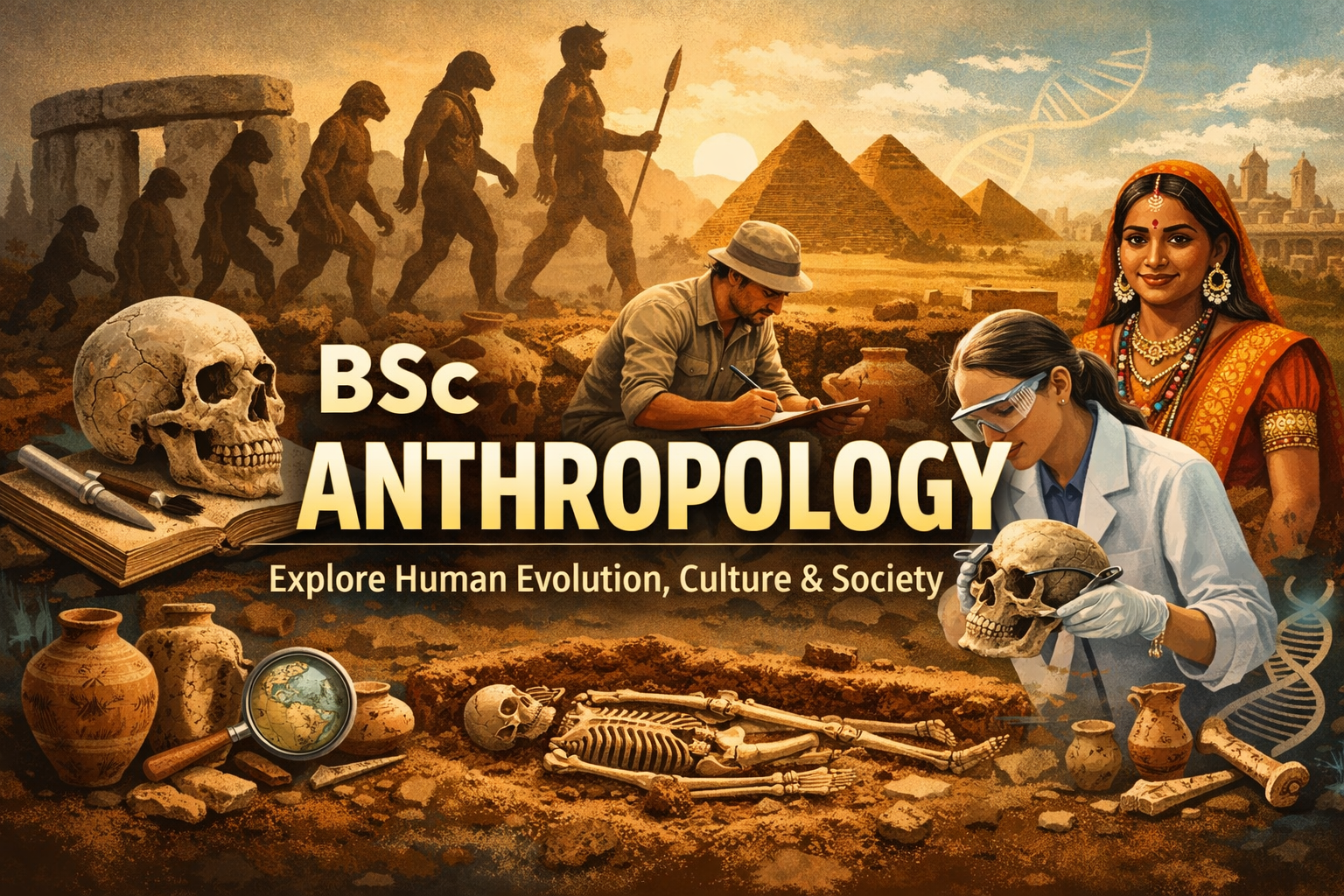
BSc Anthropology is a three-year undergraduate degree program that focuses on the scientific and cultural study of human beings. The course helps students understand how humans evolved biologically, how cultures formed, and how societies changed over time.
Anthropology studies humans from multiple perspectives. It is generally divided into three major branches:
Physical (Biological) Anthropology studies human evolution, genetics, and physical differences among populations. Students learn about fossils, human anatomy, and biological adaptation.
Social and Cultural Anthropology studies traditions, languages, customs, rituals, and social structures. This branch explains how people live in communities and how cultures influence behavior.
Archaeological Anthropology studies ancient civilizations through artifacts such as tools, pottery, and monuments. Students learn how historical discoveries help explain human history.
In India, anthropological research and documentation are carried out by institutions such as the Anthropological Survey of India, which studies tribal communities, cultural patterns, and human diversity across the country.
Anthropology is important because it helps us understand human identity, social differences, and cultural development in a scientific way.
BSc Anthropology: Key Highlights
| Particulars | Details |
|---|---|
| Course Name | BSc Anthropology |
| Course Level | Undergraduate |
| Course Duration | 3 Years (6 Semesters) |
| Stream | Science / Social Science |
| Eligibility | 10+2 from recognized board (Science preferred) |
| Admission Process | Merit-based or Entrance-based |
| Core Subjects | Physical Anthropology, Cultural Anthropology, Archaeology, Human Genetics, Forensic Anthropology |
| Practical Training | Fieldwork, Laboratory Work, Research Projects |
| Top Skills Developed | Observation Skills, Research Skills, Analytical Thinking, Communication |
| Career Options | Anthropologist, Research Assistant, Museum Curator, Forensic Assistant, NGO Professional |
| Average Starting Salary | ₹2 LPA – ₹4 LPA |
| Higher Study Options | MSc Anthropology, MA Anthropology, PhD, Forensic Science |
| Employment Areas | Research Institutes, Museums, Government Departments, NGOs, Universities |
| Future Scope | Growing demand in research, tribal development, and forensic sectors |
Why Study BSc Anthropology in India?
India is one of the most culturally diverse countries in the world. It has hundreds of languages, traditions, and tribal communities. Because of this diversity, anthropology becomes highly relevant for studying human lifestyles and cultural changes.
One major reason to study BSc Anthropology in India is the opportunity to explore real cultural diversity. Students can study tribal societies, rural communities, and urban cultures through field visits and research projects. This practical exposure makes the subject more interesting and meaningful.
Another important reason is the availability of research opportunities. Many government and academic institutions conduct research related to tribal welfare, social development, and cultural preservation. Anthropology graduates can participate in such projects.
Anthropology also supports careers in government departments, NGOs, and heritage organizations. The Indian government runs several programs for tribal development and social welfare, where anthropology graduates are required to conduct surveys and cultural analysis.
The course also provides interdisciplinary knowledge. Students learn biology, sociology, history, and environmental studies together, which helps them understand human life from multiple perspectives.
Duration of BSc Anthropology
The duration of the BSc Anthropology course is three years, divided into six semesters. Each semester is designed to gradually develop knowledge from basic concepts to advanced research methods.
In the first year, students learn introductory topics such as human evolution and cultural basics. The second year focuses on core anthropology subjects including social anthropology and biological anthropology. The final year includes advanced topics like forensic anthropology, tribal studies, and field research.
Practical learning plays an important role throughout the course. Students participate in laboratory work, museum studies, and field visits. Many universities also require students to complete a research project or dissertation in the final semester.
This structured duration helps students build strong theoretical knowledge along with practical research skills.
Eligibility Criteria for BSc Anthropology in India
Students who want to take admission in BSc Anthropology must meet basic academic requirements. The course is generally open to students from different educational backgrounds.
The most common eligibility requirement is completion of 10+2 from a recognized board with at least 45% to 60% marks. Science stream students are usually preferred because the course includes biological topics such as human genetics and anatomy. However, some universities also allow arts and commerce students.
Students who studied Biology in Class 12 may find it easier to understand subjects like physical anthropology and human evolution.
Top universities such as University of Delhi and University of Calcutta offer anthropology programs through merit or entrance-based admission systems.
Students should always check the eligibility criteria of specific colleges because requirements may vary.
| Criteria | Details |
|---|---|
| Educational Qualification | Students must complete 10+2 or equivalent from a recognized board |
| Minimum Marks Required | Generally 45%–60% aggregate marks (varies by college) |
| Stream Requirement | Science stream preferred, especially with Biology; some colleges allow Arts or Commerce |
| Age Limit | No specific age limit in most universities |
| Entrance Requirement | Some universities conduct entrance exams; others offer merit-based admission |
| Subject Preference | Biology or related subjects helpful for understanding physical anthropology |
| Reservation Criteria | Relaxation in marks may apply for reserved categories as per government norms |
Admission Process for BSc Anthropology
The admission process for BSc Anthropology depends on the university or college. Most institutions follow either merit-based or entrance-based admission.
In merit-based admission, students are selected based on their Class 12 marks. Colleges prepare cut-off lists and students who meet the criteria are offered admission.
In entrance-based admission, universities conduct exams to test students’ knowledge in basic science, logical reasoning, and general awareness. Some entrance tests also include questions related to social science topics.
Private colleges may offer direct admission based on eligibility requirements. Students should carefully check admission deadlines and application procedures to avoid missing opportunities.
The admission process usually starts between May and July in most Indian universities.
BSc Anthropology Course Structure
The course structure of BSc Anthropology is designed to develop knowledge step-by-step. Students begin with introductory subjects and gradually move toward advanced research topics.
In the first year, students learn basic concepts such as human evolution, introduction to anthropology, and fundamentals of sociology. This stage builds the academic foundation.
In the second year, students study core subjects including cultural anthropology, social anthropology, and archaeological methods. Practical sessions and small research projects are introduced.
In the third year, students learn applied and advanced topics such as forensic anthropology, tribal studies, and environmental anthropology. Fieldwork and dissertation projects become important at this stage.
This structured approach ensures students gain both theoretical understanding and practical research experience.
Semester-wise BSc Anthropology Syllabus
| Semester | Subjects |
|---|---|
| Semester 1 | Introduction to Anthropology, Human Evolution, Basics of Sociology, Human Biology, Environmental Studies |
| Semester 2 | Physical Anthropology, Cultural Anthropology, Archaeology Basics, Human Genetics, Communication Skills |
| Semester 3 | Social Anthropology, Anthropological Theories, Research Methods, Archaeological Techniques, Practical Lab Work |
| Semester 4 | Tribal Anthropology, Biological Anthropology, Statistics for Anthropology, Field Methods, Museum Studies |
| Semester 5 | Forensic Anthropology, Environmental Anthropology, Population Studies, Human Growth and Development |
| Semester 6 | Applied Anthropology, Dissertation/Project, Fieldwork Report, Data Analysis, Viva Voce |
This syllabus may vary slightly across universities, but the overall structure remains similar.
Important Subjects in BSc Anthropology
BSc Anthropology includes several interesting subjects that explain different aspects of human life.
Physical Anthropology teaches students about human evolution, skeletal structure, and genetic variation. Students learn how humans adapted to different environments over time.
Cultural Anthropology focuses on traditions, beliefs, languages, and cultural practices. It helps students understand how cultures influence daily life.
Archaeology explains how ancient civilizations are studied using artifacts and historical remains. Students learn excavation methods and artifact analysis.
Forensic Anthropology is one of the most exciting subjects. It involves identifying human remains for legal and criminal investigations.
Tribal Anthropology studies tribal communities, their lifestyles, and social structures. This subject is especially important in India because of its tribal diversity.
These subjects help students understand both scientific and cultural aspects of human life.
Practical Training and Fieldwork in BSc Anthropology
Fieldwork is one of the most important parts of the BSc Anthropology course. Unlike many other subjects, anthropology requires students to study real communities and environments.
During fieldwork, students visit villages, tribal regions, museums, or historical sites. They learn how to collect data through interviews, observation, and surveys.
Fieldwork helps students:
-
Understand real cultural practices
-
Improve research and observation skills
-
Learn data collection methods
-
Analyze social behavior
Students also prepare field reports and presentations based on their observations.
Practical training improves confidence and prepares students for research careers.
Skills Required for BSc Anthropology
To succeed in anthropology, students need a combination of research, communication, and analytical skills.
- Observation skills are very important because anthropologists study human behavior and cultural patterns. Students must carefully observe traditions and social interactions.
- Research skills are essential for collecting and analyzing data. Anthropology involves surveys, interviews, and documentation.
- Communication skills are necessary because students interact with different communities during fieldwork.
- Analytical thinking helps students understand cultural differences and interpret research findings.
- Students who develop these skills can build strong careers in anthropology.
Top Colleges Offering BSc Anthropology in India
Many universities in India offer BSc Anthropology with strong academic and research facilities.
Some well-known institutions include:
-
Panjab University
-
Utkal University
-
University of Hyderabad
These universities provide laboratory facilities, museum resources, and fieldwork opportunities for students.
When choosing a college, students should check faculty experience, research opportunities, and placement support.
Career Scope After BSc Anthropology in India
BSc Anthropology offers career opportunities in research, education, and social development sectors.
- Graduates can work as anthropologists, conducting research on human societies and cultural patterns. Research organizations and universities often hire anthropology graduates for project-based roles.
- Another career option is research assistant, where students assist senior researchers in collecting and analyzing data.
- Anthropology graduates can also work in museums as museum curators, managing cultural artifacts and exhibitions.
- Forensic anthropology is an emerging field where graduates assist in analyzing human remains for legal investigations.
- NGOs working in tribal welfare and social development also hire anthropology graduates for survey and community programs.
Career growth improves significantly after postgraduate studies.
Employment Areas for Anthropology Graduates
Anthropology graduates can work in multiple sectors depending on their specialization.
Common employment areas include:
-
Research institutes
-
Museums and heritage centers
-
Government departments
-
NGOs
-
Archaeological departments
-
Universities and colleges
Government organizations working in tribal development and cultural preservation frequently require anthropology experts.
The variety of employment areas makes anthropology a flexible career field.
Salary After BSc Anthropology in India
The salary after BSc Anthropology depends on skills, job role, and experience.
Fresh graduates usually earn between ₹2 LPA and ₹4 LPA in entry-level roles such as research assistants or project staff.
With experience or postgraduate education, salaries may increase to ₹5 LPA to ₹8 LPA or more.
Students who complete MSc or PhD and enter academic or research careers can earn higher salaries along with long-term career stability.
Field experience and research skills also improve salary opportunities.
Higher Study Options After BSc Anthropology
Many students pursue higher education to improve career prospects.
MSc Anthropology is the most common option. It provides advanced knowledge in biological, cultural, and forensic anthropology.
Students interested in cultural research may choose MA Anthropology.
Those interested in academic careers often pursue PhD in Anthropology, which focuses on advanced research.
Some students also move toward forensic science courses to specialize in forensic anthropology.
Higher education improves both job roles and salary growth.
Difference Between Anthropology and Sociology
| Feature | Anthropology | Sociology |
|---|---|---|
| Study Focus | Human evolution and culture | Social relationships |
| Approach | Biological + Cultural | Social Science |
| Fieldwork | Very important | Moderate |
| Career Scope | Research and cultural studies | Social policy and services |
Anthropology studies both biological and cultural aspects of humans, while sociology mainly studies social structures and relationships.
Future Scope of BSc Anthropology in India
The future scope of anthropology in India is growing due to increasing interest in cultural studies and forensic science.
New opportunities are developing in:
-
Forensic investigations
-
Heritage management
-
Cultural tourism
-
Social research projects
Government programs related to tribal welfare also require anthropology professionals.
Technology is also improving anthropology research through digital mapping and data analysis.
Students who develop strong research and analytical skills will have good career opportunities.
Challenges in BSc Anthropology
Although anthropology is an interesting subject, students should understand some challenges.
- Fieldwork requires time and travel, which may not be comfortable for everyone. Research work also requires patience and detailed observation.
- Job opportunities at entry level may be limited compared to some other fields, which is why higher education becomes important.
- Students who remain dedicated to research and skill development can overcome these challenges.
Tips to Succeed in BSc Anthropology
Students can improve their career opportunities by following some simple steps.
- Participating actively in fieldwork helps develop practical knowledge. Students should also improve research writing skills because anthropology involves report preparation.
- Reading about world cultures and human history increases subject understanding.
- Learning basic statistics and data analysis improves research quality.
- Most importantly, students should consider postgraduate studies for better career growth.
Conclusion
BSc Anthropology is a fascinating course that helps students understand human evolution, culture, and social systems. The subject combines science and social research, making it unique and informative.
In India, anthropology plays an important role in tribal studies, cultural research, and forensic science. Students who develop strong research skills and continue higher education can build successful careers in research organizations, government departments, museums, and academic institutions.
For students interested in human history, culture, and scientific research, BSc Anthropology is an excellent career choice with growing future opportunities.
FAQs
1. What is BSc Anthropology?
BSc Anthropology is an undergraduate course that studies human evolution, culture, biology, and society. It combines scientific and social research methods to understand human development, cultural diversity, and behavioral patterns across different regions.
2. What is the duration of BSc Anthropology in India?
The duration of BSc Anthropology in India is three years, divided into six semesters. The course includes theoretical subjects, laboratory practicals, fieldwork training, research projects, and dissertation work in the final year.
3. What is the eligibility for BSc Anthropology?
Students must complete 10+2 from a recognized board with minimum required marks. Science students are usually preferred, especially with Biology, but some colleges also allow arts or commerce students.
4. What subjects are included in BSc Anthropology?
BSc Anthropology includes subjects like physical anthropology, cultural anthropology, archaeology, human genetics, tribal studies, research methods, statistics, forensic anthropology, environmental anthropology, and fieldwork-based practical training.
5. What are the career options after BSc Anthropology?
After completing BSc Anthropology, students can work as research assistants, anthropologists, museum curators, forensic assistants, social researchers, or NGO professionals. Higher education improves opportunities in academic and advanced research fields.
6. What is the salary after BSc Anthropology in India?
Fresh graduates in anthropology usually earn between ₹2 lakh to ₹4 lakh annually. Salary increases with experience, specialization, postgraduate degrees, and research-based roles in government organizations or institutions.
7. What are higher study options after BSc Anthropology?
Students can pursue MSc Anthropology, MA Anthropology, PhD in Anthropology, or forensic science programs. Higher studies help students specialize in research areas and improve career growth opportunities significantly.
8. Why is fieldwork important in BSc Anthropology?
Fieldwork is important because it provides practical exposure to real communities and cultures. Students learn data collection, observation techniques, survey methods, and cultural analysis through direct interaction and research activities.
9. Who should study BSc Anthropology?
BSc Anthropology is suitable for students interested in human evolution, cultural diversity, history, biology, and research. Students who enjoy fieldwork, observation, and understanding social behavior will benefit from this course.
10. What is the future scope of BSc Anthropology in India?
The future scope of BSc Anthropology is growing due to increasing demand in cultural research, forensic science, tribal welfare programs, heritage management, and academic institutions focusing on human development studies.