BSc Anthropology in India: Admissions, Colleges, Fees & Career Scope
Simran is currently working as a Senior Content Writer at Findmycollege , where she creates engaging and research-driven learning resources for students. She has completed her Graduation in…
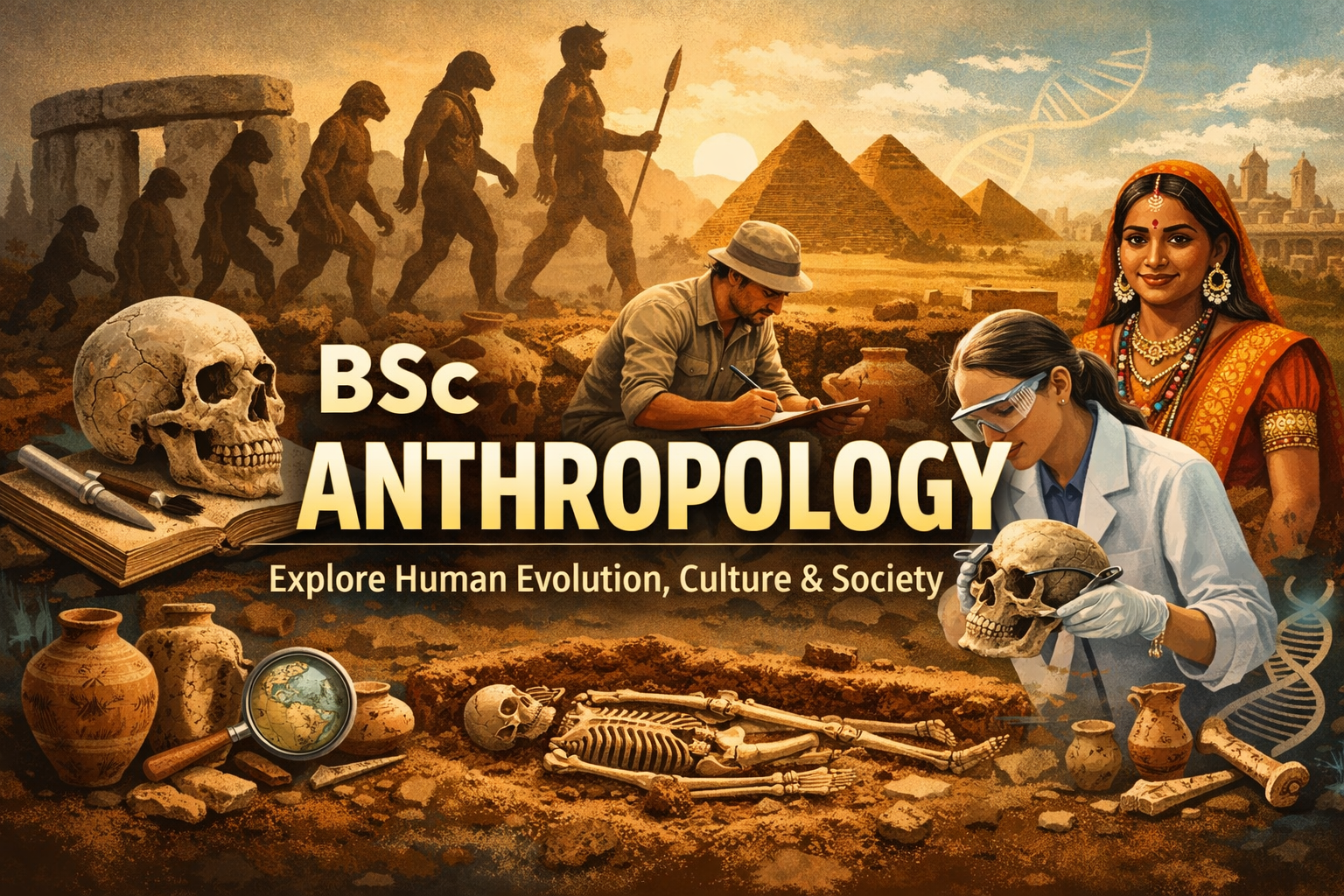
Did you know that BSc Anthropology is a 3-year undergraduate program that provides scientific knowledge about human evolution, culture, and behavior from biological, cultural, linguistic, and archaeological perspectives? With over 51 colleges in India offering this course, the average fee for BSc Anthropology ranges from ₹50,000 to ₹3 lakh per year. As of 2026, the admission process for BSc Anthropology is based on merit and entrance exams such as IAT IISER, OUAT, NEST, and CUET UG 2026.
| Parameter | Details |
|---|---|
| Course Definition | A 3-year undergraduate program (6 semesters) that provides scientific knowledge about human evolution, culture, and behavior from biological, cultural, linguistic, and archaeological perspectives. |
| Course Duration | 3 Years (Undergraduate Program, 6 Semesters) |
| Key Areas of Study | Biological Anthropology, Socio-cultural Anthropology, Archaeological Anthropology, Linguistic Anthropology. |
| Eligibility | Intermediate (10+2) from a recognized board with Physics, Chemistry, Biology, and/or Mathematics as major subjects. |
| Admission Mode | Merit-based and/or Entrance Exams (e.g., IAT IISER, OUAT, NEST, CUET UG 2026). Lateral entry options are available in some institutions. |
| Average Annual Fees | ₹50,000 – ₹3 Lakh (per year, varies by institution). |
| Career Opportunities | Graduates can work in MNCs, government departments (e.g., archaeological), general/health insurance, consulting firms, teaching, research, NGOs, higher education, museums, archives, and global organizations (WHO, UNESCO, UNICEF). |
| Average Salary Range | ₹2-9 LPA (for freshers, varies by organization, experience, and role). |
| Top Colleges | University of Delhi, Indira Gandhi National Open University (IGNOU), Aligarh Muslim University, University of Calcutta, Hansraj College, Miranda House. |
| Entrance Exams | IAT IISER, OUAT, NEST, CUET UG 2026. |
| Application Deadline | August 26, 2026 (for some colleges). |
The BSc Anthropology course structure is designed with industry demands in mind, focusing on research methods and data analysis, and incorporates quantitative techniques. Graduates can pursue jobs in India as well as abroad in Multinational Corporations, and are hired in organizations such as general insurance companies, health insurance companies, consulting firms, archaeological sites, teaching, research work, and global organizations like WHO, UNESCO, and UNICEF.
BSc Anthropology: Types, Categories & Key Components Explained
🔔 Admission Alerts 2026
- Application Open: IGNOU January 2026 session admissions began December 15, 2025.
- Deadline Nearing: IGNOU BA January 2026 session application closes January 31, 2026.
- MA Anthropology: IGNOU January 2026 session applications close March 15, 2026.
- BSc Anthropology: IGNOU 2026-27 session applications will open soon.
- UPSC CSE Mains: Anthropology Optional Syllabus 2026 available for download.
As of 2026, BSc Anthropology is a 3-year undergraduate program (6 semesters) that provides scientific knowledge about human evolution, culture, and behavior, encompassing biological, cultural, linguistic, and archaeological perspectives. The course structure is designed with industry demands in mind, featuring a mix of core and elective subjects, and aims to provide vital infrastructure for detailed learning. Key topics include Indian society, cultural change, and human evolution, with eligibility criteria requiring candidates to have completed Intermediate (10+2) from a recognized board with Physics, Chemistry, Biology, and/or Mathematics as major subjects.
| Type/Category | Details | Key Feature |
|---|---|---|
| BSc Anthropology Course Overview | A 3-year undergraduate program (6 semesters) that provides scientific knowledge about human evolution, culture, and behavior. | Interdisciplinary scientific study of humankind. |
| BSc Anthropology Course Structure | The curriculum is designed with industry demands in mind, featuring a mix of core and elective subjects. | Industry-aligned, full, and research-oriented curriculum. |
| Major Branches of Anthropology | The course thoroughly examines Socio-cultural Anthropology, Biological Anthropology, Linguistic Anthropology, and Archaeological Anthropology. | understanding of human diversity and development. |
| BSc Anthropology Eligibility Criteria | Candidates must have completed Intermediate (10+2) from a recognized board with Physics, Chemistry, Biology, and/or Mathematics as major subjects. | Mandatory science stream background in 10+2. |
| BSc Anthropology Admission Process | Admission is based on both merit (10+2 scores) and entrance exams such as IAT IISER, OUAT, NEST, and CUET UG (expected May 2026). | Dual admission modes (Merit & Entrance Exams). |
| BSc Anthropology Distance Education | Offered by institutions like Indira Gandhi National Open University (IGNOU), Andhra University, University of Madras, and Dr B R Ambedkar Open University. | Flexible and affordable learning for working professionals. |
| Leading Institutions for BSc Anthropology | Prominent universities include University of Delhi (with colleges like Hansraj and Miranda House), Aligarh Muslim University, University of Calcutta, Banaras Hindu University, Lucknow University, and Amity University. | Wide range of full-time and part-time programs across India. |
| Career Opportunities after BSc Anthropology | Graduates can work in multinational corporations, government archaeological departments, NGOs, higher education, museums, research, and global organizations like WHO, UNESCO, and UNICEF. | Diverse employment across public, private, and international sectors. |
| BSc Anthropology Average Salary | Starting salaries typically range from ₹1.2-2 LPA, with the average salary for graduates ranging between ₹2-9 LPA in India. | Promising career growth with experience and specialization. |
| Delhi University BSc (Hons) Anthropology Fees | Annual fees for UG BSc Hons courses are ₹0.33 lakh (per year). | Specific fee structure for a top-ranked institution. |
| BSc Anthropology Course Duration | 3 years (6 semesters) | Standard undergraduate program duration. |
| BSc Anthropology Specializations | Socio-cultural Anthropology, Biological Anthropology, Linguistic Anthropology, and Archaeological Anthropology. | Interdisciplinary approach to understanding human diversity. |
| BSc Anthropology Admission Mode | Merit-based and entrance exams like IAT IISER, OUAT, NEST, and CUET UG. | Dual admission modes for flexibility. |
| BSc Anthropology Top Colleges | University of Delhi, Aligarh Muslim University, University of Calcutta, Banaras Hindu University, Lucknow University, and Amity University. | Prominent institutions offering BSc Anthropology programs. |
The BSc Anthropology program offers a full understanding of human evolution, culture, and behavior, with a focus on interdisciplinary scientific study. The course structure is designed to provide vital infrastructure for detailed learning, with a mix of core and elective subjects. Graduates can pursue careers in multinational corporations, government archaeological departments, NGOs, higher education, museums, research, and global organizations like WHO, UNESCO, and UNICEF, with starting salaries ranging from ₹1.2-2 LPA and average salaries between ₹2-9 LPA in India.
BSc Anthropology: Key Statistics & Data Points for 2026
As of 2026, there are over 51 colleges in India offering BSc Anthropology, with average fees ranging from ₹0.5-3 lakh (total) and average salary packages of ₹3-4 lakhs LPA. The highest salary package for BSc Anthropology graduates can go up to ₹62 lakhs LPA. Top colleges for BSc Anthropology in India include Delhi University, Indira Gandhi National Open University (IGNOU), and Aligarh Muslim University.
| College | Location | Fees (Per Year) | NIRF Rank | Placement % | Admission Mode |
|---|---|---|---|---|---|
| Delhi University | New Delhi, Delhi NCR | ₹33,000 | 601-800 | 91% | Merit-based & Entrance Exams |
| Indira Gandhi National Open University (IGNOU) | Nationwide | ₹6,000 | – | – | Online & Distance Learning |
| Aligarh Muslim University | Aligarh, Uttar Pradesh | ₹14,260 | – | – | Merit-based & Entrance Exams |
| University of Calcutta | Kolkata, West Bengal | ₹5,170 | – | – | Merit-based & Entrance Exams |
| Andhra University Visakhapatnam | Visakhapatnam, Andhra Pradesh | ₹12,500 | – | – | Merit-based & Entrance Exams |
| University of Madras (UNOM) | Chennai, Tamil Nadu | ₹14,260 | – | – | Merit-based & Entrance Exams |
| Dr B R Ambedkar Open University Hyderabad (BRAOU) | Hyderabad, Telangana | ₹6,000 | – | – | Online & Distance Learning |
| Hansraj College | Delhi | ₹540 | – | – | Merit-based & Entrance Exams |
| Miranda House | Delhi | ₹14,260 | – | – | Merit-based & Entrance Exams |
| All India Institute of Medical Sciences (AIIMS), Delhi | Delhi | ₹59,720 | – | – | Entrance Exams |
| Ranchi University | Ranchi, Jharkhand | ₹14,260 | – | – | Merit-based & Entrance Exams |
| Banaras Hindu University | Varanasi, Uttar Pradesh | ₹20,000-2,00,000 | – | – | Merit-based & Entrance Exams |
| Lucknow University | Lucknow, Uttar Pradesh | ₹14,260 | – | – | Merit-based & Entrance Exams |
| Amity University | Noida, Uttar Pradesh | ₹50,000-3,00,000 | – | – | Merit-based & Entrance Exams |
| Shiv Nadar University, Delhi-NCR | Delhi-NCR | ₹14,260 | – | – | Merit-based & Entrance Exams |
| Panjab University | Chandigarh | ₹44,985 | – | – | Merit-based & Entrance Exams |
| NIMS University | Jaipur, Rajasthan | ₹50,000-3,00,000 | – | – | Merit-based & Entrance Exams |
| Bangabasi Morning College | Kolkata, West Bengal | ₹5,170 | – | – | Merit-based & Entrance Exams |
| Bidhannagar College | Salt Lake City, Kolkata | ₹5,170 | – | – | Merit-based & Entrance Exams |
| Vivekananda College For Women | Kolkata, West Bengal | ₹14,260 | – | – | Merit-based & Entrance Exams |
| Cotton College | Guwahati, Assam | ₹14,260 | – | – | Merit-based & Entrance Exams |
| Acharya Prafulla Chandra College | Kolkata, West Bengal | ₹5,170 | – | – | Merit-based & Entrance Exams |
| Narasinha Dutt College | Howrah, West Bengal | ₹14,260 | – | – | Merit-based & Entrance Exams |
| University of Pune | Pune, Maharashtra | ₹20,000-2,00,000 | – | – | Merit-based & Entrance Exams |
| Rayat Bahra University | Mohali, Punjab | ₹50,000-3,00,000 | – | – | Merit-based & Entrance Exams |
| Harvard | Abroad | – | – | – | Entrance Exams |
| Yale | Abroad | – | – | – | Entrance Exams |
| Cambridge | Abroad | – | – | – | Entrance Exams |
| ANU | Abroad | – | – | – | Entrance Exams |
| University of Roehampton | Abroad | GBP 13,145 | – | – | Entrance Exams |
| Durham University | Abroad | GBP 21,500 | – | – | Entrance Exams |
| University of Victoria | Abroad | CAD 25,860 | – | – | Entrance Exams |
Annual Fees for BSc Anthropology Colleges
The average salary package for BSc Anthropology graduates in India is around ₹3-4 lakhs LPA, with the highest package going up to ₹62 lakhs LPA. Top recruiters include Multinational Corporations, general insurance companies, health insurance companies, consulting firms, archaeological sites, WHO, UNESCO, UNICEF, and government research institutes.
How BSc Anthropology Works: Process, Steps & Key Details
The BSc Anthropology course is a 3-year undergraduate program divided into 6 semesters, providing scientific knowledge about humans from biological, cultural, linguistic, and archaeological views. The average fee for BSc Anthropology courses in India ranges from ₹50,000 to ₹3,00,000. Admission to BSc Anthropology is based on merit and entrance exams such as IAT IISER, OUAT, NEST, and many others administered by various colleges and universities.
- The eligibility criteria for BSc Anthropology require candidates to have completed Intermediate (10+2) from a recognized board with major subjects of Physics, Chemistry, Biology, and/or Mathematics, with a minimum aggregate percentage of 50-60%.
- The course structure is designed with industry demands in mind, focusing on research methods and data analysis, and incorporates quantitative techniques to prepare students for research and corporate roles.
- Some colleges and universities in India, such as Indira Gandhi National Open University (IGNOU), offer BSc Anthropology through distance education, with a total fee ranging from ₹15,000 to ₹50,000 annually.
- The BSc Anthropology program covers various specializations, including biological anthropology, social anthropology, archaeological anthropology, and linguistic anthropology.
- Graduates of BSc Anthropology can pursue careers in research, teaching, museum curation, social work, and public policy, with average salary packages ranging from ₹3-4 LPA.
- Top colleges offering BSc Anthropology include University of Delhi, Indira Gandhi National Open University (IGNOU), Aligarh Muslim University, and University of Calcutta, with notable features such as strong anthropology departments and affordable fees.
- The admission process for BSc Anthropology involves merit-based admission and entrance exams, with some colleges allowing lateral entry into the course.
- The course provides a full understanding of human evolution, culture, and behavior, with core subjects including Indian society and culture, social cultural change, gerontology, and archaeology.
the BSc Anthropology course provides a full understanding of human societies and cultures, with various specializations and career opportunities, and is offered by top colleges in India with affordable fees and notable features.
BSc Anthropology: Benefits, Advantages & Why Students Choose IT
BSc Anthropology is a 3-year undergraduate program that provides scientific knowledge about humans from biological, cultural, linguistic, and archaeological views, with average fees ranging from ₹50,000 to ₹3,00,000. The course structure is designed with industry demands in mind, focusing on research methods and data analysis, and prepares students for research and corporate roles. As of 2026, the average salary package for BSc Anthropology graduates is around ₹3-4 LPA, with top roles in multinational corporations, general insurance companies, health insurance companies, consulting firms, and global organizations like WHO, UNESCO, and UNICEF.
- The BSc Anthropology program offers a wide range of career opportunities, including roles in teaching, research, museums, archives, and global organizations, with hiring companies such as Multinational Corporations, general insurance companies, health insurance companies, consulting firms, and archaeological sites.
- Graduates of BSc Anthropology can pursue higher education options like MA, MSc, and PhD in Anthropology, with admission based on merit and entrance exams like IAT IISER, OUAT, NEST, and many others administered by various colleges and universities.
- The course covers various specializations, including biological anthropology, social anthropology, archaeological anthropology, and linguistic anthropology, providing students with a full understanding of human evolution, culture, and behavior.
- Top colleges offering BSc Anthropology include University of Delhi, Indira Gandhi National Open University (IGNOU), Aligarh Muslim University, University of Calcutta, and Andhra University Visakhapatnam, with fees ranging from ₹15,000 to ₹2,00,000.
- BSc Anthropology graduates can work in various sectors, including government, corporate, and research, with average salaries ranging from ₹2 LPA to ₹9 LPA, and highest packages up to ₹62,00,000.
- The course provides students with skills like data collection methods, research design principles, analytical tools, and cultural intelligence, making them suitable for roles like anthropologist, research assistant, museum manager, and social worker.
- Some colleges and universities in India offer lateral entry into the BSc Anthropology course, and admission is based on merit and entrance exams, with eligibility criteria including Intermediate (10+2) from a recognized board with major subjects of Physics, Chemistry, Biology, and/or Mathematics.
BSc Anthropology is a rewarding career option that provides students with a full understanding of human evolution, culture, and behavior, and offers a wide range of career opportunities in various sectors, making IT a popular choice among students in 2026.
BSc Anthropology vs Alternatives: Which Option is Best?
BSc Anthropology is a 3-year undergraduate program that provides scientific knowledge about humans from biological, cultural, linguistic, and archaeological views, with an average fee ranging from ₹50,000 to ₹3,00,000. In contrast, alternative programs like BA Anthropology focus on the study of social beings and human behavior, with a similar duration and fee structure. According to the latest available data, the average salary package for BSc Anthropology graduates is around ₹3-4 LPA.
| Feature | BSc Anthropology | Alternative 1 (BA Anthropology) | Alternative 2 (MA/MSc Anthropology) |
|---|---|---|---|
| Program Type | Undergraduate Degree | Undergraduate Degree | Postgraduate Degree |
| Primary Study Area | Human evolution, culture, behavior (scientific, biological, cultural, linguistic, archaeological views) | Social beings, human behavior (sociocultural, biological, linguistic, archaeological sciences); theoretical analysis | Advanced theoretical study of anthropological concepts |
| Admission Process | Merit-based or Entrance Exams (IAT IISER, OUAT, NEST, CUET) | Merit-based or Entrance Exams | Merit-based or Entrance Exams |
| Research Component | Expected research project; quantitative research, statistical analysis, laboratory-based learning | Critical thinking skills through essay-based assessments | Dissertation-based research, independent scholarly work |
| Career Scope | Multinational Corporations, archaeological sites, teaching, research, global organisations (WHO, UNESCO, UNICEF), government departments, NGOs, higher education, museum, archives, social work, public policy | Research, social services, government departments, international organizations, diplomatic services | Research, social services, government departments, international organizations, diplomatic services |
| Target Audience | Students interested in biological, sociological, and cultural history of human species; enjoy research, data analysis, scientific methodology | Students interested in social beings and human behavior; prefer reading, writing, theoretical analysis | Students seeking advanced theoretical study with dissertation-based research |
The BSc Anthropology program offers a unique blend of scientific and cultural knowledge, making IT an attractive option for students interested in human evolution, culture, and behavior. However, alternative programs like BA Anthropology and MA/MSc Anthropology also offer valuable insights into human behavior and societal structures, making them worth considering for students with different interests and career goals.
Common Misconceptions About BSc Anthropology: Myths vs Reality
BSc Anthropology is often misunderstood as a course that only deals with the study of human evolution and culture. However, IT a broad range of topics, including biological, sociological, and archaeological aspects of human beings. In 2026, the average salary package for BSc Anthropology graduates in India ranges from ₹3-4 LPA. Despite the misconceptions, BSc Anthropology offers a wide range of career opportunities in fields such as research, teaching, and global organizations like WHO, UNESCO, and UNICEF.
- Myth: BSc Anthropology is only about studying human evolution and culture. Reality: IT covers a wide range of topics, including biological, sociological, and archaeological aspects of human beings, with a total fee ranging from ₹50,000 to ₹3,00,000 for the entire course.
- Myth: BSc Anthropology has limited career opportunities. Reality: Graduates can pursue jobs in India and abroad in Multinational Corporations, general insurance companies, health insurance companies, consulting firms, archaeological sites, teaching, research work, and global organizations like WHO, UNESCO, and UNICEF, with an average salary package of ₹3-4 LPA.
- Myth: BSc Anthropology is only offered by a few colleges in India. Reality: Many leading universities, including the University of Delhi, Aligarh Muslim University, and the University of Calcutta, offer this course full-time or part-time, with over 51 colleges offering BSc Anthropology in India.
- Myth: BSc Anthropology admission is only based on merit. Reality: While some colleges accept merit scores, others use entrance exams like IAT IISER, OUAT, NEST, and many others administered by various BSc Anthropology colleges and universities, with a minimum eligibility criterion of 10+2 from a recognized board.
- Myth: BSc Anthropology has no scope for research. Reality: Graduates of the BSc Anthropology program are expected to work on research projects, which are important for assessing a student’s understanding of the specialization, and can pursue higher education in MA, MSc, or PhD Anthropology.
BSc Anthropology is a versatile course that offers a wide range of career opportunities and has a significant scope for research, making IT an attractive option for students interested in studying human societies, cultures, and evolution.
What to Do Next: Actionable Steps for Students Interested in BSc Anthropology
For students interested in pursuing BSc Anthropology in 2026, the first step is to check the eligibility criteria, which typically includes completing Intermediate (10+2) from a recognized board with major subjects of Physics, Chemistry, Biology, and/or Mathematics. The admission process is based on merit and entrance exams such as IAT IISER, OUAT, NEST, with some colleges allowing lateral entry. The total fee for BSc Anthropology can range from ₹50,000 to ₹3,00,000, with an average salary package of ₹3-4 LPA.
- Check the eligibility criteria: Intermediate (10+2) from a recognized board with major subjects of Physics, Chemistry, Biology, and/or Mathematics, with a minimum aggregate percentage of 50-60%.
- Apply for entrance exams: IAT IISER, OUAT, NEST, and other exams administered by various BSc Anthropology colleges and universities, with application deadlines such as August 26, 2026.
- Explore colleges: Research top colleges offering BSc Anthropology, such as Delhi University, Indira Gandhi National Open University (IGNOU), and University of Calcutta, with fees ranging from ₹15,000 to ₹2,00,000 per year.
- Consider lateral entry: Some colleges and universities in India allow lateral entry into the BSc Anthropology course, with notable features such as flexible learning and affordable fees.
- Check the course structure: BSc Anthropology is a 3-year undergraduate program divided into 6 semesters, with specializations in biological anthropology, social anthropology, and archaeological anthropology.
- Prepare for placements: BSc Anthropology graduates can pursue jobs in Multinational Corporations, general insurance companies, health insurance companies, consulting firms, and global organizations like WHO, UNESCO, and UNICEF, with average salary packages ranging from ₹3-4 LPA.
students interested in BSc Anthropology should start by checking the eligibility criteria, applying for entrance exams, and exploring top colleges, with a focus on placements and career opportunities.
Key Takeaways
- The eligibility criteria for BSc Anthropology typically includes completing Intermediate (10+2) from a recognized board with major subjects of Physics, Chemistry, Biology, and/or Mathematics.
- The admission process is based on merit and entrance exams such as IAT IISER, OUAT, NEST, with application deadlines such as August 26, 2026.
- BSc Anthropology graduates can pursue jobs in Multinational Corporations, general insurance companies, health insurance companies, consulting firms, and global organizations like WHO, UNESCO, and UNICEF, with average salary packages ranging from ₹3-4 LPA.
Check eligibility and apply at the official website of your desired college before the application deadline, such as August 26, 2026, and explore top colleges offering BSc Anthropology, such as Delhi University and IGNOU, for a rewarding career in anthropology.
Frequently Asked Questions (FAQs)
BSc Anthropology freshers ki average salary kitni hoti hai India mein?
BSc Anthropology freshers can expect an average salary of ₹3-4 lakhs per annum in India. According to Collegedunia, the average salary package for BSc Anthropology graduates is around ₹3-4 lakhs, with some colleges offering higher packages up to ₹9.6 lakhs. As per 2026 data, Delhi University’s BSc Anthropology graduates have been placed with an average salary of ₹4.5 lakhs.
Top colleges mein BSc Anthropology course ki fees kitni hai India mein?
The fees for BSc Anthropology course in top colleges in India can range from ₹33,000 to ₹1.5 lakhs per year. For example, Delhi University’s BSc Anthropology course fees are ₹33,000 per year, while some private colleges may charge up to ₹1.5 lakhs per year. , hostel fees can range from ₹59,720 to ₹81,040 per year.
BSc Anthropology ke liye minimum percentage kitni chahiye 12th mein?
The minimum percentage required for BSc Anthropology admission is typically 50-60% in 12th standard, depending on the college and university. For example, Delhi University requires a minimum of 55% marks in 12th standard for BSc Anthropology admission. Some colleges may also consider entrance exam scores like CUET.
Which are the best government colleges for BSc Anthropology in Delhi?
Some of the best government colleges for BSc Anthropology in Delhi include Hansraj College, Miranda House, and Delhi University. These colleges are known for their strong anthropology departments and offer affordable fees, with Delhi University’s fees being ₹33,000 per year. As per 2026 data, Hansraj College has been ranked among the top colleges in India for anthropology.
BSc Anthropology ke baad kaunse job roles milte hain aur kis sector mein?
BSc Anthropology graduates can pursue job roles like research assistant, consultant, and teacher in sectors like education, healthcare, and social services. According to Collegedunia, BSc Anthropology graduates can work in multinational corporations, general insurance companies, and global organizations like WHO, UNESCO, and UNICEF. Some graduates may also pursue higher education and research in anthropology.
BSc Anthropology mein admission ke liye CUET score kitna chahiye?
The required CUET score for BSc Anthropology admission varies depending on the college and university, but typically ranges from 50-150. For example, Delhi University may require a CUET score of 100-120 for BSc Anthropology admission. As per 2026 data, CUET scores are accepted by many top colleges in India for anthropology admission.
BSc Anthropology degree India mein worth IT hai kya future ke liye?
Yes, a BSc Anthropology degree can be worth IT in India for future prospects, with growing demand for anthropologists in sectors like healthcare, education, and social services. According to Careers360, the scope of anthropology in India is tremendous and growing rapidly, with anthropologists contributing significantly in the field. As per 2026 data, BSc Anthropology graduates have been placed in top organizations with average salaries ranging from ₹3-9 lakhs.
Disclaimer: The information provided in this article is sourced from official websites, NIRF rankings, and publicly available data. Fees, placement figures, and other details may vary. Please verify with the official institution website for the most current information.
Q: What is the typical duration of a BSc Anthropology program in India?
A BSc Anthropology program in India is generally a three-year undergraduate course. It is divided into six semesters, with examinations usually conducted at the end of each semester. Some universities might offer an integrated five-year MSc option.
Q: What are the approximate fees for a BSc Anthropology course in India for 2026?
For 2026, the annual fees for a BSc Anthropology program in India can range from INR 15,000 to INR 1,00,000, depending on the institution. Government universities typically have lower fees compared to private universities. This estimate includes tuition and basic university charges.
Q: Are there any specific entrance exams required for BSc Anthropology admissions in India?
While many universities admit based on 10+2 merit, some prominent institutions may require entrance exams. The CUET (Common University Entrance Test) conducted by NTA is increasingly being adopted by central universities. Specific university-level tests might also exist, so check individual university websites.
Q: What is the career scope after completing a BSc Anthropology in India?
Graduates can find roles in NGOs, government agencies (like ASI, tribal welfare departments), market research, human resources, and museum curation. Further studies (MSc, PhD) open doors to academia, research, and specialized fields like forensic anthropology or public health.
Q: What is the average starting salary for a BSc Anthropology graduate in India (2026 figures)?
For 2026, a BSc Anthropology graduate in India can expect an average starting salary ranging from INR 2.5 LPA to INR 5 LPA. This varies significantly based on the sector (NGO, corporate, government), specific role, and the reputation of the employing organization. Postgraduate degrees often lead to higher packages.
Q: What is the scope for pursuing higher studies or careers abroad after a BSc Anthropology from India?
A BSc Anthropology from India provides a strong foundation for pursuing Master’s or PhD programs abroad in fields like Anthropology, Sociology, International Development, or Public Health. Many international universities recognize Indian degrees, but competitive GRE/IELTS/TOEFL scores are usually required for admission and scholarships.