BTech in Aeronautical Engineering is one of the most exciting and technically advanced branches of engineering, combining physics, mathematics, and material science to design and develop aircraft and flying systems. As India rapidly expands its aerospace, drone, and defense industries under initiatives like Make in India and Atmanirbhar Bharat, the demand for skilled aeronautical engineers is soaring higher than ever in 2026.
In this blog, we’ll explore everything you need to know about BTech Aeronautical Engineering in 2026—from top IITs and private colleges to syllabus breakdown, fees, career scope, ISRO salaries, and future opportunities in India and abroad.
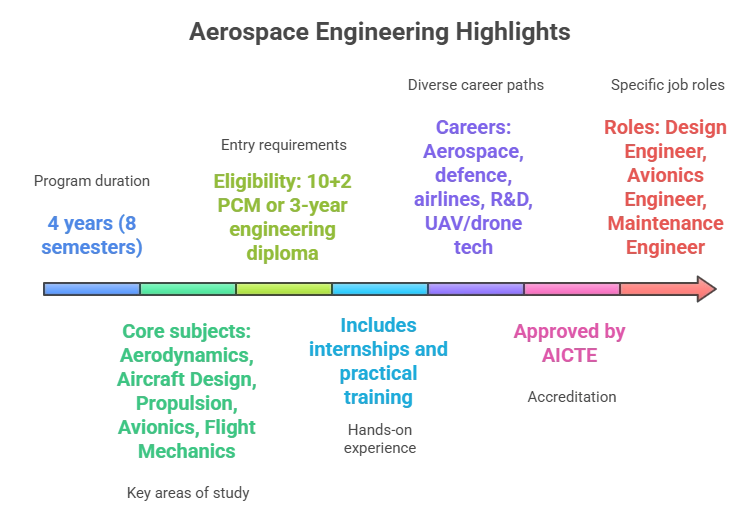
BTech Aeronautical Engineering is a 4-year undergraduate degree program that focuses on the design, construction, testing, and maintenance of aircraft, spacecraft, and related systems. Approved by AICTE, the course trains students in aerodynamics, propulsion, avionics, and aircraft structures. Unlike mechanical engineering, it specializes in flight vehicles operating within Earth’s atmosphere (aircraft, helicopters, drones). As of 2026, over 125 colleges in India offer this program, producing ~8,500 graduates annually.
Core Focus Areas
Area
Description
Aerodynamics
Study of airflow over wings, fuselage; lift, drag, and stability
Propulsion
Jet engines, turbofan, ramjet, and electric propulsion systems
Aircraft Structures
Stress analysis of wings, fuselage using composites and alloys
Avionics
Flight control, navigation, radar, and communication systems
Flight Mechanics
Aircraft performance, takeoff, landing, and maneuverability
Program Structure (8 Semesters)
Year 1: Basic sciences (Physics, Math), Engineering Drawing, Programming
Year 2: Fluid Mechanics, Thermodynamics, Solid Mechanics
Year 3: Core aeronautical subjects + labs (wind tunnel, CAD)
Year 4: Design projects, internship, electives (UAVs, rockets)
Key Outcomes
Design aircraft components using CATIA, ANSYS
Conduct wind tunnel testing and CFD simulations
Qualify for DGCA AME (B1.1) license with dual programs
Work on ISRO, HAL, Boeing, or IndiGo projects
Note:
Often confused with Aerospace Engineering — Aeronautical = within atmosphere; Aerospace = includes space.
Top institutes: MIT Chennai, HITS, IIST, Amity
100% placement in top 20 colleges; average CTC: ₹5.5 LPA
The program is ideal for students passionate about aviation, drones, and defense technology, with growing demand under Make in India and UDAAN schemes.
MIT Chennai (Anna University) – B.E. Aeronautical Engineering (fees < ₹50,000/year)
Leading Private Institutes
Hindustan Institute of Technology and Science (HITS), Chennai
Amity University, Noida
Jain University, Bangalore
Siksha ‘O’ Anusandhan (SOA), Bhubaneswar
Admission Process
National Level: JEE Main → JoSAA/CSAB counseling (for IITs, IIST, top NITs)
State Level: KEAM (Kerala), TNEA (Tamil Nadu), MHT-CET (Maharashtra)
Private Colleges: Institute entrance (e.g., HITSEEE, Amity JEE) or direct merit
Industry Connect
HAL, Bengaluru – Recruits 200+ graduates yearly
ISRO – Absorbs IIST students; others via ICRB exam
Private MROs – IndiGo, Air India Engineering, GMR Aero Technic
Global Firms – Boeing, Airbus, GE Aviation (via campus drives)
Over 75% of graduates from top 30 colleges secure jobs within 6 months, with Bangalore, Chennai, and Hyderabad as major employment hubs. The Make in India and UDAAN schemes have boosted demand, especially in UAVs and regional aircraft manufacturing.
BTech Aeronautical Engineering Eligibility
To pursue BTech in Aeronautical Engineering in India, candidates must meet specific academic and entrance exam criteria set by AICTE and individual institutes. As of 2026, eligibility is uniform across most colleges, with minor variations for state or management quota seats. The program requires a science background with Physics, Chemistry, and Mathematics (PCM) in Class 12.
Minimum Eligibility Criteria
Requirement
Details
Educational Qualification
Passed 10+2 (Class 12) or equivalent from a recognized board
Mandatory Subjects
Physics, Chemistry, Mathematics (PCM)
Minimum Marks
50% aggregate in PCM (45% for SC/ST/OBC-NCL)
Age Limit
No upper age limit for most colleges; JEE Main: max 25 years (relaxation for reserved categories)
Entrance Exam
Valid score in JEE Main, State CET (KEAM/TNEA/MHT-CET), or Institute Test (HITSEEE, Amity JEE)
Top College Cutoffs (JEE Main 2026 Expected)
College
General Rank (CRL)
IIT Bombay (Aerospace)
< 500
IIST Thiruvananthapuram
< 3,000
HITS Chennai
< 80,000
Amity Noida
Merit-based (80%+ in PCM)
Students failing JEE can apply via state exams or management quota (higher fees). Documents needed: 10th/12th marksheets, entrance scorecard, caste/income certificate (if applicable).
Recommended Entrance Strategy
Goal
Exam Priority
ISRO / Top Govt Jobs
JEE Advanced → IIST / IIT Aerospace
Top Private + Airlines
JEE Main + HITSEEE / Amity JEE
Tamil Nadu / Kerala
TNEA / KEAM (no JEE needed)
Additional Notes
Lateral Entry (Diploma Holders): Diploma in Aeronautical/Mechanical with 60% marks → direct admission to 2nd year (limited seats).
NRI/Foreign Students: 10+2 with PCM + English; IELTS/TOEFL may be required in private universities.
Physical Fitness: Required for DGCA-approved AME dual programs (normal vision, no color blindness).
Bottom Line:
With JEE Main rank under 50,000, you can join a top 20 college and earn ₹6–9 LPA starting. Even state exam route leads to solid careers in MRO, defense, and UAVs. Begin prep now — 2026 admissions are 14 months away!
BTech Aeronautical Engineering Fees
BTech Aeronautical Engineering fees in India vary widely depending on the type of institute—government, government-aided, or private. As of 2026, government colleges offer the lowest fees (₹40,000–80,000 per year), while top private universities charge ₹2–3 lakhs annually. Fees typically include tuition, lab charges, and university fees but exclude hostel/mess (₹50,000–1.2 lakhs extra). Scholarships under AICTE, state schemes, or merit reduce costs for eligible students.
Fee Structure Breakdown (2026)
College Type
Annual Fees (INR)
Examples
Government
40,000 – 80,000
MIT Chennai, RIT Kottayam, PEC Chandigarh
Government-Aided
60,000 – 1.1 lakhs
Kumaraguru College (Coimbatore), Sathyabama (partial)
Private (Tier 1)
2.0 – 3.2 lakhs
HITS Chennai, Amity Noida, Jain Bangalore
Private (Tier 2)
75,000 – 1.5 lakhs
Nehru College Thrissur, Excel Namakkal, Park Coimbatore
Additional Costs (Per Year)
Component
Cost (INR)
Hostel + Mess
60,000 – 1,20,000
Books & Uniform
8,000 – 12,000
Lab/Software License
5,000 – 15,000
Exam & Misc.
3,000 – 6,000
Note:
IITs (Aerospace): ~₹2.2–2.5 lakhs/year (including hostel); full fee waiver for SC/ST and income < ₹1 lakh.
IIST Thiruvananthapuram: Fully free for students absorbed by ISRO; others pay ~₹80,000/year.
DGCA AME Dual Program: Adds ₹1.5–2 lakhs over 4 years.
Top institutes like HITS and Amity offer 100% tuition waiver for JEE Main rankers under 10,000. Payment is semester-wise; most accept education loans from SBI, HDFC, and Axis Bank at 8–10% interest.
BTech Aeronautical Engineering Syllabus
The BTech Aeronautical Engineering syllabus is designed to build a strong foundation in aircraft design, propulsion, and flight mechanics over 4 years (8 semesters). The curriculum combines core engineering subjects with specialized aeronautical topics, approved by AICTE and followed by most universities like Amity, Jain University, and IITs offering similar programs. In the first year, focus is on basics; later years dive into aircraft systems and projects.
The program includes theory, labs, and a mandatory internship in the final year. Below is a semester-wise breakdown based on the standard syllabus used by top institutes in 2026:
Satellite Technology, Professional Ethics, Major Project Phase-II, Comprehensive Viva
Hands-on training includes software like ANSYS, CATIA, and MATLAB. Some colleges (like IIST Thiruvananthapuram) add space-related subjects early. Total credits: ~170–180. Students must complete at least one industry or ISRO/HAL internship for practical exposure.
BTech Aeronautical Engineering Subjects
BTech Aeronautical Engineering subjects blend core engineering principles with specialized aircraft and spacecraft topics across 8 semesters. The curriculum, set by AICTE and universities like Anna University, KTU, and VTU, totals 170–180 credits. First-year subjects are common with other branches; from the third semester, focus shifts to aerodynamics, structures, propulsion, and avionics. Labs and software training (CATIA, ANSYS, MATLAB) are mandatory.
IIST and IITs include Space Dynamics and Satellite Technology from Semester 5.
HITS Chennai and Kumaraguru offer DGCA AME-aligned labs for B1.1 licensing.
Final-year major project is compulsory — common topics: drone swarm, supersonic flow, composite wing design.
Total theory: 60%, labs/projects: 30%, soft skills/internship: 10%.
Students gain hands-on experience through HAL, NAL, or airport internships in the 6th/7th semester.
BTech Aeronautical Engineering Colleges in Delhi
Delhi and the NCR region host several reputed institutions offering BTech in Aeronautical Engineering, though options are limited compared to southern states. Most programs are AICTE-approved and focus on aircraft design, avionics, and propulsion. Admission is mainly through JEE Main scores, followed by counseling via JAC Delhi or institute-level tests. As of 2026, around 5–6 colleges in the region offer this specialization, with strong industry ties to DRDO labs and HAL divisions nearby.
Here are the top colleges in Delhi/NCR offering BTech Aeronautical Engineering:
College Name
Location
Approx. Annual Fees (INR)
Admission Process
Key Highlights
Amity University
Noida (NCR)
2.8–3.2 lakhs
Amity JEE / JEE Main + Interview
100% placement assistance; labs with wind tunnels; Boeing collaboration
Delhi Technological University (DTU)
Delhi
1.9–2.2 lakhs
JEE Main via JAC Delhi
Offers Aerospace (not pure Aeronautical); strong research in UAVs
Indraprastha Institute of Aeronautical Engineering (IIAE)
New Delhi
1.2–1.5 lakhs
Institute Test / Merit
Focus on practical training; tie-up with Pawan Hans for helicopter training
Guru Gobind Singh Indraprastha University (GGSIPU) – Affiliated Colleges
Delhi
1.0–1.8 lakhs
IPU CET / JEE Main
Programs via affiliated colleges like Delhi Institute of Tool Engineering
Note: IIT Delhi offers BTech in Mechanical with Aerospace specialization, not standalone Aeronautical. Pure aeronautical programs are rare in government colleges in Delhi. Amity remains the most popular private choice with consistent placements in Airbus, IndiGo, and GE Aviation. Campus visits and internships at Safdarjung Airport are common.
Govt BTech Aeronautical Engineering in Delhi
Government-run BTech Aeronautical Engineering programs in Delhi are extremely limited, as most pure aeronautical courses are offered by private institutes or under different specializations in public universities. As of 2026, no standalone government college in Delhi offers BTech in Aeronautical Engineering. However, related programs exist under Aerospace or Mechanical with Aerospace specialization in top government institutions. These are highly competitive, with admission strictly through JEE Main + JEE Advanced.
Here are the closest government options in Delhi/NCR for aeronautical/aerospace engineering:
College Name
Program Offered
Annual Fees (INR)
Admission Process
Key Highlights
Indian Institute of Technology (IIT) Delhi
BTech in Mechanical Engineering (with Aerospace specialization in later years)
~2.2–2.5 lakhs
JEE Advanced
World-class CFD & propulsion labs; ISRO/DRDO projects; 100% placement in Boeing, GE
Delhi Technological University (DTU)
BTech in Mechanical Engineering (Aerospace electives)
~1.9–2.2 lakhs
JEE Main via JAC Delhi
UAV & satellite design labs; collaboration with NAL Bangalore
Netaji Subhas University of Technology (NSUT)
BTech in Mechanical (Aerospace minor)
~2.0 lakhs
JEE Main
Research in aerodynamics; HAL internship pipeline
Important Note:
IIT Delhi does not offer a separate BTech in Aeronautical Engineering. Students opt for Mechanical Engineering and choose aerospace-related electives from the 5th semester.
No government college under DTU, GGSIPU, or JNU offers pure BTech Aeronautical Engineering.
For pure aeronautical focus, students from Delhi often apply to IIST Thiruvananthapuram (ISRO-funded) or IIT Bombay/Kharagpur (Aerospace) via JEE Advanced.
Amity University (Noida) remains the top private choice in the NCR region for dedicated aeronautical programs.
Government seats are limited (~50–60 per batch in related streams), with cutoffs in top 500 JEE Advanced ranks. Scholarships and stipends are available for SC/ST and economically weaker students.
BTech Aeronautical Engineering Colleges in Kerala
Kerala has emerged as a growing hub for aeronautical engineering education, with both private and government-supported institutes offering AICTE-approved BTech programs. As of 2026, around 8–10 colleges provide this course, focusing on aircraft maintenance, avionics, and drone technology. The curriculum follows Kerala Technological University (KTU) standards for most colleges. Admission is primarily through KEAM (Kerala Engineering Entrance) or JEE Main scores, with management quota seats available.
Here are the leading BTech Aeronautical Engineering colleges in Kerala:
College Name
Location
Approx. Annual Fees (INR)
Admission Process
Key Highlights
Rajiv Gandhi Institute of Technology (RIT)
Kottayam
35,000–50,000 (Govt. quota)
KEAM
Government college; strong focus on propulsion labs; ISRO project collaborations
SCMS School of Engineering and Technology
Ernakulam
1.2–1.5 lakhs
KEAM / JEE Main
AME + BTech dual option; tie-up with Cochin International Airport
Nehru College of Engineering and Research Centre
Thrissur
75,000–1.1 lakhs
KEAM / Management
MRO training facility; 80% placement in Air India, SpiceJet
Jawaharlal College of Engineering and Technology
Palakkad
80,000–1.0 lakh
KEAM
UAV design lab; DGCA-approved aircraft maintenance training
Mount Zion College of Engineering
Pathanamthitta
70,000–95,000
KEAM
Focus on composite materials; regular industry visits to HAL Bangalore
Note: RIT Kottayam is the only fully government-run college offering BTech Aeronautical Engineering in Kerala. Private colleges emphasize DGCA-approved Aircraft Maintenance Engineering (AME) integration, helping students clear licensing exams. Placements are strong in MRO (Maintenance, Repair, Overhaul) firms and airlines like IndiGo and AirAsia. Internships at Kochi and Trivandrum airports are mandatory in the 7th semester.
BTech Aeronautical Engineering Colleges in Tamil Nadu
Tamil Nadu is a leading state for aeronautical engineering education in India, with over 15 AICTE-approved colleges offering BTech programs. The state benefits from proximity to aerospace hubs in Bangalore and HAL facilities. Most colleges follow Anna University curriculum, with strong emphasis on aircraft structures, CFD, and avionics. Admission is through TNEA (Tamil Nadu Engineering Admissions) based on 12th marks or JEE Main via consortium counseling. As of 2026, demand for seats remains high due to 85–90% placement rates in top firms.
Here are the top BTech Aeronautical Engineering colleges in Tamil Nadu:
College Name
Location
Approx. Annual Fees (INR)
Admission Process
Key Highlights
Hindustan Institute of Technology and Science (HITS)
Chennai
2.2–2.8 lakhs
HITSEEE / JEE Main
DGCA-approved AME; Boeing & Airbus labs; 95% placement
Kumaraguru College of Technology (KCT)
Coimbatore
1.1–1.5 lakhs
TNEA / Consortium
NABL-accredited labs; ISRO-funded projects; UAV research center
Nehru Institute of Engineering and Technology
Coimbatore
80,000–1.1 lakh
TNEA
Tie-up with Air India MRO; 100+ annual airline placements
Park College of Engineering and Technology
Coimbatore
70,000–95,000
TNEA
Wind tunnel & propulsion lab; regular HAL internships
Excel Engineering College
Namakkal
75,000–1.0 lakh
TNEA
Focus on drone tech; 85% placement in L&T, Quest Global
Note: Madras Institute of Technology (MIT), Chennai (Anna University) offers B.E. Aeronautical Engineering – the most prestigious government program with fees under INR 50,000/year. HITS Chennai stands out for international collaborations and campus recruitment by GE Aviation, Safran, and Tata Advanced Systems. Many colleges offer dual certification with DGCA’s AME (Category B1.1), enabling students to work as licensed engineers post-graduation. Industrial visits to Sriharikota (ISRO) and Bangalore aerospace parks are part of the 6th/7th semester.
BTech Aeronautical Engineering Salary
Aeronautical engineering is a high-demand field in India, especially with the growth of the aviation and space sectors. As of 2025-26, fresh BTech graduates in aeronautical engineering typically start with salaries ranging from INR 3 lakhs to 6 lakhs per annum, which translates to about INR 25,000 to 50,000 per month. These figures can vary based on factors like the company, location (higher in metros like Bangalore or Mumbai), and skills such as CAD or aerodynamics expertise. With 2-5 years of experience, salaries often rise to INR 8-12 lakhs annually, and senior roles can exceed INR 15-20 lakhs.
Here’s a breakdown of average annual salaries by experience level, based on recent industry data:
Experience Level
Average Salary (INR LPA)
Common Roles
Fresher (0-1 year)
3-6
Junior Design Engineer, Production Assistant
Mid-Level (2-5 years)
8-12
Aerodynamics Analyst, Avionics Engineer
Senior (5+ years)
15-25
Project Manager, Lead Structural Engineer
Salaries in public sector organizations like ISRO or HAL tend to follow government scales starting around INR 5-7 lakhs, with added benefits like housing allowances. Private firms such as Boeing or Tata Advanced Systems may offer higher packages for top performers, sometimes up to INR 9 lakhs for entry-level hires in specialized projects.
Aeronautical Engineer Starting Salary in India Per Month
Fresh BTech Aeronautical Engineering graduates in India earn ₹25,000 to ₹50,000 per month in-hand as of November 2026, depending on the employer, location, and college tier. Top-tier institutes (IIST, HITS, MIT Chennai) secure ₹45,000–75,000/month, while mid-tier colleges average ₹30,000–40,000. Salaries are higher in metros (Bengaluru, Hyderabad, Chennai) and lower in Tier-2 cities.
Salary Breakdown (Example: ₹6 LPA CTC in Bengaluru)
Component
Amount (₹)
Basic
25,000
HRA
10,000
Special Allowance
8,000
PF (Employer)
1,800
Bonus/Variable
3,000
Gross
~47,800
Deductions (PF, Tax)
~6,000–8,000
In-Hand
₹39,000 – 41,000
Factors Affecting Starting Salary
Factor
Impact
College Tier
IIST/HITS: +50%; Mid-tier: Base
Location
Bengaluru/Chennai: +20–30%; Tier-2: –15%
Skills
CATIA, ANSYS, CFD: +₹5,000–10,000
DGCA AME License
+₹10,000–15,000 (airlines)
Internship
HAL/ISRO: +₹3,000–5,000
Top College Placements (2025 Batch)
College
Avg. Monthly In-Hand
Highest
IIST
₹70,000+
₹95,000
HITS Chennai
₹50,000
₹75,000
MIT Chennai
₹42,000
₹60,000
Amity Noida
₹38,000
₹55,000
Kumaraguru
₹35,000
₹48,000
Note:
ISRO (IIST): ₹88,000–95,000 in-hand (Level 10)
Airline AME (with license): ₹50,000+ after 6 months training
Tax: ~₹2,000–5,000/month (new regime)
Growth: +40–50% hike in 2 years with skills
Verdict:
A fresh aeronautical engineer from a reputed college starts at ₹40,000+ per month — higher than most BTech branches. Focus on skills + internship to cross ₹50,000 in Year 1.
BTech Aeronautical Engineering Jobs
BTech Aeronautical Engineering graduates in India have strong job prospects in aviation, defense, space, and manufacturing sectors. As of 2026, over 80% of students from top 30 colleges are placed within 6 months, with demand rising due to Make in India, drone technology, and regional aircraft projects. Entry-level roles focus on design, testing, and maintenance, while mid-level positions involve project management and R&D.
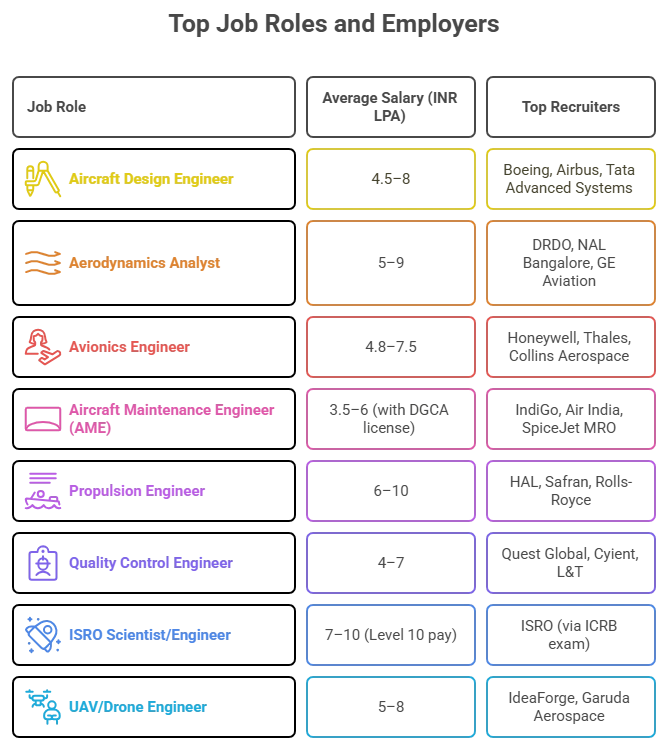
Top Job Roles and Employers
Sector-wise Opportunities
Civil Aviation: 45% of jobs — MRO, airlines, airports
Certifications Boost Salary: Six Sigma, AS9100, NDT Level II — add 15–20% to CTC
Freshers from IIST, HITS, MIT Chennai often get ₹6–9 LPA packages. Campus placements at Amity, Jain, Kumaraguru average ₹4.5–6 LPA. Government jobs via GATE or ISRO ICRB offer job security and perks like HRA, DA, and pension.
What is the Salary of an Aeronautical Engineer in ISRO
Aeronautical engineers in ISRO are recruited as Scientist/Engineer ‘SC’ under Pay Level 10 of the 7th CPC, with a starting basic pay of ₹56,100 per month. As of November 2026, the in-hand salary ranges from ₹85,000 to ₹95,000 per month in cities like Bengaluru, Thiruvananthapuram, or Sriharikota, including allowances. This is one of the highest starting packages for fresh BTech graduates in the public sector.
After 3 years: Promoted to Level 11 → Basic ₹67,700 → ₹1.05–1.15 lakhs/month in-hand
Additional Benefits
ISRO Quarters or HRA (27%/18%/9% based on city)
Medical: CGHS + reimbursement
LTC: Every 4 years (all-India + home town)
Education Allowance: ₹2,250/child/month (up to 2 children)
Pension: NPS contribution (14% by ISRO)
Canteen, Transport, Leave Encashment
Comparison with Private Sector
Employer
Starting In-Hand (₹/month)
ISRO (Scientist ‘SC’)
88,000 – 95,000
HAL (GET)
60,000 – 70,000
Boeing India
65,000 – 80,000
IndiGo (AME)
40,000 – 55,000
Note:
IIST graduates join directly at ₹70,000+ basic if CGPA ≥ 7.5.
GATE qualifiers may enter at Level 11 (₹67,700 basic).
DA revised twice yearly — expected to rise to 53% in Jan 2026.
Verdict: ISRO offers highest job security, work-life balance, and long-term growth among all aeronautical engineering employers in India.
Is BTech Aeronautical Engineering Good?
Yes, BTech Aeronautical Engineering is a strong career choice in India in 2026, especially with the rapid growth of civil aviation, defense modernization, space startups, and drone technology. The sector is backed by Make in India, UDAN, and DRDO-ISRO collaborations, creating over 15,000 new jobs annually. Graduates from top institutes enjoy 85–95% placement rates with starting packages of ₹4.5–9 LPA, and the field offers global opportunities in Boeing, Airbus, and NASA suppliers.
Why It’s a Good Option (2026 Data)
Factor
Details
Job Demand
12–15% annual growth in MRO, UAV, and regional aircraft segments
Job Security in PSUs: ISRO, HAL, BEL — pension, HRA, medical benefits
Challenges to Consider
High initial competition (JEE cutoff < 50,000 for good colleges)
Limited government seats (~2,500 nationwide)
Fieldwork involves shift duties in hangars/airports
Verdict:
Excellent for PCM-strong students passionate about aircraft and technology. Best colleges (IIST, MIT Chennai, HITS) guarantee ROI within 2 years. Even mid-tier institutes (Kumaraguru, Nehru) offer solid placements in MRO and consulting. Avoid low-ranked colleges with poor lab facilities.
Pro Tip: Combine with GATE preparation for PSU jobs or MTech at IITs for R&D leadership roles.
Do I Need JEE for BTech Aeronautical Engineering
Yes, JEE Main is mandatory for admission to 70% of BTech Aeronautical Engineering seats in India, including all NITs, IIITs, IIST Thiruvananthapuram, and top private colleges like HITS Chennai, Amity Noida, and Jain Bangalore. However, 30% of seats (especially in state and private colleges) accept state CETs, institute tests, or 12th marks under management quota. As of 2026, JEE Main remains the most widely accepted entrance exam for quality institutes.
Admission Routes (2026)
Route
Exam Required
Colleges Covered
Seat %
National (JoSAA/CSAB)
JEE Main + JEE Advanced
IITs (Aerospace), IIST, select GFTIs
~20%
State Counseling
KEAM / TNEA / MHT-CET / AP EAMCET
MIT Chennai, RIT Kottayam, Kumaraguru, PEC
~35%
Private Institute Test
HITSEEE, Amity JEE, VITEEE, SRMJEEE
HITS, Amity, SRM, Manipal
~25%
Direct/Management
12th PCM ≥ 60–75%
Nehru, Excel, Mount Zion
~20%
JEE Main Cutoff (General, 2026 Expected CRL)
College
Rank Required
IIST Thiruvananthapuram
< 3,000
PEC Chandigarh (Aerospace)
< 18,000
HITS Chennai
< 80,000
Amity Noida
< 1,20,000 (or Amity JEE)
Kumaraguru Coimbatore
TNEA cutoff: 185+ (out of 200)
Exceptions (No JEE Needed)
TNEA (Tamil Nadu): 12th PCM marks only (top 50,000 state rank)
JEE Main is essential for government seats, IIST, and top private placements.
Skip JEE only if targeting state colleges (TNEA/KEAM) or willing to pay management fees.
Prepare JEE + one state exam for maximum options.
JEE Advanced needed only for IITs (Aerospace) — not pure Aeronautical.
Can I Go to ISRO After Aeronautical Engineering
Yes, BTech Aeronautical Engineering graduates can join ISRO, and it is one of the most sought-after career paths. ISRO recruits 300–400 engineers annually through the ICRB (Centralised Recruitment Board) exam, and aeronautical engineers are eligible for roles in satellite structures, launch vehicles, propulsion, and avionics. As of 2026, IIST Thiruvananthapuram remains the only institute with 100% ISRO absorption for eligible students. Others must clear the ISRO Scientist/Engineer ‘SC’ exam.
Eligibility & Selection Process
Criteria
Details
Qualification
BTech Aeronautical/Aerospace/Mechanical with ≥ 65% (or 6.84 CGPA)
Age Limit
Max 28 years (General); +3/+5 years for OBC/SC-ST
Exam
ISRO ICRB Written Test (90 min, 80 MCQs) + Interview
IIST is the golden ticket — JEE Advanced rank < 3,000 required.
For others: Score 90+ percentile in GATE or prepare ICRB syllabus (focus on CFD, FEM, orbital mechanics).
Internships at ISRO (6 months) via INSPIR program boost interview chances.
Over 60% of ISRO’s propulsion and structures team comprises aeronautical/aerospace graduates.
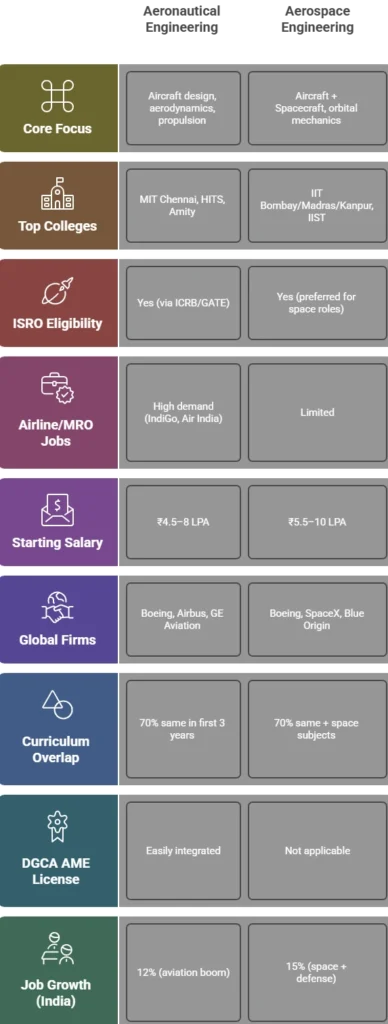
What is Better Aeronautical Engineering or Aerospace Engineering?
Aeronautical Engineering is better if your focus is on aircraft, helicopters, drones, and systems operating within Earth’s atmosphere.
Aerospace Engineering is better if you want to work on spacecraft, satellites, launch vehicles, and interplanetary missions.
As of 2026, both are excellent career choices, but Aerospace has a slight edge in government jobs (ISRO, DRDO) and global scope, while Aeronical dominates in civil aviation, MRO, and airlines. The difference is in curriculum depth and job alignment.
Key Comparison (2026)
Curriculum Difference (Sample Subjects)
Aeronautical
Aerospace
Aircraft Maintenance
Rocket Propulsion
Helicopter Dynamics
Satellite Technology
Wind Tunnel Testing
Orbital Mechanics
Airport Management
Space Environment & Re-entry
Which Should You Choose?
Choose Aeronautical if:
Choose Aerospace if:
You love aircraft, flying, airlines
You dream of space, rockets, satellites
Want DGCA AME + BTech for fast jobs
Aim for ISRO, DRDO, NASA suppliers
Prefer private sector & MRO
Want R&D, GATE, PSU jobs
Verdict (2026):
Aerospace > Aeronautical for long-term growth, ISRO, and prestige (especially via IITs/IIST).
Aeronautical = practical & job-ready in aviation industry (faster placement in airlines).
80% overlap — switching streams in MTech is easy.
Best strategy: Pick based on college rank, not just branch name.
Pro Tip: IIST (Aerospace) = 100% ISRO job. MIT Chennai (Aeronautical) = top airline placements.
Nishit Kumar is a senior EdTech industry leader with over a decade of experience in building and scaling education platforms. He was instrumental in building Collegedunia from the ground up, shaping its product, content, and growth strategy. At FindMyCollege, Nishit oversees content and editorial strategy, guiding topic selection, content frameworks to ensure accuracy, relevance, and student-first value across the website.