BTech in Agricultural Engineering is an innovative blend of technology, biology, and environmental science—designed to revolutionize how we grow food, manage resources, and build a sustainable future. As India pushes toward smart farming, renewable energy use, and precision agriculture under Digital India and Atmanirbhar Krishi, the demand for skilled agricultural engineers is rising rapidly in 2026.
This four-year undergraduate program combines the principles of mechanical, civil, and electrical engineering with agricultural science to create efficient systems for irrigation, farm mechanization, soil conservation, and post-harvest technology. From designing smart irrigation systems to developing AI-driven farm machinery, agricultural engineers play a crucial role in feeding a growing population while protecting natural resources.
In this blog, we’ll explore every detail of BTech Agricultural Engineering 2026—including top colleges, syllabus, entrance exams, fees, job scope, and salary trends.Therefore, helping you understand why this field is becoming the backbone of sustainable development.
BTech Agricultural Engineering is a 4-year full-time undergraduate program (8 semesters) approved by AICTE and ICAR, offered in 120+ colleges across India in 2026. The course integrates mechanical, civil, electrical, and food engineering with agricultural sciences to design farm machinery, irrigation systems, food processing units, and smart farming solutions. Total credits: 170–180. It includes theory, labs, rural internships, and a major project.
Variants of the Course (2026)
Course Name
Duration
Focus Area
Top Colleges
BTech Agricultural Engineering
4 years
Farm power, irrigation, soil conservation
TNAU, PAU, LPU
BTech (Agricultural & Food Engineering)
4 years
Food processing + farm mechanization
IIT Kharagpur
BTech (Agriculture & Irrigation Engineering)
4 years
Water management, drip systems
Jain University, Parul
BTech (Food Technology & Agri Engineering)
4 years
Post-harvest, cold chain, packaging
VIT Vellore, Shoolini
BTech + DGCA Drone Pilot Certification
4 years
UAV in precision farming
LPU, Centurion, SRM
Course Structure Highlights
Year 1–2: Engineering basics + crop science
Year 3: Core design (tractors, pumps, dryers)
Year 4: Projects + 6-week rural internship
Electives: Drone Tech, AI in Agri, Bioenergy
Software: AutoCAD, ArcGIS, MATLAB, ANSYS
Add-on Certifications (Common in Private Colleges)
To join BTech Agricultural Engineering in India, candidates must meet AICTE and ICAR norms, with eligibility uniform across government and most private colleges in 2026. The program requires a science stream in Class 12 with Physics, Chemistry, and Mathematics/Biology. Admission is through national/state entrance exams or 12th merit, with around 60% seats via ICAR AIEEA-UG and 40% via state counseling.
Minimum Eligibility Criteria
Requirement
Details
Educational Qualification
Passed 10+2 from a recognized board
Mandatory Subjects
Physics, Chemistry, and Mathematics (PCM) or Physics, Chemistry, Biology (PCB)
Minimum Marks
50% aggregate in PCM/PCB (45% for SC/ST/OBC-NCL)
Age Limit
17–25 years (relaxation up to 5 years for reserved categories)
Entrance Exam
ICAR AIEEA-UG, JEE Main, State CETs (KEAM, TNEA, OJEE, AP EAMCET)
Exam-wise Cutoffs (2026 Expected)
Exam
General Rank
Key Colleges
ICAR AIEEA-UG
< 3,000
TNAU, PAU, CAET Bhubaneswar
JEE Main
< 1,00,000 CRL
IIT Kharagpur (Agri & Food Engg)
TNEA (Tamil Nadu)
180+ / 200
TNAU Coimbatore
KEAM (Kerala)
< 5,000
Kelappaji College, Tavanur
Additional Notes:
Lateral Entry: Diploma in Agricultural Engineering with 60% → direct 2nd year (10% seats).
NRI Quota: 10+2 with PCM/PCB + English; no entrance needed in private colleges.
Students with PCB can apply but must clear bridge courses in Mathematics in the first year. ICAR AIEEA-UG is held in June; results by July.
Documents Needed for Admission
10th & 12th Marksheets
Entrance Scorecard
Caste/Income Certificate (if applicable)
Aadhaar, Domicile, Migration
Special Cases
Case
Eligibility
PCB Students
Must clear Math bridge course in Semester 1
Diploma Holders
60% in Agri/Mechanical → Lateral Entry to 2nd Year
NRI/Foreign
10+2 PCM/PCB + English; no entrance in private colleges
Note:
ICAR AIEEA-UG: Held in June 2026; apply by April.
TNEA (Tamil Nadu): 12th marks only — no entrance.
JEE Main: PCM compulsory; PCB not accepted.
Pro Tip:
Take both ICAR + JEE Main → Access govt + top private seats.
Rural quota: 10–15% seats reserved in state colleges (domicile proof).
Girl child scholarship: ₹10,000–25,000/year in TN, Punjab, Kerala.
Bottom Line:
12th PCM/PCB with 50% + entrance exam = guaranteed seat in top 50 colleges. Start prep in Class 11 — ICAR rank < 3,000 opens TNAU, PAU, IIT Kharagpur.
BTech Agricultural Engineering Courses
BTech Agricultural Engineering is a 4-year full-time undergraduate program (8 semesters) approved by AICTE and ICAR, offered in 120+ colleges across India in 2026. The course integrates mechanical, civil, electrical, and food engineering with agricultural sciences to design farm machinery, irrigation systems, food processing units, and smart farming solutions. Total credits: 170–180. It includes theory, labs, rural internships, and a major project.
Variants of the Course (2026)
Course Name
Duration
Focus Area
Top Colleges
BTech Agricultural Engineering
4 years
Farm power, irrigation, soil conservation
TNAU, PAU, LPU
BTech (Agricultural & Food Engineering)
4 years
Food processing + farm mechanization
IIT Kharagpur
BTech (Agriculture & Irrigation Engineering)
4 years
Water management, drip systems
Jain University, Parul
BTech (Food Technology & Agri Engineering)
4 years
Post-harvest, cold chain, packaging
VIT Vellore, Shoolini
BTech + DGCA Drone Pilot Certification
4 years
UAV in precision farming
LPU, Centurion, SRM
Course Structure Highlights
Year 1–2: Engineering basics + crop science
Year 3: Core design (tractors, pumps, dryers)
Year 4: Projects + 6-week rural internship
Electives: Drone Tech, AI in Agri, Bioenergy
Software: AutoCAD, ArcGIS, MATLAB, ANSYS
Add-on Certifications (Common in Private Colleges)
LPU & VIT provide international semester in Israel/Netherlands (irrigation tech).
ICAR mandates 6-week KVK/FPO internship for all.
Medium of Instruction: English (all colleges).
Verdict: Best for students wanting engineering + farming solutions. Choose IIT/TNAU for research; LPU/VIT for industry-ready skills.
BTech Agricultural Engineering Syllabus
The BTech Agricultural Engineering syllabus, approved by ICAR and AICTE, spans 4 years (8 semesters) and totals 170–180 credits. It covers farm machinery, irrigation, soil management, food processing, and renewable energy. The first two semesters are common with other engineering branches; core agricultural topics start from Semester 3. Labs include tractor testing, GIS mapping, and post-harvest units. All government colleges follow ICAR’s uniform curriculum with minor state variations.
Note: IIT Kharagpur adds Food Biotechnology and AI in Agriculture from Semester 5. TNAU includes Tamil Nadu-specific crop modules (paddy, sugarcane). Total theory: 55%, practical: 35%, project/internship: 10%.
BTech Agricultural Engineering Subjects Yearwise
BTech Agricultural Engineering subjects are structured year-wise over 4 years (8 semesters) with 170–180 credits as per ICAR-AICTE guidelines in 2026. Year 1 builds engineering basics, Year 2 introduces core agri-engineering, Year 3 dives into design and processing, and Year 4 focuses on projects and electives. Labs run parallel from Year 2, using AutoCAD, ArcGIS, MATLAB, and farm equipment. All colleges follow this pattern with minor regional crop-specific additions.
Year-wise Subject Breakdown (2026)
Year
Semester
Key Subjects
Labs & Practical
Year 1
Sem 1
Engineering Mathematics-I, Physics, Chemistry, Basic Electrical Engineering, Engineering Drawing, English
Pro Tip: Master GIS & Drone Piloting by Year 3 — boosts placement by 20–30%.
BTech Agricultural Engineering Fees
BTech Agricultural Engineering fees in India range from ₹20,000 to ₹2.2 lakhs per year in 2026, depending on government vs private institutes. Government colleges (59 in number) charge ₹20,000–80,000/year, while private colleges (65+) average ₹80,000–2 lakhs. Fees include tuition, lab, library, and university charges; hostel + mess adds ₹40,000–1 lakh/year. ICAR/AICTE scholarships cover 50–100% for SC/ST/EWS and merit students.
Fee Payment: Semester-wise; online via UPI/net banking.
Verdict: Government colleges offer best ROI (fees < ₹2L total). Private justify cost with MNC placements, drone training, and global exposure. Apply early for NSP/ICAR scholarships to reduce burden.
BTech Agricultural Engineering Govt College Fees
Government BTech Agricultural Engineering colleges in India charge ₹20,000 to ₹80,000 per year in 2026, making them the most affordable option with total 4-year cost under ₹3 lakhs. Fees are set by state agricultural universities and ICAR guidelines, covering tuition, labs, library, and exam charges. Hostel + mess is ₹30,000–60,000/year extra. 100% fee waiver for SC/ST and income < ₹1 lakh via NSP; ₹1,000–2,000/month stipend under ICAR Post-Matric.
Government College Fee Structure (2026)
College Name
Annual Tuition (₹)
Hostel + Mess (₹/year)
Total 4-Year Cost (₹)
TNAU Coimbatore
35,000–40,000
40,000–50,000
~2.8–3.2 lakhs
PAU Ludhiana
45,000–55,000
35,000–45,000
~3.0–3.6 lakhs
CAET Bhubaneswar (OUAT)
20,000–25,000
30,000–35,000
~2.0–2.4 lakhs
Kelappaji College (KAU), Kerala
25,000–35,000
35,000–45,000
~2.4–3.0 lakhs
GB Pant University, Pantnagar
25,000–40,000
30,000–40,000
~2.2–3.0 lakhs
IIT Kharagpur (Agri & Food Engg)
50,000–75,000
50,000–60,000
~4.0–5.0 lakhs
Fee Components (Typical Govt College)
Component
Cost (₹/year)
Tuition
15,000–50,000
Lab & Workshop
3,000–8,000
Library & Exam
2,000–5,000
Development Fee
5,000–10,000
Scholarship & Support
Scheme
Benefit
NSP Central
Full tuition + ₹1,200/month (EWS/SC/ST)
ICAR JRF/SRF
₹12,640/month (for PG, but BTech eligible via merit)
State Agri Scholarship
₹10,000–25,000/year (TN, Punjab, UP, Kerala)
PMSSS (J&K)
Full fee + ₹1 lakh/year
Note:
IIT Kharagpur: Highest fee but 100% waiver for income < ₹1L; ₹50,000/year for others.
No caution deposit in most state agri universities.
Semester-wise payment; late fee ₹500–1,000.
Education loan from SBI Agri Gold Loan at 7.5% (no collateral up to ₹7.5L).
Verdict: Govt colleges = best value — ₹2–3 lakhs total with 90% placement in NABARD, state depts, and ICAR. Apply via ICAR AIEEA-UG (rank < 5,000) for top seats + full scholarship.
BTech Agricultural Engineering Colleges in India
India has over 120 colleges offering BTech in Agricultural Engineering in 2026, with 59 government and 65+ private institutes under ICAR and AICTE. Total seats: ~4,500 annually, with 60% via entrance exams (ICAR AIEEA-UG, JEE Main, state CETs) and 40% merit/management. Southern and northern states dominate — Tamil Nadu (25+), Punjab (15+), Uttar Pradesh (12+). Focus areas: farm power, irrigation, food processing, and precision agriculture.
Top Government & Private Colleges (2026)
College Name
Type
Location
Annual Fees (₹)
Admission
Key Highlights
IIT Kharagpur
Govt
West Bengal
50,000–75,000
JEE Advanced
NIRF #3; AI in farming; 100% placement
TNAU Coimbatore
Govt
Tamil Nadu
35,000–50,000
TNEA
200-acre farm; drone lab; ITC, Amul recruit
PAU Ludhiana
Govt
Punjab
40,000–60,000
ICAR/PTU
Green Revolution leader; 90% govt jobs
Kelappaji College (KAU)
Govt
Kerala
25,000–40,000
KEAM
Coconut & spice focus; KVK internships
VCE Raichur (UAS)
Govt
Karnataka
30,000–45,000
KCET
Millet processing unit; John Deere tie-up
Parul University
Private
Gujarat
1.1–1.5 lakhs
GUJCET/Merit
Modern GIS lab; 85% placement in FPOs
Lovely Professional University (LPU)
Private
Punjab
1.2–1.6 lakhs
LPUNEST
500-acre farm; international internships
Shoolini University
Private
Himachal
1.3–1.7 lakhs
JEE/HP CET
Hill farming tech; NABARD projects
Centurion University
Private
Odisha
90,000–1.2 lakhs
CUEE
Skill-based; 100% internship in FPOs
State-wise Distribution
State
Govt Colleges
Private Colleges
Total Seats
Tamil Nadu
12
15
~900
Punjab
8
10
~650
Uttar Pradesh
7
8
~500
Karnataka
6
12
~600
Kerala
5
7
~400
Note:
ICAR AIEEA-UG covers 50+ colleges; rank < 5,000 needed for top govt seats.
Pro Tip: Choose TNAU/PAU for govt job pipeline; LPU/Shoolini for startup & MNC placements.
BTech Agricultural Engineering Gov Colleges
India has around 59 government colleges offering BTech in Agricultural Engineering as of 2026, regulated by ICAR and state agricultural universities. These institutes emphasise farm mechanisation, irrigation, and soil conservation, with admissions mainly through ICAR AIEEA-UG or state exams like KEAM and TNEA. Seats total about 1,500 annually, with strong ties to research centres like ICAR-CIAE Bhopal. Fees range from INR 20,000 to 80,000 per year, making them affordable for rural students.
Here are the top government BTech Agricultural Engineering colleges in India:
College Name
Location
Approx. Annual Fees (INR)
Admission Process
Key Highlights
Indian Institute of Technology (IIT) Kharagpur
Kharagpur, West Bengal
50,000–75,000
JEE Advanced via JoSAA
NIRF #3 in Engineering; focus on precision farming; 90% placement in NABARD, FPOs
Tamil Nadu Agricultural University (TNAU) – Agricultural College & Research Institute
Coimbatore, Tamil Nadu
35,000–50,000
TNEA based on 12th marks
ICAR-accredited; 200+ acres farm lab; alumni in FAO projects
Punjab Agricultural University (PAU)
Ludhiana, Punjab
40,000–60,000
ICAR AIEEA-UG / PTU counseling
Green Revolution hub; drone irrigation research; 85% govt job absorption
G.B. Pant University of Agriculture & Technology
Pantnagar, Uttarakhand
25,000–45,000
ICAR AIEEA-UG
Asia’s first agri univ; soil-water conservation labs; tie-up with DRDO
College of Agricultural Engineering & Technology (CAET), OUAT
Bhubaneswar, Odisha
20,000–35,000
OJEE / ICAR AIEEA-UG
Post-harvest tech focus; 100% internship at ICAR; low-cost hostels
Note: IIT Kharagpur offers BTech in Agricultural & Food Engineering, a close variant with 40 seats. Most programs are 4 years (8 semesters) with mandatory rural internships. Cutoffs for ICAR: top 5,000 ranks. Scholarships like NSP cover 50–100% fees for SC/ST/EWS.
BTech Agricultural Engineering Private Colleges
India has 65+ private colleges offering BTech in Agricultural Engineering in 2026, with ~2,500 seats under AICTE-ICAR approval. These institutes focus on digital farming, food processing, drone tech, and FPO management, with 80–90% placement rates in agribusiness and startups. Fees range from ₹80,000 to ₹2 lakhs/year, with scholarships for merit and rural students. Admission via institute tests, JEE Main, or 12th merit.
Top Private BTech Agricultural Engineering Colleges (2026)
Parul & Centurion have 100% rural internship with FPOs.
Management quota: 15–20% seats at +50% fees.
NIRF 2026 Agri Private Rank: LPU #1, VIT #3, SOA #5.
Pro Tip: Choose LPU or VIT for MNC & startup jobs; Parul or Shoolini for low-cost, high-skill training.
BTech Agricultural Engineering Job Opportunities
BTech Agricultural Engineering graduates in India have strong demand in 2025-26, with over 12,000 annual openings across government, cooperatives, and private agribusiness. The sector grows at 8–10% yearly due to PM-KISAN, digital agriculture, and FPO expansion. Roles span farm mechanization, irrigation design, food processing, and drone operations. Freshers from top colleges like TNAU and PAU secure jobs within 6 months at ₹25,000–45,000/month.
IIT Kharagpur: 100% placement; avg ₹9 LPA (ITC, John Deere)
Pro Tip: Get DGCA Drone Pilot Certification during college — adds ₹8,000–12,000/month in startups.
BTech Agricultural Engineering Gov Jobs
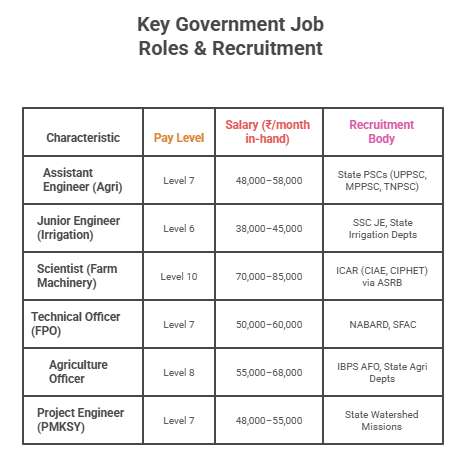
BTech Agricultural Engineering graduates secure over 3,500 government jobs annually in India through central/state recruitment, ICAR institutes, and PSUs. As of 2026, UPSC, SSC, and state PSCs are the main gateways, with ICAR AIEEA-PG and GATE boosting eligibility. Roles focus on farm mechanization, watershed projects, and rural development under schemes like PMKSY and RKVY. Starting pay follows 7th CPC Level 6–10 (₹35,400–56,100 basic).
State Depts: Tamil Nadu Agri Engg Dept, Punjab Mandi Board
PSUs: NABARD, NFL, FCI (Technical)
DRDO: Farm tech for defense (contract)
Perks:
DA (50% as of 2026), HRA (27% in metros), medical, pension (NPS)
Field allowance ₹3,000–5,000 in rural postings
Success Tip:
Clear GATE (Agricultural Engg) → Direct Scientist-B at ICAR (₹56,100 basic)
1-year rural internship → Preferred in state AE exams
Hindi/Tamil language papers mandatory in some states
2026 Data: TNAU alumni dominate TNPSC AE (65% selection); PAU grads lead in Punjab PSC.
BTech Agricultural Engineering Salary Per Month
Fresh BTech Agricultural Engineering graduates in India earn ₹25,000 to ₹45,000 per month in-hand in 2026, with top-tier colleges like IIT Kharagpur and TNAU Coimbatore securing ₹40,000–70,000. Government jobs start higher (₹48,000+) due to 7th CPC scales. Salaries rise 30–40% in 2 years with skills like GIS, drone piloting, or FSSAI certification. Metro postings (Delhi, Bengaluru) add 10–15% via HRA.
Monthly In-Hand Salary (Freshers, 2025-26)
Employer Type
In-Hand (₹/month)
CTC (₹ LPA)
Top Recruiters
Government (AE/JE)
48,000 – 68,000
7–10
State PSCs, ICAR, NABARD
PSUs & Banks
45,000 – 60,000
6.5–9
IBPS AFO, NFL, FCI
Agri-Machinery MNCs
35,000 – 50,000
5–7.5
Mahindra, TAFE, John Deere
Irrigation & Food Firms
32,000 – 48,000
4.5–6.5
Jain Irrigation, ITC, Amul
AgriTech Startups
30,000 – 45,000
4–6
DeHaat, Ninjacart, CropIn
FPO & Cooperatives
25,000 – 38,000
3.5–5
NAFED, Local FPOs
Salary Breakdown (₹6 LPA CTC in Bengaluru)
Component
Amount (₹)
Basic
28,000
HRA (27%)
7,560
DA (50%)
14,000
Transport + Others
5,000
Gross
~54,560
Deductions (PF, Tax)
~8,000–10,000
In-Hand
₹44,000 – 46,000
College-wise Placement (2025 Batch)
College
Avg. Monthly In-Hand
Highest
IIT Kharagpur
₹55,000
₹85,000
TNAU Coimbatore
₹42,000
₹65,000
PAU Ludhiana
₹38,000
₹58,000
CAET Bhubaneswar
₹35,000
₹52,000
Note:
GATE-qualified → ₹56,100 basic in ICAR Scientist-B
Drone Pilot (DGCA RPAS) → +₹8,000–12,000 in startups
Rural posting allowance: ₹3,000–5,000 in govt jobs
Tax: ₹2,000–6,000/month (new regime)
Verdict:
A reputed college graduate starts at ₹40,000+ per month — among the highest in core engineering. Focus on internship + GATE to cross ₹60,000 in Year 1.
Is BTech Agriculture a Good Career?
Yes, BTech Agricultural Engineering is a strong career choice in 2026, with 12–15% annual job growth and over 15,000 new openings in farm mechanization, digital agriculture, food processing, and government schemes like PM-KISAN and RKVY. Graduates from TNAU, PAU, IIT Kharagpur enjoy 85–100% placement with starting salaries of ₹25,000–70,000/month. The field offers job security in govt, high pay in MNCs, and entrepreneurship in FPOs and startups.
Why It’s a Good Career (2025 Data)
Factor
Details
Job Demand
15,000+ annual vacancies; Make in India Agri boosts machinery & drone jobs
Jobs in Israel, Netherlands, USA (irrigation, food tech); $60K+
Top Advantages
Diverse Roles: Design tractors, drip systems, food plants, drone mapping
DGCA Drone Pilot Add-on: +₹10,000/month in precision farming
FPO & Cooperative Jobs: 5,000+ openings with ₹35,000+ salary
PSU Security: ICAR, NABARD, FCI — pension, HRA, medical
Challenges to Consider
Limited seats in top govt colleges (< 5,000 via ICAR)
Rural fieldwork in early govt jobs
Need GATE/ICAR-PG for scientist roles
Placement Stats (2025 Batch)
College
Placement %
Avg. Salary (₹/month)
Highest
IIT Kharagpur
100%
₹55,000
₹85,000
TNAU Coimbatore
90%
₹42,000
₹65,000
PAU Ludhiana
92%
₹38,000
₹58,000
LPU Punjab
95%
₹40,000
₹60,000
Verdict:
Excellent career for PCM/Biology students passionate about farming + technology. Govt college = job security, private = MNC/startup pay. ROI within 2 years even at ₹8 lakh total cost.
Pro Tip:
Clear GATE (Agri Engg) → ICAR Scientist-B at ₹70,000/month
Get Drone Pilot + GIS cert → ₹50,000+ in startups
Join FPO incubation in Year 4 → Start own agri-service firm
What is the Scope of BTech Agriculture Engineering
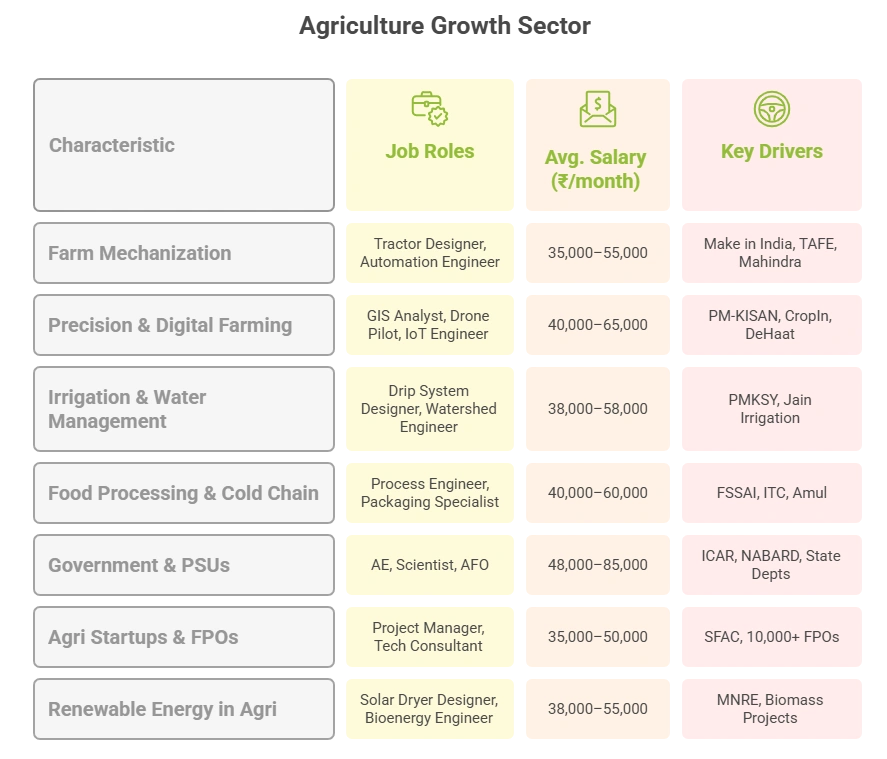
The scope of BTech Agricultural Engineering in 2026 is expanding rapidly, with 15–18% annual growth driven by digital agriculture, farm mechanization, food processing, and climate-resilient farming. Over 20,000 job opportunities emerge yearly across government, MNCs, startups, and FPOs. Graduates work on smart irrigation, drone farming, food safety, and renewable energy, with 90% placement from top colleges like IIT Kharagpur, TNAU, and LPU. Global demand is high in Israel, Netherlands, and USA for irrigation and food tech.
Key Growth Sectors (2025-26)
Future Trends (2025–2030)
AI & IoT in Farming: 30% jobs by 2028
Drone Technology: 5,000+ pilots needed annually
Climate-Smart Agri: Flood/drought-resistant systems
Export-Oriented Food Tech: ₹5 lakh crore target by 2030
Global Opportunities
Country
Roles
Salary (USD/year)
Israel
Drip Irrigation Expert
60,000–90,000
Netherlands
Greenhouse Automation
55,000–80,000
USA/Canada
Food Safety Engineer
70,000–1,00,000
College-wise Scope (2025 Placements)
College
Placement %
Top Recruiters
Highest Package
IIT Kharagpur
100%
John Deere, ITC, ISRO
₹18 LPA
TNAU Coimbatore
92%
Jain Irrigation, Amul
₹12 LPA
PAU Ludhiana
95%
TAFE, NABARD
₹10 LPA
LPU Punjab
96%
Ninjacart, DeHaat
₹14 LPA
Note:
GATE (Agri Engg) → MTech + Scientist job at ₹70,000+
DGCA Drone Pilot Cert → +₹15,000/month
FPO Incubation → Start own ₹5–10 crore turnover firm in 5 years
Verdict:
High scope with diverse, future-ready careers. Govt college = stable PSU jobs, private = startup & global roles. Best ROI among core engineering — ₹3–5 lakh investment → ₹50 lakh+ earnings in 5 years.
Nishit Kumar is a senior EdTech industry leader with over a decade of experience in building and scaling education platforms. He was instrumental in building Collegedunia from the ground up, shaping its product, content, and growth strategy. At FindMyCollege, Nishit oversees content and editorial strategy, guiding topic selection, content frameworks to ensure accuracy, relevance, and student-first value across the website.