Choosing the right BTech branch is one of the biggest decisions in an engineering student’s life. With over a hundred engineering streams offered across India, knowing which ones lead to great careers and which are losing relevance can make all the difference.
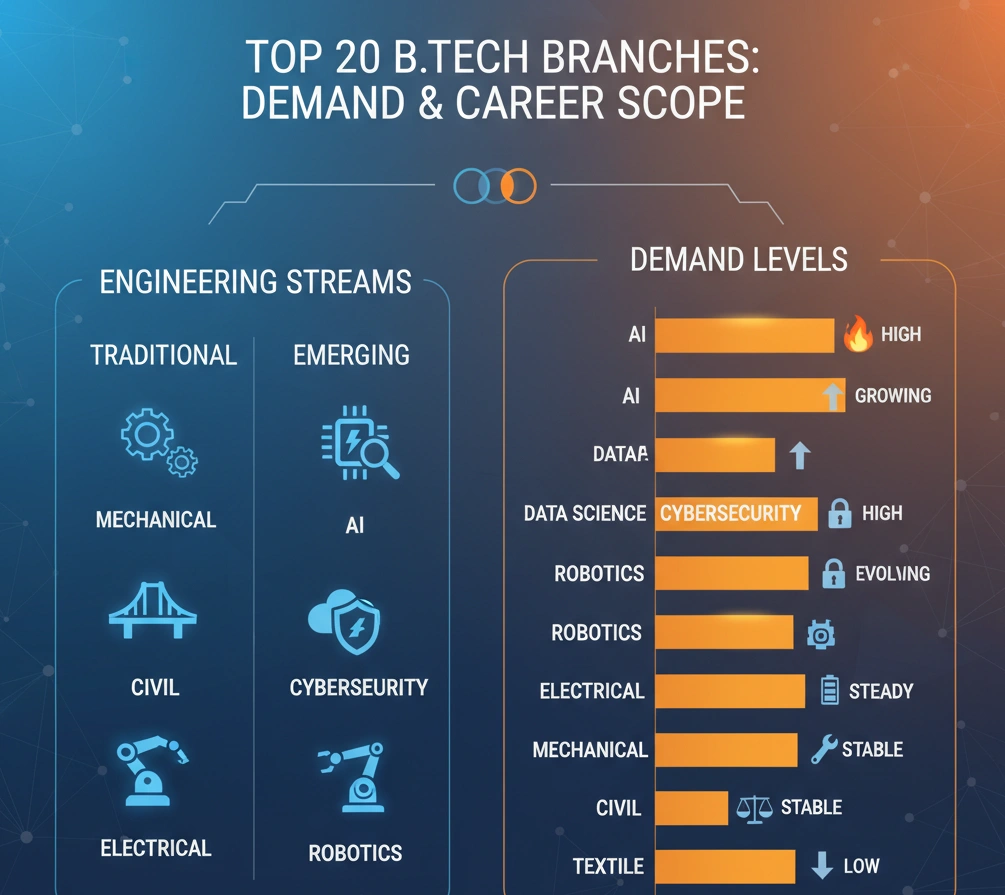
As technology reshapes industries, the boundaries between traditional and new-age specialisations are rapidly fading. Fields like Mechanical, Civil, and Electrical Engineering continue to hold steady, while modern domains such as Artificial Intelligence (AI), Data Science, and Cybersecurity are redefining what it means to be an engineer in 2025.
In this guide, we’ll explore the complete list of top 20 BTech branches, compare traditional vs emerging streams, and examine which specialisations offer the best career scope, demand trends, and placement prospects in 2025. Whether you’re choosing your path after JEE, counselling, or lateral entry, this breakdown will help you align your interests with the future of technology.
Engineering has always been the backbone of innovation — but what counts as “engineering” is changing fast. The types of BTech branches available today can broadly be grouped into two categories: traditional and emerging. Understanding this difference helps you make a smarter choice, balancing job security with future growth.
1. Traditional BTech Branches
These are the foundational streams that have powered industries for decades. Traditional branches focus on the physical, mechanical, and infrastructural aspects of technology — designing, building, and maintaining real-world systems.
Popular Traditional Engineering Branches:
Mechanical Engineering: Deals with machines, engines, robotics, and manufacturing systems — vital for the automotive and aerospace sectors.
Civil Engineering: Focuses on infrastructure like roads, bridges, smart cities, and sustainable construction.
Electrical Engineering: Covers power generation, energy systems, and electric networks — now blending with renewable energy technologies.
Electronics & Communication Engineering (ECE): Connects hardware and communication systems — essential for telecom, embedded systems, and IoT devices.
Chemical Engineering: Combines chemistry and process engineering — used in pharmaceuticals, oil refining, and materials science.
These branches are considered “evergreen” because core engineering jobs will always exist — from construction to energy, manufacturing to utilities. However, many traditional engineers now need digital upskilling, as industries adopt automation, AI, and data-driven operations.
2. Emerging BTech Branches
The last decade has seen the rise of technology-driven specialisations, where data, AI, and automation take centre stage. These emerging BTech branches are in high demand because they align with the digital economy — from IT and fintech to robotics and sustainability.
Top Emerging Engineering Branches (2025):
Computer Science & Engineering (CSE): The most sought-after branch, focusing on software, programming, and system design.
Artificial Intelligence & Machine Learning (AI-ML): Specialises in intelligent systems, automation, and predictive modelling — one of the fastest-growing global fields.
Data Science: Focuses on extracting insights from data using analytics, AI, and visualisation tools — crucial in business and tech sectors.
Cybersecurity: Deals with protecting systems, networks, and data from cyberattacks — massive demand across governments and companies.
Robotics & Automation: Combines mechanical and computing principles to create autonomous systems and smart manufacturing tools.
Internet of Things (IoT): Connects physical devices to the internet, powering smart homes, factories, and cities.
Cloud Computing & DevOps: Focuses on scalable computing infrastructure, vital for modern software and enterprise systems.
Environmental & Sustainable Engineering: A rising branch driven by climate goals and green technologies.
These emerging branches represent the future of engineering, offering global opportunities, interdisciplinary roles, and high-paying jobs. They also emphasise problem-solving, innovation, and adaptability — skills that define successful engineers in the modern world.
The Shift in 2025
The line between traditional and emerging engineering is no longer rigid. Mechanical engineers learn coding for robotics, civil engineers use AI for smart city planning, and electrical engineers design renewable energy grids managed through IoT. The result is a hybrid engineering ecosystem, where technical fundamentals meet digital intelligence.
In short: Traditional branches build the world; emerging branches digitise it. Together, they define the next generation of engineering careers.
India offers more than a hundred engineering specialisations, but only a few hold strong demand, placement potential, and long-term career scope. Below is the updated list of top 20 BTech branches in 2025, grouped under Traditional and Emerging categories — reflecting both stability and innovation.
A. Traditional Engineering Branches (Core Fields)
These branches form the foundation of engineering education and continue to play a vital role in infrastructure, energy, design, and manufacturing.
Mechanical Engineering (ME) – Focuses on machines, robotics, thermodynamics, and manufacturing. Core to automotive, aerospace, and production industries.
Civil Engineering (CE) – Deals with the design and construction of buildings, bridges, roads, and urban infrastructure. Growing relevance in smart cities and green construction.
Electrical Engineering (EE) – Concerned with electricity, power systems, renewable energy, and control systems. In demand for both the traditional and renewable energy sectors.
Electronics & Communication Engineering (ECE) – Bridges hardware, signal processing, and communication technology. Foundational to IoT, semiconductors, and 5G.
Chemical Engineering (ChE) – Integrates chemistry and process engineering. Key to manufacturing, pharmaceuticals, food tech, and clean energy.
Aerospace Engineering – Focuses on the design, propulsion, and aerodynamics of aircraft and spacecraft. Growing with the rise of space tech startups in India.
Automobile Engineering – Specialises in vehicle design and performance. Currently transitioning to electric and autonomous vehicles.
Biotechnology Engineering (BioTech) – Combines biology and technology for innovations in healthcare, agriculture, and genetic research.
Marine Engineering – Involves ship design, ocean systems, and maritime logistics. Steady demand in defence and international trade.
Metallurgical & Materials Engineering – Deals with metals, alloys, and materials science. Crucial for manufacturing, aerospace, and defence applications.
B. Emerging & High-Demand Branches (2025 Focus)
These specialisations are data-driven, AI-powered, and tech-centric, offering top placements and global job opportunities.
Computer Science & Engineering (CSE) – The most versatile and high-paying branch, covering software development, databases, and system architecture.
Artificial Intelligence & Machine Learning (AI-ML) – Focuses on intelligent algorithms, automation, and predictive systems — a core skill in the tech revolution.
Data Science & Analytics – Concentrates on big data, visualisation, and decision modelling. Demandis soaring across IT, finance, and healthcare.
Cybersecurity – Protects digital networks and systems from threats. Fastest-growing IT specialisation globally.
Internet of Things (IoT) – Connects devices to the internet, enabling automation in smart homes, cities, and factories.
Robotics & Automation – Combines mechanical and computer systems for industrial and service robots. Huge scope in manufacturing and logistics.
Cloud Computing & DevOps – Focuses on scalable cloud systems and deployment automation. Core to modern enterprise IT infrastructure.
Mechatronics Engineering – Integrates mechanical, electrical, and software systems — key for robotics and advanced manufacturing.
Environmental Engineering – Deals with sustainable design, pollution control, and renewable resource management. Rising in importance amid climate goals.
Software Engineering – Specialises in application development, system design, and testing — core to IT, fintech, and startups.
Top 5 B.Tech Branches: Scope in 2025-26
While every engineering branch has its own value, some specialisations consistently lead the job market. These top 5 BTech branches in 2025 stand out for their strong placement rates, diverse career options, and long-term relevance in an increasingly digital world.
1. Computer Science and Engineering (CSE)
CSE continues to be the most popular and high-paying branch in India. It covers programming, algorithms, system design, database management, and emerging technologies like AI and Cloud.
Career Scope: CSE graduates are in demand across every sector — from IT and finance to healthcare and government services. They design software systems, develop apps, and optimise digital infrastructure.
Top Recruiters: Google, Microsoft, Amazon, TCS, Infosys, Accenture, Wipro.
Average Salary Range: ₹6–20 LPA (depending on college and role).
Future Outlook: With AI, automation, and digital transformation expanding, CSE skills will remain essential for at least the next two decades.
AI-ML is the fastest-growing engineering specialisation in 2025. It focuses on building intelligent systems that can learn, adapt, and make decisions — from chatbots and self-driving cars to predictive analytics and medical diagnostics.
Career Scope: AI-ML engineers work as Machine Learning Engineers, AI Developers, Data Analysts, NLP Specialists, and AI Researchers. The demand is particularly strong in IT, fintech, healthcare, and autonomous systems.
Top Recruiters: NVIDIA, Google DeepMind, IBM, Meta, Deloitte, and emerging Indian AI startups.
Average Salary Range: ₹8–25 LPA (often higher for AI research roles).
Future Outlook: As automation, generative AI, and robotics mature, AI engineers will be among the most in-demand professionals worldwide.
3. Data Science & Analytics
The world runs on data — and Data Science is the engine behind it. This branch merges statistics, programming, and machine learning to extract insights from massive datasets. It’s central to decision-making in both business and technology.
Career Scope: Graduates become Data Scientists, Business Analysts, Data Engineers, and BI Developers. Industries like e-commerce, finance, and healthcare rely heavily on data professionals.
Top Recruiters: Amazon, Flipkart, Deloitte, EY, IBM, ZS Associates, and government analytics wings.
Average Salary Range: ₹7–18 LPA.
Future Outlook: As AI-driven analytics and big data grow, the demand for skilled data professionals will continue to soar.
4. Cybersecurity
With the rise of digital systems comes the rise of cyber threats — making Cybersecurity one of the most critical and future-proof branches of engineering. This stream focuses on ethical hacking, network security, cryptography, and cyber forensics.
Career Scope: Cybersecurity graduates work as Security Analysts, Ethical Hackers, Penetration Testers, and Cyber Risk Consultants. There’s strong demand across IT, defence, banking, and government sectors.
Top Recruiters: Palo Alto Networks, Cisco, IBM, EY, PwC, and CERT-In (Government).
Average Salary Range: ₹6–15 LPA.
Future Outlook: As India aims for a $1 trillion digital economy, cybersecurity experts will become essential to national and corporate security.
5. Electronics & Communication Engineering (ECE)
ECE bridges hardware and software — making it one of the most versatile engineering branches. It covers semiconductors, signal processing, embedded systems, VLSI, and 5G communication technologies.
Career Scope: ECE graduates find opportunities in telecom, chip design, consumer electronics, defence, and IT. Many also transition into software and AI roles due to their strong technical foundation.
Top Recruiters: Qualcomm, Intel, Samsung, Ericsson, DRDO, ISRO, and tech startups.
Average Salary Range: ₹5–14 LPA.
Future Outlook: The semiconductor boom, IoT adoption, and India’s growing electronics manufacturing ecosystem will keep ECE in high demand.
Demand Table: Job Trends for BTech 2025
The engineering job market in 2025 is shifting rapidly. While AI, Data Science, and Cybersecurity are driving global demand, traditional branches like Civil, Mechanical, and Electrical Engineering remain vital to India’s growing infrastructure and energy needs. The table below gives a clear snapshot of how each branch is performing in terms of demand level and career outlook this year.
BTech Branch
2025 Demand Level
Career Outlook
Artificial Intelligence
🔥 High
Explosive global demand across the IT, healthcare, and finance sectors
Computer Science
🔥 High
Strong placement rates, high salaries, and international career mobility
Data Science
🔥 High
Expanding the analytics ecosystem across startups and MNCs
Cybersecurity
🔥 High
Mission-critical field with rapid job creation
Electronics & Communication
⚖️ Stable
Consistent demand in hardware, telecom, and semiconductor manufacturing
Mechanical Engineering
⚖️ Moderate
Steady growth through automation, robotics, and design roles
Civil Engineering
⚖️ Stable
Sustained demand in infrastructure, housing, and smart city projects
Chemical Engineering
⚖️ Stable
Moderate opportunities in energy, manufacturing, and process industries
Environmental Engineering
🔼 Rising
Growing importance due to climate goals and sustainability policies
Textile Engineering
⬇️ Low
Declining demand due to automation and outsourcing
Mining Engineering
⬇️ Low
Niche opportunities; industry modernisation is slow
Pattern & Insights
The demand trend in 2025 clearly favours digital-first and data-driven branches. Artificial Intelligence, Computer Science, and Cybersecurity are not just hot trends — they’re foundational to the future of global engineering.
Meanwhile, core fields like Civil, Electrical, and Mechanical continue to see stable employment, supported by India’s infrastructure boom and Make-in-India initiatives. Environmental Engineering is an emerging dark horse, driven by the push for sustainability and renewable energy projects.
Colleges for Top BTech Specialisations
Choosing the right branch is only half the journey — the college you choose determines your exposure, placements, and research opportunities. India hosts a mix of elite government institutes, technology-focused universities, and private institutions offering world-class BTech programs in 2025. Below is a curated list of the top engineering colleges for the most in-demand specialisations this year.
1. Computer Science & Engineering (CSE)
Top Colleges:
IIT Bombay, IIT Delhi, IIT Madras: Global recognition for computer science research and placements.
IIIT Hyderabad & IIIT Delhi: Known for industry-linked curricula in AI, data, and systems.
BITS Pilani: Excellent coding culture and international placement opportunities.
Private Universities: VIT, SRM, Manipal Institute of Technology, Amity Noida.
Placement Highlights: CSE graduates from top-tier institutes often secure roles with global tech firms and startups, averaging ₹15–25 LPA from IITs and ₹6–10 LPA from reputed private universities.
IIT Hyderabad: India’s first dedicated AI BTech program with strong research output.
IIIT Hyderabad, IIIT Delhi: Leaders in AI-ML and data-driven computing.
VIT, SRM University, Chandigarh University: Offer specialised AI degrees with internship tie-ups.
BITS Pilani (Pilani/Hyderabad): Interdisciplinary AI research with CSE foundation.
Placement Highlights: AI-ML graduates are hired by companies like NVIDIA, Google, Deloitte, and TCS AI Labs, with packages between ₹10–25 LPA for skilled candidates.
3. Data Science & Analytics
Top Colleges:
IIT Madras: Offers BTech in Data Science & AI — one of India’s most popular new-age programs.
IIIT Bangalore: Known for data analytics programs with strong industry collaboration.
VIT, Manipal University Jaipur, Bennett University: Offer applied Data Science degrees.
Delhi Technological University (DTU): Focuses on applied data and big data analytics.
Placement Highlights: Data Science graduates are absorbed into consulting, finance, e-commerce, and analytics firms, with average packages of ₹7–18 LPA depending on skill proficiency.
4. Electronics & Communication Engineering (ECE)
Top Colleges:
IIT Kharagpur, IIT Kanpur, IIT Roorkee: Leading in semiconductor and 5G technology research.
NIT Trichy, NIT Warangal: Excellent core labs and placement networks.
BITS Pilani, VIT Vellore: Focus on embedded systems and hardware-software integration.
Manipal Institute of Technology: Offers advanced courses in IoT and communication systems.
Placement Highlights: Recruiters like Qualcomm, Intel, and Texas Instruments offer packages between ₹8–20 LPA for ECE graduates from top institutes.
5. Electrical Engineering (EE)
Top Colleges: IIT Bombay, IIT Roorkee, NIT Warangal, DTU, VIT Why It’s Core: Power systems, renewable energy, and smart grids ensure EE remains central to infrastructure growth. Career Scope: Electrical design engineer, power systems engineer, control systems specialist Average Package: ₹6–18 LPA Top Recruiters: Siemens, ABB, Tata Power, Schneider Electric
6. Mechanical Engineering (ME)
Top Colleges: IIT Madras, IIT Kanpur, BITS Pilani, NIT Surathkal, MIT Pune Why It’s Reliable: The backbone of manufacturing, automation, and robotics industries. Career Scope: Design engineer, production engineer, robotics/mechatronics specialist Average Package: ₹5–14 LPA Top Recruiters: Tata Motors, Mahindra, Ashok Leyland, L&T
7. Civil Engineering
Top Colleges: IIT Roorkee, IIT Madras, NIT Trichy, SRM Institute, LPU Why It’s Essential: From smart cities to highways, civil engineers shape the nation’s infrastructure. Career Scope: Structural engineer, construction manager, project consultant Average Package: ₹4–10 LPA Top Recruiters: Larsen & Toubro, GMR Group, Shapoorji Pallonji, Govt PSUs
8. Chemical Engineering
Top Colleges: IIT Bombay, IIT Kharagpur, ICT Mumbai, BITS Pilani Why It’s Strategic: Chemical engineers drive the energy, petrochemical, and pharmaceutical industries. Career Scope: Process engineer, research associate, plant operations manager Average Package: ₹5–12 LPA Top Recruiters: Reliance Industries, Shell, BPCL, Pfizer
9. Biotechnology / Bioengineering
Top Colleges: IIT Delhi, VIT Vellore, Amity University, SRM University, Anna University Why It’s Promising: Convergence of biology and tech — biotech fuels innovation in healthcare, food, and sustainability. Career Scope: Biotech researcher, genetic engineer, bioinformatics specialist Average Package: ₹4–10 LPA Top Recruiters: Biocon, Serum Institute, Cipla, Novozymes
Summary Table: Top Colleges for BTech Specialisations in India (2025)
Branch / Specialisation
Top Colleges (Highlights)
Placement Range (Avg. LPA)
Career Scope / Key Industries
Computer Science & Engineering (CSE)
IIT Bombay, IIT Delhi, IIIT Hyderabad, BITS Pilani, VIT
While IITs and IIITs remain the most prestigious, many private universities now offer cutting-edge curricula and placement partnerships in AI, Data Science, and Cybersecurity. Students should focus on factors like:
Accreditation (NAAC/NBA)
Industry internships and research labs
Placement record for their chosen specialisation
Access to innovation hubs or startup incubators
Tip: The best college isn’t always the oldest; it’s the one that gives you the right mix of skills, exposure, and mentorship in your chosen branch.
Factors to Consider Before Choosing a BTech Branch
Choosing the right BTech branch can define your career direction. Don’t just follow trends — match your skills, interests, and long-term goals to the right specialisation.
Interest & Aptitude
Pick a branch that aligns with what you enjoy learning.
Like coding and logic? → CSE or AI.
Love machines and design? → Mechanical or Mechatronics.
Enjoy construction or planning? → Civil or Architecture.
Your interest will fuel your success more than popularity.
Research / higher studies: Biotechnology, Chemical.
Choose a branch that matches your future plan.
Placement & Job Demand
In 2025, AI-ML, Data Science, and Cybersecurity are high-demand fields.
Mechanical, Electrical, and Civil remain stable with PSU and industrial roles. Always check your target college’s placement report for your branch.
College Strength
A top college can make a huge difference. Prioritize institutes that are strong in your chosen field — for example, IIT Hyderabad for AI, IIT Roorkee for Civil, BITS Pilani for Mechanical.
ROI & Future Adaptability
Compare the cost of your program with placement outcomes. Choose a branch that allows flexibility — engineers often shift into new fields like AI, robotics, or data analytics with additional skills.
Final Thought
There’s no “best” branch for everyone, only the one best suited to you. Your branch should align with your curiosity, career goals, and the kind of problems you want to solve. Remember, every stream, from Civil to AI, has produced innovators, CEOs, and researchers who shaped industries. What matters most is how deeply you engage with what you study.
FAQs
1. Which is the best BTech branch in 2025 for high-paying jobs?
In 2025, Computer Science Engineering (CSE), Artificial Intelligence & Machine Learning (AI-ML), and Data Science top the list for high-paying jobs. These fields have global demand and offer average packages between ₹10–25 LPA in top institutes.
2. What are the traditional BTech branches still in demand today?
Traditional branches like Mechanical, Civil, Electrical, and Chemical Engineering continue to be relevant in industries such as infrastructure, energy, and manufacturing. While growth is slower than tech branches, they offer stable jobs and strong PSU opportunities.
3. Which emerging BTech specialisations are best for the future?
Emerging specialisations such as AI-ML, Cybersecurity, Robotics, IoT (Internet of Things), and Blockchain are shaping the future of engineering. They provide strong international career prospects and are integrated into the Industry 4.0 ecosystem.
4. How should I decide which BTech branch is right for me?
Consider three things: your interests, college strengths, and career goals. If you enjoy coding and data, go for CSE or AI. If you prefer physical systems and design, choose Mechanical or Electrical. Always check the placement record of your preferred branch in your target college.
5. Which BTech branches are best for government jobs?
Branches like Civil, Mechanical, Electrical, and Electronics are most preferred for government and PSU jobs. Graduates can appear for exams like GATE, ESE, ISRO, and DRDO, which primarily recruit from these traditional streams.
6. Can I switch my career field after completing BTech?
Yes. Many engineers move into data analytics, management, or software roles regardless of their original branch. With certifications and skill upgrades (like Python, AI tools, or project management), you can pivot into high-demand fields even after graduation.
Nishit Kumar is a senior EdTech industry leader with over a decade of experience in building and scaling education platforms. He was instrumental in building Collegedunia from the ground up, shaping its product, content, and growth strategy. At FindMyCollege, Nishit oversees content and editorial strategy, guiding topic selection, content frameworks to ensure accuracy, relevance, and student-first value across the website.