BTech Biomedical Engineering 2026: Top Colleges, Fees, Scope in Medtech & Prosthetics
BTech Biomedical Engineering stands among the most dynamic and future-focused engineering disciplines in 2026. It blends technology, biology, and medicine to create solutions that enhance healthcare and human well-being. Biomedical engineers work on advanced prosthetics, artificial organs, AI-based diagnostic tools, and next-generation wearable health devices. As MedTech continues to expand globally, this field places graduates at the centre of notable innovations that are reshaping modern healthcare.
In India, the demand for skilled biomedical professionals is rising rapidly. All thanks to the growing healthcare sector, digital hospitals, and startup innovations in medical devices and diagnostics. This four-year undergraduate program not only opens doors to top research labs and hospitals. Moreover, it opens the door to advanced industries where engineering meets human anatomy.
In this complete guide, we’ll explore everything about BTech Biomedical Engineering 2026. From the top colleges, fees, and syllabus to career scope, salary trends, and opportunities in MedTech and prosthetics. Whether you’re aiming for innovation in healthcare or a career that blends creativity with compassion, this field offers one of the most rewarding paths in modern engineering.
What is Biomedical Engineering in BTech?
BTech Biomedical Engineering is a four-year undergraduate program that blends engineering principles with medical and biological sciences to design, develop, and maintain healthcare technologies. The goal of this discipline is to bridge the gap between medicine and technology. Thus creating solutions that help doctors diagnose, monitor, and treat patients more effectively.
Students learn about medical imaging systems, prosthetics, bioinstrumentation, biomaterials, tissue engineering, and healthcare robotics. The curriculum integrates mechanical, electrical, and computer engineering with human anatomy and physiology, giving students a deep understanding of how machines and the human body can work in harmony.
Biomedical engineers play a key role in the development of life-saving devices such as pacemakers, MRI machines, prosthetic limbs, and advanced diagnostic tools. As healthcare moves toward automation and precision medicine, the demand for professionals who can innovate in these areas is rapidly increasing.
The course typically requires students to have studied Physics, Chemistry, and Mathematics or Biology at the 10+2 level. Colleges often encourage internships in hospitals or MedTech firms. Thus, allowing students to apply theoretical knowledge in real-world healthcare environments.
BTech Biomedical Engineering for PCB Students
A common question among aspirants is whether PCB (Physics, Chemistry, Biology) students can pursue Biomedical Engineering. The answer is yes — many universities in India accept PCB students for admission to this course.
Since Biomedical Engineering is rooted in both life sciences and engineering, students with a biology background often find it easier to grasp subjects like human anatomy, physiology, biomaterials, and tissue engineering. Their biological understanding gives them an advantage in research and innovation related to prosthetics, medical imaging, and rehabilitation technologies.
However, since the program also involves engineering concepts like circuits, mechanics, and computing, some colleges may prefer students who have studied Mathematics as well. In such cases, PCB students can opt for bridge courses or introductory math modules offered in the first semester to build their foundation.
BTech Biomedical Engineering Eligibility
To pursue BTech Biomedical Engineering in India, students must meet certain academic and entrance exam criteria. Since this course combines engineering with medical science, eligibility requirements are slightly more flexible compared to other traditional engineering streams. Here’s a detailed breakdown:
People Also Read




BTech Biomedical Engineering Eligibility: Highlights
| Criteria | Details |
| Qualification | 10+2 with Physics & Chemistry + Mathematics/Biology |
| Minimum Marks | 50–60% (varies by institute) |
| Accepted Streams | PCM or PCB |
| Entrance Exams | JEE Main, VITEEE, SRMJEEE, WBJEE, MHT CET, etc. |
| Age Limit | Minimum 17 years |
| Admission Type | Entrance-based / Merit-based |
BTech Biomedical Engineering Syllabus
The BTech Biomedical Engineering syllabus is designed to build a strong foundation in engineering principles, life sciences, and medical technology. Over four years (eight semesters), students learn how to apply mechanical, electrical, and computational techniques to solve problems in healthcare — from designing prosthetics and imaging devices to developing biosensors and AI-based diagnostic systems.
The course structure combines theory, laboratory work, and research projects, ensuring students gain both conceptual understanding and hands-on experience with modern medical instruments and technologies.
Download BTech Biomedical Engineering Syllabus PDF here.
Year-Wise BTech Biomedical Engineering Syllabus Overview
First Year – Foundation in Science & Engineering
The first year introduces students to the fundamentals of physics, chemistry, mathematics, and biology, along with basic engineering concepts.
Key Subjects:
- Engineering Mathematics I & II
- Physics for Engineers
- Chemistry & Environmental Science
- Introduction to Biology for Engineers
- Basic Electrical and Mechanical Engineering
- Engineering Graphics & Workshop Practice
- Programming in C / Python
- Communication Skills
(Goal: Build a multidisciplinary base blending science and engineering fundamentals.)
Second Year – Core Biomedical Concepts
Students dive into subjects connecting engineering and medical sciences. This year focuses on understanding the human body as a system and learning to design supporting technology.
Key Subjects:
- Human Anatomy & Physiology
- Biochemistry
- Biomedical Instrumentation I
- Analog and Digital Electronics
- Signals & Systems
- Fluid Mechanics and Thermodynamics
- Sensors and Transducers
- Electrical and Electronic Measurements
(Goal: Learn how biological systems work and how to design instruments that interact safely with the human body.)
Third Year – Application and Analysis
The third year focuses on applications of engineering in healthcare, with advanced lab work and design projects.
Key Subjects:
- Biomedical Instrumentation II
- Medical Imaging Systems (X-Ray, MRI, CT, Ultrasound)
- Biomechanics
- Biomaterials and Artificial Organs
- Microprocessors and Embedded Systems
- Control Systems
- Bio-signal Processing
- Rehabilitation Engineering
- Biomedical Device Design Lab
(Goal: Gain practical exposure to diagnostic systems, prosthetics, and medical robotics.)
Fourth Year – Specialization, Research & Industry Exposure
In the final year, students choose electives, work on major projects, and often participate in industrial internships or research programs in hospitals or MedTech startups.
Key Subjects:
- Medical Robotics
- Neural Engineering
- Tissue Engineering
- Healthcare Data Analytics / AI in Medicine
- Hospital Management & Bioethics
- Project Work / Dissertation
- Internship / Industrial Training
(Goal: Apply knowledge through research, innovation, and real-world healthcare problem-solving.)
Popular Elective Courses
Students can choose electives based on their interests and career goals:
- Wearable Medical Devices
- Nanotechnology in Medicine
- Telemedicine & e-Health
- 3D Printing in Biomedical Applications
- Medical Signal & Image Processing
- Bioinformatics and Computational Biology
Practical Training & Projects
The program emphasizes hands-on learning through:
- Hospital visits and equipment training
- Internships with medical device companies
- Mini and major research projects
- Workshops on prosthetic design, IoT in healthcare, and biomedical data systems
BTech Biomedical Engineering Colleges
Choosing the right college for a BTech in Biomedical Engineering is critical — not just for the name on your degree, but for infrastructure, industry connections (especially in MedTech & prosthetics), research labs, internships, and placement opportunities. Here’s how you should approach the selection and a list of strong candidates for 2026.
Top Government Biomedical Engineering Colleges in India
Government colleges offer excellent academic quality, research infrastructure, and placement opportunities at comparatively lower fees. These institutes are known for strong interdisciplinary programs in biomedical, bioengineering, and instrumentation specializations. The table also has BTech Biomedical Engineering fees as well.
| College Name | Location | BTech Biomedical Engineering fees (Annual)(₹) | Entrance Exam | Average Placement (₹ LPA) |
| IIT Bombay | Mumbai, Maharashtra | 2.2 – 2.5 Lakh | JEE Advanced | 18 – 20 LPA |
| IIT Delhi | New Delhi | 2.2 – 2.5 Lakh | JEE Advanced | 17 – 19 LPA |
| IIT Madras | Chennai, Tamil Nadu | 2 – 2.3 Lakh | JEE Advanced | 18 – 22 LPA |
| IIT Roorkee | Uttarakhand | 2 – 2.3 Lakh | JEE Advanced | 16 – 18 LPA |
| IIT Guwahati | Assam | 2 – 2.2 Lakh | JEE Advanced | 15 – 17 LPA |
| IIT Hyderabad | Telangana | 2.4 – 2.6 Lakh | JEE Advanced | 16 – 18 LPA |
| IIT BHU | Varanasi, UP | 1.9 – 2.2 Lakh | JEE Advanced | 14 – 16 LPA |
| IIT Mandi | Himachal Pradesh | 2 – 2.3 Lakh | JEE Advanced | 12 – 15 LPA |
| IIT Jodhpur | Rajasthan | 2 – 2.4 Lakh | JEE Advanced | 13 – 15 LPA |
| IIT Indore | Madhya Pradesh | 2.1 – 2.3 Lakh | JEE Advanced | 14 – 16 LPA |
| IIT Ropar | Punjab | 2 – 2.2 Lakh | JEE Advanced | 12 – 14 LPA |
| IIT Dharwad | Karnataka | 2 – 2.2 Lakh | JEE Advanced | 11 – 13 LPA |
| IIT Bhilai | Chhattisgarh | 2 – 2.1 Lakh | JEE Advanced | 11 – 13 LPA |
| NIT Rourkela | Odisha | 1.8 – 2 Lakh | JEE Main | 10 – 12 LPA |
| NIT Kurukshetra | Haryana | 1.6 – 1.8 Lakh | JEE Main | 8 – 10 LPA |
| NIT Raipur | Chhattisgarh | 1.6 – 1.8 Lakh | JEE Main | 7 – 9 LPA |
| College of Engineering, Pune (COEP) | Maharashtra | 1.2 – 1.5 Lakh | MHT CET / JEE Main | 6 – 8 LPA |
Top Private Biomedical Engineering Colleges in India 2026
Private institutions are known for modern facilities, global collaborations, and specialized MedTech labs. Some also offer flexible eligibility for PCB students and strong placement tie-ups with healthcare and biotech companies.
| College Name | Location | BTech Biomedical Engineering Fees (Average Annual Fees in ₹) | Entrance Exam / Admission Criteria | Average Placement (₹ LPA) |
| VIT University | Vellore, Tamil Nadu | 2.5 – 3 Lakh | VITEEE / Merit | 6 – 8 LPA |
| SRM Institute of Science & Technology | Chennai, Tamil Nadu | 2.5 – 3.2 Lakh | SRMJEEE / Merit | 5 – 7 LPA |
| Manipal Institute of Technology | Manipal, Karnataka | 3 – 3.5 Lakh | MET / Merit | 6 – 8 LPA |
| Amrita Vishwa Vidyapeetham | Coimbatore, Tamil Nadu | 2.2 – 2.8 Lakh | AEEE / Merit | 5 – 7 LPA |
| Amity University | Noida, Uttar Pradesh | 4 Years | ₹2 – 3 Lakhs | Amity JEE / Direct Admission |
| Galgotias University | Greater Noida, Uttar Pradesh | 4 Years | ₹1.5 – 2 Lakhs | CUET / GU Entrance |
| KL University | Guntur, Andhra Pradesh | 4 Years | ₹2.2 Lakhs | KLUEEE / JEE Main |
| UPES University | Dehradun, Uttarakhand | 4 Years | ₹3 – 3.5 Lakhs | UPESEAT / JEE Main |
| Shobhit University | Meerut, Uttar Pradesh | 4 Years | ₹1.2 – 1.5 Lakhs | SU Entrance / CUET |
| Chhotu Ram Rural Institute of Technology | Delhi | 4 Years | ₹90,000 – 1.2 Lakhs | IPU CET / Merit |
| GD Goenka University | Gurugram, Haryana | 4 Years | ₹2 – 2.5 Lakhs | GATA / Direct Admission |
| SASTRA University | Thanjavur, Tamil Nadu | 1.8 – 2.2 Lakh | Merit (12th Marks + JEE) | 4 – 6 LPA |
| Karunya Institute of Technology | Coimbatore, Tamil Nadu | 1.8 – 2 Lakh | KEE / Merit | 4 – 5 LPA |
| Sri Ramakrishna Engineering College | Coimbatore, Tamil Nadu | 1.6 – 1.8 Lakh | TNEA / Merit | 3.5 – 5 LPA |
| Hindustan Institute of Technology & Science | Chennai, Tamil Nadu | 2.2 – 2.6 Lakh | HITSEEE / Merit | 4 – 6 LPA |
| Bharath Institute of Higher Education and Research | Chennai, Tamil Nadu | 1.5 – 2 Lakh | Direct / Merit | 3 – 5 LPA |
BTech Biomedical Engineering Colleges in Delhi
Delhi, being a hub for education and healthcare innovation, offers some of the best institutes in India for pursuing BTech in Biomedical Engineering. The city’s unique advantage lies in its proximity to top hospitals, government research labs, and MedTech startups — giving students hands-on exposure to real-world healthcare challenges.
Students in Delhi benefit from strong industry-academia collaborations, opportunities for internships at leading hospitals like AIIMS, Fortis, and Max Healthcare, and active research in areas such as prosthetics, medical imaging, and healthcare data analytics.
Top Biomedical Engineering Colleges in Delhi 2026
| College Name | Type | Affiliation / University | BTech Biomedical Engineering Fees (Average Annual Fees in ₹) | Admission Through |
| IIT Delhi | Government | Autonomous (IIT) | ₹2 – 2.5 Lakhs | JEE Advanced |
| Netaji Subhas University of Technology (NSUT) | Government | University of Delhi | ₹1.8 – 2 Lakhs | JEE Main / JAC Delhi |
| Delhi Technological University (DTU) | Government | State University | ₹1.9 – 2.2 Lakhs | JEE Main / JAC Delhi |
| Indraprastha Institute of Information Technology (IIIT Delhi) | Government | State University | ₹2 – 2.5 Lakhs | JEE Main / UCEED (for Design Tech) |
| Chhotu Ram Rural Institute of Technology | Private | GGSIPU | ₹90,000 – 1.2 Lakhs | IPU CET / Merit Based |
| Amity University, Noida | Private | Amity University (Private) | ₹2 – 3 Lakhs | Amity JEE / Direct Admission |
| Galgotias University | Private | Galgotias University (Private) | ₹1.5 – 2 Lakhs | CUET / Direct Admission |
| GD Goenka University, Gurugram | Private | Private University | ₹2 – 2.5 Lakhs | GATA / Direct Admission |
Govt Biomedical Engineering Colleges in Delhi
There are a few Govt biomedical engineering colleges in Delhi. From top-ranked institutes like IIT to reputed institutes like DTU and IIT Delhi, there are a few but the best options for biomedical engineering. Below is the list:
| College Name | Type | Affiliation / University | BTech Biomedical Engineering Fees (Average Annual Fees in ₹) | Admission Through |
| IIT Delhi | Government | Autonomous (IIT) | ₹2 – 2.5 Lakhs | JEE Advanced |
| Netaji Subhas University of Technology (NSUT) | Government | University of Delhi | ₹1.8 – 2 Lakhs | JEE Main / JAC Delhi |
| Delhi Technological University (DTU) | Government | State University | ₹1.9 – 2.2 Lakhs | JEE Main / JAC Delhi |
| Indraprastha Institute of Information Technology (IIIT Delhi) | Government | State University | ₹2 – 2.5 Lakhs | JEE Main / UCEED (for Design Tech) |
BTech Biomedical Engineering Galgotias University
BTech Biomedical Engineering at Galgotias University is a 4-year undergraduate program that blends core engineering with medical and biological sciences. The course includes training in biomedical instrumentation, biomaterials, imaging systems, and AI in healthcare. Students gain practical exposure through modern labs and projects, preparing them for careers in medical device design, healthcare technology, and R&D. Average fees range around ₹1–1.5 lakhs per year. Below are some more details:
Programme Duration & Structure
- A 4-year full-time undergraduate programme (8 semesters).
- The curriculum blends core engineering (electronics, instrumentation, signal processing) with life/medical sciences (biomaterials, human physiology, medical imaging).
- Includes practical training: labs on medical instrumentation, microcontrollers, VLSI, biosensors, plus electives like AI in healthcare and bio-MEMS.
Eligibility & Fees (approximate)
- Eligibility: 10+2 (Class XII) with Physics, Chemistry and Mathematics or Biology/Biotechnology; “50 % marks in Physics, Chemistry & Mathematics/Biology/Biotechnology” is cited for this programme.
- Tuition fee: Reported around ₹1,00,000 per annum (plus exam/other fees) for recent year.
Key Highlights
- Private university located in Greater Noida, Uttar Pradesh — so good accessibility for students from Delhi NCR and nearby regions.
- Offers a well-rounded biomedical engineering curriculum tailored to device design, diagnostics and healthcare innovation.
- Career pathways: Graduates can aim for roles in medical device manufacturing, hospital technologies, AI/healthcare start-ups, R&D labs.
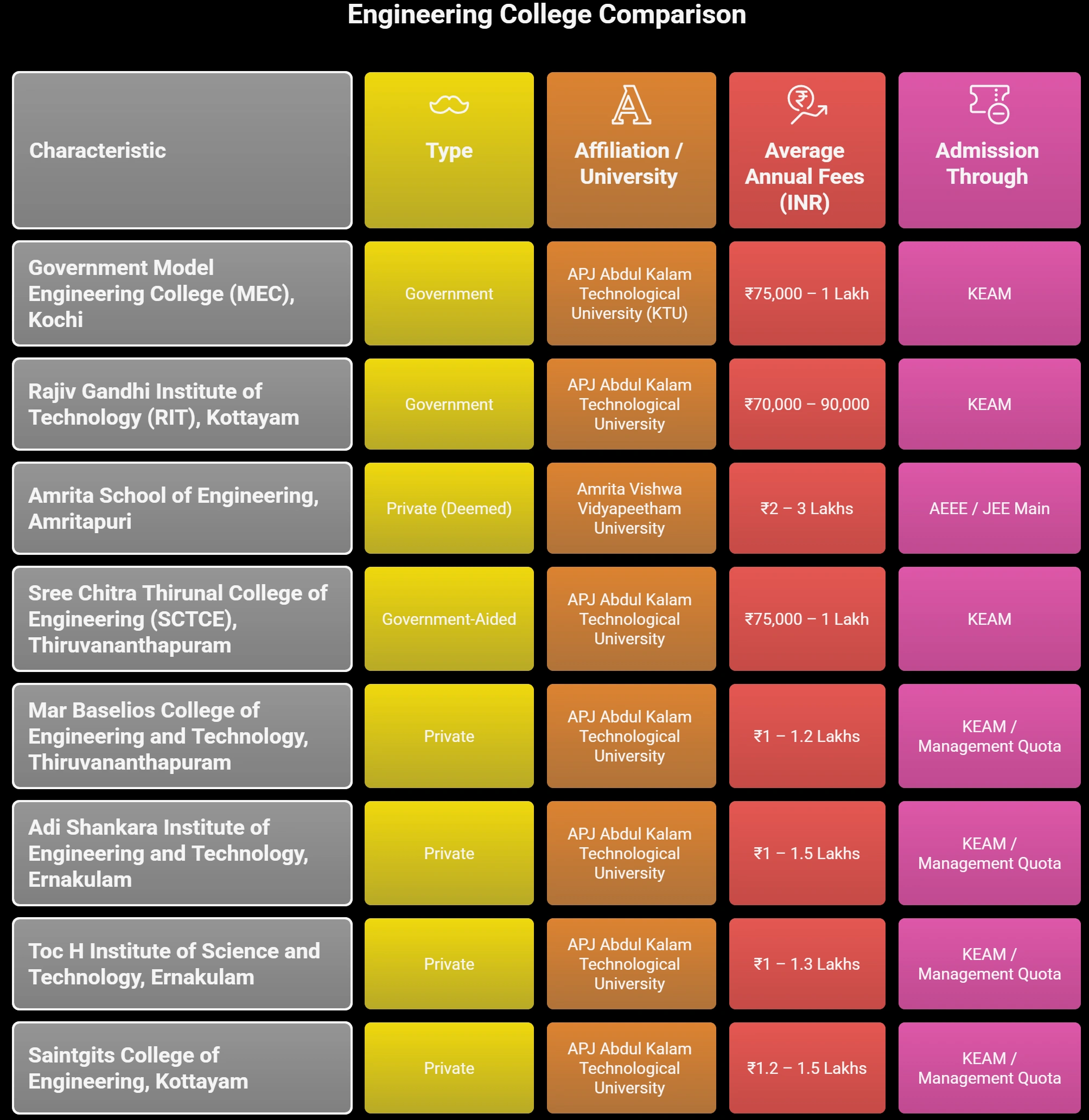
BTech Biomedical Engineering Colleges in Kerala
Kerala has emerged as one of India’s key destinations for Biomedical Engineering education, known for its strong academic standards, excellent healthcare infrastructure, and rising investments in medical technology and biotechnology research. The state’s colleges emphasize both engineering innovation and clinical application, making it ideal for students aspiring to work in medical devices, hospital technology management, or prosthetic development.
BTech Biomedical Engineering Colleges in AP (Andhra Pradesh)
Andhra Pradesh is steadily becoming a hub for biomedical and healthcare technology education in South India. With a growing focus on research-driven engineering, AI-based medical innovations, and MedTech startups, several universities in the state now offer specialized BTech Biomedical Engineering programs. These courses are designed to equip students with the knowledge and skills to develop medical instruments, diagnostic systems, and prosthetic technologies — bridging the gap between engineering and healthcare.
Top Biomedical Engineering Colleges in Andhra Pradesh 2026
| College Name | Type | Affiliation / University | BTech Biomedical Engineering Fees (Average Annual Fees in ₹) | Admission Through |
| KL University (Koneru Lakshmaiah Education Foundation), Guntur | Private (Deemed) | KL University | ₹2 – 2.5 Lakhs | KLUEEE / JEE Main |
| Vignan’s Foundation for Science, Technology & Research, Guntur | Private (Deemed) | Vignan University | ₹1.5 – 2 Lakhs | V-SAT / JEE Main |
| Amrita Sai Institute of Science and Technology, Vijayawada | Private | JNTU Kakinada | ₹1 – 1.3 Lakhs | AP EAPCET / Management Quota |
| Vellore Institute of Technology (VIT-AP), Amaravati | Private (Deemed) | VIT University | ₹2.5 – 3 Lakhs | VITEEE / JEE Main |
| Rajiv Gandhi University of Knowledge Technologies (RGUKT), Nuzvid | Government | State University | ₹70,000 – 1 Lakh | RGUKT CET / AP EAPCET |
| SRM University, AP – Amaravati | Private (Deemed) | SRM Institute of Science and Technology | ₹2.5 – 3 Lakhs | SRMJEEE / JEE Main |
| GITAM University, Visakhapatnam | Private (Deemed) | GITAM (Deemed to be University) | ₹2 – 2.8 Lakhs | GAT / JEE Main |
| Anil Neerukonda Institute of Technology & Sciences (ANITS), Visakhapatnam | Private (Autonomous) | Andhra University | ₹1.2 – 1.5 Lakhs | AP EAPCET |
| Godavari Institute of Engineering and Technology (GIET), Rajahmundry | Private | JNTU Kakinada | ₹1 – 1.4 Lakhs | AP EAPCET / Management Quota |
BTech Biomedical Engineering Colleges in Kolkata
Kolkata, known as the academic capital of Eastern India, is steadily growing into a hub for Biomedical Engineering education. With a strong base in engineering, healthcare, and research, the city offers several reputed institutions that provide students with exposure to both technical innovation and clinical applications. Biomedical Engineering colleges in Kolkata emphasize the integration of electronics, data analytics, and biotechnology to design advanced medical devices, prosthetics, and diagnostic systems.
Students also benefit from proximity to major hospitals like Apollo Gleneagles, AMRI, and Medica Superspecialty Hospital, which frequently collaborate with universities for internships and biomedical research projects.
Top Biomedical Engineering Colleges in Kolkata 2026
| College Name | Type | Affiliation / University | BTech Biomedical Engineering Fees (Average Annual Fees in ₹) | Admission Through |
| University of Calcutta (CU) | Government | University of Calcutta | ₹25,000 – 40,000 | WBJEE |
| Jadavpur University | Government | Autonomous (State University) | ₹20,000 – 35,000 | WBJEE |
| Heritage Institute of Technology (HIT) | Private | Maulana Abul Kalam Azad University of Technology (MAKAUT) | ₹1.3 – 1.6 Lakhs | WBJEE / JEE Main |
| Techno India University | Private (Deemed) | Techno India Group | ₹1.5 – 2 Lakhs | WBJEE / JEE Main |
| B.P. Poddar Institute of Management and Technology | Private | MAKAUT | ₹1.2 – 1.5 Lakhs | WBJEE / JEE Main |
| Netaji Subhash Engineering College (NSEC) | Private | MAKAUT | ₹1 – 1.3 Lakhs | WBJEE / JEE Main |
| Guru Nanak Institute of Technology (GNIT) | Private | MAKAUT | ₹1 – 1.4 Lakhs | WBJEE / JEE Main |
| St. Thomas’ College of Engineering and Technology | Private | MAKAUT | ₹1.2 – 1.5 Lakhs | WBJEE / JEE Main |
BTech Biomedical Engineering Salary
BTech Biomedical Engineering offers a promising career that blends engineering innovation with healthcare advancement. As India rapidly expands its medical technology, diagnostics, and healthcare infrastructure, the demand for skilled biomedical engineers is on the rise — resulting in strong starting salaries and diverse career paths.
Biomedical engineers work in fields such as medical equipment design, prosthetics, hospital technology management, R&D, bioinformatics, and pharmaceutical engineering. Salaries vary based on factors like education, experience, job location, and the type of organization (government, private, or research-based).
Average Biomedical Engineering Salary in India 2026
| Experience Level | Job Role Examples | Average Annual Salary (INR) |
| Fresher (0–2 years) | Biomedical Engineer, Lab Technician, Technical Associate | ₹3.5 – 6 LPA |
| Mid-Level (3–6 years) | Design Engineer, R&D Engineer, Clinical Engineer | ₹6 – 10 LPA |
| Senior Level (7+ years) | Product Manager, Biomedical Project Lead, Research Scientist | ₹10 – 20 LPA+ |
BTech Biomedical Engineering Jobs
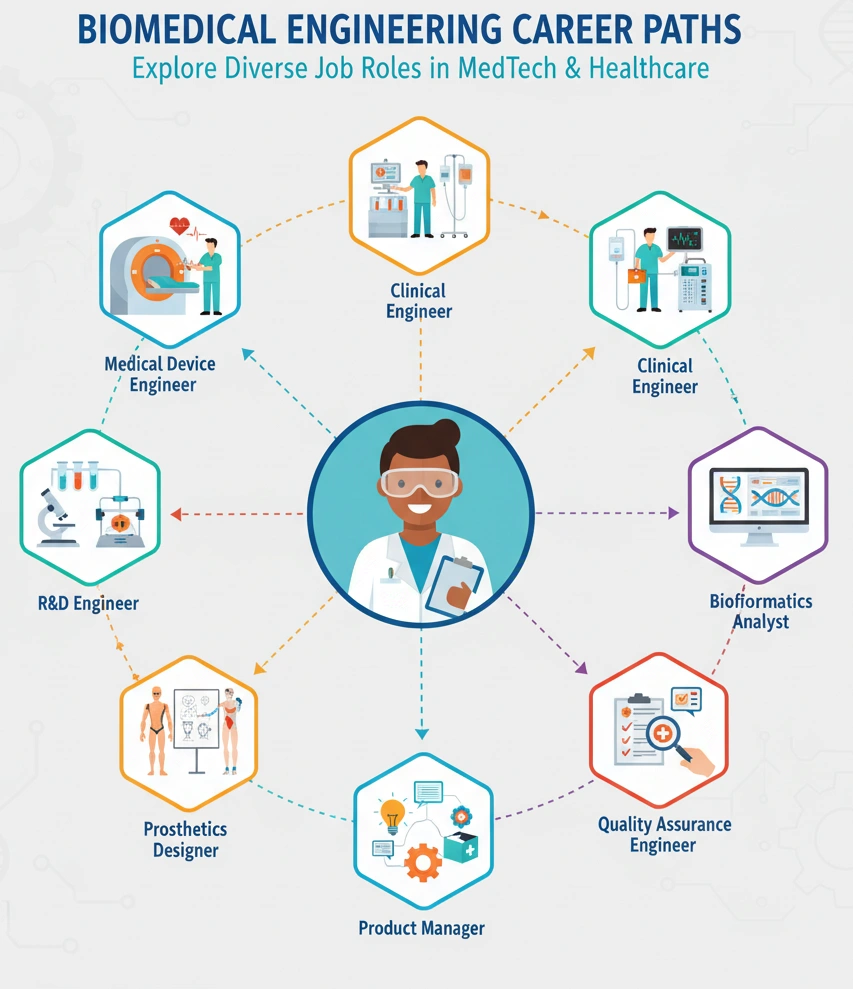
| Job Profile | Average Annual Salary (INR) | Description |
| Biomedical Engineer | ₹4 – 6 LPA | Works on designing, testing, and maintaining medical devices and systems. |
| Clinical Engineer | ₹5 – 8 LPA | Manages and maintains hospital equipment; ensures regulatory compliance. |
| R&D Engineer (Medical Devices) | ₹6 – 10 LPA | Engages in research and development of new healthcare technologies. |
| Bioinformatics Analyst | ₹5 – 9 LPA | Uses data analytics and software tools to interpret biological and medical data. |
| Quality Assurance Engineer | ₹4 – 7 LPA | Ensures medical equipment meets industry and safety standards. |
| Regulatory Affairs Specialist | ₹6 – 9 LPA | Handles product approvals and compliance with medical device regulations. |
| Medical Imaging Specialist | ₹7 – 12 LPA | Works with MRI, CT, and ultrasound technologies to improve imaging accuracy. |
| Product Manager (MedTech) | ₹10 – 20 LPA | Leads the strategy, design, and marketing of medical technologies. |
BTech Biomedical Engineering Placements
Placements in BTech Biomedical Engineering are seeing rapid growth as India’s healthcare and MedTech industries expand. With increasing collaborations between engineering institutes, hospitals, and medical device companies, students now enjoy broader placement opportunities across R&D, clinical engineering, manufacturing, biotech, and healthcare IT sectors.
The demand for biomedical engineers is fueled by the country’s shift toward digital healthcare, medical robotics, prosthetic innovations, and AI-based diagnostics. Graduates from reputed colleges like IITs, NITs, Amrita, and SRM secure placements in both core biomedical roles and interdisciplinary domains like data analytics, product design, and regulatory affairs.
Top Biomedical Engineering Recruiters in India
| Category | Top Recruiters |
| Medical Equipment & Devices | GE Healthcare, Philips Healthcare, Siemens Healthineers, Medtronic, Dräger, BPL Medical, Skanray Technologies |
| Hospitals & Clinical Organizations | Apollo Hospitals, Fortis Healthcare, Max Healthcare, AIIMS, Narayana Health |
| Biotech & Pharma Companies | Biocon, Cipla, Serum Institute of India, Sun Pharma, Dr. Reddy’s Laboratories |
| Healthcare IT & Analytics | TCS Life Sciences, Wipro GE, Infosys Healthcare, IBM Watson Health, Practo, Tricog Health |
| Research & Government Labs | DRDO, CSIR, ICMR, ISRO Life Sciences Division, IIT Biomedical Research Labs |
Average Biomedical Engineering Placement Packages (2026)
| Type of Institution | Average Package (INR per annum) | Highest Package (INR per annum) |
| IITs / NITs | ₹8 – 14 LPA | ₹20 – 25 LPA |
| Top Private Universities (Amrita, SRM, VIT, UPES) | ₹5 – 10 LPA | ₹15 – 18 LPA |
| State / Government Colleges | ₹3.5 – 6 LPA | ₹8 – 12 LPA |
| Emerging Private Institutes | ₹3 – 5 LPA | ₹7 – 10 LPA |
The biomedical industry in India is projected to grow at over 15% CAGR. Driven further by Make-in-India initiatives, medical device manufacturing hubs, and foreign investment in healthcare technology. By 2030, the demand for skilled biomedical engineers is expected to double, especially in prosthetics, wearable health devices, and robotic surgery systems.
BTech Biomedical Engineering Scope
BTech Biomedical Engineering is one of the most promising and rapidly evolving engineering disciplines in India and worldwide. The scope of this branch extends across medical technology, hospital management, prosthetics, biotechnology, and research, making it ideal for students who want to combine engineering skills with healthcare solutions. With India emerging as a global hub for MedTech and biotech startups, the demand for qualified biomedical engineers continues to grow.
Career Opportunities in India
| Sector / Role | Key Responsibilities | Top Recruiters | Average Salary (INR LPA) |
| Medical Devices & Equipment | Design, development, and maintenance of MRI machines, prosthetics, pacemakers, imaging systems | Philips Healthcare, Siemens Healthineers, GE Healthcare, Medtronic, Dräger | 4 – 8 |
| Hospital Technology Management | Managing biomedical equipment, regulatory compliance, implementing new technologies | Apollo, Fortis, AIIMS, Max Healthcare | 4 – 6 |
| Research & Development (R&D) | Innovation in prosthetics, tissue engineering, biomedical imaging, biosensors | IITs, NITs, CSIR Labs, AIIMS | 6 – 10 |
| Bioinformatics & Healthcare Analytics | Analyzing medical data, predictive healthcare, AI diagnostics | TCS Life Sciences, Wipro, IBM Watson Health, Practo | 5 – 9 |
| Prosthetics & Rehabilitation Engineering | Designing artificial limbs, exoskeletons, and assistive devices | MedTech startups, hospitals, NGOs | 4 – 7 |
| Pharmaceutical & Biotech | Medical product design, quality control, regulatory affairs | Biocon, Dr. Reddy’s, Serum Institute, Sun Pharma | 5 – 9 |
| Entrepreneurship / Startups | Launching MedTech solutions, portable diagnostics, AI health apps | Self-started ventures, incubators, AMTZ, Startup India | 3 – 15+ |
Higher Education & Research Opportunities
| Program | Specializations / Focus Areas | Top Institutes |
| MTech / MS / PhD | Biomedical Signal Processing, Medical Imaging, Prosthetics & Biomechanics, AI in Healthcare, Biomaterials | IITs, NITs, IISc Bangalore, Abroad: USA, UK, Germany, Canada |
| Research Fellowships | Neural engineering, wearable health devices, rehabilitation robotics | AIIMS, CSIR, DRDO, MedTech startups, International R&D Labs |
Global Career Opportunities
| Country / Region | Popular Roles | Salary Range (Equivalent INR LPA) |
| USA | R&D Engineer, Clinical Engineer, Product Manager | 60 – 90 |
| UK | Medical Device Engineer, Bioinformatics Analyst | 45 – 65 |
| Germany | Prosthetics Designer, Biomedical R&D | 50 – 70 |
| Canada | Medical Imaging Specialist, Regulatory Affairs | 55 – 75 |
| Singapore / UAE | Hospital Technology Manager, MedTech Product Developer | 40 – 55 |
BTech Biomedical Engineering offers diverse career paths, high growth potential, and global opportunities. Graduates can work in core engineering, healthcare technology, research, or entrepreneurship, making it one of the most promising branches for future-ready engineers.
FAQs
What is the eligibility criteria for BTech Biomedical Engineering?
Candidates must have completed 10+2 (Physics, Chemistry, and Mathematics/Biology) with a minimum aggregate (usually around 50%). Admission is generally through JEE Main/Advanced, state entrance exams (like KEAM, AP EAPCET), or university-specific entrance tests.
Can PCB (Physics, Chemistry, Biology) students pursue BTech Biomedical Engineering?
Yes, several universities and private colleges allow PCB students, though some IITs and NITs require PCM (Physics, Chemistry, Mathematics) for eligibility. Students should check the specific college criteria before applying.
What is the scope of BTech Biomedical Engineering?
Graduates can work in medical device design, hospital technology management, prosthetics, R&D, bioinformatics, healthcare analytics, pharmaceuticals, and biotech. Opportunities also exist for higher studies (MTech/MS/PhD) in India or abroad.
What is the average salary of a Biomedical Engineer in India?
- Fresher: ₹3.5 – 6 LPA
- Mid-level: ₹6 – 10 LPA
- Senior/Specialized Roles: ₹10 – 20+ LPA
Salaries may vary depending on college, location, and job role.
Which are the top colleges for BTech Biomedical Engineering in India?
Some top government biomedical colleges: IIT Bombay, IIT Delhi, IIT Madras, NIT Rourkela, College of Engineering Pune. Now, some top private biomedical engineering colleges: Amity University, Galgotias University, KL University, UPES, Shobhit University, Chhotu Ram Rural Institute of Technology, GD Goenka University.