BTech Chemical Engineering is a 4-year undergraduate program that integrates chemistry, physics, and mathematics to design and optimise industrial processes that turn raw materials into useful products. Entering 2026, the field is expanding quickly with strong demand in Oil, Gas, Petrochemicals, and Pharmaceuticals, along with emerging areas such as green energy, nanotechnology, and battery technology.
This guide explains the BTech Chemical Engineering syllabus, key subjects, fees, and career prospects, showing how chemical engineers are driving innovation across multiple industries. Whether you aim to work in a refinery, a research facility, or a pharmaceutical plant, this overview will help you understand the career opportunities and return on investment associated with Chemical Engineering in 2026.
BTech in Chemical Engineering is a 4-year undergraduate engineering program that focuses on the study of chemical processes and the transformation of raw materials into useful products such as fuels, fertilizers, plastics, medicines, and food. It combines core sciences (chemistry, physics, and biology) with engineering principles to design, analyze, and operate industrial-scale chemical plants efficiently and safely.
Chemical engineers apply concepts of thermodynamics, fluid mechanics, heat and mass transfer, and reaction engineering to create sustainable processes that meet the needs of industries like oil & gas, petrochemicals, pharmaceuticals, food processing, and energy. The course bridges science and technology, training students to convert laboratory discoveries into practical, large-scale manufacturing solutions.
In simple terms, a chemical engineer is a problem-solver who ensures that industrial production is efficient, economical, and environmentally responsible. By 2026, the field is becoming even more interdisciplinary — blending data analytics, biotechnology, and green chemistry — preparing engineers to lead innovations in renewable energy, process automation, and sustainable materials.
To pursue BTech in Chemical Engineering, students must meet specific academic and entrance exam requirements. The eligibility criteria ensure that applicants have a strong foundation in science and mathematics, as the program demands analytical and problem-solving skills for process and design-oriented learning.
Eligibility Criteria
Details (2026 Admission)
Educational Qualification
Must have passed 10+2 (Class 12) or equivalent from a recognized board
Core Subjects Required
Physics, Chemistry, and Mathematics (PCM)
Minimum Marks Required
60% aggregate (General); 55% for Reserved categories
Accepted Entrance Exams
– JEE Main / JEE Advanced (for IITs, NITs, IIITs) – State-level exams: MHT CET, WBJEE, KCET, AP EAMCET – Private university exams: BITSAT, VITEEE, SRMJEEE, LPU NEST, UPESMET
Direct Admission
Available in select private universities based on Class 12 PCM merit
Lateral Entry (Diploma Holders)
Eligible for direct 2nd-year admission via LEET or university-specific exams
Age Limit
Typically 17–25 years at the time of admission (relaxation for SC/ST/OBC as per rules)
Medium of Instruction
English proficiency required
Medical Fitness
Candidates must meet basic health and fitness requirements for lab and industrial training
BTech Chemical Engineering Syllabus
The BTech Chemical Engineering syllabus is designed to build a strong foundation in chemical principles, process engineering, and technology design, integrating both theoretical concepts and industrial applications. The 4-year program, divided into 8 semesters, covers core engineering sciences, laboratory experiments, computational tools, and real-world projects aligned with the latest AICTE model curriculum (2026).
Core Structure Overview
Each year of study progressively shifts from basic sciences to advanced process and design subjects, along with laboratory training and internships.
Year
Focus Area
BTech Chemical Engineering Subjects
1st Year
Foundation in Basic Sciences & Engineering
Engineering Chemistry, Physics, Mathematics I & II, Engineering Drawing, Computer Programming, Environmental Studies, Communication Skills
2nd Year
Fundamental Chemical Engineering Principles
Chemical Process Calculations, Fluid Mechanics, Thermodynamics, Material Science, Electrical & Mechanical Engineering Basics, Process Instrumentation
3rd Year
Core Process & Design Courses
Heat Transfer Operations, Mass Transfer I & II, Reaction Engineering, Process Dynamics & Control, Numerical Methods, Chemical Technology, Plant Utilities
4th Year
Industrial Application & Research
Process Design, Plant Design & Safety, Optimization Techniques, Energy Engineering, Environmental Engineering, Project Work, Industrial Training
Laboratory & Practical Components
Each semester integrates lab courses that reinforce theoretical concepts through experiments and simulation software. Common lab courses include:
Fluid Mechanics Lab
Heat & Mass Transfer Lab
Chemical Reaction Engineering Lab
Process Control Lab
Mechanical Operations Lab
Computer-Aided Process Simulation (Aspen Plus / MATLAB)
Chemical Engineering Drawing & Design Lab
BTech Chemical Engineering Subjects (Elective)
Modern syllabi include electives aligned with global industry trends and sustainability goals. Students can specialize in emerging areas such as:
Biochemical & Pharmaceutical Engineering
Polymer & Petrochemical Technology
Energy and Environmental Engineering
Nanotechnology
Process Automation & Data Analytics
Renewable & Hydrogen Energy Systems
These electives reflect the shift toward green technology, AI integration, and data-driven plant design.
Industrial Training & Final Year Project
Internship / In-Plant Training: Typically 6–8 weeks during the summer after the 6th semester in chemical industries, refineries, or R&D labs.
Major Project (7th–8th Semester): Students work on real-world problems—like reactor design, waste minimisation, or renewable fuel development—guided by faculty or industry mentors.
Skill Development & Software Tools
Students are trained in specialised simulation and process design tools widely used in industry:
Students like you often search for a handy BTech Chemical Engineering syllabus. Below, we have provided the BTech Chemical Engineering Syllabus PDF of a top college. Generally, the course structure remains the same with minor alterations.
India offers some of the best Chemical Engineering programs in Asia, with a blend of top government institutes (known for research excellence and global ranking) and leading private universities (renowned for industry tie-ups and modern infrastructure). Whether your goal is to join an IIT for advanced research or a private university for hands-on industry exposure, the options are wide-ranging and competitive.
BTech Chemical Engineering Government Colleges in India
Government institutions continue to set the benchmark for academic depth, laboratory infrastructure, and research output. These colleges are ideal for students who want to pursue R&D, public sector jobs, or higher studies abroad.
Institute Name
Location
Average Fees (4 Years)
Average Package (LPA)
IIT Kharagpur
West Bengal
₹9–₹10 Lakh
₹16–₹18 LPA
IIT Bombay
Maharashtra
₹9–₹10 Lakh
₹18–₹20 LPA
IIT Delhi
New Delhi
₹8–₹10 Lakh
₹17–₹18 LPA
IIT Roorkee
Uttarakhand
₹8–₹9 Lakh
₹15–₹16 LPA
IIT Patna
Bihar
₹8–₹9 Lakh
₹13–₹15 LPA
NIT Tiruchirappalli (NIT Trichy)
Tamil Nadu
₹6–₹7 Lakh
₹10–₹12 LPA
Institute of Chemical Technology (ICT)
Mumbai
₹5–₹6 Lakh
₹9–₹11 LPA
NIT Rourkela
Odisha
₹6–₹7 Lakh
₹9–₹10 LPA
IIT Guwahati
Assam
₹8–₹9 Lakh
₹16 LPA
Jadavpur University
Kolkata
₹2–₹3 Lakh
₹8–₹9 LPA
BTech Chemical Engineering Private Colleges
Private universities have gained prominence for their modern labs, global collaborations, flexible electives, and strong campus placements. Many also integrate emerging fields like biotechnology, renewable energy, and process automation into their curriculum.
Institute Name
Location
Average Fees (4 Years)
Average Package (LPA)
BITS Pilani
Rajasthan
₹22–₹25 Lakh
₹13–₹15 LPA
Vellore Institute of Technology (VIT)
Tamil Nadu
₹8–₹9 Lakh
₹6–₹7 LPA
SRM Institute of Science and Technology (SRMIST)
Tamil Nadu
₹9–₹10 Lakh
₹6 LPA
MIT World Peace University (MIT-WPU)
Pune
₹10–₹11 Lakh
₹5.5–₹6.5 LPA
Lovely Professional University (LPU)
Punjab
₹8–₹9 Lakh
₹5–₹6 LPA
Manipal Institute of Technology (MIT)
Karnataka
₹12–₹14 Lakh
₹7–₹8 LPA
UPES Dehradun (University of Petroleum & Energy Studies)
Uttarakhand
₹14–₹16 Lakh
₹6–₹8 LPA
Amrita Vishwa Vidyapeetham
Coimbatore
₹10–₹11 Lakh
₹6–₹7 LPA
Chandigarh University (CU)
Punjab
₹8–₹9 Lakh
₹5–₹6 LPA
Graphic Era University (GEU)
Dehradun
₹10–₹12 Lakh
₹6.5–₹7.5 LPA
BTech Chemical Engineering Colleges in Delhi
Delhi and the NCR region host some of India’s most reputed institutions for BTech in Chemical Engineering, offering an excellent mix of government-funded institutes with strong research backgrounds and private universities with industry-driven curricula. Students benefit from proximity to industrial hubs, refineries, and research centers, making Delhi one of the most sought-after regions for Chemical Engineering aspirants.
Top Government Colleges for BTech Chemical Engineering in Delhi
Government institutes in Delhi are known for academic rigor, affordable fees, and national-level placements. These institutions admit students mainly through JEE Main and JEE Advanced, and consistently rank among the best in India for engineering education.
Institute Name
Location
Admission Through
Average Fees (4 Years)
Average Package (LPA)
Indian Institute of Technology (IIT) Delhi
Hauz Khas
JEE Advanced
₹9–₹10 Lakh
₹18–₹20 LPA
Delhi Technological University (DTU)
Rohini
JEE Main
₹7–₹8 Lakh
₹10–₹12 LPA
Netaji Subhas University of Technology (NSUT)
Dwarka
JEE Main
₹7–₹8 Lakh
₹9–₹10 LPA
Jamia Millia Islamia (JMI)
Jamia Nagar
JEE Main
₹1.6–₹2.0 Lakh
₹6–₹7 LPA
Indraprastha Institute of Information Technology (IIIT Delhi)
Okhla
JEE Main / UCEED
₹8–₹9 Lakh
₹9–₹11 LPA
Top Private Colleges for BTech Chemical Engineering in Delhi NCR
Private universities in and around Delhi NCR provide modern infrastructure, updated curricula, and international collaborations. These institutions often focus on industry-oriented learning, internships, and global exposure.
Institute Name
Location
Average Fees (4 Years)
Average Package (LPA)
Amity University
Noida
₹10–₹14 Lakh
₹6–₹7 LPA
Shiv Nadar University (SNU)
Greater Noida
₹11–₹12 Lakh
₹6–₹8 LPA
Galgotias University
Greater Noida
₹6–₹7 Lakh
₹4.5–₹6 LPA
GD Goenka University
Sohna (Gurugram)
₹7–₹8 Lakh
₹4.5–₹5.5 LPA
Manav Rachna International Institute of Research and Studies (MRIIRS)
Faridabad
₹6–₹7 Lakh
₹4–₹6 LPA
Amity Institute of Chemical Technology
Noida
₹12–₹13 Lakh
₹6 LPA
UPES Dehradun (close to Delhi NCR)
Dehradun
₹14–₹16 Lakh
₹6.5–₹8 LPA
Government vs Private Chemical Engineering Colleges in Delhi
Aspect
Government Colleges (IIT, DTU, NSUT, JMI)
Private Universities (Amity, SNU, Galgotias)
Tuition Fees
₹1.5–₹10 Lakh
₹6–₹15 Lakh
Admission Criteria
JEE Main / Advanced
University entrance or direct admission
Placement Rate
90–95%
85–90% (varies by college)
Average Package
₹7–₹15 LPA
₹5–₹7 LPA
Core Chemical Jobs
Strong (PSUs, R&D, refineries)
Moderate, more IT/consulting-oriented
ROI
Very High
Moderate to High (depends on scholarships)
BTech Chemical Engineering Colleges in Mumbai
Mumbai, often called India’s chemical and industrial hub, is one of the best destinations to pursue BTech in Chemical Engineering. The city hosts a perfect balance of top government institutes known for research excellence and renowned private universities that focus on practical, industry-oriented training. With proximity to major oil refineries, pharmaceutical companies, and R&D centers, Chemical Engineering students in Mumbai gain direct exposure to real-world industrial processes and career opportunities.
Top Government Colleges for BTech Chemical Engineering in Mumbai
Mumbai’s government institutes are globally recognized for their academic depth, low tuition fees, and strong connections with the chemical, petrochemical, and pharmaceutical sectors.
Institute Name
Location
Admission Through
Average Fees (4 Years)
Average Package (LPA)
Institute of Chemical Technology (ICT)
Matunga
MHT-CET / JEE Main
₹5–₹6 Lakh
₹9–₹11 LPA
Indian Institute of Technology (IIT) Bombay
Powai
JEE Advanced
₹9–₹10 Lakh
₹18–₹20 LPA
Veermata Jijabai Technological Institute (VJTI)
Matunga
MHT-CET
₹3–₹4 Lakh
₹7–₹8 LPA
University of Mumbai (UDCT Affiliated Colleges)
Fort
MHT-CET
₹2–₹3 Lakh
₹5–₹6 LPA
Dr. Babasaheb Ambedkar Technological University (DBATU)
Lonere (near Mumbai)
MHT-CET
₹4–₹5 Lakh
₹5–₹6 LPA
Top Private Colleges for BTech Chemical Engineering in Mumbai & Nearby Areas
Private colleges in Mumbai complement government institutes by offering modern laboratories, global tie-ups, and flexible specializations. They’re a strong choice for students seeking practical learning and international exposure.
Institute Name
Location
Average Fees (4 Years)
Average Package (LPA)
NMIMS University (Mukesh Patel School of Technology)
Vile Parle
₹12–₹14 Lakh
₹6–₹7 LPA
Thadomal Shahani Engineering College (TSEC)
Bandra
₹6–₹7 Lakh
₹5–₹6 LPA
K. J. Somaiya College of Engineering (KJSCE)
Vidyavihar
₹8–₹9 Lakh
₹6–₹7 LPA
Rajiv Gandhi Institute of Technology (RGIT)
Andheri
₹5–₹6 Lakh
₹4–₹5 LPA
Vivekanand Education Society’s Institute of Technology (VESIT)
Chembur
₹6–₹7 Lakh
₹5–₹6 LPA
Universal College of Engineering (UCoE)
Thane
₹5–₹6 Lakh
₹4–₹5 LPA
Amity University Mumbai
Panvel
₹10–₹12 Lakh
₹5.5–₹6.5 LPA
Government vs Private BTech Chemical Engineering Colleges in Mumbai
Aspect
Government Institutes (ICT, IITB, VJTI, MU)
Private Universities (NMIMS, KJSCE, Amity)
Tuition Fees
₹3–₹10 Lakh
₹6–₹14 Lakh
Admission Criteria
JEE Main / MHT-CET
CET / NPAT / University Exam / Direct
Placements (Average)
₹6–₹10 LPA
₹5–₹7 LPA
Research Opportunities
Very Strong
Moderate to High
Industry Exposure
Excellent
Good (via internships)
ROI
Very High
Moderate
Top Recruiters
Reliance, BPCL, Shell, L&T, BASF, Unilever
Asian Paints, Pfizer, TCS, Honeywell, Hikal
BTech Chemical Engineering in Chennai
Chennai is one of India’s leading educational and industrial centers for Chemical Engineering, thanks to its strong base in petrochemicals, fertilizers, energy, and manufacturing industries. The city hosts a mix of top government institutes known for research and renowned private universities that emphasize practical, industry-linked training. With its proximity to industrial belts in Manali, Ennore, and Sriperumbudur, Chennai provides an ideal environment for Chemical Engineering students to gain both academic knowledge and hands-on industrial exposure.
Top Government Colleges for BTech Chemical Engineering in Chennai
Chennai’s government institutions are highly reputed for their academic excellence, affordable tuition, and strong placement networks. These colleges admit students through national or state-level entrance exams, primarily JEE Main, JEE Advanced, and TNEA (Tamil Nadu Engineering Admissions).
Institute Name
Location
Admission Through
Average Fees (4 Years)
Average Package (LPA)
Indian Institute of Technology (IIT) Madras
Guindy
JEE Advanced
₹9–₹10 Lakh
₹18–₹22 LPA
Anna University (College of Engineering, Guindy – CEG)
Guindy
TNEA (Class 12 Merit)
₹2–₹3 Lakh
₹6–₹8 LPA
Alagappa College of Technology (ACT)
Guindy
TNEA
₹2–₹3 Lakh
₹5–₹6 LPA
Madras Institute of Technology (MIT), Chromepet
Chromepet
TNEA
₹2–₹3 Lakh
₹5–₹6 LPA
Central Polytechnic College (CPC)
Taramani
TNEA / Direct
₹1–₹2 Lakh
₹3–₹4 LPA
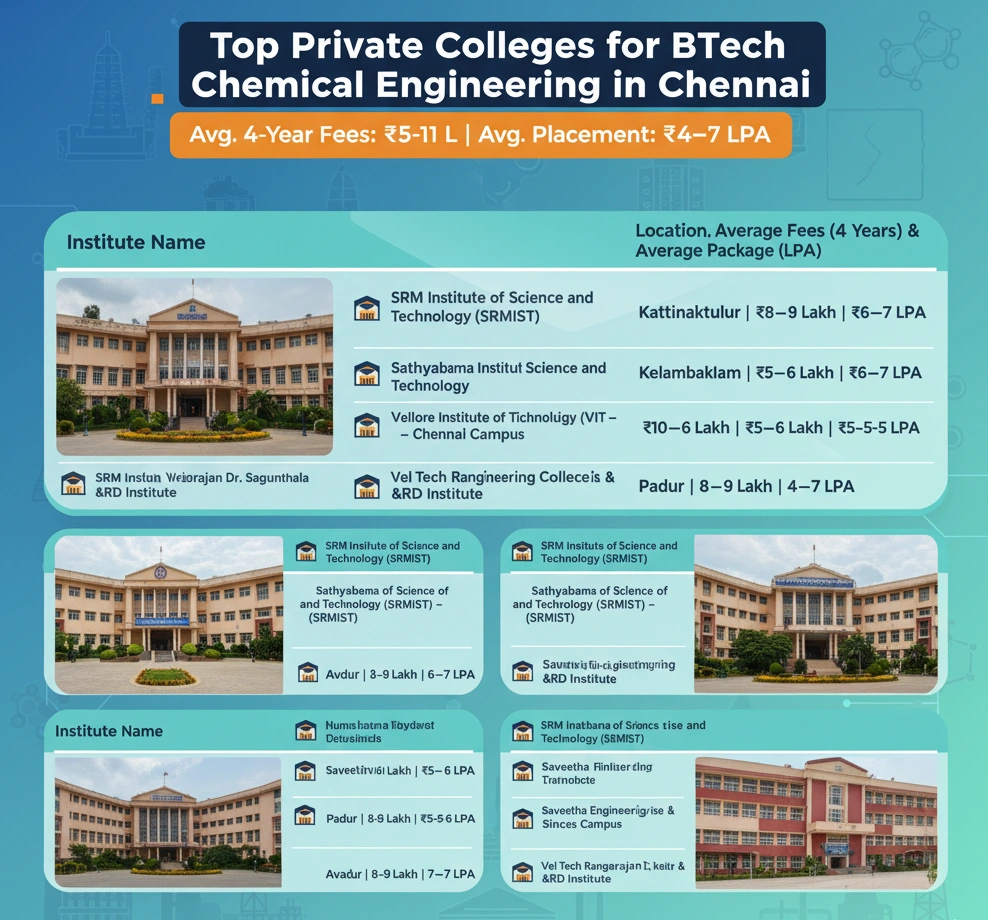
Top Private Colleges for BTech Chemical Engineering in Chennai
Private universities in Chennai have built strong reputations for modern infrastructure, flexible electives, and corporate collaborations. Many have active MoUs with leading companies in Oil, Gas, Energy, and Pharmaceuticals, offering internships and placement opportunities.
Institute Name
Location
Average Fees (4 Years)
Average Package (LPA)
SRM Institute of Science and Technology (SRMIST)
Kattankulathur
₹10–₹11 Lakh
₹6–₹7 LPA
Sathyabama Institute of Science and Technology
Sholinganallur
₹8–₹9 Lakh
₹5–₹6 LPA
Vellore Institute of Technology (VIT – Chennai Campus)
Kelambakkam
₹8–₹9 Lakh
₹6–₹7 LPA
Saveetha Engineering College
Thandalam
₹5–₹6 Lakh
₹4.5–₹5.5 LPA
Hindustan Institute of Technology & Science (HITS)
Padur
₹8–₹9 Lakh
₹5–₹6 LPA
Vel Tech Rangarajan Dr. Sagunthala R&D Institute of Science and Technology
Avadi
₹6–₹7 Lakh
₹4–₹5 LPA
Government vs Private Chemical Engineering Colleges in Chennai
Parameter
Government Institutes (IIT-M, Anna Univ, ACT, MIT)
Private Universities (SRM, VIT, Sathyabama)
Fees (4 Years)
₹2–₹10 Lakh
₹6–₹11 Lakh
Admission Mode
JEE Advanced / TNEA
SRMJEEE / VITEEE / Merit
Placements (Average)
₹6–₹10 LPA
₹5–₹6.5 LPA
Top Recruiters
CPCL, ONGC, Reliance, L&T, TCS
Pfizer, Asian Paints, Infosys, Shell
Infrastructure
Strong research labs, process simulators
Modern labs, global partnerships
ROI
Very High
Moderate to High
Research Opportunities
Excellent
Moderate
BTech Chemical Engineering Jobs
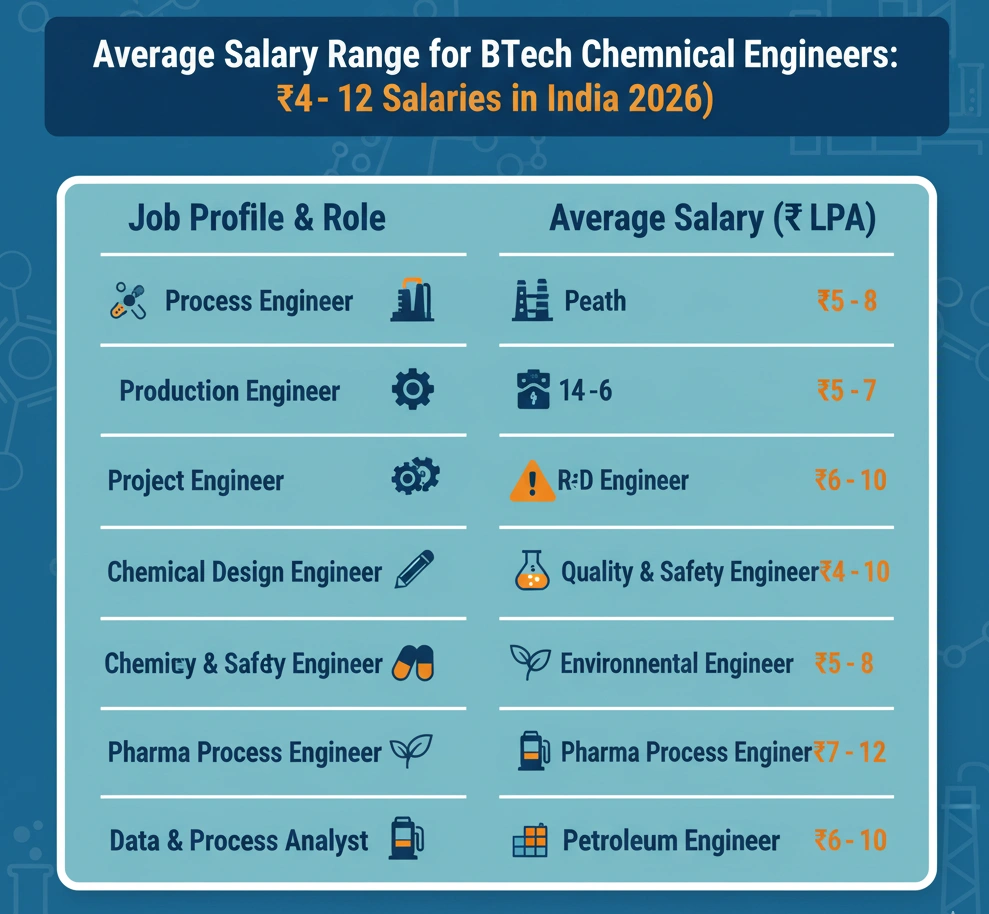
A BTech in Chemical Engineering opens diverse career opportunities across industries such as Oil & Gas, Petrochemicals, Pharmaceuticals, Fertilizers, Energy, Food Processing, and Materials Manufacturing. Chemical engineers are crucial in designing processes, managing production plants, and improving the efficiency and safety of industrial operations.
From working in refineries and R&D labs to joining space and energy research organizations, graduates can choose between core engineering roles, research positions, or management profiles in both the public and private sectors.
Job Profile
Role Description
Average Salary (₹ LPA)
Top Recruiters / Sectors
Process Engineer
Designs and optimizes chemical processes in refineries and manufacturing plants
5 – 8
ONGC, Shell, Reliance, BPCL, L&T
Production Engineer
Oversees day-to-day plant operations, quality control, and safety compliance
4 – 6
Tata Chemicals, BASF, Deepak Fertilizers
Project Engineer
Manages installation and commissioning of new process equipment and systems
5 – 7
Technip Energies, Honeywell, Adani
Chemical Design Engineer
Develops flow diagrams and simulations using software like Aspen Plus, HYSYS
6 – 9
Jacobs, GAIL, IOCL, ExxonMobil
Research & Development (R&D) Engineer
Conducts experiments and develops new materials or chemical processes
6 – 10
CSIR, BARC, DRDO, ISRO, Pfizer
Quality Control / Safety Engineer
Ensures compliance with environmental, safety, and product quality standards
4 – 6
Asian Paints, Hindustan Unilever, ITC
Environmental Engineer
Designs eco-friendly systems for waste treatment, water purification, and emissions
5 – 7
NTPC, Adani Green, Praj Industries
Pharmaceutical Process Engineer
Works on drug manufacturing, purification, and chemical synthesis
5 – 8
Sun Pharma, Dr. Reddy’s, Biocon
Petroleum Engineer
Specialises in refining, extraction, and fuel processing systems
7 – 12
ONGC, Schlumberger, Indian Oil
Data & Process Analyst(emerging role)
Uses data analytics to improve production efficiency and energy optimisation
6 – 10
Honeywell, Shell, Accenture, Infosys
Career Growth Outlook
Entry-level (0–2 years): ₹4–6 LPA
Mid-level (3–6 years): ₹8–12 LPA
Senior-level / Abroad Roles: ₹15–25 LPA+
Research / PSU / ISRO/DRDO Scientists: ₹10–18 LPA (depending on grade & department)
Which companies hire chemical engineers?
Chemical engineers are in high demand across industries that rely on chemical reactions, process design, or large-scale material transformation. Top employers range from energy conglomerates to pharmaceutical and FMCG companies.
Project Engineer, Simulation Specialist, Process Consultant
Renewable & Environmental
Adani Green Energy, Tata Power, NTPC Green Energy, Praj Industries
Environmental Engineer, Waste Management Engineer
Emerging Opportunities (2026 and beyond):
Hydrogen fuel and battery manufacturing
Carbon capture and storage technologies
Sustainable polymers and bio-based materials
AI-driven process optimization
With industries shifting toward green and data-driven processes, chemical engineers now work on solutions that balance industrial growth with sustainability — a field projected to grow significantly through the next decade.
Can a Chemical Engineer join ISRO?
Yes, Chemical Engineers can join ISRO (Indian Space Research Organisation) through multiple pathways. While ISRO primarily recruits Mechanical, Electronics, and Aerospace Engineers, it also hires Chemical Engineers for specific roles in propulsion, cryogenics, materials, and fuel technology.
Key Areas Where ISRO Employs Chemical Engineers:
Rocket Propulsion & Fuel Systems: Design and testing of liquid and solid propellants.
Cryogenic Engineering: Handling low-temperature systems used in space missions.
Material Science: Development of polymers, composites, and coatings for spacecraft.
Environmental & Safety Engineering: Waste management, emission control, and energy optimization in launch centers.
Recruitment Pathways:
ISRO Centralized Recruitment (ICRB): Graduates can apply for Scientist/Engineer – SC posts when Chemical Engineering is listed in the notification.
GATE Score: ISRO occasionally shortlists Chemical Engineers through GATE (Chemical Engineering – CH paper) for research roles.
Internships & Research Projects: Final-year students can apply for ISRO’s academic programs for research collaboration.
Other Research Organizations Hiring Chemical Engineers:
DRDO (Defence Research and Development Organisation) – Propellant and material R&D.
BARC (Bhabha Atomic Research Centre) – Nuclear fuel cycle and process design.
CSIR Labs (Council of Scientific & Industrial Research) – Catalysis, polymer, and biofuel research.
What is the salary of B Tech chemical engineer in India?
The salary for BTech Chemical Engineering graduates in India varies based on several key factors — including sector, specialisation, job role, company, location, and experience. Chemical Engineers are employed in a wide range of industries such as Oil & Gas, Petrochemicals, Pharmaceuticals, Fertilisers, Food Processing, Renewable Energy, and Research organisations.
With India’s growing focus on energy transition, sustainable chemistry, and process automation, the average salary for chemical engineers has shown steady growth — especially in roles related to green technology, hydrogen energy, and advanced materials.
BTech Chemical Engineering Salary in India
Experience Level
Average Annual Salary (₹ LPA)
Typical Job Roles
Entry-Level (0–2 years)
₹4 – ₹6 LPA
Graduate Engineer Trainee, Production Engineer, Quality Engineer
Mid-Level (3–6 years)
₹7 – ₹12 LPA
Process Engineer, Design Engineer, Project Lead
Senior-Level (7–12 years)
₹12 – ₹18 LPA
Senior Process Manager, R&D Engineer, Operations Head
Top/International Roles (10+ years)
₹20 – ₹35 LPA+
Technical Director, Plant Head, R&D Specialist, Global Consultant
BTech Chemeical Engineering Average Salary by Industry Sector
Industry / Sector
Average Salary Range (₹ LPA)
Top Employers
Oil & Gas / Petrochemical
6 – 12
ONGC, Reliance, Shell, IOCL, BPCL
Pharmaceuticals & Biotechnology
5 – 8
Pfizer, Dr. Reddy’s, Sun Pharma, Biocon
Fertilizers & Agrochemicals
4.5 – 7
IFFCO, RCF, Coromandel, GNFC
Food & FMCG Processing
4 – 6.5
Unilever, ITC, Nestlé, PepsiCo
Energy & Power
6 – 9
NTPC, Adani Green, Tata Power, Praj Industries
Research & Government (ISRO, DRDO, BARC, CSIR)
8 – 15
Central R&D Labs, Space & Defence Projects
Consulting & EPC Firms
7 – 12
Technip Energies, L&T, Jacobs, Honeywell
Renewable & Green Energy
6 – 10
Adani Green, ReNew Power, BP Energy, Praj Industries
Top-Paying Companies for Chemical Engineers in India
Company Name
Average Starting Package (₹ LPA)
Type of Organization
Reliance Industries Limited (RIL)
8 – 10
Petrochemical / Refining
Shell India
9 – 12
Oil & Gas
BASF / Dow Chemicals
9 – 11
Chemical Manufacturing
Larsen & Toubro (L&T)
6 – 8
EPC / Project Management
Indian Oil Corporation Limited (IOCL)
7 – 9
PSU
Praj Industries
6 – 8
Renewable & Bioenergy
Honeywell
7 – 10
Process Automation
Pfizer / Dr. Reddy’s Labs
6 – 8
Pharma
Technip Energies
8 – 10
Consulting / Design
ISRO / BARC / DRDO
10 – 18
Government R&D
Observation: Multinational companies like Shell, BASF, and Honeywell offer higher starting packages, especially for candidates with simulation skills (Aspen Plus, MATLAB, ANSYS) and strong internships or research experience.
BTech Chemical Engineering Salary Comparison: Private vs Government Sector
Higher performance-linked pay, faster career growth
Consulting / EPC Firms
7 – 9
Project-based exposure, diverse experience
Research Organizations (ISRO, CSIR, DRDO)
10 – 18
High prestige, advanced research roles
Academic / Teaching Roles
5 – 8
Ideal for MTech/PhD graduates, research-driven
International Salary Trends
For students planning to work abroad, Chemical Engineering remains among the highest-paying engineering disciplines globally.
Country
Average Salary (USD per year)
Equivalent in ₹ (approx.)
USA
$85,000 – $120,000
₹70 – ₹1 Cr
Canada
$65,000 – $90,000
₹54 – ₹75 Lakh
Germany
€50,000 – €75,000
₹45 – ₹65 Lakh
Gulf Countries (Qatar, UAE, Saudi Arabia)
$40,000 – $65,000
₹35 – ₹55 Lakh
Australia
AUD 80,000 – 110,000
₹45 – ₹65 Lakh
Note: Engineers with experience in petroleum refining, process control, or environmental engineering are particularly sought after internationally.
BTech Chemical Engineering Scope
The scope of BTech Chemical Engineering is vast and ever-expanding — spanning industries that power the global economy, from oil and gas refining to pharmaceuticals, renewable energy, and materials innovation. Chemical Engineers are the backbone of process industries — they design, optimize, and operate large-scale systems that turn raw materials into valuable products like fuels, polymers, fertilizers, and medicines.
In 2026 and beyond, as industries move toward green technologies, decarbonization, and AI-driven process optimization, the demand for chemical engineers is expected to grow by 10–12% annually, both in India and abroad.
India’s chemical and energy sectors are among the fastest-growing in the world, offering a wealth of opportunities for chemical engineers. The Indian chemical industry, valued at $220 billion in 2024, is projected to reach $300 billion by 2027, driving massive recruitment across refineries, pharma companies, and renewable energy firms.
Key growth areas include:
Oil & Gas Refining: Engineers work in refineries (Reliance, ONGC, IOCL) to design efficient distillation and cracking processes.
Pharmaceuticals & Biotech: Chemical engineers play a central role in drug manufacturing, purification, and process validation, especially in cleanroom and fermentation environments.
Fertilizers & Agrochemicals: With the focus on food security and sustainable agriculture, fertilizer companies hire engineers for process optimization and environmental safety.
Petrochemicals & Polymers: Demand for chemical engineers is rising in polymer science, plastics recycling, and sustainable materials.
Renewable & Green Energy: Chemical engineers design hydrogen fuel systems, battery technologies, carbon capture units, and biofuel plants — the future of sustainable engineering.
Process Consulting & Design: Engineering firms like L&T, Technip Energies, Honeywell, and Jacobs recruit chemical engineers for plant design and simulation-based roles.
Industry Outlook (India 2026):
Employment growth in core chemical industries – 8–10% annually
Increase in green jobs and sustainability roles – 15%+ annually
Expansion of R&D and simulation-driven roles due to Industry 4.0 integration
Scope of BTech Chemical Engineering Abroad
Chemical engineers are among the highest-paid engineering professionals globally, with demand particularly strong in USA, Canada, Germany, Gulf countries, and Australia.
Key Global Sectors Hiring Chemical Engineers:
Energy & Oil Refineries: ExxonMobil, Chevron, BP, Shell, Saudi Aramco
Pharmaceuticals & Biotech: Pfizer, Johnson & Johnson, GSK, Novartis
Process Design & Automation: Honeywell, Siemens, Technip, Schlumberger
Environmental & Sustainable Solutions: Tesla Energy, BASF, Dow Chemical, DuPont
Research & Academia: Universities and R&D labs across Europe and North America
Opportunities Abroad:
USA / Canada: Focus on green energy, materials science, and bioprocess engineering
Gulf Countries (Qatar, UAE, Saudi Arabia): High-paying refinery and petrochemical jobs
Germany & Europe: Demand for engineers in chemical manufacturing and energy transition projects
Australia: Opportunities in mineral processing, water treatment, and hydrogen economy
With global sustainability goals, chemical engineers are increasingly hired in carbon capture, energy storage, and climate-tech startups, opening pathways for international research and innovation careers.
Summary – The Future of Chemical Engineering
Scope Area
Opportunities (2026–2030)
Average Salary (₹ LPA)
Oil & Gas / Petrochemical
High – Process, Refinery, Design
6 – 12
Pharmaceutical / Biotech
Very High – Process & QA roles
5 – 8
Renewable Energy / Hydrogen
Fast-Growing Sector
7 – 14
Consulting / EPC
Strong International Demand
8 – 12
R&D / Government Labs
Competitive & Prestigious
10 – 18
Abroad Opportunities
High-paying & expanding
20 – 35 (equivalent)
BTech Chemical Engineering Career Growth Report (2026-2036)
The decade between 2026 and 2036 is poised to be transformative for Chemical Engineers, as the global economy pivots toward clean energy, sustainable manufacturing, and materials innovation. While traditional sectors like oil refining, fertilizers, and pharmaceuticals will remain major employers, the next wave of growth will come from hydrogen fuel, battery manufacturing, carbon capture, and bio-based industries.
By 2036, Chemical Engineering is expected to evolve from a conventional industrial discipline to a core driver of sustainable technology and process innovation — positioning engineers as crucial players in global climate and energy solutions.
Download the complete BTech Chemical Engineering Career Growth Report (2026-2036) PDF. It comes with a comprehensive coverage of this sector for the next decade.
What is the salary of a BTech Chemical Engineer in India?
The average salary of a BTech Chemical Engineer in India ranges between ₹5–8 LPA for fresh graduates, while mid-level professionals earn ₹10–15 LPA. Senior engineers and R&D specialists can earn up to ₹25 LPA or more, especially in industries like Oil & Gas, Pharmaceuticals, and Renewable Energy.
Which field is best after BTech in Chemical Engineering?
After BTech, students can specialize through MTech or MS in areas such as Process Design, Energy Systems, Environmental Engineering, or Biochemical Engineering. Alternatively, pursuing an MBA in Operations or Project Management opens managerial roles in industrial and consulting firms.
What is the scope of Chemical Engineering in the future?
The scope of Chemical Engineering (2026–2036) is expanding beyond traditional industries into green hydrogen, carbon capture, battery manufacturing, and climate-tech. With global sustainability goals rising, Chemical Engineers are expected to play a crucial role in clean energy production and circular economy innovations.
Which companies hire Chemical Engineers in India?
Top recruiters include Reliance Industries, ONGC, IOCL, Shell, BASF, Sun Pharma, Dr. Reddy’s, L&T, Technip Energies, Honeywell, and NTPC. Research organizations like ISRO, DRDO, and BARC also recruit chemical engineers for specialized R&D and materials science roles.
Is Chemical Engineering a good career for the next 10 years?
Yes. Chemical Engineering is among the most future-proof engineering branches due to its integration with AI, clean energy, and sustainability technologies. Between 2026 and 2036, job opportunities are projected to grow by 8–10% annually, with a strong demand for experts in green hydrogen, environmental systems, and process automation.
Nishit Kumar is a senior EdTech industry leader with over a decade of experience in building and scaling education platforms. He was instrumental in building Collegedunia from the ground up, shaping its product, content, and growth strategy. At FindMyCollege, Nishit oversees content and editorial strategy, guiding topic selection, content frameworks to ensure accuracy, relevance, and student-first value across the website.