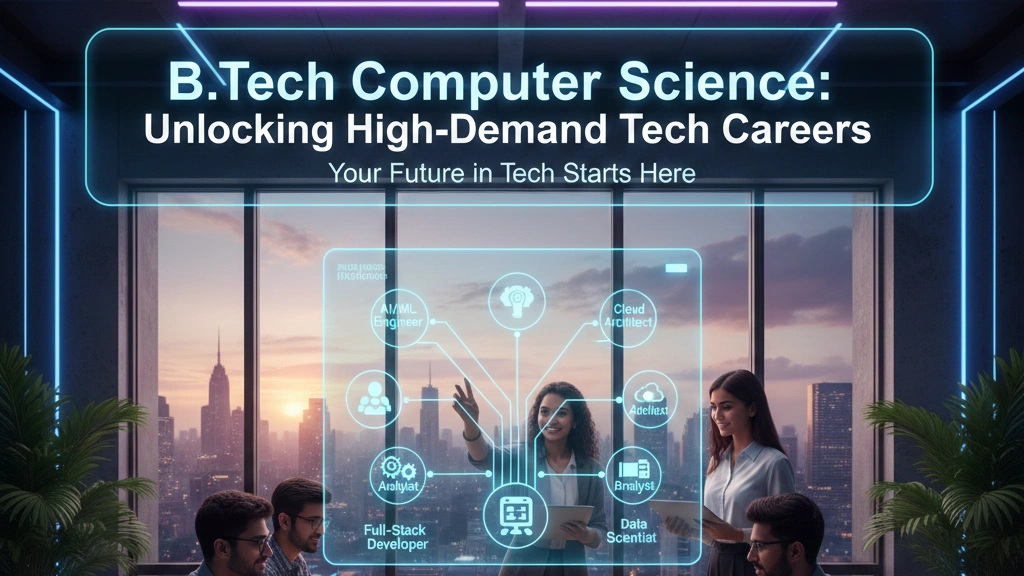
We are in an era where every facet of our lives is going digital. From how we shop and communicate to how factories operate and governments serve citizens. Therefore, the demand for technology-savvy professionals is skyrocketing.
For students and aspirants eyeing the future, a degree such as the Bachelor of Technology in Computer Science & Engineering (B.Tech CSE) is more than just a credential. It’s a launchpad into one of the most dynamic and high-demand fields of our time.
Here’s why this is not just hype. On the industry side, the country’s tech sector is projected to achieve revenues of around US $500 billion (~₹43.1 lakh crore) by 2030. This figure alone signifies massive expansion and opportunities for engineers.
What does this mean for someone considering B.Tech in CSE? It means you’re stepping into a field that is growing, reshaping, and ripe with possibilities. The degree isn’t just relevant, it’s one of the most strategic choices you can make. If you want to align with the core of modern innovation (AI, cloud, cybersecurity, big data) and also build a career that responds to real demand. B Tech CSE is the key.
Considering B Tech CSE? This blog will walk you through it all. From what the degree is, why it remains the most popular engineering branch in 2026 to how the curriculum is structured. Along with this, what skills you’ll need, where this path can take you, and more. If you’re ready to turn curiosity into capability, this guide is your map.
B.Tech in Computer Science and Engineering (CSE) is a 4-year undergraduate program focused on the design, development, and application of computer systems and software. It combines core engineering principles with advanced computing concepts to produce industry-ready professionals.
Key Highlights:
Duration: 4 years (8 semesters)
Eligibility: 10+2 with Physics, Chemistry, Mathematics (PCM)
In 2025, CSE remains the most sought-after engineering branch due to explosive growth in digital transformation, AI, and cloud computing.
Metric
Insight
Employability Rate
78.2% (India Skills Report 2025)
Average B Tech in Computer Science Salary
₹8–25 LPA (India)
Global Demand
2.3 million new tech jobs by 2030 (NASSCOM)
Top Recruiters
Google, Microsoft, Amazon, TCS, Infosys, Meta
Insight: CSE graduates are 2.5x more likely to secure jobs within 3 months compared to other branches.
B Tech in Computer Science Eligibility after 12th
To pursue B.Tech in Computer Science, candidates must meet academic and age-related requirements set by their chosen universities and national exam authorities. While the criteria may vary slightly by institution, the general eligibility remains consistent across India.
Basic B Tech CSE Eligibility Requirements:
Academic Qualification: Candidates must have passed Class 12 (10+2) or equivalent examination with Physics, Chemistry, and Mathematics (PCM) as core subjects.
Minimum Marks: A minimum aggregate of 50–75% is typically required (depending on the university).
For IITs and NITs: Admission through JEE Main + JEE Advanced, with a strong percentile (90+ in Mains, AIR-based selection in Advanced).
For state or private universities: 50–60% aggregate in PCM with valid entrance exam scores (like BITSAT, SRMJEEE, or university-level tests).
Age Limit: Candidates should generally be below 25 years of age as of the admission year (with a 5-year relaxation for reserved categories in some institutes).
Equivalent Qualifications: International Baccalaureate (IB) Diploma or equivalent with Mathematics and Physics may also be accepted by certain private or foreign-collaboration universities in India.
B Tech Computer Science Admission 2026
Admission to B.Tech CSE programs in India can happen through national, state, or institutional-level entrance examinations. Additionally, in some private universities, B Tech CSE admission happens through direct merit-based admission. The process usually follows the stages provided below.
Top B Tech Computer Science Entrance Exams
Admission to B Tech in Computer Science happens through multiple entrance exams. Firstly, there are the national-level entrance exams. Then there are state and institute-specific entrances.
Entrance-Based Admissions (Major Pathway)
National-Level Exams
JEE Main: Conducted by NTA, the qualifying exam for NITs, IIITs, and many central institutions.
JEE Advanced: Admission gateway to IITs — the top echelon of engineering education in India.
BITSAT: Online exam for BITS Pilani, Goa, and Hyderabad campuses.
VITEEE, SRMJEEE, KIITEE, MET, and COMEDK: University-specific exams for top private universities.
State-Level Exams
Examples: WBJEE (West Bengal), MHT CET (Maharashtra), KCET (Karnataka), EAMCET (Telangana & Andhra Pradesh).
Admission to government and private colleges within the respective states.
Counselling Rounds
After the results, centralised counselling (like JoSAA for IITs/NITs or state counselling boards) allocates seats. The seats are allocated based on rank, category, and preferences.
Direct or Merit-Based Admissions (Alternative Pathway)
Some private and deemed universities offer direct admission under the management quota or based on Class 12 merit. This happens especially if seats remain vacant after entrance-based rounds.
Examples include Amity University, Chandigarh University, Lovely Professional University (LPU), and Galgotias University. These institutions also offer scholarships to high-performing students.
B Tech Computer Science Admission 2026 Timeline
Below is the B Tech Computer Science tentative schedule for 2026. This timeline is in accordance with the dates followed in past years. For exact dates, keep visiting the official website.
B Tech in Computer Science Syllabus (Semester-Wise Breakdown)
The B Tech in Computer Science syllabus is designed to cultivate both theoretical knowledge and hands-on technical expertise. It bridges mathematics, computer science fundamentals, and real-world applications. Thus, ensuring graduates are industry-ready for diverse roles, from software development to AI research.
The curriculum varies slightly across universities (IITs, NITs, BITS, private institutions, etc.). However, it broadly follows a standardised structure recommended by AICTE (All India Council for Technical Education) and the National Education Policy (NEP 2020).
B Tech in Computer Science Subjects 1st Year: Foundation in Computing & Engineering Sciences
Semester I
Semester II
Computational Thinking & Programming (C/Python)
Object-Oriented Programming using Java/C++
Engineering Calculus
Linear Algebra & Differential Equations
Physics for Engineers / Electromagnetics
Mechanics & Electrical Fundamentals
Environmental Studies & Sustainability
Digital Logic Design
Innovation & Entrepreneurship / Life Skills
Discrete Mathematics
Engineering Graphics / Workshop Practice
Introduction to Electronics Engineering
Programming Lab / Physics Lab
OOPs & Digital Design Lab
Credits: 18–20
Credits: 20–24
Focus: Students build a foundation in programming, mathematics, and physics while developing engineering thinking. They also learn environmental awareness and basic electronics — the bridge between hardware and software.
Year 2: Core Computing Concepts
Semester III
Semester IV
Data Structures using C++ / Python
Design and Analysis of Algorithms
Computer Organisation & Microprocessors
Operating Systems
Database Management Systems (DBMS)
Computer Networks
Probability & Statistics / Discrete Maths II
Ethics, Patents & IPR
Software Engineering Principles
Design Thinking & Innovation
Specialisation Core I (AI, DS, Cloud, etc.)
Specialisation Core II (Advanced Track)
Data Structures & DBMS Labs
Algorithms & OS Labs
Open Elective I
Open Elective II (Choice-Based)
Credits: 24–27
Credits: 22–25
Focus: This is the technical core of the degree. Students master algorithms, data handling, OS design, and networking. Minor specialisations (AI/ML, Cybersecurity, Cloud Computing, Full Stack, etc.) begin in the 4th semester.
Year 3: Advanced Computing & Specialisations
Semester V
Semester VI
Artificial Intelligence & Machine Learning
Undergraduate Research / Project Work
Automata Theory & Computability
Humanities / Management Elective (HSS)
High-Performance Computing / Compiler Design
Elective IV (Specialised Domain)
Competitive Programming / Emerging Tech Seminar
Elective V (Advanced Technical)
Specialisation Elective I (AI, Blockchain, Cloud, etc.)
Specialisation Elective III (Advanced Track)
Open Elective II
Open Elective III
Industrial Internship (Summer)
Industry / Research Internship Report
Credits: 20–22
Credits: 18–20
Focus: The focus shifts from general computing to applied AI, systems optimisation, and research. Students engage in competitive programming, specialised electives, and often begin contributing to open-source or minor research projects.
Year 4: Capstone, Industry Exposure & Innovation
Semester VII
Semester VIII
Capstone Project / Dissertation
Industrial / R&D / Startup Project
Specialisation Elective VI (Final Track)
Comprehensive Viva / Internship Assessment
Open Elective IV (Cross-disciplinary)
—
Professional Practical Internship (Optional in place of Capstone)
—
Credits: 12–14
Credits: 12
Total Program Credits: ≈ 160 (as per AICTE norms)
Focus: This final year emphasises industry readiness, entrepreneurship, and real-world problem-solving. Students spend one whole semester on projects, either in companies, startups, or research labs. Thus leading to placement or innovation-driven ventures.
Specialisation & Elective Areas (Varies by University)
While the core syllabus remains uniform, students can choose electives and specialisation tracks typically from the 3rd year onward. Common tracks include:
Each track offers 2-4 core courses and multiple electives that align with current and emerging industry trends.
Pedagogical Enhancements Across the Curriculum
Hands-On Labs: Each semester integrates labs to apply theoretical learning.
Mini Projects: Begin in 2nd year, scaling up to a full Capstone in 4th year.
Hackathons & Coding Contests: Embedded as credits or electives.
Industry Certifications: AWS, Microsoft, or Google Cloud integrated in electives.
Internships: Mandatory 6–8 weeks (usually after 6th semester).
B Tech Computer Science Syllabus PDF
Want to explore the complete semester-wise structure? Download the B.Tech CSE Syllabus here.
Top BTech CSE Colleges in India (2026)
Choosing the right college is one of the most crucial decisions for any Computer Science aspirant. In India, Computer Science Engineering (CSE) is offered across hundreds of government and private institutions — but the quality of curriculum, placements, and research infrastructure varies widely.
Here’s a breakdown of the best government and private colleges for B.Tech in Computer Science based on NIRF 2025 rankings, placement data, and academic reputation. Explore Top Engineering Colleges in India for more.
B Tech in Computer Science Colleges: Government
Government colleges — particularly the IITs, NITs, and IIITs — continue to dominate the list for Computer Science programs in India. These institutions combine world-class faculty, strong industry collaborations, and high placement records with affordable tuition fees. Check Government BTech Colleges in India.
College Name
NIRF Rank
Avg. Overall BTech Placement (₹ LPA)
IIT Madras
1
17
IIT Delhi
2
19
IIT Bombay
3
23.5
IIT Kanpur
4
26.27
IIT Kharagpur
5
19.8
IIT Roorkee
6
17.0
IIT BHU
10
22.8
NIT Trichy
9
17.9
IIT Guwahati
8
25.75
IIT Hyderabad
7
15.0
Delhi Technological University (DTU)
30
15.4
Jadavpur University
18
11
B Tech Computer Science Private Colleges
Private universities have modern infrastructure, flexible curricula, and strong industry tie-ups — making them excellent alternatives for students who don’t secure IIT/NIT admission. Many of these colleges follow ABET or NBA-accredited programs, ensuring global recognition. See Top 10 Private BTech Colleges in India.
The following are some of the best BTech CSE colleges available in Delhi:
College Name
Avg. Package Range
IIIT Delhi
₹16 LPA
Delhi Technological University (DTU)
₹15.4 LPA
Netaji Subhas University of Technology (NSUT)
₹10.8 LPA
Maharaja Agrasen Institute of Technology (MAIT)
₹7.06 LPA
Amity University, Noida
₹6.5 LPA
Jaypee Institute of Information Technology (JIIT)
₹5 to 6 LPA (Overall) ₹8.7 LPA(for CSE)
Bharati Vidyapeeth’s College of Engineering
₹5.5 LPA
B Tech Computer Science Colleges in Delhi University
B Tech Computer Science is offered by the Faculty of Technology (FOT) of Delhi University. The admission is this college happens through JEE Mains. FOT offers a more traditional engineering curriculum. It comes with a strong emphasis on technical skills, laboratory exposure, and campus placements.
Institute
Admission Exam
Specializations
Focus Area
Faculty of Technology (FOT)
JEE Main
CSE (available)
Core Engineering & Placements
Top Skills to Master in B.Tech CSE
Skill
Tools/Platforms
Programming
Python, Java, C++, JavaScript
Web Development
HTML, CSS, React, Node.js, Django
Databases
MySQL, MongoDB, PostgreSQL
Cloud
AWS, Azure, Google Cloud
AI/ML
TensorFlow, PyTorch, Scikit-learn
DevOps
Docker, Kubernetes, Jenkins, Git
Soft & Professional Skills
Problem-Solving (LeetCode, HackerRank)
System Design (Low-Level & High-Level)
Agile & Project Management
Communication & Team Collaboration
Pro Tip: Build 3–5 strong projects (e.g., AI chatbot, e-commerce app, blockchain wallet) for your portfolio.
BTech CSE Jobs
A B.Tech in Computer Science offers unmatched career flexibility. Graduates can enter core IT companies, tech startups, and research labs. They can also join public sector undertakings (PSUs), defence organisations, or even launch their own ventures. The beauty of this degree lies in its interdisciplinary nature. BTech CSE combines programming, electronics, mathematics, and problem-solving skills valued across every modern industry.
BTech CSE jobs are largely divided into three categories. Let’s break it down into three major pathways:
Private Sector Careers (Corporate/Tech Industry)
Government & PSU Jobs (through GATE and other exams)
Entrepreneurship and Research Careers
1. Private Sector Career Opportunities
Private-sector employment remains the largest recruiter of CSE graduates. Almost 80–85% of graduates enter roles across software, IT services, data science, and product development. Know more about BTech Salary in India.
Career Path
Typical Job Titles
Average Salary (INR LPA)
Top Employers
Software Development
Software Engineer, Application Developer, System Programmer
💡Insight: According to NASSCOM’s 2025 Tech Talent Report, India’s tech sector will add over 2.3 million new jobs by 2030, primarily in AI, cybersecurity, and data analytics. In all these domains where B.Tech CSE graduates lead the charge.
2. Government Jobs for B.Tech Computer Science
Contrary to the common assumption that CSE graduates only work in IT firms, there are numerous lucrative and secure government job opportunities. These roles often combine technology with public administration, defence research, or national security. These jobs are ideal for those seeking both stability and social impact.
(a) Public Sector Undertakings (PSUs)
Many PSUs recruit Computer Science engineers through GATE (Graduate Aptitude Test in Engineering). Candidates with valid GATE scores can apply to PSUs offering technical roles in software, systems, and cybersecurity.
Organization / PSU
Role Offered
Average CTC (INR LPA)
Selection Process
Indian Oil Corporation (IOCL)
Systems Engineer / IT Officer
10–12
GATE Score + Interview
Bharat Electronics Limited (BEL)
Software Engineer, R&D Engineer
8–10
GATE / Written Test + Interview
Bharat Heavy Electricals Limited (BHEL)
IT Analyst, Programmer
9–11
GATE + GD/PI
Oil and Natural Gas Corporation (ONGC)
Computer Engineer
9–12
GATE + Interview
National Informatics Centre (NIC)
Scientist ‘B’, Technical Assistant
8–15
Written + Interview (NIELIT)
DRDO / ISRO
Research Scientist, Software Developer
10–18
Separate Recruitment Exams
Steel Authority of India (SAIL)
Systems Engineer
8–10
GATE + Interview
(b) Central Government & Defence Roles
Computer Science graduates play a crucial role in India’s digital governance, defence tech, and cybersecurity missions.
Organisation
Key Role Areas
Exam / Entry Route
Indian Space Research Organisation (ISRO)
Onboard Software, AI, Data Systems
ISRO Scientist Exam
Defence Research and Development Organisation (DRDO)
AI, Cyberwarfare, Simulation Systems
DRDO Scientist ‘B’ Recruitment
National Informatics Centre (NIC)
e-Governance Projects, Cybersecurity
NIELIT Scientist/Technical Assistant Exam
Indian Railways (CRIS, RITES)
Database & System Management
RRB / GATE
Ministry of Electronics & IT (MeitY)
AI Policy, Digital India Projects
Central Govt Recruitment
Intelligence Bureau (IB)
Cybersecurity & Intelligence Analysis
IB ACIO (Technical) Exam
Public Sector Banks (IT Officer Posts)
Fintech Development, IT Security
IBPS SO (IT) Exam
📍 Emerging Trend: Government agencies are now hiring AI/ML experts, cloud architects, and blockchain developers for projects under Digital India, Smart Cities, and National Cybersecurity Policy.
(c) Indian Engineering Services (IES)
Though IES primarily recruits from core branches (Civil, Mechanical, Electrical, Electronics), Computer Science engineers can appear for General Central Services roles or technical consultancies under departments like NIC or MeitY after additional qualification exams.
3. Entrepreneurship & Startup Opportunities
The B.Tech CSE degree is also the breeding ground for tech founders and innovators. Graduates skilled in software, AI, and systems design often launch startups in:
SaaS (Software as a Service)
Fintech / EdTech / HealthTech
AI & Automation Tools
Cybersecurity & Data Analytics
Blockchain & Web3 Products
Some notable examples:
Sachin Bansal and Binny Bansal (Flipkart)- BTech,IIT Delhi
Bhavish Aggarwal and Ankit Bhati (Ola) – BTech, IIT Bombay
Sridhar Vembu (Zoho) – B Tech, IIT Madras
Vijay Shekhar Sharma (Paytm) B.Tech
🚀 Support Ecosystems: Many IITs, IIITs, and NITs run startup incubators (like IIT Madras’ Research Park or BITS Pilani’s Pilani Innovation Centre) that fund and mentor student-founded ventures.
4. Higher Studies and Research
If you’re inclined towards deeper academic or technical mastery, these are the logical next steps:
M.Tech (via GATE) – For specialization in AI, Data Science, Cybersecurity, Cloud Computing.
MS (Abroad) – Popular destinations: USA, Germany, Canada, Singapore.
MBA – Transition to tech management or product leadership (IIMs, ISB).
Ph.D. / Research – For those pursuing R&D in quantum computing, AI ethics, or computational neuroscience.
🌍 Emerging Trend:
Remote and hybrid tech jobs are exploding — 40% of software roles in 2025 will be location-independent (LinkedIn India Jobs Report, 2025). This makes CSE one of the most flexible career fields globally.
Fees & ROI: Is It Worth the Investment?
The B.Tech in Computer Science is one of the most financially demanding undergraduate programs in India, but also one of the few where the return on investment (ROI) is consistently high. The key question is simple: Do the salaries and career outcomes justify the cost? The answer, almost always, is yes—if you choose your college wisely and build the right skill set.
College Name
Total Fee (in ₹ Lakh) (Approx., based on Ist sem fee)
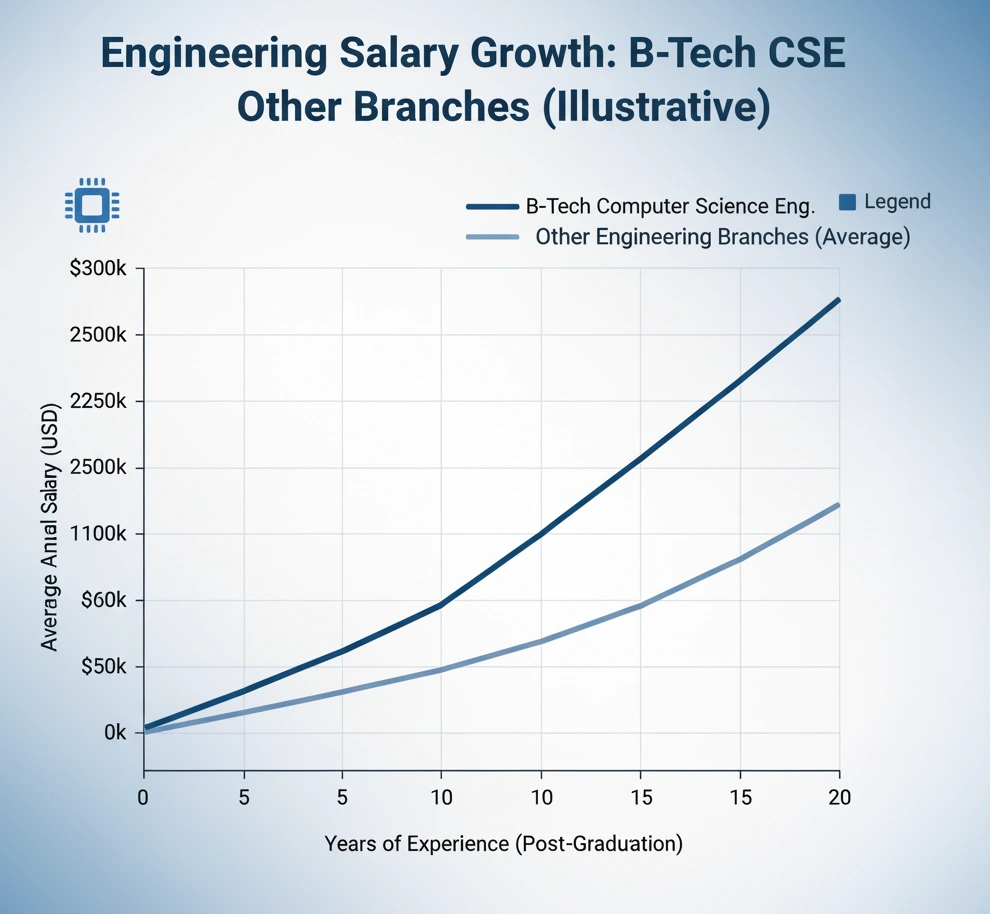
Even with high upfront fees, Computer Science remains the best-paying engineering stream in India and abroad. While mechanical, civil, or electrical engineers often take 4–5 years to break even, CSE graduates recover their investment within the first 1–2 years of employment—sometimes faster if placed in global tech firms.
B Tech in Computer Science Distance Education
The B.Tech in Computer Science (Distance Education) program is designed for learners who wish to pursue an engineering degree in computing without attending a full-time, on-campus program. This flexible mode is ideal for working professionals, diploma holders, or students with time or location constraints, who still want to gain recognised technical qualifications in the IT and software domain.
However, it’s important to note that traditional full-time B.Tech programs remain the most industry-preferred and AICTE-approved model. Distance or part-time alternatives are typically recognised under AICTE’s Work Integrated Learning Program (WILP) or IGNOU’s flexible technology courses, not as standard engineering degrees.
Duration and Eligibility
Particular
Details
Duration
4 years (Regular) or 3 years (Lateral Entry for Diploma Holders)
Eligibility
10+2 with Physics, Chemistry, Mathematics OR 3-year Diploma in Engineering plus work experience
Minimum Marks
50% aggregate (relaxation for reserved categories)
Study Mode
Online / Hybrid (Recorded + Live Classes + Lab Workshops)
Top Universities Offering Distance / Work-Integrated B.Tech (Computer Science)
Bachelor of Science in Computer Science (through Coursera)
Work-Integrated (for professionals)
AICTE Approved
Amity University Online
BCA with Specialisation in Software Engineering
Online + Lab Workshops
UGC-DEB Recognized
IGNOU
IGNOU Online BTech in Computer Science
Online + Study Centres
UGC-DEB
Mangalayatan University
BTech in Computer Science Engineering Course for Working Professionals
Hybrid
AICTE Approved
Lingayas University
B.Tech Integrated Work Model
Online + Industry Mentorship
UGC
Aryabhatta Degree College, Delhi
B.Tech for Working Professionals
Hybrid
AICTE Approved
Shri Venkateshwara University (SVU) in Gajraula
B.Tech for Working Professionals
Hybrid
AICTE Approved
University of Technology, Jaipur
B.Tech for Working Professionals
Hybrid
AICTE Approved
Karnataka State Open University
B.Tech for Working Professionals
Hybrid
AICTE Approved
Note: As per AICTE and UGC regulations, B.Tech degrees cannot be offered 100% online. Only Work Integrated Learning Programs (WILP) or Part-Time Engineering Programs are recognised for working professionals.
Challenges & How to Overcome Them
Challenge
Solution
High Competition
Build a GitHub portfolio, contribute to open-source
Rapid Tech Changes
Follow roadmap.sh, take Coursera/Udemy specialisations
Theory vs Practice Gap
Do internships from the 2nd year, join coding clubs
Burnout
Follow 1-language, 1-project, 1-skill per semester rule
Future of B.Tech CSE (2025–2030)
Trend
Impact
AI & GenAI Boom
40% of jobs will involve AI tools
Quantum Computing
New roles in quantum algorithms
Edge Computing
Demand for IoT + 5G specialists
Web3 & Blockchain
Growth in decentralised apps
Green Coding
Focus on energy-efficient software
Prediction: By 2030, 70% of CSE jobs will require AI/ML skills.
Action Plan: How to Excel in B.Tech CSE
Year
Focus
1st Year
Master C/Python, build logic, join coding club
2nd Year
Learn DSA, build 2 projects, start LeetCode
3rd Year
Specialise (AI/Web/Cloud), secure internship
4th Year
Capstone project, placements, certifications
Which is better, BCA or BTech?
This question has echoed in the minds of countless tech aspirants — Should I go for BCA (Bachelor of Computer Applications) or B.Tech in Computer Science and Engineering? Both degrees promise entry into the technology world, but they differ sharply in depth, structure, scope, and industry perception.
Let’s decode the difference — not with buzzwords, but with real data and outcomes.
1. Program Overview
Parameter
BCA (Bachelor of Computer Applications)
B.Tech in Computer Science & Engineering
Duration
3 years (6 semesters)
4 years (8 semesters)
Type
Application-oriented
Engineering & Research-oriented
Eligibility
10+2 with any stream (Mathematics preferred)
10+2 with Physics, Chemistry, Mathematics (PCM)
Regulatory Body
UGC (University Grants Commission)
AICTE (All India Council for Technical Education)
Curriculum Focus
Software applications, programming, web & database management
Hardware + software, algorithms, networks, system design, and computing theory
Mathematical Depth
Basic
Advanced (includes calculus, discrete math, data structures)
2. Curriculum Comparison
Category
BCA Subjects
B.Tech CSE Subjects
Core Programming
C, Java, Python, Web Development
C, C++, Java, Python, Data Structures, OOPs
System Foundations
OS, DBMS
OS, DBMS, Computer Architecture, Compiler Design
Mathematics
Discrete Maths, Basic Stats
Calculus, Linear Algebra, Probability, Discrete Structures
Hardware Exposure
Minimal
High (Digital Logic, Microprocessors, Embedded Systems)
Emerging Tech
Optional modules in AI, Cloud
Deep coverage of AI, ML, Cloud, IoT, Cybersecurity
Capstone Projects
1 final-year project
Multiple projects, mini-projects, and internships
Internship/Industry Linkage
Optional
Mandatory (6–8 weeks minimum)
3. Admission Process & Entry Difficulty
Program
Entrance Exams
Admission Difficulty
BCA
Usually merit-based or via simple entrance (CUET, university-level tests)
1. What is the full form of B.Tech CSE and what does it cover?
The full form of B.Tech CSE is Bachelor of Technology in Computer Science and Engineering. It covers programming, data structures, algorithms, AI, machine learning, databases, and software development. Thus, preparing students for careers in technology and innovation.
2. Is B.Tech in Computer Science a good career option in 2025?
Yes, B.Tech in Computer Science is one of the best engineering branches in 2025. With AI, cloud computing, and digital transformation booming, CSE graduates enjoy the highest employability rate (78.2%) and lucrative salaries ranging from ₹8–25 LPA. Check BTech Salary in India.
3. What are the top colleges for B.Tech in Computer Science in India 2025?
Some of the top B.Tech CSE colleges in India (2025) include IIT Delhi, IIT Bombay, IIT Madras, BITS Pilani, and NIT Trichy. Private universities like VIT Vellore, SRM, Manipal, and Thapar are also popular choices for strong placements and modern infrastructure. See the full list at Top Engineering Colleges in India.
4. What are the top skills required for B.Tech in Computer Science students?
Students should focus on programming (Python, Java, C++), data structures and algorithms, AI/ML, cloud computing, and web development. Additionally, problem-solving, teamwork, and project management skills are vital for success.
5. What are the best career options after B.Tech in Computer Science?
After completing B.Tech CSE, graduates can pursue roles such as Software Engineer, Data Scientist, AI/ML Engineer, Cloud Engineer, Full Stack Developer, or Cybersecurity Analyst. Others opt for higher studies (M.Tech/MS/MBA) or entrepreneurship.
6. What is the future scope of B.Tech in Computer Science in India and abroad?
The future scope of B.Tech CSE is vast, with AI, quantum computing, edge computing, and Web3 driving demand. By 2030, over 70% of tech jobs will require AI/ML expertise, making CSE a future-proof degree globally. Learn more in All BTech Branches 2025.
Nishit Kumar is a senior EdTech industry leader with over a decade of experience in building and scaling education platforms. He was instrumental in building Collegedunia from the ground up, shaping its product, content, and growth strategy. At FindMyCollege, Nishit oversees content and editorial strategy, guiding topic selection, content frameworks to ensure accuracy, relevance, and student-first value across the website.