BTech Entrance Exams 2026: JEE Main, VITEEE, SRMJEEE, BITSAT – Dates, Pattern & Prep
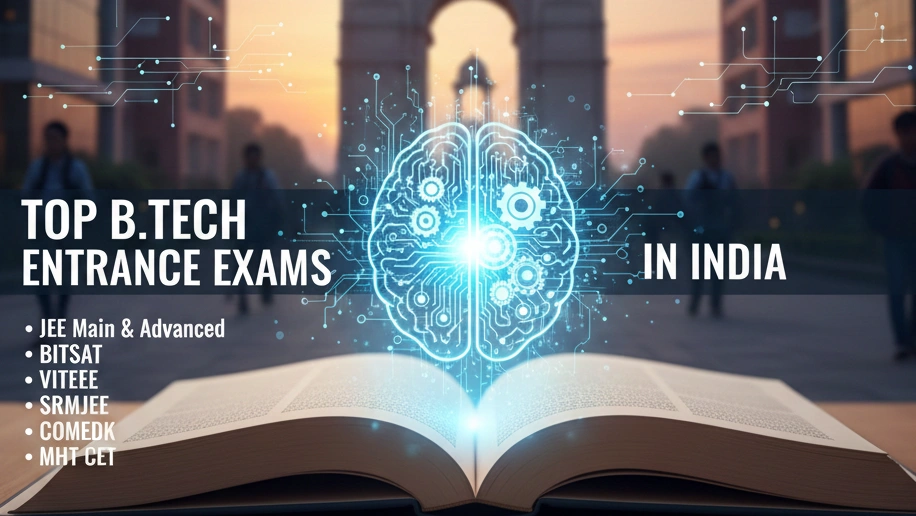
Every engineering dream in India begins with a test, and 2026 will be no different. From JEE Main and BITSAT to VITEEE and SRMJEEE, thousands of students will compete for seats in the nation’s top institutes. These BTech entrance exams are the gateway to India’s premier engineering colleges, determining who gets into IITs, NITs, and leading private universities.
With the upcoming 2026 admission season, it’s crucial to understand how each exam differs in pattern, difficulty, and opportunities. This guide covers everything you need — from important dates and exam formats to a comparison of success rates and preparation strategies. Whether you’re aiming for a national-level test or a private university exam, here’s your complete roadmap to crack the engineering admission tests of 2026.
Types of BTech Entrance Exams in India
India’s engineering admission landscape is vast, with multiple entrance exams conducted every year for admission into top BTech programs. These exams are generally categorised into three levels — National, State, and University/Institute-Level — depending on the body that conducts them and the colleges they cover. Understanding these categories helps you target the right exams based on your dream college and career goals.
1. National-Level Entrance Exams
National-level exams are conducted across India and are accepted by most government and private engineering colleges. They are the most competitive and serve as the primary gateway to IITs, NITs, IIITs, and top GFTIs (Government-Funded Technical Institutes).
Key Exams:
- JEE Main 2026: Conducted by NTA, it’s the largest BTech entrance test in India and also the qualifying exam for JEE Advanced (for IIT admissions).
- JEE Advanced 2026: Organised by one of the IITs for admission into 23 IITs.
- BITSAT 2026: Conducted by BITS Pilani for its campuses in Pilani, Goa, and Hyderabad.
- VITEEE 2026: Held by VIT University for admission to its Vellore, Chennai, Bhopal, and Amaravati campuses.
- SRMJEEE 2026: Conducted by SRM Institute of Science & Technology for BTech admission.
Why choose: Wider national recognition, transparent selection process, and high career value after graduation.
2. State-Level Entrance Exams
State governments conduct these exams for admission into state engineering colleges, government universities, and private institutes within that state. Some states also reserve a portion of seats for candidates from outside their region.
Popular State Exams:
- WBJEE (West Bengal Joint Entrance Exam)
- KCET (Karnataka Common Entrance Test)
- MHT CET (Maharashtra Common Entrance Test)
- AP EAMCET / TS EAMCET (Andhra Pradesh & Telangana)
- KEAM (Kerala)
Why choose: Affordable tuition, state quota benefits, and good placement opportunities in regional industries.
People Also Read



3. University / Institute-Level Entrance Exams
Private and deemed universities conduct their own entrance exams for BTech admissions. These are usually easier to crack than JEE and often have flexible eligibility criteria. Many of these universities also offer direct admission based on JEE Main scores or Class 12 marks.
Major University Exams:
- VITEEE – VIT University
- SRMJEEE – SRM University
- MET – Manipal Entrance Test (Manipal University)
- KIITEE – KIIT University
- LPUNEST – Lovely Professional University
Why choose: Modern infrastructure, specialised BTech programs (like AI, Data Science, Robotics), and high placement rates in tech companies.
Below is the concise table on B.Tech Entrance Exams in India:
| Exam Name | Conducting Body | Mode | Expected Date (2026) | Primary Accepting Institutions | Typical Subjects | Approx. No. Of Applicants (Annual) |
| JEE Main | National Testing Agency (NTA) | Computer-Based Test (CBT) | Session 1: Jan 21-29; Session 2: Apr 2-9 | NITs, IIITs, GFTIs, State colleges; qualifier for JEE Advanced | Physics, Chemistry, Mathematics | 12-14 lakh |
| JEE Advanced | One of the IITs (IIT Roorkee for 2026) | Computer-Based Test (CBT) | May 17 | 23 IITs | Physics, Chemistry, Mathematics | 1.5-2.5 lakh (qualified from JEE Main) |
| BITSAT | BITS Pilani | Computer-Based Test (CBT) | Session 1: Apr 15-17; Session 2: May 24-26 | BITS Pilani campuses (Pilani, Goa, Hyderabad) | Physics, Chemistry, Mathematics, English + Logical Reasoning | 3-4 lakh |
| VITEEE | Vellore Institute of Technology (VIT) | Computer-Based Test (CBT) | Apr 28 – May 3 (tentative) | VIT campuses (Vellore, Chennai, Bhopal, Amaravati) | Physics, Chemistry, Mathematics/Biology, English, Aptitude | 2-3 lakh |
| SRMJEEE | SRM Institute of Science and Technology | Remote Proctored Online | Phase 1: Apr 23-28; Phase 2: Jun 10-15; Phase 3: Jul 4-5 | SRM campuses | Physics, Chemistry, Mathematics/Biology, Aptitude | 2-3 lakh |
| WBJEE | West Bengal Joint Entrance Examinations Board (WBJEEB) | Offline (OMR-based) | April (tentative, likely late April) | Government & private colleges in West Bengal | Physics, Chemistry, Mathematics | 1-1.5 lakh |
| KCET | Karnataka Examinations Authority (KEA) | Offline | Apr 23-24 (subjects); Apr 22 (Kannada test, tentative) | Government & private colleges in Karnataka | Physics, Chemistry, Mathematics/Biology | 2-3 lakh |
| MHT CET | State Common Entrance Test Cell, Maharashtra | Computer-Based Test (CBT) | PCM: Apr 11-19 (Session 1), May 14-17 (Session 2); PCB: Apr 21-26 (Session 1), May 10-11 (Session 2) | Government & private colleges in Maharashtra | Physics, Chemistry, Mathematics/Biology | 4-5 lakh |
| AP EAMCET (EAPCET) | Jawaharlal Nehru Technological University (on behalf of APSCHE) | Computer-Based Test (CBT) | Engineering: May 12-15 & 18; Agri/Pharmacy: May 19-20 | Government & private colleges in Andhra Pradesh | Physics, Chemistry, Mathematics/Biology | 2-3 lakh |
| TS EAMCET (EAPCET) | Jawaharlal Nehru Technological University Hyderabad (on behalf of TGCHE) | Computer-Based Test (CBT) | Engineering: May 9-11; Agri/Pharmacy: May 4-5 | Government & private colleges in Telangana | Physics, Chemistry, Mathematics/Biology | 2-3 lakh |
| KEAM | Commissioner for Entrance Examinations (CEE), Kerala | Computer-Based Test (CBT) for Engg/Pharmacy | Apr 17-23 (with buffer days Apr 13, 16, 24-25) | Government & private colleges in Kerala | Physics, Chemistry, Mathematics | 1-1.5 lakh |
| MET (Manipal Entrance Test) | Manipal Academy of Higher Education (MAHE) | Computer-Based Test (CBT) | Phase 1: Apr 13-14; Phase 2: May 23-24 | Manipal campuses | Physics, Chemistry, Mathematics, English, Aptitude | 1-2 lakh |
| KIITEE | KIIT University | Computer-Based Test (CBT) | Phase 1: Apr 16-20; Phase 2: Jun 4-8 (tentative) | KIIT University campuses | Physics, Chemistry, Mathematics/Biology | 1-2 lakh |
| LPUNEST | Lovely Professional University (LPU) | Online (Remote Proctored) / Test Centre-Based | Jan 10-Feb 5 (remote); Jan 20-Feb 5 (centre-based) | Lovely Professional University | Physics, Chemistry, Mathematics/Biology, English, Aptitude, GK | 1-2 lakh |
Top BTech Entrance Exams 2026: Overview
India has dozens of engineering entrance exams, but a few stand out for their reach, reputation, and role in shaping the country’s tech talent. Below is an overview of the top 5 BTech entrance exams for 2026. These include key highlights, conducting bodies, and exam features.
1. JEE Main 2026
Conducting Body: National Testing Agency (NTA)
Exam Level: National
Mode: Computer-Based Test (CBT)
Frequency: Twice a year — January & April 2026
Purpose: Admission to NITs, IIITs, GFTIs, and eligibility for JEE Advanced.
JEE Main is the largest engineering entrance exam in India, taken by over 10 lakh students annually. The paper covers Physics, Chemistry, and Mathematics, testing conceptual clarity and problem-solving speed. High scorers qualify for JEE Advanced, the next step toward IIT admissions.
2. JEE Advanced 2026
Conducting Body: One of the IITs (on rotation)
Exam Level: National (for IITs only)
Mode: Online
Eligibility: Top 2.5 lakh JEE Main qualifiers
JEE Advanced is known as India’s toughest engineering exam, leading to admission in 23 IITs. The exam emphasises analytical reasoning, applied physics, and deep mathematics. It offers entry to elite programs such as Computer Science at IIT Bombay and IIT Delhi.
3. BITSAT 2026
Conducting Body: BITS Pilani
Exam Level: University-Level (Pan-India Reach)
Mode: Online (adaptive pattern)
Frequency: Two sessions (May & June 2026)
BITSAT (Birla Institute of Technology and Science Admission Test) is one of the most prestigious private engineering entrance exams. It’s a computer-adaptive test, meaning question difficulty changes based on your responses. The syllabus overlaps with JEE Main but adds English proficiency and logical reasoning. Admissions are for BITS campuses in Pilani, Goa, and Hyderabad.
4. VITEEE 2026
Conducting Body: VIT University
Exam Level: University-Level
Mode: Online
Expected Date: March 2026
VITEEE (VIT Engineering Entrance Examination) offers admission to VIT’s four campuses — Vellore, Chennai, Bhopal, and Amaravati. The test has 125 multiple-choice questions from Physics, Chemistry, Mathematics, Aptitude, and English. Known for moderate difficulty and strong placement outcomes, it’s a top choice for students seeking private engineering admissions.
5. SRMJEEE 2026
Conducting Body: SRM Institute of Science and Technology
Exam Level: University-Level
Mode: Online (Remote Proctored)
Expected Date: April 2026
SRMJEEE is an adaptive computer-based exam with questions from Physics, Chemistry, Mathematics/Biology, and Aptitude. The exam is conducted in multiple phases, offering flexibility to students. SRM’s engineering programs are especially popular for AI, Robotics, and Computer Science specialisations.
Exam Calendar 2026: Upcoming Engineering Entrance Exams 2026 Dates
The BTech entrance exam season 2026 will stretch from January to June, with different tests conducted by national agencies, private universities, and state boards. Knowing the exam dates in advance helps aspirants plan their preparation and avoid overlapping test windows. Below is a full calendar of top engineering entrance exams 2026 — including national, university, and state-level tests.
📅 BTech Entrance Exams 2026: Complete Schedule
| S. No. | Engineering Entrance Exam | Conducting Body | Exam Dates (Tentative) |
| 1 | JEE Main 2026 | National Testing Agency (NTA) | Between 21–30 January 2026 [Session 1] Between 01–10 April 2026 [Session 2] |
| 2 | JEE Advanced 2026 | National Testing Agency (NTA) | May 2026 |
| 3 | VITEEE 2026 | VIT University | April 2026 |
| 4 | SRMJEEE 2026 | SRM Institute of Science and Technology | April 2026 (Phase 1) June 2026 (Phase 2) June 2026 (Phase 3) |
| 5 | BITSAT 2026 | BITS Pilani | May 3rd week 2026 (Session 1) June 3rd week 2026 (Session 2) |
| 6 | MET 2026 | Manipal Academy of Higher Education | April 2026 (Phase 1) May 2026 (Phase 2) |
| 7 | COMEDK UGET 2026 | Consortium of Medical, Engineering, and Dental Colleges of Karnataka (COMEDK) | May 2026 |
| 8 | AP EAMCET 2026 | Jawaharlal Nehru Technological University (JNTU), Kakinada | May 2026 |
| 9 | KCET 2026 | Karnataka Examinations Authority (KEA) | April 2026 |
| 10 | MHT CET 2026 | State CET Cell, Mumbai | April 2026 (PCM Group) April 2026 (PCB Group) |
| 11 | WBJEE 2026 | West Bengal Joint Entrance Examinations Board | April 2026 |
| 12 | GUJCET 2026 | Gujarat Secondary & Higher Secondary Education Board (GSHSEB) | March 2026 |
Exam Pattern & Syllabus Snapshot
Each BTech entrance exam follows its own structure and marking style, but most are built around the core subjects — Physics, Chemistry, and Mathematics (PCM). Some private university exams also include Aptitude or English to assess communication and reasoning skills.
Here’s a quick comparison of major BTech entrance exams for 2026, covering duration, subjects, and question format.
| Exam | Mode | Subjects Covered | Total Questions / Marks | Marking Scheme | Duration |
| JEE Main 2026 | Online (CBT) | Physics, Chemistry, Mathematics | 90 Qs (Attempt 75) / 300 Marks | +4, −1 | 3 Hours |
| JEE Advanced 2026 | Online | Physics, Chemistry, Mathematics | 54–60 Qs (Varies yearly) | Variable +/− | 3 Hours per Paper (2 Papers) |
| BITSAT 2026 | Online (Adaptive) | Physics, Chemistry, Mathematics, English, Logical Reasoning | 130 Qs (+12 bonus) / 390 Marks | +3, −1 | 3 Hours |
| VITEEE 2026 | Online | Physics, Chemistry, Mathematics, Aptitude, English | 125 Qs / 125 Marks | +1, No Negative | 2.5 Hours |
| SRMJEEE 2026 | Online | Physics, Chemistry, Mathematics/Biology, Aptitude | 125 Qs / 125 Marks | +1, No Negative | 2.5 Hours |
| MET 2026 (Manipal) | Online | Physics, Chemistry, Mathematics | 60 Qs / 240 Marks | +4, No Negative | 2 Hours |
| COMEDK UGET 2026 | Online | Physics, Chemistry, Mathematics | 180 Qs / 180 Marks | +1, No Negative | 3 Hours |
Common Syllabus Core
Despite differences in format, the core syllabus remains similar across exams:
- Physics: Mechanics, Electricity & Magnetism, Optics, Thermodynamics
- Chemistry: Physical, Organic, and Inorganic Chemistry (NCERT-based)
- Mathematics: Algebra, Calculus, Coordinate Geometry, Trigonometry
- Additional (some exams): Aptitude & English
A strong foundation in NCERT concepts, problem-solving practice, and time management remains the key to cracking any engineering exam in 2026.
National & State vs Private Exams: Which BTech Entrance Exam to Choose?
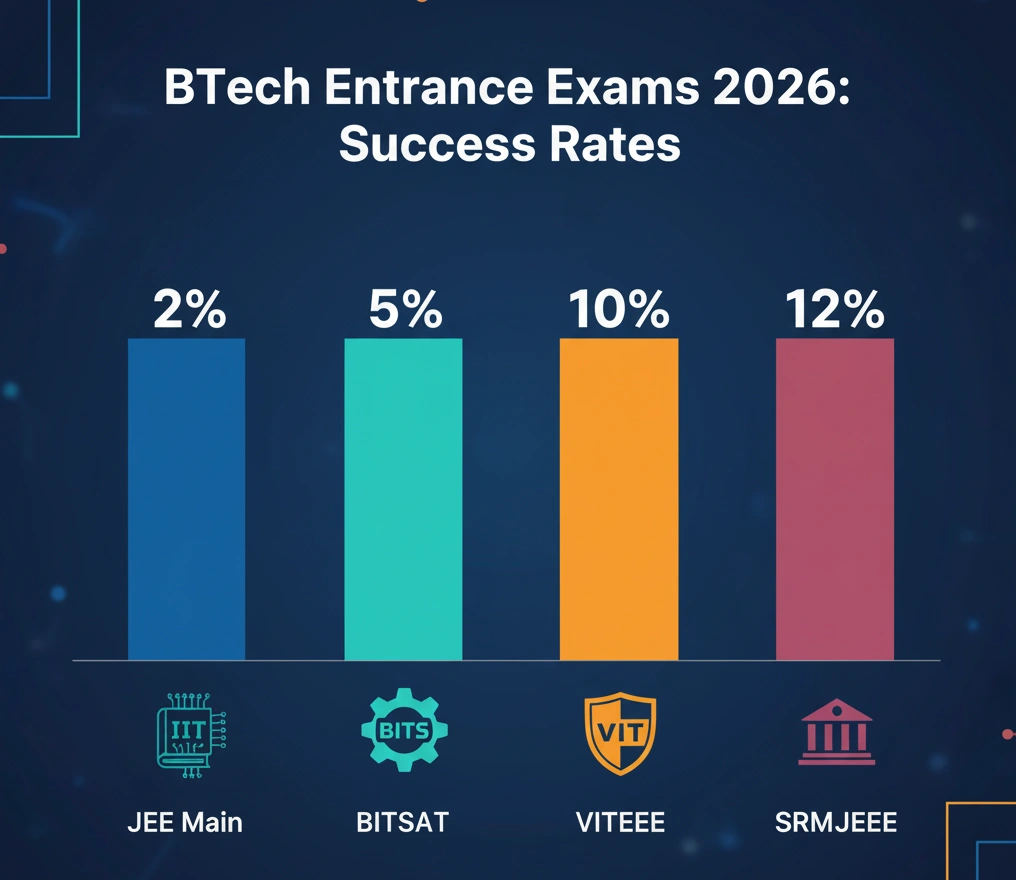
India’s BTech entrance ecosystem can seem overwhelming — with multiple exams conducted by national agencies, state boards, and private universities. Each exam opens doors to a different set of colleges and comes with its own level of competitiveness, cost, and flexibility. Understanding these differences helps you choose smartly, rather than chasing every form and deadline.
1. National-Level Exams
Examples: JEE Main, JEE Advanced
These are the most recognised engineering admission tests in India. JEE Main grants access to NITs, IIITs, and top government-funded colleges, while JEE Advanced is the only route to the IITs.
Why choose them:
- National reputation and global recognition of degrees
- Access to scholarships, research opportunities, and strong alumni networks
- Transparent, standardised process through JoSAA counselling
Keep in mind: Extremely competitive — JEE Main sees over 10 lakh applicants annually, with less than 2% reaching IITs. A serious, long-term preparation strategy is essential.
2. State-Level Exams
Examples: WBJEE, MHT CET, KCET, AP EAMCET, TS EAMCET
These exams are conducted by state education boards to fill engineering seats in state government and private colleges. While their difficulty level is generally moderate, they’re highly relevant for students aiming to study within their home state quota.
Why choose them:
- Easier access to reputed state universities (e.g., COEP Pune, Jadavpur University, UVCE Bangalore)
- Lower tuition fees under the domicile quota
- Familiar syllabus aligned with state board curriculum
Keep in mind: Admission scope is limited — very few state exams offer seats in national-level institutions.
3. Private University / Institute-Level Exams
Examples: BITSAT, VITEEE, SRMJEEE, MET (Manipal), LPUNEST
Top private universities conduct their own entrance exams to manage admissions independently. These tests often have adaptive or aptitude-based formats and are typically easier than JEE, with a stronger focus on speed and accuracy rather than deep conceptual difficulty.
Why choose them:
- Smooth admission process and multiple exam slots (ideal for flexibility)
- Modern infrastructure, global tie-ups, and industry-driven curriculum
- Merit-based and need-based scholarships are available for high scorers
Keep in mind: Tuition fees are usually higher than public institutions, and brand value varies from one university to another — always check placement records and ROI before committing.
🔍 The Smart Strategy (2026 Admission Cycle)
For most aspirants, a balanced mix works best. Appear for:
- JEE Main (National) – for NITs, IIITs, and eligibility for JEE Advanced
- One State Exam – for a strong fallback option
- One or Two Private Exams – such as VITEEE, BITSAT, or SRMJEEE for flexibility and safety
This multi-tier approach covers national prestige, state affordability, and private flexibility, ensuring you don’t miss out on any quality college in the 2026 admission schedule.
FAQs
Which is the toughest BTech entrance exam in India?
Among all engineering admission tests, JEE Advanced is considered the toughest due to its conceptual depth and limited seats at IITs. JEE Main follows next in difficulty, while exams like VITEEE, SRMJEEE, and BITSAT are more speed-oriented and moderately challenging.
What are the top BTech entrance exams in India for 2026?
The major exams include JEE Main, JEE Advanced, BITSAT, VITEEE, SRMJEEE, MET, WBJEE, MHT CET, and COMEDK UGET. JEE Main and Advanced are national-level exams, while others are state or private university exams.
When will the BTech entrance exams 2026 be conducted?
Tentatively, the JEE Main 2026 Session 1 will be held in January, and Session 2 in April. Other major exams will follow — VITEEE and SRMJEEE in April, BITSAT in May–June, and most state exams between April and May 2026.
What is the average success rate in JEE vs private exams?
JEE Main has a success rate of around 3–5%, while exams like BITSAT, VITEEE, and SRMJEEE have 10–25% selection rates. This difference mainly arises from the number of applicants and the seats available per exam.
Which entrance exam gives the best ROI for engineering?
JEE-based colleges (IITs, NITs, IIITs) offer the best return on investment (ROI) because of low tuition fees and high placement packages. Some private universities like BITS Pilani, VIT, and SRM also offer excellent ROI if you secure scholarships or merit-based admission.