B.Tech in Food Technology: Complete Guide (2025)
B.Tech in Food Technology is a 4-year engineering program focusing on food production, processing, preservation, quality control, packaging, and safety. It blends engineering, chemistry, microbiology, and nutrition to meet the demands of the rapidly growing food industry. Moreover, this industry is expanding at 8-10% annually in India due to rising demand for processed, sustainable, and health-focused foods. With global challenges like food security and climate change, this field is important for innovation in areas like plant-based alternatives and AI-driven quality control.
Syllabus (Semester-Wise Table)
| Semester | Core Subjects | Labs / Practical / Other |
| 1-2 (Foundation) | • Mathematics (Calculus, Algebra)• Physics & Chemistry• Basic Engineering (Mechanics, Thermodynamics)• Biology / Microbiology• Introduction to Food Technology• Computer Programming | • Basic Science & Engineering Labs• Communication Skills• Environmental Studies |
| 3-4 (Core) | • Food Chemistry & Nutrition• Food Microbiology• Food Engineering (Heat & Mass Transfer)• Food Processing (Dairy, Fruits, Vegetables)• Unit Operations in Food Processing• Biochemistry | • Food Analysis Lab• Microbiology Lab• Industrial Visits |
| 5-6 (Advanced) | • Food Preservation & Packaging• Food Quality Control & Assurance• Fermentation Technology• Food Plant Design & Layout• Instrumentation & Process Control | • Food Processing & Quality Labs• Electives: Food Biotech, Sensory Evaluation, Waste Management• Industrial Training / Internship |
| 7-8 (Specialization) | • Food Safety & Standards (HACCP, FSSAI)• Food Product Development• Entrepreneurship in Food Industry | • Major Project / Thesis• Seminar & Viva• Electives: Nutraceuticals, Food Laws, Sustainability• Industrial Visits |
Total Credits: 160–180 | Practical Component: 30–40%
Entrance Exams: JEE Main, MHT-CET, TNEA, WBJEE, LPUNEST, etc.
Top 10 Colleges in India for Btech Food Technology
| Rank | College | Location | Approx. Fees (per year) | Entrance Exam |
| 1 | IIT Kharagpur | West Bengal | ₹2–3 L | JEE Main + Advanced |
| 2 | NIFTEM | Kundli, Haryana | ₹1.5–2 L | JEE Main / NIFTEM Test |
| 3 | ICT Mumbai | Maharashtra | ₹85,000 | MHT-CET / JEE Main |
| 4 | Anna University | Chennai, TN | ₹50K–1 L | TNEA |
| 5 | Amity University | Noida, UP | ₹2–3 L | Amity JEE / 12th Merit |
| 6 | LPU | Punjab | ₹1–2 L | LPUNEST / JEE |
| 7 | SRM IST | Chennai, TN | ₹2.5 L | SRMJEEE |
| 8 | BHU | Varanasi, UP | ₹10K–50K | BHU UET / JEE |
| 9 | Tezpur University | Assam | ₹50K | JEE Main |
| 10 | Jadavpur University | Kolkata, WB | ₹5,000 | WBJEE |
Government colleges offer lower fees; private ones provide scholarships.
Check official websites for 2025 updates.
Scope of B.Tech Food Technology
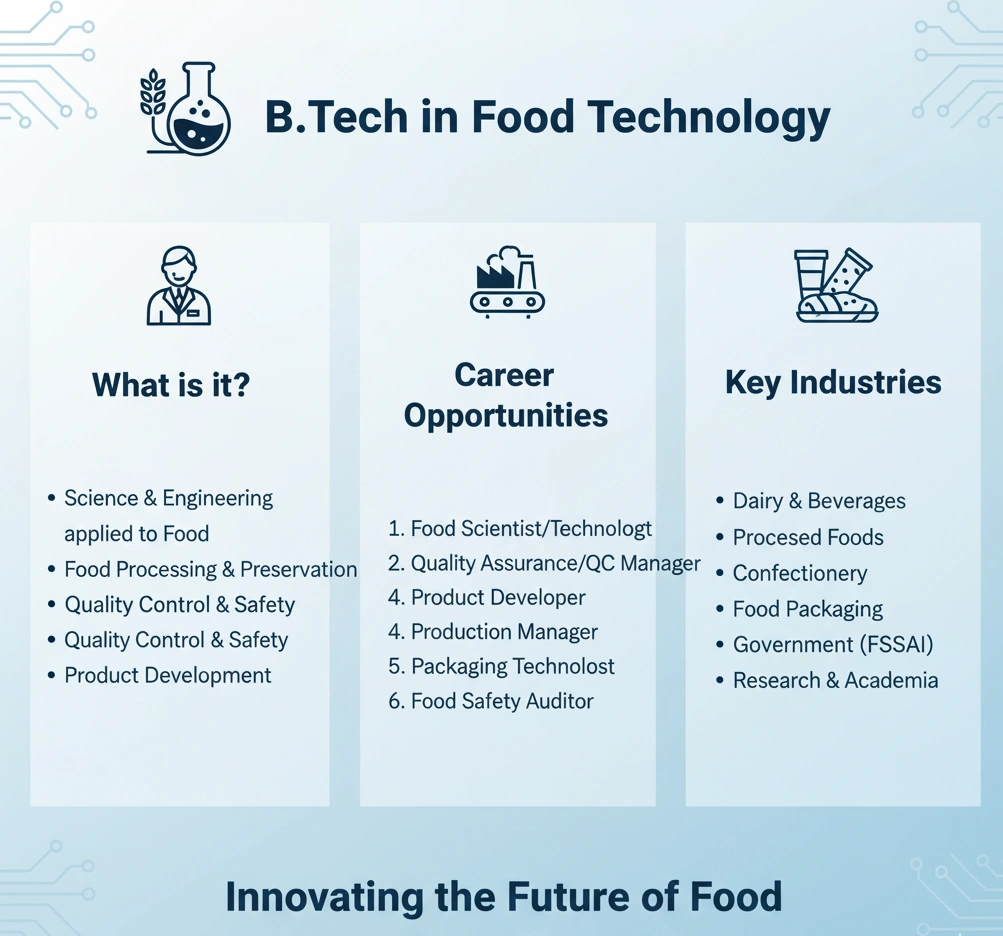
The scope is vast and promising in 2025, driven by India’s food processing sector contributing 14% to manufacturing GDP and 13% to exports. Globally, the industry is projected to add around 20,000 jobs in India by 2024-2025, with opportunities in food processing, manufacturing, packaging, retail, quality control, pharmaceuticals, hospitality, R&D, FMCG, and beverages. Emerging trends include sustainable practices, AI integration for supply chains, and health-focused innovations like functional foods and plant-based products.
Abroad (USA, UK, Australia), roles in biotech-enhanced food systems offer higher pay and research opportunities. With food security challenges, graduates can work in hospitals, hotels, startups, or government bodies like FSSAI and ICAR. Job security is high due to the evergreen nature of the food industry.
People Also Read
Jobs & Career Scope (2025)
| Job Role | Key Responsibilities | Top Recruiters |
| Food Technologist | Product development, process optimization | Nestlé, ITC, Britannia |
| Quality Assurance Manager | FSSAI compliance, audits, testing | PepsiCo, Amul, Parle |
| Production Manager | Plant operations, efficiency | Hindustan Unilever, Cargill |
| R&D Scientist | New product innovation | Mondelez, Dabur, Patanjali |
| Food Safety Officer | Regulatory compliance, inspections | FSSAI, Government Bodies |
| Packaging Engineer | Sustainable packaging design | Tetra Pak, Huhtamaki |
| Supply Chain Manager | Logistics, cold chain | BigBasket, Flipkart, DHL |
| Nutrition Consultant | Health-focused product lines | HealthifyMe, startups |
| Entrepreneur | Organic, plant-based, functional foods | Startup India, Incubators |
Emerging Roles in 2025:
- AI Food Quality Analyst (using AI for predictions and trends)
- Plant-Based Meat Technologist (developing alternatives amid rising cocoa prices and GLP-1 drug impacts)
- Sustainable Food Systems Specialist (focusing on resilient, eco-friendly tech)
- Process Engineer (optimizing manufacturing with new tech)
- Food Data Analyst (leveraging data for innovation) These roles reflect trends in AI, sustainability, and health tech, with opportunities in food manufacturing growing due to innovations like 3D printing and precision fermentation.
Salary Trends (India, 2025)
| Experience Level | Salary Range (₹ LPA) | With M.Tech/MBA |
| Fresher (0–2 yrs) | ₹3.0 – ₹6.0 | ₹5.0 – ₹8.0 |
| Mid-Level (3–5 yrs) | ₹6.0 – ₹12.0 | ₹10.0 – ₹15.0 |
| Senior (5+ yrs) | ₹12.0 – ₹25.0+ | ₹18.0 – ₹35.0+ |
- Average Starting Salary: ₹4.5–5.5 LPA
- Top MNCs (Nestlé, HUL): ₹5.5–7 LPA for freshers
- Government (FSSAI, ICAR): ₹4–8 LPA + perks
- Abroad (USA/UK): $50K–70K (~₹40–60 L)
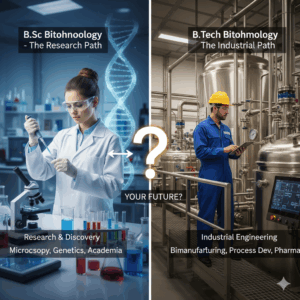
Food Technology vs Biotechnology
| Aspect | Food Technology | Biotechnology |
| Focus | Application of science and engineering to food production, processing, preservation, and safety. | Broader use of biological processes for health, agriculture, environment, and medicine. |
| Key Areas | Food quality, packaging, nutrition, and industry-specific tech (e.g., fermentation for foods). | Genetic engineering, microbial tech, diagnostics, and tissue culture. |
| Career Impact | Quick results in product development; specialized in food industry. | Longer R&D cycles; broader prospects in pharma and agri. |
| Scope | Steady demand in food sector; more business-oriented. | Higher growth potential but competitive. |
Food Biotechnology overlaps as a subset, using biotech for food improvements. Choose Food Tech if you’re food-industry focused; Biotech for diverse applications.
Is B.Tech Food Technology Hard?
The degree is moderate to challenging, depending on your interest and background. It involves strong foundations in chemistry, math, microbiology, and engineering, which can be tough if you’re not inclined toward STEM. Entrance exams are moderately difficult. However, with passion for food science, it’s manageable—practical labs (30-40%) make it engaging. Not as hard as core engineering like CS, but requires consistent effort.
BSc Food Technology vs BTech Food Technology
| Aspect | BSc Food Technology | BTech Food Technology |
| Duration & Type | 3 years; Science-focused (theory-heavy). | 4 years; Engineering-focused (applied, professional). |
| Curriculum | Basics of food science, nutrition, microbiology. | Advanced engineering, processing, plant design. |
| Fees & Scope | Lower fees; Good for entry-level, but limited scope (₹4-6 LPA starting). | Higher fees; Broader, higher-paying jobs (₹4.8 LPA+ average). |
| Career Edge | Suited for research or basic roles; Less competitive. | Better for industry, management; More specialized. |
BTech is generally preferred for better salary, scope, and technical depth.
Quick Summary
| Aspect | Verdict |
| Demand in 2025 | High (Food processing growing at 8–10%) |
| Difficulty Level | Moderate to Challenging (Strong in Chemistry & Engineering) |
| Better Than B.Sc.? | Yes – More technical, higher salary, better jobs |
| Global Scope | Excellent (USA, Canada, EU, Australia) |
| Startup Potential | Very High (Organic, vegan, functional foods) |
Ideal for: Students strong in PCM/PCB, interested in science + industry + innovation.
Next Steps:
- Prepare for JEE Main / State CET
- Explore internships in food companies
- Consider M.Tech (Food Tech) or MBA (Agri-Business) for faster growth
FAQs
What is the scope of B.Tech in Food Technology in 2025?
The scope of B.Tech Food Technology in 2025 is rapidly expanding, with India’s food processing industry growing at 8–10% annually. Graduates can find roles in product development, food safety, quality assurance, and R&D with top companies like Nestlé, ITC, and Amul.
What are the top colleges for B.Tech Food Technology in India in 2025?
Some of the best colleges offering B.Tech Food Technology in India include IIT Kharagpur, NIFTEM (Kundli), ICT Mumbai, Anna University, and Jadavpur University — all ranked among the top for engineering and food sciences.
What is the average salary after B.Tech in Food Technology in India?
The average starting salary for B.Tech Food Technology graduates in India ranges from ₹4.5–5.5 LPA, with higher packages in MNCs like HUL and PepsiCo (₹6–7 LPA) and government roles like FSSAI or ICAR offering ₹4–8 LPA plus benefits.
Is B.Tech in Food Technology better than B.Sc in Food Technology?
Yes. B.Tech in Food Technology offers a more technical, industry-oriented curriculum with better job prospects and salaries compared to a B.Sc, which is more research-focused and limited to entry-level roles.
What are the emerging career opportunities in Food Technology in 2025?
New roles include AI Food Quality Analyst, Sustainable Food Systems Engineer, Plant-Based Product Developer, and Food Data Analyst driven by global trends in health, sustainability, and automation.
Is Food Technology a good career choice for the future?
Absolutely. With rising demand for safe, nutritious, and eco-friendly foods worldwide, B.Tech Food Technology offers long-term job security, global opportunities, and strong growth potential in both industry and entrepreneurship.